

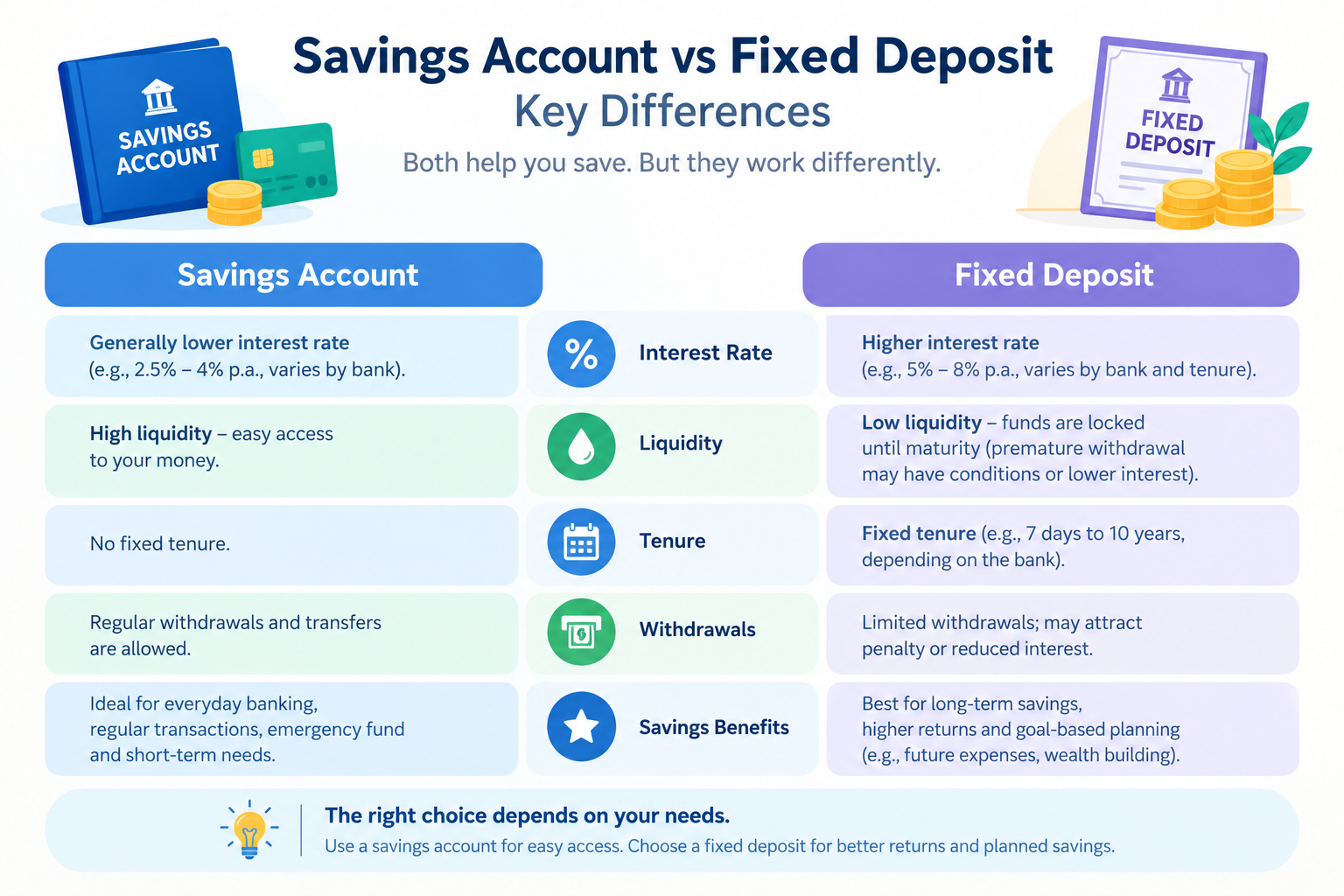
When it comes to keeping money safely in a bank, two common options are a Savings Account and a Fixed Deposit (FD). Both can help you manage your money and earn interest, but they serve different purposes.
A savings account is generally designed for regular transactions and easy access to money, while a fixed deposit is designed to keep a lump sum invested for a selected period in exchange for a predetermined interest rate.
Understanding the difference between a Savings Account vs Fixed Deposit can help you choose an option based on your liquidity needs, financial goals and investment horizon.
What Is a Savings Account?
A savings account is a bank account used for keeping money while allowing convenient access for everyday financial needs.
You can generally use a savings account to:
- Deposit and withdraw money
- Receive salary or other income
- Make UPI and online payments
- Transfer money
- Use a debit card
- Pay bills
- Maintain an emergency fund
The interest rate on a savings account is generally lower than the rate offered on many fixed deposits, although the actual rate depends on the bank and account type.
What Is a Fixed Deposit?
A Fixed Deposit, commonly called an FD, allows you to deposit a lump sum with a bank for a predetermined tenure.
Depending on the FD, the interest rate is generally agreed upon when the deposit is booked. At maturity, the depositor receives the principal along with applicable interest.
Fixed deposits can be useful for people who have money that they do not expect to need immediately.
Common FD tenures can range from short periods to several years, depending on the bank's available products.
Savings Account vs Fixed Deposit: Key Differences
| Feature | Savings Account | Fixed Deposit |
|---|---|---|
| Main purpose | Everyday banking and liquidity | Saving/investing a lump sum |
| Access to money | Generally easy and immediate | Usually locked until maturity |
| Interest rate | Usually lower | Generally higher than savings accounts, depending on bank and tenure |
| Tenure | No fixed maturity | Fixed tenure |
| Withdrawals | Regular withdrawals permitted | Premature withdrawal may involve conditions or reduced interest |
| Transactions | UPI, debit card, transfers and payments | Not intended for regular transactions |
| Interest calculation | Based on applicable account balance rules | Based on deposit amount, rate and tenure |
| Suitable for | Emergency funds and daily expenses | Medium-term or planned savings |
| Maturity | No maturity date | Has a maturity date |
Interest Rate Difference
One of the biggest differences between a savings account and an FD is the way interest is earned.
Savings account interest is generally calculated according to the bank's applicable balance and interest rules. Since the money remains accessible, the account is suitable when liquidity is important.
With an FD, you deposit a specific amount for a selected period. The interest rate is generally fixed for that deposit according to the product's terms.
However, FD rates vary between banks, tenures and customer categories, so borrowers and depositors should check the current rate before opening an FD.
Liquidity: Savings Account vs FD
Liquidity means how easily you can access your money when you need it.
A savings account usually provides greater flexibility because you can withdraw or transfer funds according to the account's terms.
An FD, on the other hand, is intended to remain invested until maturity. Banks may allow premature withdrawal, but conditions, penalties or reduced interest may apply.
For this reason, money required for rent, bills, emergencies or daily expenses is generally better kept readily accessible rather than locked into an FD.
Which Is Better for an Emergency Fund?
An emergency fund should be easily accessible because unexpected expenses can arise at any time.
A savings account can provide convenient access to emergency money through:
- ATM withdrawals
- UPI payments
- Online transfers
- Debit card transactions
Some people may also consider splitting their emergency savings between highly liquid accounts and suitable deposit products, depending on their needs and the terms offered by their bank.
Which Is Better for Long-Term Savings?
For money that you do not need immediately, an FD may be worth considering because it offers a defined tenure and interest structure.
For example, someone saving money for a planned expense in one or two years may consider an FD if the available rate and terms suit their financial objective.
However, before investing, compare:
- Interest rate
- Tenure
- Maturity amount
- Premature withdrawal rules
- Applicable penalties
- Tax treatment
- Deposit insurance coverage
Tax on Savings Account and Fixed Deposit Interest
Interest earned from bank deposits can have tax implications depending on the individual's circumstances and applicable tax rules.
The tax treatment of savings account interest and FD interest is not necessarily identical. Interest income should therefore be considered when comparing the actual return from different deposit options.
For significant deposits, investors should review the latest Income Tax Department rules or consult a qualified tax professional.
Safety of Bank Deposits
Both savings accounts and fixed deposits with eligible banks can fall under the deposit insurance framework administered by the Deposit Insurance and Credit Guarantee Corporation (DICGC), subject to applicable rules and limits.
DICGC currently provides deposit insurance up to ₹5 lakh per depositor per bank, including principal and interest, subject to the applicable aggregation rules. Depositors should check the latest DICGC information when making large deposits.
Savings Account or FD: What Should You Choose?
The answer depends on why you are saving the money.
Choose a Savings Account When:
- You need frequent access to your money.
- You use UPI and debit cards regularly.
- You are building an emergency fund.
- You need money for everyday expenses.
- Liquidity is more important than earning a higher deposit rate.
Consider an FD When:
- You have a lump sum you don't need immediately.
- You want a defined deposit tenure.
- You prefer a predetermined interest structure.
- You are saving for a known future expense.
- You want to separate long-term savings from everyday spending.
Can You Have Both?
Yes. You do not necessarily have to choose only one.
A practical approach can be to maintain a savings account for daily expenses and emergency liquidity, while using FDs for money that can remain untouched for a specific period.
For example:
Monthly expenses → Savings Account
Emergency-access money → Savings Account
Money needed after a fixed period → Suitable FD
This approach can help separate spending money from planned savings.
Savings Account vs Fixed Deposit: Simple Example
Suppose you have ₹2 lakh available.
If you expect to use the money soon for a major expense, keeping it accessible in a savings account may be more suitable.
If you have no immediate need for the ₹2 lakh and want to keep it invested for a fixed period, an FD could be considered after comparing the available rates, tenure and premature-withdrawal conditions.
The right option depends on your personal cash-flow requirements rather than simply choosing the account with the higher interest rate.
Key Takeaways
- A savings account focuses on liquidity and everyday banking.
- An FD focuses on fixed-tenure savings and interest earnings.
- Savings accounts generally provide easier access to money.
- FD premature withdrawals may be subject to bank-specific conditions.
- Compare interest rates, tenure, penalties and tax implications before opening an FD.
- Keeping both options can help separate emergency money from planned savings.
- Always check the bank's latest terms before making a deposit.
Frequently Asked Questions
1. Is an FD better than a savings account?
Neither is universally better. A savings account is generally more suitable for liquidity, while an FD may suit money that can remain invested for a fixed period.
2. Which gives more interest, savings account or FD?
FDs generally offer higher interest rates than standard savings accounts, but rates vary by bank, tenure and product.
3. Can I withdraw money from an FD before maturity?
Many banks allow premature withdrawal subject to their terms. The interest payable may be reduced and a penalty may apply.
4. Can I use an FD for emergency savings?
You can, but an FD may not provide the same immediate flexibility as a savings account. Check premature-withdrawal rules before relying on it for emergencies.
5. Is FD interest taxable?
FD interest can have tax implications. The applicable tax treatment depends on current tax rules and the depositor's circumstances.
6. Can I keep both savings and FD accounts?
Yes. Many people use a savings account for liquidity and FDs for planned savings.
7. Does a savings account have a fixed tenure?
Normally, a savings account does not have a fixed maturity date like an FD.
8. What should I check before opening an FD?
Compare the interest rate, tenure, maturity amount, premature-withdrawal conditions, penalties, tax implications and applicable deposit-insurance rules.
Published on : 29th September 2026
Published by : shibam nath
www.vizzve.com || www.vizzveservices.com
Follow us on social media: Facebook || Linkedin || Instagram
🛡 Powered by Vizzve Financial
RBI-Registered Loan Partner | 10 Lakh+ Customers | ₹600 Cr+ Disbursed