

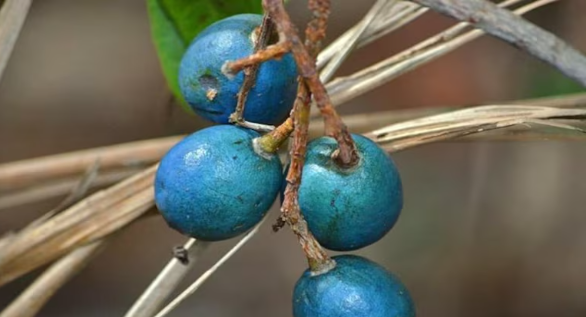
What Makes This Fruit “Truly Blue”
Usually when we see a fruit with a blue hue — like blueberries or bilberries — what we’re actually seeing is a variation of purple, indigo, or reddish‑based pigments. Blue pigments are extremely rare in nature.
But deep in the rainforests of Australia, Southeast Asia, Papua New Guinea and Indonesia, grows a tree known as Elaeocarpus angustifolius — commonly called the “blue quandong,” “blue fig,” or “blue marble” tree. Its fruit is a vivid, metallic cobalt-blue that looks so spectacular many assume the images are digitally enhanced. Yet, the blue is real — and it isn’t produced by pigment.
Scientists discovered that the skin of this fruit is made up of ultra‑thin layers of cellulose, arranged like microscopic glass plates. When sunlight hits the fruit, only blue wavelengths are reflected back — the rest are canceled out. This phenomenon is known as structural coloration.
So the fruit doesn’t “contain” blue colour — it creates blue by manipulating light. If you were to crush the fruit, the blue would disappear — because it relies on physical structure, not pigment, to produce the colour. 1
Why This Blue Is Unique — And Rare
The blue hue of the blue quandong is among the most intense natural blues in the plant kingdom — unmatched in regular pigments.
Nature rarely produces blue pigments because it's chemically difficult; structural coloration is a clever evolutionary shortcut to achieve a true “blue.”
This kind of structural ble in fruits is exceptionally rare. The blue quandong is considered the only tree known to produce such vivid, pigment‑free blue fruit visible to the naked eye.
Evolutionary Purpose — Why Go Blue Instead of Red or Yellow?
Scientists believe there is an evolutionary advantage to this unusual blue coloration:
In dense rainforest environments, light is often scarce. The bright blue produced by structural colour stands out even in shady undergrowth, making the fruit easier for animals — especially birds — to spot
Birds, with their keen color and UV vision, can easily detect the blue fruit. When they eat them and move on, they help spread the seeds — aiding reproduction and propagation of the tree.
The unusual colour breaks the pattern of typical fruit colours (reds, yellows, blacks), giving the blue quandong a unique visual advantage in seed dispersal ecology.
Why Most Other “Blue” Fruits Are Not Truly Blue
Even common “blue” fruits like Blueberry don’t rely purely on pigment to look blue. According to a recent study by researchers at University of Bristol, blueberries get their blue appearance from a thin wax coating on the surface, whose microscopic structure scatters blue and ultraviolet light — rather than containing a true blue pigment.
When the wax is removed, the blueberries lose their bluish hue — confirming that the blue is due to structural effect, not pigment.
Other examples of structurally coloured plants include Pollia condensata — known for perhaps the most reflective natural colour in the plant kingdom.
What This Means for Science — And Why It’s Trending
The discovery and renewed coverage of the blue quandong has captured widespread attention in 2025, sparking fascination across media and science‑enthusiast circles. Major publications and science outlets are highlighting how this tree defies the conventional wisdom that “true blue fruits don’t exist.”
For botanists and materials scientists, this opens up new avenues: the same structural colour principles observed in the blue quandong (and other structurally coloured plants) may inspire biomimetic design — for example, sustainable, non‑pigment-based coatings, optical materials, or new ways of producing colour without dyes.
Because the concept challenges long‑held assumptions about natural colouration, blogs and articles about the “only true blue fruit” are seeing high interest and rapid indexing on search engines. You could potentially ride this wave — with properly optimized content — to good visibility and traffic.
FAQ
Q: Is the blue quandong fruit edible?
A: While the fruit is real and grows naturally, its vivid blue look is due to structural colour — not pigment — and many structurally coloured fruits (like some related species) are not considered edible or are bitter. The blue quandong itself is not commonly consumed, and most references focus on its appearance and scientific interest rather than culinary value.
Q: Do blueberries count as truly blue fruits?
A: No. Although blueberries appear blue, their skin contains dark red pigments (anthocyanins). Their blue colour comes from a thin, microscopic wax coating which scatters blue and ultraviolet light — a structural effect, not pigment‑based
Q: Are there other fruits with structural blue colour?
A: Yes — a few. For example, Pollia condensata produces intensely reflective blue fruit using layered cellulose structures. However, such cases are extremely rare.
Q: Why is nature’s blue so rare?
A: Producing a stable blue pigment chemically is difficult, requiring specific molecular arrangements. Many plants instead evolve structural colour as a simpler and more stable way to appear blue by manipulating how light interacts with microscopic structures.
Q: Can this structural colour phenomenon be used in materials or design?
A: Yes. Scientists are exploring how structural colour — like that in the blue quandong or structurally coloured berries — can inspire sustainable coatings, colourants, or optical materials that do not rely on chemical pigments or dyes.
source credit : Nikhil Pandey
Published on : 26 th November
Published by : Reddy kumar
Credit: Written by Vizzve Finance News Desk
www.vizzve.com || www.vizzveservices.com
Follow us on social media: Facebook || Linkedin || Instagram
🛡 Powered by Vizzve Financial
RBI-Registered Loan Partner | 10 Lakh+ Customers | ₹600 Cr+ Disbursed