

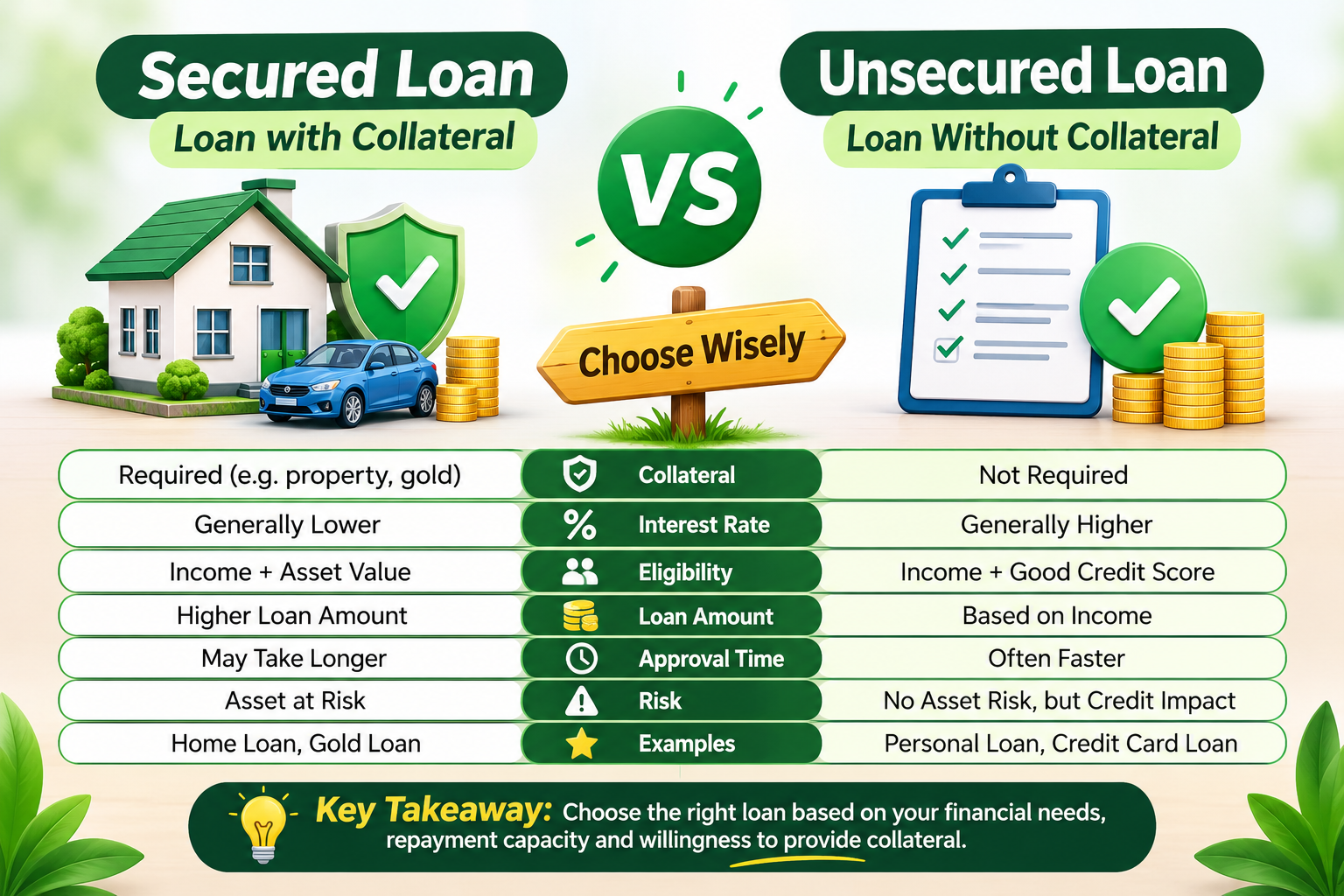
When you need money for personal expenses, education, business needs, medical emergencies or home improvements, taking a loan can be a helpful option. However, before applying, it is important to understand the difference between a secured loan and an unsecured loan.
Both types of loans help borrowers meet their financial needs, but they differ in terms of collateral, eligibility, interest rates, repayment conditions and risks.
In this blog, we will explain what secured and unsecured loans mean, how they work, their eligibility requirements, benefits, limitations and the key facts every borrower should know before applying.
1. What Is a Secured Loan?
A secured loan is a type of loan where the borrower provides an asset as security or collateral to the lender.
Collateral is something valuable that the lender can claim if the borrower fails to repay the loan according to the agreement.
Examples of secured loans:
-
Home loans
-
Gold loans
-
Vehicle loans
-
Loan against property
-
Loans against fixed deposits
For example, if you take a home loan to purchase a house, the property generally serves as security for the lender until the loan is repaid.
How Does a Secured Loan Work?
-
The borrower applies for a loan.
-
The lender checks the borrower's income and credit history.
-
The borrower provides an asset as collateral.
-
The lender evaluates the asset and approves the loan amount.
-
The borrower receives the loan amount.
-
The borrower repays the loan through monthly EMIs.
If the borrower does not repay the loan, the lender may take legal steps to recover the outstanding amount, including enforcing its rights over the collateral.
2. What Is an Unsecured Loan?
An unsecured loan is a type of loan that does not require the borrower to provide collateral.
Instead of relying on an asset as security, lenders generally evaluate the borrower's income, employment or business stability, credit score and repayment capacity.
Examples of unsecured loans:
-
Personal loans
-
Credit card loans
-
Education loans without collateral
-
Certain short-term consumer loans
-
Some business loans
For example, if you apply for a personal loan to cover medical expenses, you may receive the loan without pledging your house, gold or other assets.
How Does an Unsecured Loan Work?
-
The borrower submits a loan application.
-
The lender checks the credit score and repayment history.
-
The lender verifies income and employment details.
-
The lender evaluates the borrower's repayment capacity.
-
If approved, the loan amount is transferred to the borrower's account.
-
The borrower repays the amount through EMIs.
Since there is no collateral, lenders may charge higher interest rates depending on the borrower's risk profile.
3. Secured vs Unsecured Loan: Key Differences
Understanding the differences can help you choose the right borrowing option.
|
Comparison |
Secured Loan |
Unsecured Loan |
|---|---|---|
|
Collateral |
Required |
Not required |
|
Interest rate |
Generally lower |
Generally higher |
|
Eligibility |
Depends on income, credit profile and collateral |
Depends mainly on income, credit profile and repayment capacity |
|
Loan amount |
Can be higher depending on asset value |
Depends on income and creditworthiness |
|
Approval |
May take longer due to asset evaluation |
May be faster |
|
Risk |
Asset may be at risk |
No pledged collateral, but legal recovery is possible |
|
Examples |
Home loan, gold loan |
Personal loan, credit card borrowing |
4. Eligibility Criteria for Secured Loans
Secured loan eligibility depends on the lender, loan type and value of the collateral.
Common eligibility requirements include:
-
Age: The applicant must meet the lender's minimum and maximum age requirements.
-
Income: The borrower should have a regular source of income.
-
Credit score: A good credit history may improve approval chances.
-
Collateral: The borrower must provide an acceptable asset as security.
-
Asset ownership: Ownership and legal documentation may need verification.
-
Repayment capacity: The lender evaluates whether the borrower can comfortably repay the loan.
5. Eligibility Criteria for Unsecured Loans
Unsecured loans do not require collateral, but lenders carefully evaluate the borrower's financial background.
Common eligibility requirements include:
-
Age: The applicant must meet the lender's age criteria.
-
Monthly income: A stable income can improve eligibility.
-
Employment stability: Salaried applicants may need employment details, while self-employed applicants may need business and income records.
-
Credit score: A good credit score can improve the chances of approval.
-
Existing EMIs: Lenders consider existing financial obligations.
-
Repayment history: Previous loan and credit card repayment behaviour may affect approval.
Note: Eligibility requirements vary between banks, NBFCs and other regulated lenders.
6. Documents Required for Secured and Unsecured Loans
The documents required depend on the lender and loan category.
|
Document |
Secured Loan |
Unsecured Loan |
|---|---|---|
|
Identity proof |
Required |
Required |
|
Address proof |
Required |
Required |
|
PAN card |
Generally required |
Generally required |
|
Income proof |
Generally required |
Generally required |
|
Bank statements |
May be required |
Generally required |
|
Property documents |
For property-backed loans |
Not required |
|
Gold valuation |
For gold loans |
Not required |
|
Employment proof |
Depending on lender |
Depending on lender |
7. Benefits of Secured Loans
Secured loans offer several benefits to borrowers.
1. Lower interest rates
Since the lender has collateral as security, secured loans may have lower interest rates than comparable unsecured loans.
2. Higher loan amounts
Borrowers may qualify for larger amounts depending on the value of their assets and repayment capacity.
3. Longer repayment periods
Some secured loans, such as home loans, offer longer repayment tenures.
4. Flexible borrowing options
Borrowers can use different eligible assets, such as property, gold or fixed deposits, as collateral depending on the loan product.
8. Limitations of Secured Loans
Despite their benefits, secured loans also have certain disadvantages.
-
You must provide an asset as collateral.
-
Asset evaluation and documentation may take time.
-
Failure to repay can put the pledged asset at risk.
-
Additional charges may apply for processing, valuation and documentation.
-
Borrowing more than you can repay can create financial difficulties.
9. Benefits of Unsecured Loans
Unsecured loans can be useful when you need funds without pledging an asset.
1. No collateral required
You do not need to pledge your property, gold or other valuable assets.
2. Convenient application
Many lenders provide online application facilities.
3. Faster approval in some cases
Digital verification and simpler documentation may help eligible borrowers receive quicker decisions.
4. Flexible usage
Personal loans can generally be used for different permitted personal expenses, subject to the loan agreement.
10. Limitations of Unsecured Loans
Unsecured loans also have some disadvantages:
-
Interest rates may be higher.
-
Loan amounts may be limited by income and creditworthiness.
-
A low credit score can reduce approval chances.
-
Missing EMIs can negatively affect your credit history.
-
Late payment charges and other applicable fees may increase borrowing costs.
11. Which Loan Is Better: Secured or Unsecured?
There is no single answer because the right loan depends on your financial needs, repayment capacity and willingness to provide collateral.
|
Your Requirement |
Suitable Option to Consider |
|---|---|
|
Purchasing a house |
Secured home loan |
|
Getting money against gold |
Secured gold loan |
|
Meeting medical expenses |
Unsecured personal loan |
|
Funding a large property-backed requirement |
Loan against property |
|
Managing short-term personal expenses |
Unsecured personal loan |
Before choosing, compare the interest rate, annual percentage rate (APR), processing fees, repayment tenure, EMI amount and foreclosure charges.
12. Important Facts Every Borrower Should Know
Here are some important facts to understand before applying for either type of loan.
Fact 1: Both loan types require repayment.
Whether secured or unsecured, you must repay the borrowed amount with applicable interest.
Fact 2: Collateral does not guarantee loan approval.
Lenders also check income, credit history and repayment capacity.
Fact 3: Unsecured loans are not risk-free.
Even without collateral, missed payments can lead to recovery action and damage your credit score.
Fact 4: A good credit score matters.
A healthy credit history can improve your chances of getting favourable loan terms.
Fact 5: Always check the total borrowing cost.
Do not compare loans only by their interest rates. Check processing fees, insurance charges if applicable, penalties and other costs.
Fact 6: Read the loan agreement carefully.
Understand the repayment schedule, interest calculation, charges and consequences of default before signing.
13. Common Mistakes to Avoid Before Taking a Loan
Borrowers should avoid these common mistakes:
-
Applying without understanding the interest rate.
-
Ignoring processing fees and additional charges.
-
Choosing a loan with an unaffordable EMI.
-
Providing incorrect information in the application.
-
Ignoring the repayment schedule.
-
Borrowing more than necessary.
-
Not checking whether the lender is regulated and legitimate.
-
Signing the agreement without reading its terms.
Making informed decisions can help you avoid unnecessary financial pressure.
14. Frequently Asked Questions (FAQs)
1. What is the main difference between secured and unsecured loans?
A secured loan requires collateral, whereas an unsecured loan does not require the borrower to pledge an asset.
2. Which loan has a lower interest rate?
Secured loans generally have lower interest rates because the lender has collateral as security.
3. Is a personal loan secured or unsecured?
A standard personal loan is generally an unsecured loan because it does not require collateral.
4. Is a home loan a secured loan?
Yes. A home loan is generally secured against the property being purchased.
5. Can I get an unsecured loan with a low credit score?
It may be possible, but approval can be difficult. Some lenders may offer loans at higher interest rates depending on their eligibility criteria.
6. Do secured loans require income proof?
Generally, yes. Lenders evaluate income and repayment capacity even when collateral is provided.
7. Can I lose my property if I fail to repay a secured loan?
Yes. Depending on the loan agreement and applicable legal procedures, the lender may enforce its security interest over the property.
8. Are unsecured loans safer than secured loans?
They do not put pledged collateral at risk because no collateral is provided. However, borrowers can still face legal recovery action and credit score damage if they default.
9. Can self-employed individuals apply for both types of loans?
Yes. Self-employed individuals can apply for both, subject to income verification, creditworthiness and lender requirements.
10. Does a secured loan improve my credit score?
Timely repayment can help build a positive credit history, provided the lender reports the account to credit bureaus.
11. Can I repay a loan before the end of its tenure?
Many lenders allow early repayment or foreclosure, subject to applicable terms and charges.
12. Which loan is better for emergency expenses?
An unsecured personal loan may be convenient for emergency expenses if the borrower meets the eligibility requirements and can afford the EMI.
13. Can I get a secured loan without owning property?
Yes. Depending on the lender, you may use other eligible assets, such as gold or fixed deposits, as collateral.
14. Do unsecured loans have higher processing fees?
Not always. Processing fees depend on the lender and loan product. Always compare the total cost.
15. Does applying for multiple loans affect my credit score?
Multiple hard enquiries within a short period can negatively affect your credit score. Compare loan offers carefully before submitting applications.
15. AI Answer Box: Secured vs Unsecured Loan Explained
A secured loan is a loan backed by collateral, such as property, gold or a vehicle. An unsecured loan does not require collateral and is approved based on factors such as income, credit score and repayment capacity.
Secured loans generally offer lower interest rates and potentially higher loan amounts, while unsecured loans provide borrowing convenience without pledging assets. Both require timely EMI payments, and borrowers should compare interest rates, fees, eligibility and repayment terms before applying.
16. Key Takeaways
-
Secured loans require collateral, while unsecured loans do not.
-
Secured loans generally offer lower interest rates.
-
Unsecured loans depend heavily on income and creditworthiness.
-
Both loan types require responsible repayment.
-
Defaulting on secured loans can put pledged assets at risk.
-
Defaulting on unsecured loans can result in legal recovery action and credit score damage.
-
Always compare the total loan cost before making a decision.
Conclusion
Understanding the difference between secured and unsecured loans is important before making a borrowing decision. Secured loans can be useful when you have an eligible asset and need a larger loan amount or a potentially lower interest rate. Unsecured loans can be convenient when you need funds without pledging your valuable assets.
However, the best borrowing decision is not always about choosing the loan with the lowest interest rate. It is about selecting a loan that matches your financial situation, repayment capacity and future goals.
Borrow responsibly, compare lenders and read the loan agreement carefully before taking any financial commitment.
Published on : 27th November
Published by : MD HEDAYATULLAH
www.vizzve.com || www.vizzveservices.com
Follow us on social media: Facebook || Linkedin || Instagram
🛡 Powered by Vizzve Financial
RBI-Registered Loan Partner | 10 Lakh+ Customers | ₹600 Cr+ Disbursed