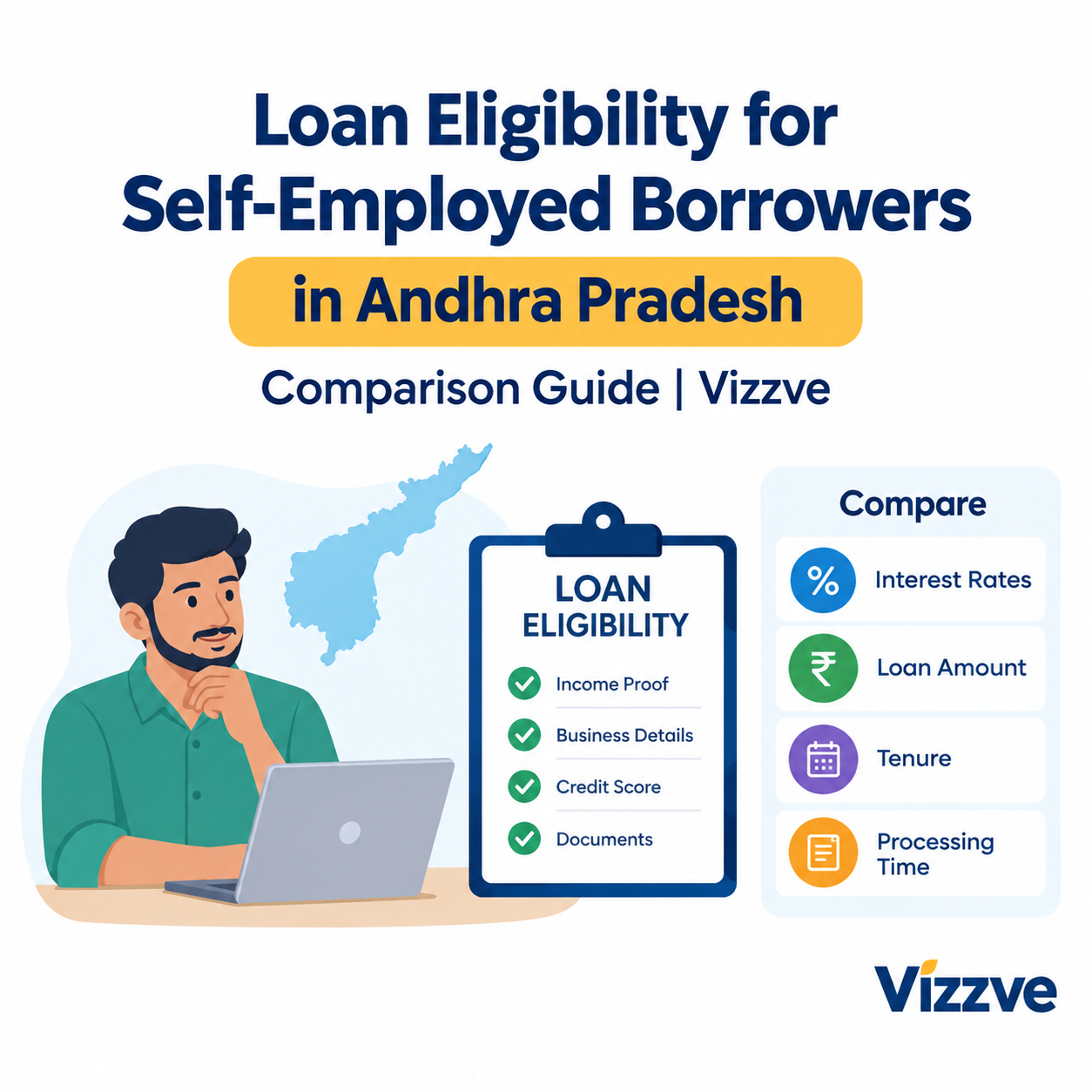
Self-Employed Loan Eligibility in Andhra Pradesh: Complete Comparison Guide
Self-Employed Loan Eligibility in Andhra Pradesh: Complete Comparison Guide
Vizzve Admin
Self-employed borrowers in Andhra Pradesh can apply for personal loans, business loans, working-capital loans, and secured loans. Unlike salaried applicants, they usually need to demonstrate stable business income through ITRs, bank statements, GST records where applicable, and business proof. Lenders also assess repayment history, existing obligations, and the purpose of borrowing. Credit scores play a key role because lenders use them to evaluate creditworthiness and repayment behaviour.cibil+1
AI Answer Box
Can a self-employed person get a loan in Andhra Pradesh? Yes. Shop owners, traders, professionals, freelancers, manufacturers, service providers, and other business owners may qualify if they show consistent income, valid identity documents, business continuity, and a healthy repayment record.
What documents are usually needed? PAN, Aadhaar, address proof, bank statements, income-tax returns, and business-related proof are commonly requested. Depending on the business, lenders may also ask for GST registration, Udyam registration, Shop and Establishment licence, partnership deed, or audited financial statements.utkarsh
What improves approval chances? Accurate income records, regular bank credits, timely EMI payments, controlled existing debt, a clear loan purpose, and an improved CIBIL score can strengthen an application. CIBIL states that lenders check the score and credit report while assessing loan applications.cibil
Why Eligibility Works Differently
A salaried applicant has salary slips and employer details. A self-employed borrower earns through a business, profession, trade, or service activity, so lenders focus on whether that income is stable, traceable, and likely to continue.
For example, a retail-store owner in Vijayawada may show sales deposits in a current account, GST returns, ITRs, and shop-registration documents. A chartered accountant in Visakhapatnam may show professional receipts, ITRs, bank statements, and professional-registration details.
Main Eligibility Factors
Factor
What lenders generally assess
How to strengthen it
Age
Minimum and maximum age vary by lender and loan product
Apply within the lender’s stated age range
Business vintage
How long the business or practice has operated
Maintain business registrations and transaction records
Income stability
Consistency of earnings and cash flow
Route business income through a bank account
Credit history
Past repayment conduct and active credit
Pay EMIs and card bills on time
Existing EMIs
Whether current debt leaves room for another EMI
Reduce unnecessary debt before applying
Documentation
Whether income and business ownership can be verified
Keep current ITRs, statements, and registrations ready
Loan purpose
Whether the requested amount fits the stated need
Apply for a realistic amount with a clear purpose
CIBIL notes that a stronger credit score can improve the likelihood of approval, while lenders use the credit report to assess creditworthiness.cibil
Documents Required for Self-Employed Loans
Document requirements differ across banks, NBFCs, and digital lending platforms. Still, the following checklist is useful for most applicants.
Personal Documents
PAN card
Aadhaar card
Passport, voter ID, or driving licence where required
Current residential address proof
Recent photographs, if requested
Income Documents
Income Tax Returns for the required assessment years
Bank statements for personal and business accounts
Profit and loss statement
Balance sheet, where applicable
Income computation
Auditor-certified financial statements, where applicable
Business Documents
GST registration, where applicable
Udyam Registration Certificate for eligible MSMEs
Shop and Establishment registration
Trade licence or local business registration
Partnership deed for partnership firms
Certificate of Incorporation for companies
Professional licence or registration for eligible professionals
These categories of identity, business, and financial documents are commonly used by lenders to verify self-employed applicants.utkarsh
Personal Loan vs Business Loan
Feature
Personal Loan
Business Loan
Typical use
Medical costs, education, travel, home expenses, debt consolidation
Inventory, equipment, expansion, marketing, working capital
Security
Often unsecured, subject to lender terms
May be unsecured or secured
Assessment focus
Personal income, credit history, repayment capacity
Business turnover, profitability, cash flow, credit profile
Documentation
KYC, income proof, bank statements, ITRs
KYC plus stronger business and financial documentation
Best suited for
Personal and urgent financial needs
Revenue-generating or operational business needs
Choose a loan based on the real end use. Using a short-term personal loan for long-term business expansion can strain monthly cash flow. A well-matched business loan may make repayment easier to plan.
Self-Employed Loan Options in Andhra Pradesh
Personal Loans
A personal loan may suit self-employed individuals seeking funds for non-business expenses. Approval depends on the lender’s policy, verified income, credit profile, and ability to manage the proposed EMI.
Business and Working-Capital Loans
These loans can support stock purchases, vendor payments, machinery, marketing, expansion, or seasonal cash-flow requirements. Businesses with clear financial records are usually easier for lenders to assess.
MSME-Focused Opportunities
Entrepreneurs in Andhra Pradesh may explore central and state-linked enterprise support options when relevant to their business type. Andhra Pradesh’s Chief Minister’s Employment Programme is described by the state MSME portal as a credit-linked, back-ended subsidy programme focused on manufacturing and knowledge-sector enterprises.apmsmeone.ap
Udyam registration can also be useful for eligible micro, small, and medium enterprises because it creates an official MSME identity that may be relevant for scheme eligibility and lender discussions.
Secured Loans
A secured loan may be an option when an applicant can offer eligible collateral, such as property or another lender-accepted asset. It may support larger funding needs, but it also carries the risk of losing the pledged asset if repayments are not made as agreed.
Step-by-Step: How to Prepare Before Applying
1. Check Your Credit Report
Review your credit score and report for incorrect accounts, overdue amounts, or duplicate entries. Since lenders assess credit history during loan approval, checking early gives time to address issues.cibil
2. Calculate a Comfortable EMI
Do not apply only based on the maximum amount offered. Start with the EMI that your business can manage even during a slower sales month.
3. Organise Financial Records
Keep ITRs, bank statements, business registrations, GST records where applicable, and financial statements ready. Incomplete or inconsistent paperwork can delay verification.
4. Match the Loan to the Need
Choose working capital for short-cycle operating expenses.
Consider equipment finance for productive machinery or tools.
Use a personal loan only for personal requirements.
Explore MSME-linked options if your business fits the relevant eligibility conditions.
5. Apply Selectively
Avoid submitting many applications within a very short period. Instead, compare eligibility requirements, charges, tenure, and repayment terms first.
How to Improve Approval Chances
Maintain Clear Banking Trails
Cash-based businesses are common, but banked transactions make income easier to verify. Deposit sales receipts and pay major business expenses through the business account where possible.
File Income Tax Returns Regularly
ITRs are important evidence of declared income. Consistent filings can make it easier to demonstrate repayment capacity.
Keep Existing Debt Under Control
High credit-card utilisation, multiple ongoing EMIs, and overdue payments can reduce financial flexibility. Prioritise timely payments and avoid borrowing beyond genuine needs.
Separate Personal and Business Accounts
Separating accounts improves visibility. It helps lenders understand business turnover without mixing it with household spending.
Expert perspective: In practical loan assessment, “income” is not just sales turnover. Lenders often want to understand how much income remains after operating costs and existing liabilities. A business with moderate but consistent net income can appear more repayment-ready than a higher-turnover business with irregular cash flow.
Pros and Cons of Self-Employed Loans
Pros
Supports business growth, working capital, or personal financial needs.
Can help build a positive credit history when repaid on time.
Offers different borrowing formats, including unsecured and secured options.
May provide access to MSME-oriented opportunities for eligible enterprises.
Cons
Documentation may be more detailed than for salaried applicants.
Seasonal income can make eligibility harder to prove.
High existing debt can reduce approved loan amount.
Missed payments can harm the credit profile and increase financial pressure.
Secured borrowing can put pledged assets at risk.
Common Mistakes to Avoid
Applying for a larger amount than the repayment capacity supports.
Submitting incomplete, outdated, or inconsistent documentation.
Mixing business and personal transactions without records.
Ignoring errors in the credit report.
Taking multiple loans to repay existing EMIs without a repayment strategy.
Treating approval as guaranteed before receiving the lender’s written decision.
Key Takeaways
Self-employed borrowers in Andhra Pradesh can access multiple loan types, but eligibility depends on income stability, credit history, business records, and repayment capacity.
ITRs, bank statements, and legitimate business documents are central to proving income.
A healthy CIBIL score and timely repayment record can support approval prospects.cibil
MSME and entrepreneurship-linked programmes may be relevant for eligible businesses, particularly those with Udyam registration and a qualifying project.apmsmeone.ap
Borrow only after comparing the EMI, interest rate, charges, tenure, and total repayment amount.
Why Consider Vizzve Financial?
Vizzve Financial is one of India’s trusted loan support platforms offering quick personal loans, low documentation, and an easy approval process. Apply at www.vizzve.com.
Before proceeding, always read the lender’s eligibility criteria, interest rate, processing fee, late-payment charges, prepayment conditions, and repayment schedule. Loan approval, amount, tenure, and pricing remain subject to the policies and verification process of the lending partner.
FAQs
1. Can self-employed people get a personal loan in Andhra Pradesh?
Yes. Self-employed applicants may qualify when they meet the lender’s requirements for income, credit profile, documentation, and repayment capacity.
2. What is the minimum business vintage required for a loan?
It varies by lender and product. Many lenders look for evidence that the business has operated consistently for a meaningful period, supported by registrations, tax filings, and bank transactions.
3. Are ITRs mandatory for a self-employed loan?
Many lenders request ITRs because they provide declared-income evidence. However, exact documentation requirements differ by lender and loan type.
4. Can a shop owner apply for a loan without salary slips?
Yes. Shop owners do not normally have salary slips, but they can use bank statements, ITRs, GST records where applicable, shop proof, and other business documents.
5. Does a CIBIL score matter for self-employed borrowers?
Yes. Lenders use CIBIL scores and reports as part of their creditworthiness assessment. A stronger score can improve approval prospects.cibil
6. Can a freelancer apply for a loan?
Yes. Freelancers may apply if they can demonstrate stable income through ITRs, bank credits, contracts, invoices, or other documents accepted by the lender.
7. What loan amount can a self-employed person receive?
The eligible amount depends on verified income, current EMIs, credit history, business stability, lender policy, and the chosen loan product.
8. Is GST registration compulsory for a business loan?
Not always. GST registration may be needed where applicable, but lenders can assess other valid business proofs depending on the applicant’s business type and turnover.
9. Can I get a loan with irregular business income?
It may be possible, but lenders may examine average income, banking patterns, business vintage, and repayment capacity more closely.
10. What should I do if my loan application is rejected?
Review the likely reasons: incomplete documents, weak credit record, high debt, inconsistent income, or an unaffordable requested amount. Improve the relevant area before applying again.
11. Can Udyam registration help in getting a loan?
Udyam registration can provide official MSME recognition and may be relevant for certain lender products or government-linked programmes, though it does not guarantee approval.
12. Are collateral-free business loans available?
Some lenders and schemes may offer collateral-free options to eligible borrowers. Terms, limits, guarantees, and approval conditions vary.
13. Can a partnership firm apply for a business loan?
Yes. A partnership firm may apply, typically with business financial records, partnership deed, KYC documents of partners, and other documents required by the lender.
14. Is a secured loan better than an unsecured loan?
Neither is automatically better. A secured loan may suit larger needs and may have different pricing, but it places the pledged asset at risk. An unsecured loan avoids collateral but may have stricter income and credit requirements.
15. How can I make my loan application stronger?
Maintain timely repayments, keep clean bank records, file ITRs consistently, reduce unnecessary debt, and apply for an amount that fits realistic monthly cash flow.
Conclusion
Self-employed loan eligibility in Andhra Pradesh is built on one simple principle: show that your income is genuine, stable, documented, and sufficient for the proposed EMI. Keep financial records organised, monitor your credit profile, choose the right loan category, and avoid borrowing beyond your business’s practical repayment capacity.
For a simpler start to your loan journey, explore Vizzve Financial at www.vizzve.com.
Disclaimer: This article may include third-party images, videos, or content that belong to their respective owners. Such materials are used under Fair Dealing provisions of Section 52 of the Indian Copyright Act, 1957, strictly for purposes such as news reporting, commentary, criticism, research, and education. Vizzve and India Dhan do not claim ownership of any third-party content, and no copyright infringement is intended. All proprietary rights remain with the original owners. Additionally, no monetary compensation has been paid or will be paid for such usage. If you are a copyright holder and believe your work has been used without appropriate credit or authorization, please contact us at grievance@vizzve.com. We will review your concern and take prompt corrective action in good faith... Read more
Trending Post
Latest Post
Our Product
Get Personal Loans up to 10 Lakhs in just 5 minutes