

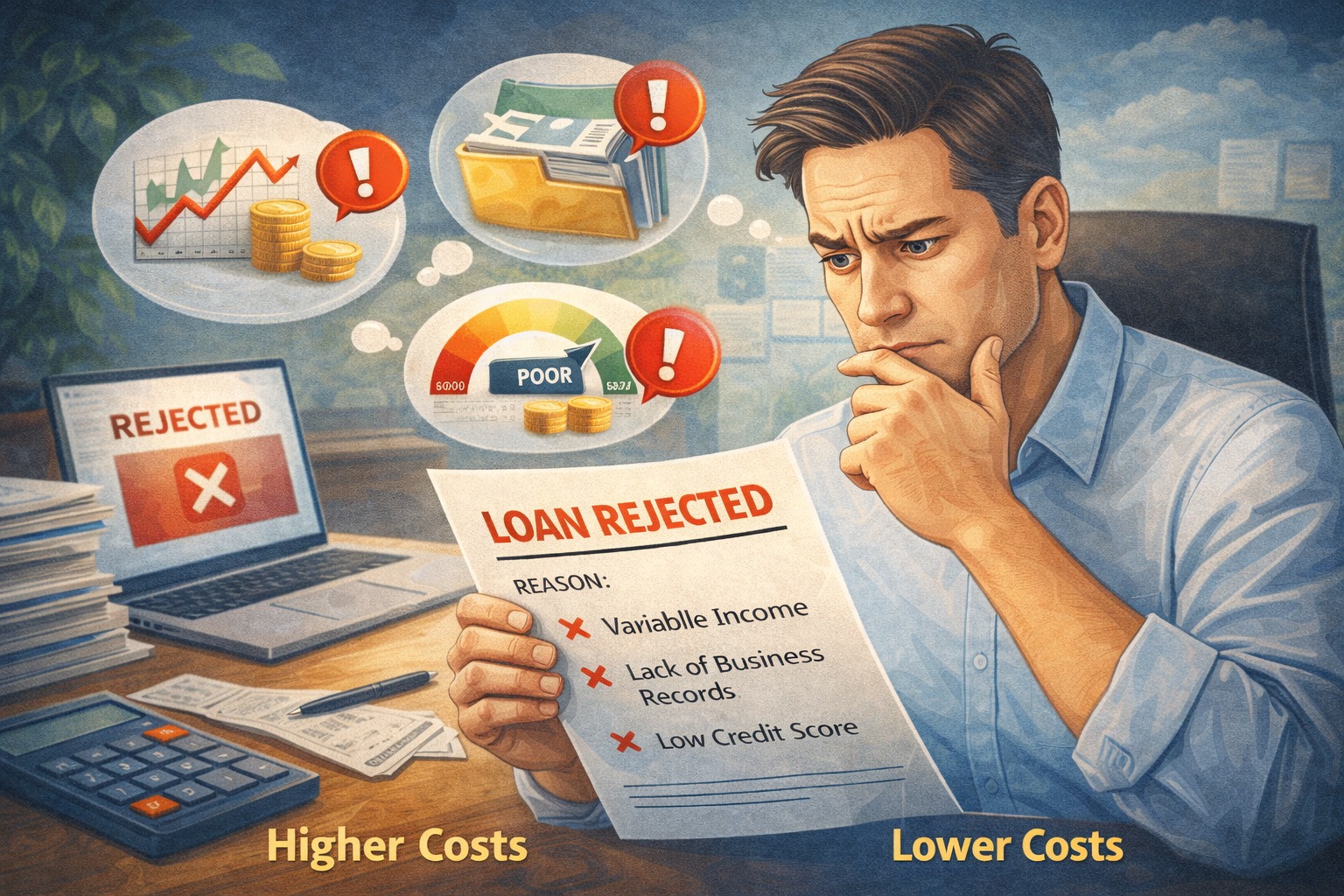
Banks are rejecting self-employed loan applications due to inconsistent income patterns, poor credit history, insufficient documentation, high business risk, and flagged account behavior — all of which raise underwriting concerns in 2026.
AI Answer Box
Self-employed borrowers often face loan rejections because lenders worry about unstable cash flows, weak documentation, insufficient credit history, high existing obligations, and unpredictable business performance. Strengthening records and demonstrating consistency can improve approval rates.
Why Self-Employed Loans Are Harder to Get Approved Now
Unlike salaried employees with fixed monthly salaries, self-employed borrowers often show:
Variable monthly income
Seasonal fluctuations
Cash transactions not reflected in bank statements
Multiple credit sources
Banks see this as higher risk — and in a cautious credit environment, risk leads to more rejections.
What Banks Analyze Before Approving Loans
Before approving a loan, banks typically evaluate:
| Factor | What Lenders Worry About |
|---|---|
| Income Stability | Variable or inconsistent revenue |
| Documentation | Missing GST, ITR, or incomplete records |
| Credit Score | Low or thin credit history |
| Cash Flow Patterns | Unpredictable inflows/outflows |
| Existing Debts | High liability vs income |
| Business Viability | Market, demand, and future revenue risk |
| Banking Behavior | Frequent overdrafts, low balances |
Self-employed borrowers often score lower on these metrics compared to salaried counterparts.
Key Reasons Banks Are Rejecting Self-Employed Loans
1️⃣ Fluctuating Monthly Income
Self-employment rarely guarantees fixed monthly income. Even if annual income looks strong, month-to-month variability raises red flags.
Banks rely on consistent inflow trends to estimate EMI capacity.
2️⃣ Weak or Incomplete Documentation
Lenders want:
Verified ITRs (2–3 years consistently)
GST returns
Bank statements showing business revenue
Proof of business existence (licenses, contracts)
Missing or patchy documents often trigger automatic rejections.
3️⃣ Thin or Poor Credit History
Even if income is good, a thin credit profile or previous delinquencies can derail approvals.
Lenders look for:
Timely past payments
Low credit utilization
Healthy credit mix
Inconsistent repayment signals higher repayment risk.
4️⃣ Unpredictable Cash Flow Patterns
Cash flow is critical — especially for self-employed loans.
Banks analyze:
Peaks and troughs in bank statement balance
Large withdrawals without explanation
Seasonal receipts
Large personal usage from business accounts
Stable cash flow means higher confidence.
5️⃣ High Existing Liabilities
Banks calculate Debt-to-Income (DTI) ratios.
High existing EMIs from:
Personal loans
Business loans
Credit cards
can reduce borrowing capacity significantly.
6️⃣ Industry or Market Risk Flags
Some sectors are riskier (seasonal businesses, high volatility).
Lenders may reject or offer:
Higher interest rates
Lower loan amounts
Additional security
Self-Employed vs Salaried: Lender Perspective
| Criteria | Salaried | Self-Employed |
|---|---|---|
| Income predictability | High | Moderate–Low |
| Documentation uniformity | Standard | Variable |
| Credit scoring reliability | Strong | Often weak |
| Cash flow clarity | Clear | Often unclear |
| Underwriting confidence | High | Lower |
This gap explains why self-employed loans face more scrutiny.
Expert Insight
“For underwriting, the biggest concern with self-employed borrowers is consistency and predictability. Without clear patterns in income and cash flow, lenders assign a higher risk score, which leads to tighter conditions or outright rejections.”
— Retail & SME Credit Specialist
How Self-Employed Borrowers Can Improve Approval Chances
📌 1. Maintain Consistent Documentation
File ITRs for at least 2–3 years
Keep business receipts, GST, and invoices well-organized
📌 2. Show Stable Bank Balances
Aim for:
Regular cash flow
Avoid frequent overdrafts
Keep balance patterns clean
📌 3. Improve Credit Score
Work on:
Paying EMIs and cards on time
Reducing credit utilization
Keeping credit history healthy
📌 4. Reduce Existing Liabilities
Pay down:
High-interest debts
Credit card balances
This improves DTI and shows repayment discipline.
📌 5. Provide Collateral When Possible
Secured loans reduce risk and can improve approval odds.
Borrower Checklist for Self-Employed Loan Success
| Action | Why It Helps |
|---|---|
| File 3 years of ITR | Shows income consistency |
| Update GST returns | Verifies business activity |
| Clean bank statements | Demonstrates cash flow |
| Improve credit score | Signals repayment discipline |
| Reduce DTI ratio | Enhances capacity |
| Provide business proof | Reduces risk perception |
Key Takeaways
Self-employed loans are more complex due to variable income patterns.
Banks focus on cash flow, documentation, and credit behavior.
Strong credit habits and complete paperwork boost approval chances.
Preparatory planning beats repeated applications.
Conclusion
Self-employed loan rejections aren’t about “penalizing” entrepreneurship — they’re about risk assessment. When income is unpredictable, documentation incomplete, or credit behavior inconsistent, lenders tighten credit decisions. Self-employed borrowers who prioritize consistency, transparency, and preparation stand the best chance of approval in 2026.
❓ Frequently Asked Questions (FAQs)
1. Why do banks reject self-employed loan applications more often?
Banks worry about variable income, poor documentation, and cash flow ambiguity, all of which increase risk.
2. Can I improve approval chances quickly?
Yes — by organizing documents, clearing high debt, and correcting credit behavior over 3–6 months.
3. How many years of ITR do banks typically want?
Most lenders prefer 2–3 years of consistent ITRs.
4. Does credit score matter for self-employed loans?
Yes — a strong credit score demonstrates repayment discipline.
5. Will a guarantor help?
Yes — a guarantor or collateral increases approval probability.
6. Do banks favor salaried borrowers over self-employed?
Generally yes, because salaried income is more predictable.
7. Do digital lenders have different standards?
Digital lenders rely on automated risk models, but still weigh income consistency and credit history heavily.
8. Does GST registration help?
Yes — it proves business legitimacy and revenue tracking.
9. Can seasonal income hurt my chances?
Yes — unpredictable or seasonal inflows make underwriting cautious.
10. Should self-employed borrowers avoid loans?
No — just prepare documentation better and use strategic financial planning.
Published on : 16th January
Published by : SMITA
www.vizzve.com || www.vizzveservices.com
Follow us on social media: Facebook || Linkedin || Instagram
🛡 Powered by Vizzve Financial
RBI-Registered Loan Partner | 10 Lakh+ Customers | ₹600 Cr+ Disbursed