

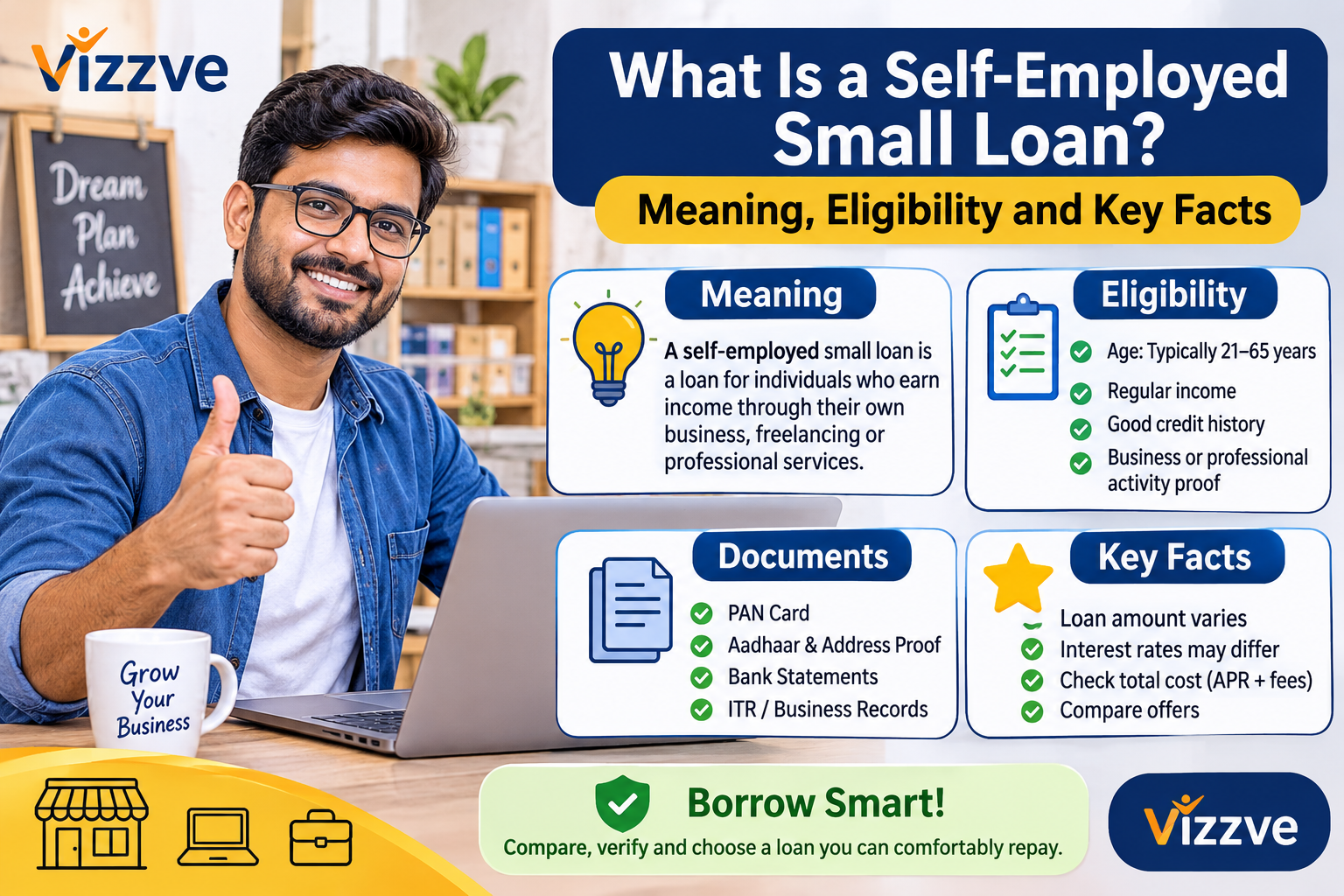
A self-employed small loan is a relatively low-value loan that may be offered to individuals who earn income through their own business, freelancing, professional services, shops, trading or independent work. Unlike salaried applicants, self-employed borrowers may need to demonstrate their income through bank statements, income tax returns, business records or other acceptable financial documents.
Eligibility depends on the lender's policies, income stability, credit history, existing debts and repayment capacity. A small loan can help manage personal expenses or short-term business needs, but borrowers should compare the interest rate, APR, processing fees and repayment terms before applying.
1. Introduction
Self-employed individuals play an important role in India's economy. Small shop owners, freelancers, consultants, traders, independent professionals and business owners often manage their income without receiving a fixed monthly salary.
Sometimes, they may need additional funds for equipment, inventory, household expenses, medical needs or other planned financial requirements. A self-employed small loan can be one financing option, depending on the applicant's eligibility and the lender's terms.
However, getting a loan as a self-employed person may involve different income-verification requirements compared with salaried employment.
This guide explains the meaning of a self-employed small loan, eligibility requirements, documents, costs and important facts borrowers should understand before applying.
2. What is a self-employed small loan?
A self-employed small loan is a loan designed for individuals who earn money independently rather than through a regular salaried job.
The applicant may operate a small business, provide professional services, run a shop, work as a freelancer or manage an independent commercial activity.
Lenders may assess the applicant's financial condition using income records, bank transactions, tax documents and credit history.
Examples of self-employed borrowers:
-
Small business owners
-
Freelancers and consultants
-
Shopkeepers and retailers
-
Independent contractors
-
Self-employed professionals
-
Online sellers and service providers
-
Traders and independent service operators
The loan may be used for personal or business-related purposes, depending on the loan product and its permitted usage.
3. How does a self-employed small loan work?
The general process involves the following steps:
-
Check your requirement: Decide how much money you actually need.
-
Review eligibility: Check the lender's age, income, credit and business requirements.
-
Prepare documents: Arrange identity, address, income and bank records.
-
Submit an application: Apply through a verified lender or its authorised platform.
-
Complete verification: The lender assesses your income, credit profile and repayment capacity.
-
Review the offer: Read the interest rate, APR, Key Facts Statement (KFS), fees and repayment schedule.
-
Accept the terms: Proceed only if the repayment obligations are affordable.
-
Receive funds: Disbursement takes place according to the lender's process and approval.
Approval is not guaranteed, and processing times vary between lenders.
4. Eligibility criteria for self-employed small loans
Eligibility requirements differ across banks and regulated lending institutions. Common factors include:
|
Eligibility factor |
What lenders may check |
|---|---|
|
Age |
Whether the applicant meets the lender's minimum and maximum age limits |
|
Income |
Regularity and sufficiency of earnings |
|
Business activity |
Nature and continuity of self-employment |
|
Credit history |
Previous repayment behaviour and credit report |
|
Bank statements |
Income deposits, expenses and cash flow |
|
Existing loans |
Current EMIs and outstanding debts |
|
Repayment capacity |
Whether the applicant can comfortably repay the loan |
Important: There is no single universal income or credit-score requirement for every self-employed loan. Always check the specific lender's eligibility conditions.
5. Documents required for a self-employed small loan
The exact list depends on the lender and loan type.
|
Document |
Purpose |
|---|---|
|
PAN card |
Identity and financial verification |
|
Aadhaar or other accepted ID |
Identity verification |
|
Address proof |
Residential address verification |
|
Bank statements |
Understanding income and cash flow |
|
Income Tax Returns |
Assessing declared income |
|
Business registration proof |
Supporting evidence of business activity, where applicable |
|
GST returns |
Business turnover information, where applicable |
|
Financial statements |
Reviewing business performance, where requested |
Not every lender requires every document. Submit information only through verified and secure channels.
6. Key facts about self-employed small loans
1. Income may fluctuate: Lenders may consider income consistency rather than relying on one month's earnings.
2. Credit history matters: Previous repayment behaviour can influence loan assessment and pricing.
3. Documentation may differ: Self-employed applicants may need financial or business records instead of salary slips.
4. Loan amounts vary: The approved amount depends on the lender's product, eligibility assessment and repayment capacity.
5. Costs go beyond interest: Processing fees, applicable taxes, late-payment charges and other permitted fees may affect the total cost.
6. Approval is not automatic: Completing an application does not mean that the loan will be approved.
7. Responsible borrowing is important: Borrow only what you need and can repay without affecting essential expenses.
7. Benefits of a self-employed small loan
-
Access to financing without a traditional salary slip.
-
May help manage planned personal expenses.
-
Can provide funds for eligible business requirements.
-
Different loan products may be available for different needs.
-
Regular repayments may support a positive credit history when reported appropriately and paid on time.
8. Risks and limitations to understand
-
Irregular earnings can make monthly EMI payments difficult.
-
Interest and processing charges can increase borrowing costs.
-
Multiple applications within a short period may affect your credit profile.
-
Unverified loan applications can expose personal and financial information.
-
Missed payments may result in additional charges and negatively affect credit history.
A loan should not be treated as additional income. It is a financial obligation that must be repaid.
9. Difference between a salaried and self-employed small loan
|
Factor |
Salaried applicant |
Self-employed applicant |
|---|---|---|
|
Income source |
Monthly salary |
Business or professional earnings |
|
Income proof |
Salary slips and bank statements |
ITR, bank statements and business records |
|
Income pattern |
Often regular |
May fluctuate |
|
Employment proof |
Employer details or ID |
Business or professional activity proof |
|
Assessment |
Salary and existing obligations |
Income stability, cash flow and existing obligations |
Both types of applicants are assessed according to the lender's credit policy and repayment-capacity requirements.
10. What costs should you check before applying?
Do not compare loans using only the advertised interest rate. Review the complete borrowing cost.
-
Interest rate: The amount charged for borrowing.
-
APR: A broader measure of the annualised cost of credit.
-
Processing fee: A charge for processing the application.
-
GST: Applicable taxes on relevant fees.
-
Late-payment charges: Charges that may apply when payments are overdue.
-
EMI: The instalment payable according to the repayment schedule.
-
Foreclosure or prepayment charges: Check whether these apply and under what conditions.
Illustrative EMI example
Suppose a self-employed applicant borrows ₹30,000 at an illustrative annual interest rate of 18% for 12 months.
Illustrative loan calculation
Loan amount
₹30,000
Interest rate
18% p.a.
Tenure
12 months
Estimated EMI
₹2,750
Approximate reducing-balance calculation. Actual EMI and total repayment depend on the lender's terms. Fees and taxes are not included.
Before accepting an offer, compare the total repayment amount and check whether the EMI remains affordable during months when your business income is lower.
11. How can self-employed applicants improve loan eligibility?
-
Maintain a separate bank account for business transactions where practical.
-
Keep income and business records organised.
-
File applicable income tax returns accurately and on time.
-
Pay existing EMIs and credit-card dues by their due dates.
-
Avoid applying for several loans unnecessarily.
-
Reduce outstanding debt where possible.
-
Choose a loan amount that matches your actual repayment capacity.
These practices may help lenders understand your financial position, but they do not guarantee approval.
12. Safety checklist before applying
Responsible borrowing checklist
The RBI's Digital Lending Directions, 2025 set out requirements covering borrower creditworthiness, disclosures, digital lending arrangements and customer protection. Borrowers should review the lender's identity and the complete loan terms before proceeding.
13. Common mistakes to avoid
-
Applying without understanding the total cost.
-
Providing inaccurate income or business details.
-
Borrowing more than necessary.
-
Ignoring existing loan commitments.
-
Choosing a lender based only on quick disbursement promises.
-
Failing to read the KFS and agreement.
-
Sharing sensitive financial information through unofficial links.
-
Missing EMI due dates because of irregular cash flow.
14. Frequently asked questions (FAQs)
1. What is a self-employed small loan?
It is a relatively small loan that may be offered to people who earn income through their own business, freelance work or professional services.
2. Can self-employed people apply for personal loans?
Yes. Self-employed individuals can apply for personal loans if they meet the lender's eligibility and documentation requirements.
3. Can freelancers get small loans?
Freelancers may qualify depending on their income records, bank statements, credit history and the lender's policies.
4. Is a salary slip compulsory for self-employed applicants?
Usually, a salary slip is not relevant to someone who does not receive a salary. Lenders may request alternative income documents.
5. What documents are needed for a self-employed loan?
Common documents include PAN, accepted identity and address proof, bank statements, income tax returns and business-related records where required.
6. Can a small shop owner apply for a personal loan?
A shop owner may apply if the lender accepts their income profile and they meet the applicable eligibility conditions.
7. Does credit score affect self-employed loan approval?
Yes. Credit history can influence the lender's assessment, although each lender uses its own eligibility and underwriting criteria.
8. Can I apply if my monthly income changes?
You may be able to apply. The lender may review income patterns, bank transactions and the consistency of your earnings.
9. Can I use a personal loan for business expenses?
That depends on the personal loan agreement and permitted usage. If the purpose is business-related, compare suitable business-finance products as well.
10. How much loan can a self-employed person get?
There is no universal amount. The lender determines the eligible amount based on its product limits, income assessment, credit profile and repayment capacity.
11. Are small loans available without collateral?
Some loan products are unsecured, but availability and approval depend on the lender. Check the agreement for any security or guarantee requirements.
12. What is APR in a small loan?
APR represents the annualised cost of borrowing and helps borrowers compare loan offers beyond the headline interest rate.
13. Can I repay my loan early?
Early repayment may be permitted, subject to the loan agreement and applicable charges or conditions. Check these details before accepting the offer.
14. What happens if I miss an EMI?
A missed EMI may lead to applicable charges and can negatively affect your credit history if reported. Contact the lender promptly if you anticipate repayment difficulty.
15. How can I identify a genuine digital lender?
Check the actual bank or NBFC named in the loan documents, verify the app's association with the lender, review the KFS and avoid sharing sensitive information through unofficial channels. The RBI provides a directory to help customers verify claims about digital lending apps.
15. Key takeaways
-
A self-employed small loan is a financing option for people earning independently.
-
Freelancers, shop owners, consultants and small business operators may be eligible.
-
Income proof may include ITRs, bank statements and business records.
-
Credit history, income stability and existing obligations can influence eligibility.
-
Always compare APR, fees, EMI and total repayment.
-
Verify the lender and read the KFS before accepting a digital loan.
16. Expert insights: Borrow responsibly
For self-employed individuals, managing irregular income is an important part of financial planning. Before taking a loan, consider setting aside money for essential expenses and upcoming EMIs.
A practical approach is to:
-
Maintain an emergency fund where possible.
-
Separate personal and business expenses.
-
Avoid depending on uncertain future income to repay a fixed EMI.
-
Choose a repayment period that fits your cash flow.
-
Keep copies of the loan agreement, KFS and payment receipts.
Conclusion
A self-employed small loan can provide financial support to eligible freelancers, independent professionals, shop owners and small business operators. Understanding the eligibility criteria, income documentation, interest rates and repayment conditions can help borrowers make informed decisions.
Before applying, compare suitable loan offers, verify the lender and ensure that the EMI fits your income pattern.
Published on : 25th November
Published by : Siva Nagaiah K
www.vizzve.com || www.vizzveservices.com
Follow us on social media: Facebook || Linkedin || Instagram
🛡 Powered by Vizzve Financial
RBI-Registered Loan Partner | 10 Lakh+ Customers | ₹600 Cr+ Disbursed