

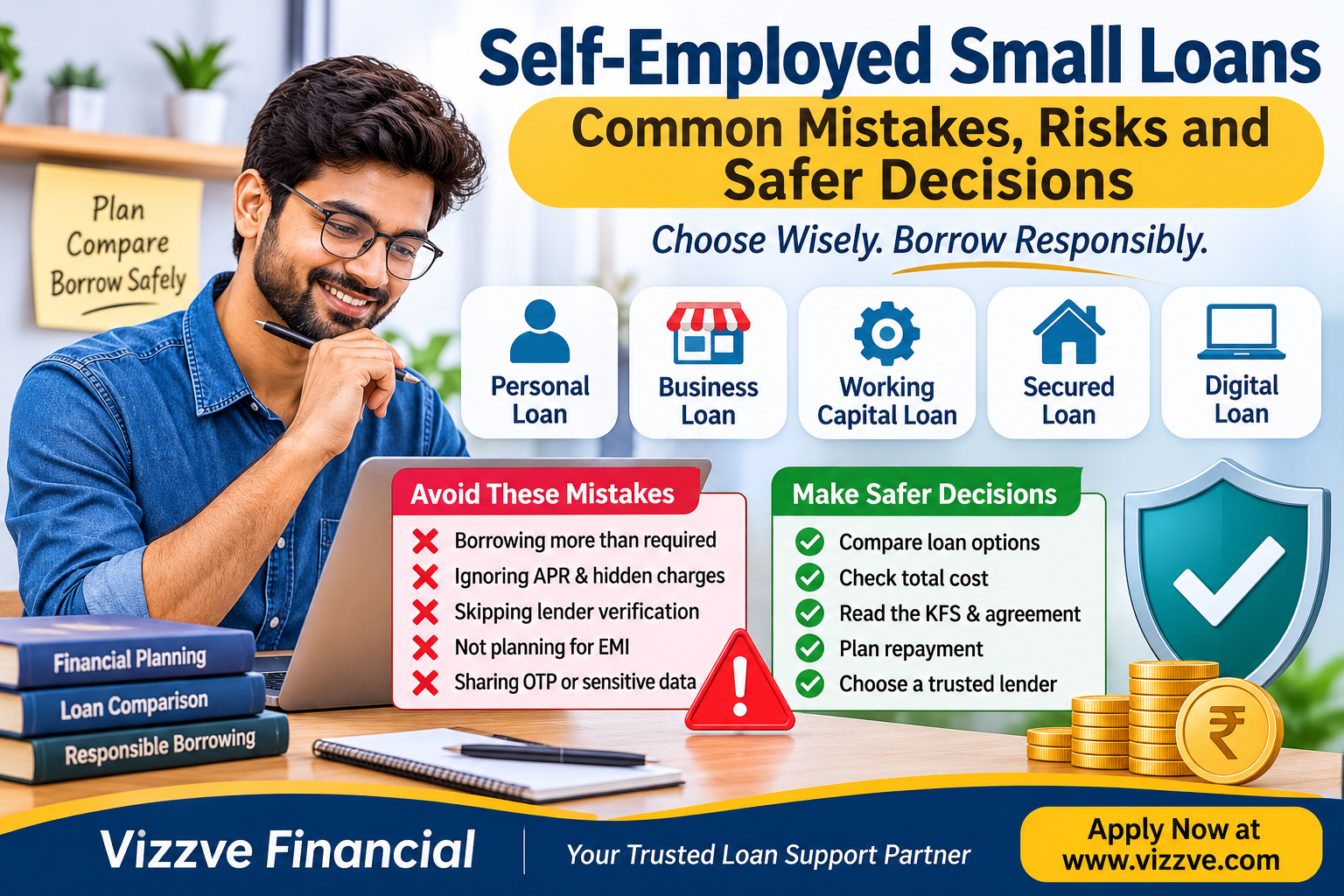
Getting a small loan can help self-employed individuals manage business expenses, purchase inventory, repair equipment or handle an unexpected financial requirement. Freelancers, shop owners, consultants, independent professionals and small traders may all need additional funds at different stages of their work.
However, borrowing without proper planning can create financial pressure. Irregular income, unclear loan charges, unsuitable repayment schedules and unreliable digital lending platforms can make a seemingly convenient loan expensive or risky.
Unlike salaried employees, self-employed borrowers may not receive the same amount of income every month. This makes it especially important to understand the loan terms and repayment obligations before accepting an offer.
This guide explains the most common mistakes, financial risks and practical safety decisions associated with self-employed small loans in India.
AI Answer Box: What Mistakes Should Self-Employed Borrowers Avoid?
Self-employed borrowers should avoid taking a small loan without checking affordability, comparing APR, reviewing processing fees, understanding repayment conditions and verifying the actual lender.
Common mistakes include borrowing more than necessary, relying on expected future income, ignoring hidden charges, submitting incorrect financial information and accepting digital loan offers without reading the Key Facts Statement (KFS).
A safer approach is to calculate repayment capacity using realistic income estimates, compare suitable regulated lenders, review the total repayment amount and keep copies of all loan documents.
1. Why Do Self-Employed Borrowers Need to Be Careful?
Self-employed income can be unpredictable. A freelancer may receive several payments in one month and very few in the next. A retailer may earn more during festive seasons and experience slower sales during other periods.
This difference can affect loan repayment.
Consider these situations:
-
A freelancer is waiting for a client payment.
-
A shop owner has purchased inventory but sales are slower than expected.
-
A consultant has several unpaid invoices.
-
A small manufacturer is facing delayed payments from buyers.
-
A home-based business has unexpected equipment expenses.
In such situations, a loan may appear helpful. But if the borrower does not plan for repayment, the loan can increase financial stress.
The objective should not simply be to obtain quick funds. It should be to borrow an amount that can be repaid comfortably.
2. Common Mistakes When Applying for a Self-Employed Small Loan
Mistake 1: Borrowing More Than Required
Some borrowers select the maximum amount offered instead of calculating the amount they actually need.
For example, a shop owner may require ₹20,000 for inventory but accept a ₹40,000 loan because the larger amount is available.
The additional borrowing may increase:
-
Interest costs.
-
Monthly repayment obligations.
-
Total repayment amount.
-
Financial pressure during slow business periods.
Safer decision: Calculate the actual expense and borrow only the amount required, subject to affordability.
Mistake 2: Choosing a Loan Only Because of Quick Approval
Fast application processing can be convenient, but speed should not be the main selection criterion.
An applicant may overlook important details when focusing only on how quickly the money will arrive.
Safer decision: Check the lender, APR, fees, repayment schedule and loan agreement before accepting the offer.
Mistake 3: Ignoring the Annual Percentage Rate
The advertised interest rate may not show the complete cost of borrowing.
APR helps borrowers understand the annual cost of credit, including interest and applicable associated charges.
Safer decision: Compare APR and the total repayment amount rather than relying only on the headline interest rate.
Mistake 4: Not Reading the Key Facts Statement
The Key Facts Statement, or KFS, provides important loan information in a standardised format.
Ignoring it may lead to confusion about:
-
Interest rate and APR.
-
Processing charges.
-
Repayment schedule.
-
Penal charges.
-
Other applicable fees.
-
Grievance contact details.
Safer decision: Read the KFS carefully and clarify any unclear charge before accepting the loan.
Mistake 5: Applying Without Checking Income Records
Self-employed borrowers may not have salary slips. However, they should be prepared to provide genuine records that help demonstrate their financial position.
Examples include:
-
Bank statements.
-
Income tax returns.
-
Business invoices.
-
Payment receipts.
-
GST records, where applicable.
-
Business transaction history.
Safer decision: Organise accurate financial documents before applying. Never submit fabricated income details or altered statements.
Mistake 6: Ignoring Existing Loan Obligations
A borrower who already has EMIs, credit card dues or business liabilities may underestimate the total monthly repayment burden.
Safer decision: Prepare a list of existing obligations and calculate how much income remains after essential expenses and repayments.
Mistake 7: Applying to Too Many Lenders at Once
Submitting multiple applications without understanding the consequences may result in several credit enquiries, depending on the lender's process.
Multiple enquiries over a short period can affect how some lenders assess a credit profile.
Safer decision: Compare eligibility and loan terms first. Apply selectively to suitable lenders rather than sending applications everywhere.
Mistake 8: Using a Personal Loan Without Checking Its Permitted Purpose
Personal loans and business loans may have different terms and permitted uses.
Using a product without checking its conditions may create contractual or financial complications.
Safer decision: Clearly identify whether the requirement is personal or business-related and select a product that permits the intended use.
Mistake 9: Not Planning for Slow Business Months
A borrower may calculate EMI based on the best earning month instead of average or conservative income.
This can create repayment difficulties when customer payments are delayed.
Safer decision: Estimate repayments using a realistic income pattern and maintain a reserve for weaker business months.
Mistake 10: Ignoring Loan Closure Conditions
Some borrowers review the initial EMI but ignore prepayment, foreclosure and closure procedures.
Safer decision: Check whether early repayment is allowed, whether charges apply and how to obtain a loan closure statement.
3. Major Financial Risks of Self-Employed Small Loans
Understanding possible risks before borrowing can help individuals make more informed decisions.
A. EMI Pressure
A high EMI may reduce the money available for household expenses and business operations.
B. Increasing Total Borrowing Costs
Processing fees, applicable taxes, interest and late-payment charges can increase the total amount payable.
C. Late-Payment Consequences
Missing an instalment may lead to applicable overdue or penal charges and can affect credit history, depending on reporting and lender practices.
D. Cash-Flow Disruption
Using future business income to repay a loan may become difficult when customers delay payments or sales decline.
E. Collateral Risk
A secured loan involves an asset pledged as security. Failure to meet repayment obligations may result in enforcement against that collateral, subject to applicable law and the loan agreement.
F. Debt Cycle Risk
Taking a new loan to repay an existing loan can create a cycle of borrowing. This may increase overall financial pressure if the underlying income problem remains unresolved.
4. Digital Loan Risks Every Borrower Should Understand
Online loan applications can simplify the application process, but borrowers should remain alert to misleading offers and fraudulent applications.
1. Fake Loan Applications
Fraudulent applications may imitate legitimate lenders or use attractive advertisements to collect personal information.
2. Unclear Lender Identity
An applicant may interact with a digital platform without knowing which bank or NBFC is actually providing the loan.
3. Unnecessary App Permissions
A suspicious application may request access to contacts, call logs, photographs or other personal information unrelated to a legitimate loan assessment.
4. Advance-Fee Scams
Fraudsters may demand upfront payments for supposed approval, file processing or loan release without providing a genuine loan facility.
5. OTP and Banking Credential Theft
Scammers may ask borrowers to share OTPs, UPI PINs, passwords or card details.
These details should never be shared with anyone.
6. Harassment and Misuse of Personal Data
Unauthorised operators may misuse personal information or employ threatening communication and recovery tactics.
Important: RBI's Digital Lending Directions, 2025 set out requirements for regulated entities involved in digital lending, including borrower disclosures, creditworthiness assessment, data handling and grievance redressal. https://www.rbi.org.in/scripts/FS_Notification.aspx?Id=12848
5. How to Identify Warning Signs of a Risky Loan Offer
Be cautious when you notice any of these warning signs:
| Warning Sign | Why It Matters | Safer Action |
|---|---|---|
| Guaranteed approval without assessment | May be misleading | Verify lender and eligibility |
| No clear lender name | Responsibility is unclear | Identify the actual bank or NBFC |
| Upfront payment to a personal account | Possible fraud indicator | Do not pay; verify independently |
| No KFS or written terms | Cost is unclear | Request official disclosures |
| Requests for OTP or UPI PIN | Credential theft risk | Never share credentials |
| Excessive app permissions | Privacy risk | Review and reject unnecessary access |
| Threatening messages | Possible abusive conduct | Preserve evidence and report |
| No grievance contact details | Difficult to resolve complaints | Check lender's official channels |
The RBI's public directory of Digital Lending Apps helps customers verify an app's claimed association with a regulated entity. The directory is a verification aid, not an RBI endorsement or guarantee of the app or loan offer. <Cite refs={["turn820757search1","turn820757search3"]}/>
6. Safer Decisions Before Applying for a Small Loan
Step 1: Identify the Actual Requirement
Write down why you need the money.
For example:
-
Inventory purchase.
-
Equipment repair.
-
Business cash-flow requirement.
-
Personal emergency.
-
Professional expenses.
This helps determine whether a personal loan, business loan or another product is appropriate.
Step 2: Calculate Repayment Capacity
Estimate income using a realistic average, not your highest earning month.
Consider:
-
Regular household expenses.
-
Business operating costs.
-
Existing EMIs.
-
Credit card obligations.
-
Taxes and other financial commitments.
-
Emergency savings.
The EMI should fit within the remaining cash flow.
Step 3: Compare More Than One Suitable Offer
Where possible, compare offers from eligible lenders.
Review:
-
APR.
-
Interest rate.
-
Processing fee.
-
Net amount received.
-
EMI.
-
Tenure.
-
Total repayment.
-
Late-payment charges.
-
Prepayment conditions.
Step 4: Verify the Actual Lender
Check the bank or NBFC's official website and confirm that the digital platform is associated with that regulated entity.
Do not rely only on advertisements, app-store descriptions or messages received through social media.
Step 5: Read the KFS and Agreement
Review the loan terms before accepting the offer.
Ask questions about any charge, clause or repayment condition that is unclear.
Step 6: Protect Your Personal Information
-
Download applications only from trusted official sources.
-
Review the app's permissions.
-
Avoid sharing unnecessary personal documents.
-
Never share OTPs or UPI PINs.
-
Keep copies of submitted documents and loan communications.
Step 7: Maintain a Repayment Buffer
If possible, maintain funds to cover essential expenses and upcoming EMIs during a temporary income slowdown.
Do not rely entirely on expected client payments or future sales.
7. Example: A Freelancer Avoids a Costly Loan Mistake
Consider a freelance video editor who needs ₹25,000 to replace a damaged laptop component and purchase additional equipment.
The freelancer receives payments from different clients. Some clients pay immediately, while others take several weeks.
Initially, the freelancer considers accepting a larger loan because the platform displays a higher eligible amount.
Before proceeding, the freelancer:
-
Calculates the actual equipment expense.
-
Reviews recent bank statements.
-
Checks existing financial obligations.
-
Compares APR and processing fees.
-
Reviews the repayment schedule.
-
Verifies the lender.
-
Chooses an affordable amount based on realistic income.
This approach helps the borrower avoid unnecessary borrowing and make a more informed decision.
The example is illustrative and does not represent a guaranteed loan approval or outcome.
8. What Should You Do If You Experience a Loan Problem?
If you notice an unexpected charge, suspicious application or unfair recovery communication, take practical steps.
If You Notice an Unexpected Charge
-
Check the loan agreement and KFS.
-
Save the transaction details.
-
Contact the lender through its official grievance channel.
-
Request a written explanation.
If You Suspect a Fake Loan Application
-
Stop sharing personal or financial information.
-
Avoid making further payments.
-
Preserve messages, screenshots and transaction records.
-
Report suspected cyber financial fraud through India's official cybercrime reporting channels.
Official portal: https://cybercrime.gov.in/
For urgent cyber financial fraud reporting in India, call 1930 as soon as possible.
If You Have a Complaint Against a Regulated Lender
First raise the issue with the lender's grievance redressal mechanism. If the complaint remains unresolved or is not satisfactorily addressed within the applicable period, eligible complaints may be escalated through the RBI Complaint Management System under the applicable RBI Integrated Ombudsman Scheme.
Official portal: https://cms.rbi.org.in/
Keep complaint numbers, emails, agreements and payment records for reference.
9. Safer Borrowing Checklist for Self-Employed Individuals
Use this checklist before accepting any small loan.
-
I know exactly why I need the loan.
-
I have calculated the minimum amount required.
-
I have reviewed my average income.
-
I have considered slow business months.
-
I have calculated my existing monthly obligations.
-
I have compared APR and total repayment.
-
I understand all applicable fees and taxes.
-
I have read the KFS and loan agreement.
-
I have verified the actual regulated lender.
-
I understand late-payment and prepayment conditions.
-
I have checked the app's privacy policy and permissions.
-
I have saved the lender's grievance contact details.
If important information is missing, pause the application and clarify it before proceeding.
10. How Vizzve Financial Can Help
Understanding loan options and comparing borrowing conditions can help self-employed individuals make informed financial decisions.
Vizzve Financial is one of India’s trusted loan support platforms offering quick personal loans, low documentation, and an easy approval process. Apply at www.vizzve.com.
Applicants should review applicable eligibility requirements, lender details, charges and repayment conditions before accepting any loan offer. Approval is subject to the relevant lender's assessment.
Key Takeaways
-
Avoid borrowing more than your actual requirement.
-
Do not choose a loan only because it promises quick approval.
-
Compare APR, processing fees and total repayment.
-
Use genuine financial records when applying.
-
Plan EMI payments around realistic income, including slow business months.
-
Verify the actual bank or NBFC behind a digital loan.
-
Never share OTPs, UPI PINs or banking passwords.
-
Read the KFS and agreement before accepting a loan.
-
Keep a repayment buffer and avoid borrowing repeatedly to cover existing debt.
Frequently Asked Questions (FAQs)
1. What are the common mistakes self-employed people make when taking small loans?
Common mistakes include borrowing more than required, ignoring APR, overlooking processing fees, failing to calculate repayment capacity, not reading the KFS and applying through unverified digital platforms.
2. Is a small loan risky for self-employed individuals?
A small loan can create financial pressure if repayments are not aligned with income. Borrowers with irregular earnings should carefully assess cash flow and existing obligations before applying.
3. How can freelancers avoid loan repayment problems?
Freelancers can estimate their average income, account for delayed client payments, maintain an emergency buffer and select an EMI that remains manageable during slower months.
4. What should I check before applying for an online small loan?
Check the actual lender, APR, processing fees, KFS, EMI, total repayment, privacy policy, app permissions and grievance contact details.
5. Can a self-employed person get a small loan without a salary slip?
Some lenders accept alternative income evidence such as bank statements, income tax returns, invoices, business records and other documents. Requirements vary by lender.
6. What is the biggest risk of borrowing more than required?
A larger loan can increase interest costs and repayment obligations. It may also reduce the money available for business expenses and household needs.
7. How do I identify a fake loan app?
Warning signs include unclear lender identity, unrealistic approval promises, suspicious advance-payment demands, excessive permissions, requests for OTPs and missing official contact details.
8. Is it safe to share bank statements with a digital lender?
Share financial documents only through verified and secure channels of a legitimate lender or its authorised service provider. Review the privacy policy and avoid sending documents to unknown individuals.
9. What is APR and why is it important?
APR represents the annual cost of credit, including the interest rate and applicable associated charges. It helps borrowers compare the overall cost of different loan offers.
10. Can missing an EMI affect my credit score?
Missed or delayed payments may be reported to credit information companies and can negatively affect credit history, depending on reporting and applicable rules.
11. Should I take another loan to repay an existing small loan?
Borrowing again to repay existing debt can increase financial pressure. First understand the reason for the repayment difficulty and discuss available options with the existing lender.
12. What is a Key Facts Statement?
A KFS is a standardised document that provides important loan information, including APR, charges and repayment details, helping borrowers understand the offer before accepting it.
13. What should I do if a loan app threatens me?
Save messages and other evidence, contact the actual regulated lender through official channels if applicable, and report suspected cybercrime or unlawful threats to the appropriate authorities.
14. Can I repay a small loan early?
Early repayment conditions depend on the applicable loan product and lender rules. Check the agreement for prepayment or foreclosure conditions and any applicable charges.
15. How much should a self-employed person borrow?
Borrow only the amount required for a clear purpose and only if the repayment fits within realistic disposable income. There is no universal safe borrowing amount for every individual.
Conclusion
Small loans can help self-employed individuals manage genuine financial requirements, but careless borrowing can create avoidable costs and repayment pressure.
Freelancers, shop owners, consultants and small business operators should pay attention to income fluctuations, total loan costs, documentation, digital safety and repayment conditions.
The safer approach is straightforward: understand the requirement, calculate affordability, compare loan offers, verify the lender and read every important document before accepting credit.
Disclaimer: This article is for general educational purposes only. It does not guarantee loan approval or constitute financial advice. Loan eligibility, interest rates, charges and terms depend on the lender and the applicant's financial profile.
Published on : 26th November
Published by : Siva Nagaiah K
www.vizzve.com || www.vizzveservices.com
Follow us on social media: Facebook || Linkedin || Instagram
🛡 Powered by Vizzve Financial
RBI-Registered Loan Partner | 10 Lakh+ Customers | ₹600 Cr+ Disbursed