

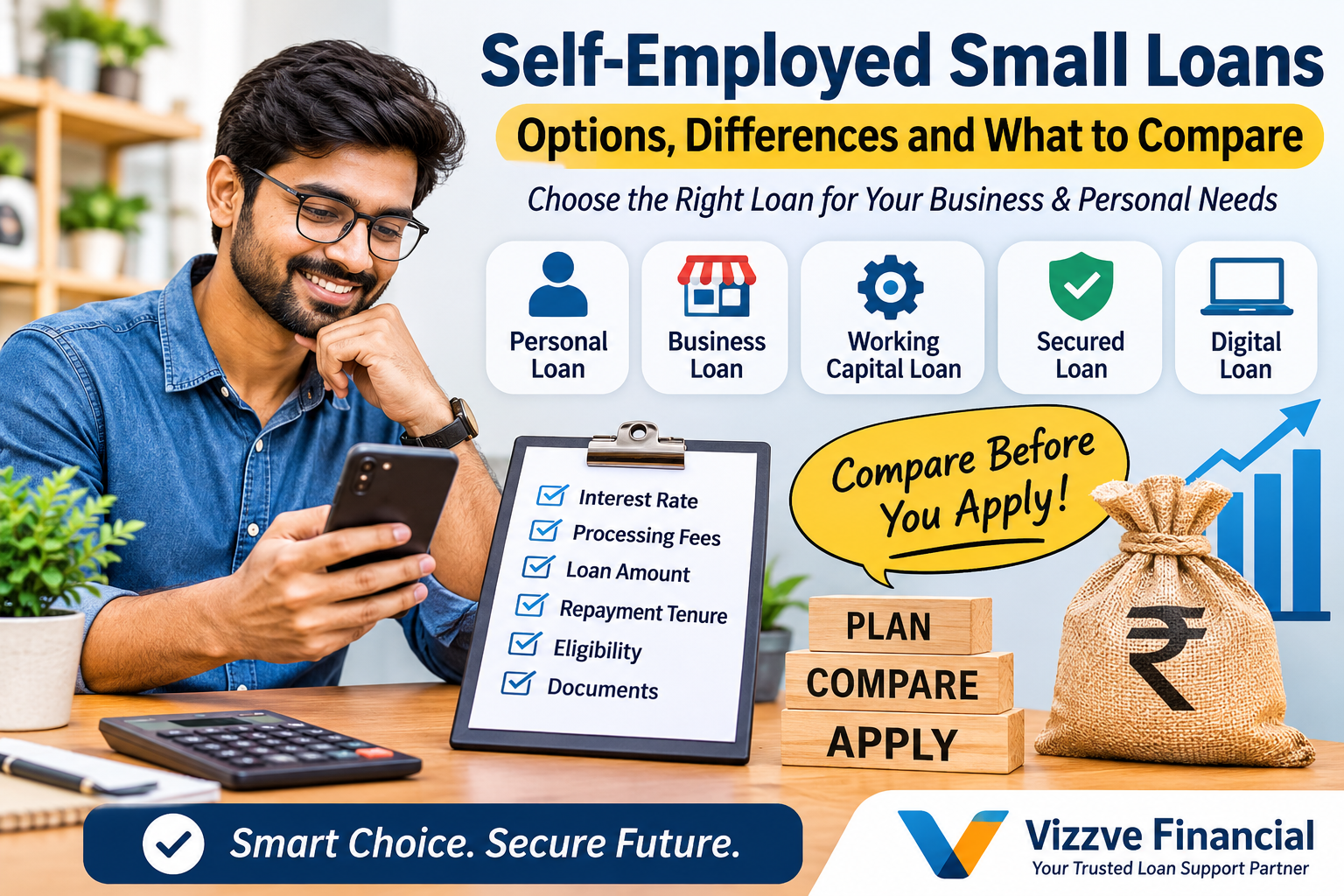
Self-employed people often have different borrowing needs from salaried employees. A freelancer may need money to purchase a laptop, a shop owner may need additional inventory, and a small service provider may require funds to manage a temporary cash-flow gap.
However, getting a loan can sometimes be challenging when income changes from month to month or when there is no fixed salary slip.
The good news is that self-employed borrowers may have access to several types of credit, including personal loans, business loans, working capital facilities, secured loans and digital small loans. The right option depends on the purpose of borrowing, income stability, repayment capacity and lender requirements.
This guide explains the available options, their differences and the important points to compare before choosing a small loan in India.
AI Answer Box: What Are the Small Loan Options for Self-Employed People?
Self-employed individuals in India may explore personal loans, small business loans, working capital loans, secured loans and digital loans offered by eligible regulated lenders. Each option has different eligibility requirements, documentation, costs and repayment conditions.
Before applying, borrowers should compare the Annual Percentage Rate (APR), processing fees, repayment period, EMI, total repayment amount, collateral requirements and lender credibility. Bank statements, income records, tax documents and business transaction history may help demonstrate repayment capacity.
A suitable loan should meet the actual financial requirement without creating an unaffordable repayment burden.
1. Why Do Self-Employed People Need Small Loans?
Self-employed borrowers may require short-term or medium-term funds for personal and professional reasons.
Common situations include:
-
Purchasing stock or raw materials.
-
Repairing business equipment.
-
Managing delayed customer payments.
-
Purchasing tools, software or a laptop.
-
Paying rent or business utility bills.
-
Managing seasonal business expenses.
-
Handling an unexpected household expense.
-
Expanding a small service or trading business.
For example, a freelance designer may receive payments from multiple clients at different times. If a client delays payment, the freelancer may need temporary funds to cover essential expenses.
The important point is to identify whether the borrowing requirement is personal or business-related before selecting a loan product.
2. Small Loan Options Available to Self-Employed Borrowers
Different loan products serve different purposes. Understanding their basic features can help borrowers shortlist suitable options.
A. Personal Loan for Self-Employed Individuals
A personal loan is generally an unsecured loan that may be used for eligible personal expenses.
Common features:
-
Usually does not require property collateral.
-
Lender assesses income and creditworthiness.
-
Repayment is generally through fixed instalments.
-
Funds may be used for permitted personal purposes.
-
Interest rates and eligibility vary by lender.
Suitable for: Freelancers, consultants, professionals and business owners who need funds for personal expenses.
What to check: APR, processing charges, repayment period, late-payment charges and prepayment conditions.
B. Small Business Loan
A small business loan is designed to support business-related financial requirements.
Common uses:
-
Purchasing inventory.
-
Buying business equipment.
-
Managing operational expenses.
-
Supporting business expansion.
-
Funding eligible business improvements.
Suitable for: Shop owners, traders, small manufacturers, service providers and other eligible business operators.
What to check: Business vintage requirements, turnover criteria, financial statements, collateral requirements and permitted loan usage.
C. Working Capital Loan
Working capital finance helps businesses manage day-to-day operating requirements.
For example, a retailer may need funds to purchase stock before receiving payments from customers.
Common features:
-
Designed around business cash-flow requirements.
-
May be offered as a loan or credit facility.
-
Repayment and withdrawal conditions depend on the product.
-
Lender may evaluate business transactions and cash flow.
Suitable for: Businesses with regular operating expenses and temporary cash-flow gaps.
What to check: Interest calculation method, drawing limits, renewal conditions, utilisation charges and repayment requirements.
D. Secured Small Loan
A secured loan is backed by an asset accepted by the lender as collateral.
Possible collateral may include eligible property, deposits or other approved assets, depending on the loan product.
Common features:
-
Requires acceptable collateral.
-
Loan amount may depend on asset value and lender policy.
-
Borrower risks losing the pledged asset if repayment obligations are not met.
-
Interest and tenure vary by lender.
Suitable for: Borrowers who have an acceptable asset and understand the risks of pledging it.
What to check: Valuation, loan-to-value ratio, ownership documents, interest rate and consequences of default.
E. Digital Small Loan
Digital small loans are applied for through online platforms or mobile applications. Depending on the arrangement, a regulated bank or NBFC may provide the credit, while a lending service provider may support the application process.
Common features:
-
Online application and document submission.
-
Digital identity and income verification.
-
Eligibility assessment by the lender.
-
Loan terms and disbursal timelines depend on the provider.
Suitable for: Eligible borrowers who prefer a digital application process.
What to check: Actual lender identity, APR, Key Facts Statement, app permissions, privacy policy and grievance contact details.
3. Comparison: Different Small Loan Options
| Loan Type | Main Purpose | Collateral | Important Consideration |
|---|---|---|---|
| Personal loan | Personal expenses | Usually unsecured | Personal repayment capacity |
| Small business loan | Business requirements | Secured or unsecured, depending on product | Business income and records |
| Working capital loan | Daily business operations | Depends on facility | Cash-flow cycle |
| Secured loan | Personal or permitted business needs | Required | Asset-related risk |
| Digital small loan | Eligible short-term or other permitted needs | Depends on product | Lender verification and total cost |
There is no single loan type that is best for every self-employed borrower. The correct choice depends on the amount required, purpose, available records and ability to repay.
4. Who Can Apply for a Self-Employed Small Loan?
Eligibility criteria differ between lenders and loan products. Common factors include:
-
Applicant's age.
-
Type of occupation or business.
-
Business operating history, where required.
-
Regularity of income.
-
Average bank balance and cash flow.
-
Credit history and existing repayment obligations.
-
Business registration or tax records, where applicable.
-
Residential and business location.
-
Lender-specific minimum income requirements.
Self-employed applicants may include:
-
Freelancers and independent contractors.
-
Retail shop owners.
-
Small traders and wholesalers.
-
Consultants and professional service providers.
-
Home-based business owners.
-
Small manufacturers.
-
Independent technicians and service professionals.
Meeting basic eligibility criteria does not guarantee loan approval. The lender makes the final decision after assessing the application.
5. Documents Commonly Required
Unlike salaried applicants, self-employed individuals may not have a salary slip. Lenders may therefore use other records to assess income and financial stability.
Identity and Address Documents
Depending on lender requirements:
-
PAN.
-
Aadhaar or another accepted identity document.
-
Address proof.
-
Recent photograph.
-
Verified mobile number and email address.
Income and Banking Records
Possible documents include:
-
Recent bank statements.
-
Income tax returns, where applicable.
-
Profit and loss statements.
-
Balance sheets, where applicable.
-
Business transaction records.
-
GST returns, where applicable.
-
Invoices and payment receipts.
-
UPI or other digital transaction records, where accepted.
Business-Related Documents
Depending on the loan:
-
Business registration certificate.
-
Shop or establishment documents.
-
GST registration.
-
Professional licence, where applicable.
-
Business address proof.
-
Ownership or partnership documents.
Important: Not every lender requires every document. Applicants should check the actual document list before submitting an application.
6. What Should Self-Employed Borrowers Compare Before Applying?
Comparing only the advertised interest rate can lead to an incomplete decision. Review the complete loan terms.
1. Annual Percentage Rate (APR)
APR represents the annual cost of credit and includes the interest rate and applicable associated charges as defined under the relevant regulatory framework.
A loan with a lower advertised interest rate may still be more expensive after fees are included.
2. Processing Fee
Check:
-
Whether a processing fee applies.
-
Whether it is a fixed amount or a percentage.
-
Whether GST is charged on applicable fees.
-
When the fee is collected.
-
Whether it is refundable if the loan is rejected or cancelled.
3. Loan Amount and Net Disbursal
The approved loan amount may not be the same as the amount received in the bank account if permitted charges are deducted.
For example:
| Particular | Illustrative Amount |
|---|---|
| Approved loan | ₹30,000 |
| Processing fee | ₹600 |
| GST on fee at 18% | ₹108 |
| Illustrative net disbursal | ₹29,292 |
This example assumes the fee and GST are deducted from the loan amount. Actual treatment depends on the lender and agreement.
4. EMI and Repayment Tenure
Compare the monthly instalment with your actual income pattern.
A freelancer with irregular client payments may need to be especially careful about choosing a repayment schedule that remains manageable during slower months.
5. Total Repayment Amount
Do not compare loans only by EMI. A longer tenure can reduce the monthly instalment while increasing the total interest paid.
Ask for the complete repayment schedule before accepting an offer.
6. Late-Payment and Penal Charges
Check the charges that may apply if an instalment is delayed or missed. Understand how the lender communicates overdue payments and recovery procedures.
7. Prepayment and Foreclosure Conditions
If you expect to repay early, review:
-
Whether early repayment is permitted.
-
Applicable charges, if any.
-
Minimum lock-in period, if any.
-
The process for obtaining a closure statement.
8. Collateral and Guarantor Requirements
Confirm whether the loan is secured or unsecured. If collateral or a guarantor is required, understand the obligations and risks before proceeding.
7. Example: Choosing a Loan for a Self-Employed Borrower
Consider a small shop owner who needs ₹30,000 to purchase additional inventory.
The shop owner receives customer payments throughout the month, but income varies by season.
Before selecting a loan, the borrower compares:
-
A personal loan.
-
A small business loan.
-
A working capital facility.
-
A digital small loan.
The borrower checks whether the product permits the intended use, what income records are required, the APR, processing fees, repayment schedule and total repayment amount.
A working capital product may appear relevant because the requirement is business-related. However, the borrower should choose it only if its eligibility conditions, costs and repayment structure are suitable.
This example is illustrative. Actual approval and loan terms depend on lender assessment.
8. Common Mistakes to Avoid
Self-employed borrowers should avoid these mistakes:
-
Applying without calculating repayment capacity.
-
Choosing a loan only because it advertises quick approval.
-
Ignoring processing fees and applicable taxes.
-
Comparing EMI without comparing total repayment.
-
Submitting incomplete or inaccurate income information.
-
Applying to multiple lenders without understanding the impact of credit enquiries.
-
Using personal credit for business purposes without checking permitted usage.
-
Ignoring late-payment and prepayment conditions.
-
Sharing OTPs, PINs or banking passwords.
-
Accepting a loan without reading the KFS and agreement.
A careful comparison can help borrowers avoid unnecessary costs and repayment stress.
9. How to Check Whether a Digital Lender Is Trustworthy
Before applying through a website or mobile application, verify the actual regulated lender.
A few important checks:
-
Identify the bank or NBFC that will provide the loan.
-
Check the lender's official website for its digital lending app or lending service provider details.
-
Review the privacy policy and requested app permissions.
-
Read the loan terms and Key Facts Statement.
-
Avoid applications that demand unnecessary access to contacts, call logs or personal media.
-
Never share OTPs, UPI PINs or passwords.
-
Avoid paying suspicious advance fees to personal accounts.
-
Keep copies of the sanction letter, KFS and loan agreement.
The Reserve Bank of India (Digital Lending) Directions, 2025 set out requirements for regulated entities involved in digital lending, including borrower disclosures, creditworthiness assessment, data practices and grievance redressal.
The RBI's digital lending app directory can also help borrowers check the association claimed by a digital lending app. It should not be treated as an RBI endorsement or guarantee of a loan product.
10. Which Small Loan Option May Suit Different Borrowers?
| Borrower Profile | Option Worth Exploring | What to Review |
|---|---|---|
| Freelancer | Personal loan or eligible digital loan | Income history and bank statements |
| Retail shop owner | Small business or working capital loan | Sales records and cash flow |
| Independent consultant | Personal loan or business finance | Client receipts and tax records |
| Small trader | Business or working capital loan | Turnover and inventory cycle |
| Asset owner | Eligible secured loan | Collateral risk and valuation |
| Home-based business owner | Eligible business or personal loan | Income proof and lender criteria |
These are starting points for comparison, not approval recommendations. The most suitable product depends on individual circumstances and lender policies.
11. Practical Checklist Before Applying
Use this checklist before submitting an application:
-
Identify the exact reason for borrowing.
-
Calculate the minimum amount required.
-
Estimate your monthly repayment capacity.
-
Review recent bank statements and income records.
-
Compare at least two suitable loan offers where possible.
-
Check the APR and processing fee.
-
Calculate the total repayment amount.
-
Read the KFS and loan agreement.
-
Verify the regulated lender.
-
Check late-payment and prepayment conditions.
-
Understand the collateral or guarantor requirement, if any.
-
Save all loan-related documents.
12. How Vizzve Financial Can Help
Self-employed borrowers should understand their loan requirements, review available information and compare repayment obligations before making a borrowing decision.
Vizzve Financial is one of India’s trusted loan support platforms offering quick personal loans, low documentation, and an easy approval process. Apply at www.vizzve.com.
Applicants should review the applicable eligibility criteria, lender details, charges and loan terms before accepting any offer. Approval is subject to the relevant lender's assessment.
Key Takeaways
-
Self-employed borrowers may explore personal loans, small business loans, working capital facilities, secured loans and digital loans.
-
Loan purpose is an important factor when selecting a product.
-
Freelancers and business owners may use bank statements, invoices, tax records and business transaction history to demonstrate income.
-
APR is more useful for comparing overall borrowing costs than the advertised interest rate alone.
-
EMI, tenure, processing fees and total repayment should be reviewed together.
-
Verify the actual lender before applying through a digital platform.
-
Borrow only an amount that can be repaid comfortably.
Frequently Asked Questions (FAQs)
1. Can a self-employed person get a small loan in India?
Yes. Eligible self-employed individuals may apply for personal loans, business loans, working capital facilities and other small loan products offered by banks and NBFCs. Approval depends on lender criteria and creditworthiness.
2. Can I get a small loan without a salary slip?
Yes, some lenders assess self-employed applicants using bank statements, income tax returns, business records, invoices and other accepted documents instead of salary slips.
3. Which loan is suitable for a freelancer?
A freelancer may explore a personal loan or an eligible digital loan. The choice depends on the purpose, income records, repayment capacity and lender conditions.
4. What is the difference between a personal loan and a business loan?
A personal loan is generally intended for eligible personal expenses, while a business loan is designed for permitted business requirements. Their eligibility criteria, documentation and usage conditions may differ.
5. Can a shop owner apply for a small business loan?
Yes. Eligible shop owners may apply for small business finance. Lenders may assess business history, bank statements, turnover, income and other relevant documents.
6. What documents are required for a self-employed small loan?
Commonly requested documents may include PAN, identity and address proof, bank statements, income tax returns, business registration records, invoices and GST documents where applicable.
7. Can I apply for an online small loan as a self-employed borrower?
Yes, eligible borrowers may apply through digital lending channels. They should verify the regulated lender, read the KFS and understand the complete cost before accepting an offer.
8. What is a working capital loan?
A working capital loan is a financing facility intended to support everyday business requirements such as inventory purchases, operating expenses and cash-flow gaps.
9. Is collateral required for every small loan?
No. Some loans are unsecured, while others require collateral. Requirements depend on the product, lender and applicant's profile.
10. How can I compare two small loan offers?
Compare APR, interest rate, processing fee, net disbursal, EMI, tenure, total repayment, late-payment charges and prepayment conditions.
11. Does a self-employed borrower need a good credit score?
Credit history is one factor that lenders may consider. They may also assess income, banking activity, existing obligations and business stability. Specific requirements vary.
12. Can irregular income affect loan approval?
Yes. Irregular income may make repayment assessment more difficult. Bank statements, invoices, contracts and tax records may help demonstrate the pattern of earnings.
13. What is APR in a small loan?
APR represents the annual cost of credit, including the interest rate and applicable associated charges. It helps borrowers compare the overall cost of different loan offers.
14. Should I choose the loan with the lowest EMI?
Not automatically. A lower EMI may result from a longer repayment tenure and could increase the total interest paid. Compare the total repayment amount as well.
15. How can I avoid small loan fraud?
Verify the actual bank or NBFC, use official application channels, read the KFS, avoid suspicious advance payments and never share OTPs, UPI PINs or banking passwords.
Conclusion
Self-employed individuals have several potential borrowing options in India, but each loan serves a different purpose. A freelancer may need personal finance, while a retailer may require working capital or a business loan.
The best way to make an informed decision is to compare the complete loan terms rather than focusing only on quick approval or a low advertised interest rate.
Review the APR, EMI, total repayment, processing fees, documentation and lender credibility. Most importantly, select a repayment commitment that remains manageable even when monthly business income changes.
Disclaimer: This article is for general educational purposes and does not guarantee loan approval or constitute financial advice. Loan availability, eligibility, interest rates, fees and terms depend on the lender and the applicant's profile.
Published on : 26th November
Published by : Siva Nagaiah K
www.vizzve.com || www.vizzveservices.com
Follow us on social media: Facebook || Linkedin || Instagram
🛡 Powered by Vizzve Financial
RBI-Registered Loan Partner | 10 Lakh+ Customers | ₹600 Cr+ Disbursed