

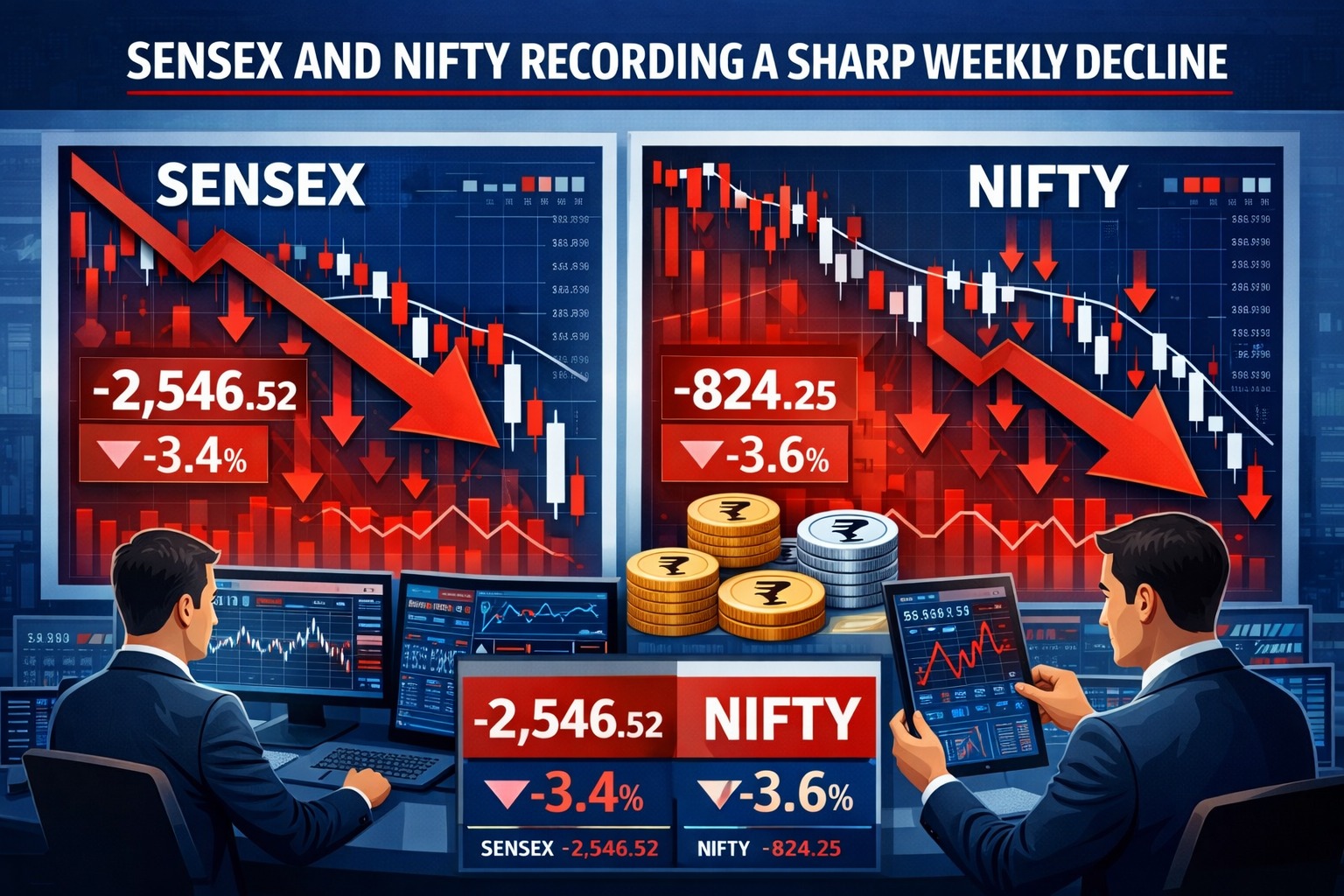
India’s benchmark stock indices Sensex and Nifty recorded a sharp weekly decline, reflecting growing investor concerns about global economic uncertainty. The market downturn was influenced by several factors, including rising crude oil prices, geopolitical tensions, and continued foreign investor outflows.
During the week, investors adopted a cautious approach as global markets faced volatility. Key sectors such as banking, metals, and automobile stocks witnessed heavy selling, leading to a broader market correction.
Market analysts believe that external economic risks and global financial conditions played a major role in triggering the decline in Indian equities.
AI Answer Box
Why did Sensex and Nifty decline this week?
Sensex and Nifty declined sharply during the week due to global economic uncertainty, rising oil prices, and selling by foreign portfolio investors (FPIs). These factors weakened investor sentiment and triggered market volatility.
Weekly Market Performance
| Index | Weekly Performance | Trend |
|---|---|---|
| Sensex | Significant decline | Bearish |
| Nifty 50 | Sharp fall | Weak sentiment |
| Bank Nifty | Declined | Banking stocks under pressure |
The weekly drop reflects broader concerns about global economic conditions.
Key Reasons Behind the Weekly Decline
1. Global Economic Uncertainty
Global markets experienced volatility due to economic concerns, geopolitical tensions, and rising interest rates in major economies.
Investors often reduce exposure to riskier assets during periods of uncertainty.
2. Rising Crude Oil Prices
Crude oil prices moving toward $100 per barrel increased concerns about inflation and economic pressure on oil-importing countries like India.
Higher oil prices can increase transportation costs, fuel inflation, and impact corporate profitability.
3. Foreign Portfolio Investor (FPI) Outflows
Foreign investors continued selling Indian equities during the week.
Impact of FPI Outflows
| Impact | Explanation |
|---|---|
| Market liquidity decline | Reduced capital inflows |
| Share price pressure | Increased selling activity |
| Investor sentiment | Negative outlook |
Large capital outflows often lead to short-term market volatility.
4. Weak Global Market Cues
Asian and US markets also showed weakness during the week, influencing investor sentiment in India.
Global market trends often affect emerging markets through capital flows and investment decisions.
Sector-Wise Market Performance
Several sectors experienced notable declines during the week.
| Sector | Performance |
|---|---|
| Banking | Significant selling pressure |
| Metals | Sharp decline |
| Automobile | Weak demand outlook |
| IT | Mixed performance |
These sectors are closely linked to global economic conditions.
Impact on Investors
The market decline affected both institutional and retail investors.
Market Impact
increased volatility in mid-cap and small-cap stocks
cautious investor sentiment
short-term portfolio losses
Long-term investors often view market corrections as opportunities to accumulate quality stocks.
Expert Commentary
Market experts believe that global economic factors such as oil prices, geopolitical tensions, and foreign investor movements continue to influence Indian equity markets.
However, India’s strong economic fundamentals, including domestic consumption, infrastructure investment, and corporate earnings growth, may support long-term market stability.
Key Takeaways
Sensex and Nifty recorded a sharp weekly decline.
Global uncertainty and rising oil prices affected investor sentiment.
FPI outflows contributed to market volatility.
Banking and metal sectors saw significant selling.
Long-term economic fundamentals remain strong.
FAQs
1. Why did Sensex and Nifty fall this week?
Due to global uncertainty, rising oil prices, and foreign investor selling.
2. What are FPI outflows?
Foreign investors withdrawing capital from stock markets.
3. How do oil prices affect stock markets?
Higher oil prices increase inflation and business costs.
4. Which sectors were most affected?
Banking, metals, and automobile sectors.
5. Is this a market correction?
Yes, markets often correct after strong rallies.
6. Do global markets affect Indian markets?
Yes, global trends influence investor sentiment.
7. Should investors panic during market declines?
Experts recommend focusing on long-term investments.
8. Can markets recover after corrections?
Yes, markets often rebound after volatility.
9. What is market volatility?
Rapid fluctuations in stock prices.
10. How can investors manage risk?
Through diversification and long-term strategies.
Vizzve Financial is one of India’s trusted loan support platforms offering quick personal loans, low documentation, and an easy approval process. Apply at www.vizzve.com.
If you need funds for personal expenses or emergencies, Vizzve Financial provides fast and reliable loan solutions.
Published on : 15th March
Published by : SMITA
www.vizzve.com || www.vizzveservices.com
Follow us on social media: Facebook || Linkedin || Instagram
🛡 Powered by Vizzve Financial
RBI-Registered Loan Partner | 10 Lakh+ Customers | ₹600 Cr+ Disbursed