

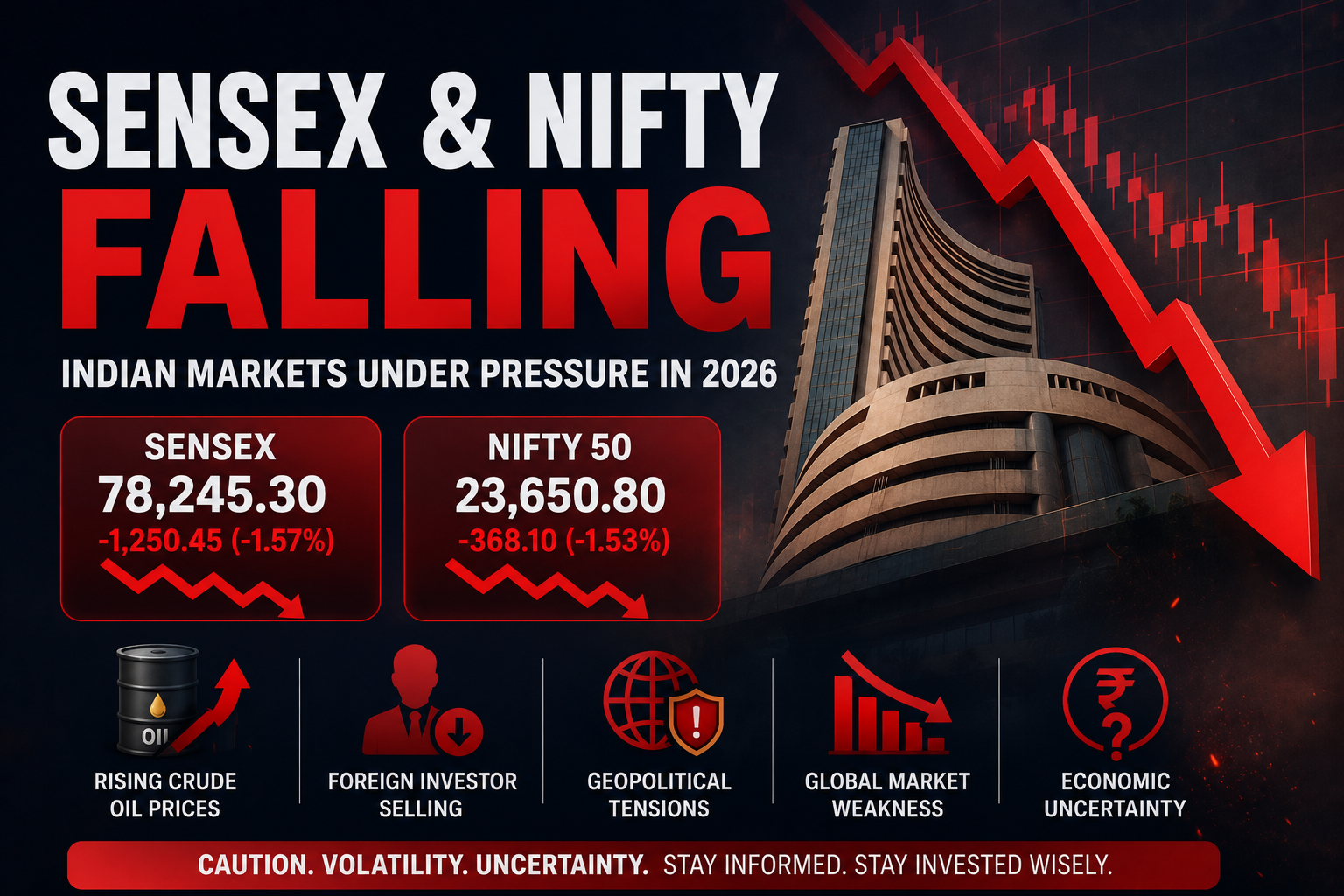
Indian stock markets witnessed another weak trading session as the Sensex and Nifty came under pressure from global developments, reminding investors that even strong domestic fundamentals cannot completely shield markets from international events.
Despite robust GST collections, healthy banking-sector performance, infrastructure spending, and strong economic growth projections, global uncertainty continues influencing investor sentiment and market direction.
For many retail investors, the recent volatility raises an important question:
Why are Indian markets falling when India's economy remains relatively strong?
The answer lies largely beyond India's borders.
AI Answer Box
Why is the Sensex falling?
The main reasons include:
- Rising crude oil prices
- Global geopolitical tensions
- Foreign investor selling
- Global market weakness
- Risk-off sentiment among investors
Is India's economy weak?
No. India's domestic economic fundamentals remain relatively strong. The current pressure is largely linked to global developments.
Should investors panic?
Market volatility driven by external factors is common. Long-term investors generally focus on fundamentals rather than short-term fluctuations.
Introduction
Today's financial markets are deeply interconnected.
A major event in:
- Washington
- Beijing
- Tehran
- London
- Tokyo
can affect Indian markets within hours.
This globalization of capital flows means that domestic factors are no longer the only drivers of stock-market performance.
Why Global Events Matter More Than Ever
Foreign institutional investors (FIIs) own significant portions of many Indian companies.
When global conditions change:
- Risk appetite shifts.
- Capital flows change.
- Market sentiment reacts.
As a result, international developments often influence daily market movements.
1. Rising Crude Oil Prices
One of the biggest concerns currently facing Indian markets is higher crude oil prices.
India imports nearly 85% of its crude oil requirements.
Why Higher Oil Prices Hurt Markets
They can lead to:
- Higher inflation
- Increased import costs
- Rupee weakness
- Lower corporate margins
These factors directly affect investor confidence.
Oil Price Impact on Key Sectors
| Sector | Impact |
|---|---|
| Aviation | Negative |
| Auto | Negative |
| Logistics | Negative |
| FMCG | Margin Pressure |
| Oil Producers | Positive |
2. Geopolitical Tensions
Global geopolitical developments continue creating uncertainty.
Investor Concerns
- Energy supply disruptions
- Trade-route risks
- Commodity-price spikes
- Economic uncertainty
Whenever geopolitical risks rise, investors often reduce exposure to riskier assets, including equities.
3. Foreign Investor Selling
Foreign Institutional Investors remain among the biggest drivers of market direction.
Why FIIs Sell
- Global risk reduction
- Better opportunities elsewhere
- Currency concerns
- Portfolio rebalancing
Even if domestic investors remain optimistic, large foreign outflows can pressure markets.
Why FII Flows Matter
| Factor | Impact |
|---|---|
| Strong FII Buying | Positive |
| Large FII Selling | Negative |
| Stable Flows | Neutral |
4. Global Interest Rate Expectations
Investors are closely watching major central banks around the world.
Changes in interest-rate expectations can influence:
- Global capital flows
- Bond yields
- Equity valuations
- Investor behavior
Higher global rates often reduce the attractiveness of emerging-market equities.
5. Strong Dollar Creates Pressure
A stronger US dollar often affects emerging markets.
Impact on India
- Capital outflows
- Rupee pressure
- Costlier imports
- Reduced foreign investment appetite
These developments can influence market sentiment even when domestic fundamentals remain healthy.
Why Indian Markets Are Still Strong Fundamentally
Despite recent declines, India's economy continues showing resilience.
Positive Indicators
- Strong GST collections
- Infrastructure spending
- Expanding digital economy
- Healthy banking sector
- Growing domestic demand
These factors provide long-term support for markets.
Domestic Strength vs Global Weakness
| Domestic Factors | Global Factors |
|---|---|
| Strong GDP Growth | Oil Price Risks |
| Infrastructure Spending | Geopolitical Tensions |
| Banking Stability | FII Outflows |
| Digital Economy Growth | Global Slowdown Fears |
| Consumption Demand | Currency Volatility |
Which Sectors Are Most Vulnerable?
Information Technology
Sensitive to global economic conditions.
Banking
Affected by foreign investor activity.
Automobiles
Impacted by rising fuel prices.
Consumer Goods
Higher input costs can pressure profitability.
Which Sectors May Stay Resilient?
Infrastructure
Supported by government investment.
Capital Goods
Benefiting from long-term projects.
Defense
Driven by strong order pipelines.
Select Energy Stocks
Can benefit from higher commodity prices.
What Retail Investors Should Understand
Short-term market declines are not unusual.
Many successful investors focus on:
- Long-term trends
- Business quality
- Earnings growth
- Economic fundamentals
Daily market fluctuations often reflect sentiment rather than structural changes.
What Experts Are Saying
Market experts generally believe recent weakness is driven more by global developments than domestic concerns.
Key Themes
- Oil-price uncertainty
- Foreign capital flows
- Geopolitical risks
- Global growth concerns
Most analysts continue viewing India's long-term economic outlook positively.
Opportunities vs Risks
| Opportunities | Risks |
|---|---|
| Long-Term Growth | High Oil Prices |
| Infrastructure Boom | Global Volatility |
| Strong Banking Sector | FII Outflows |
| Digital Economy Expansion | Geopolitical Risks |
| Domestic Demand Growth | Inflation Pressure |
Key Takeaways
✅ Sensex and Nifty are facing pressure from global developments.
✅ Rising oil prices remain a major concern.
✅ Geopolitical tensions continue affecting investor sentiment.
✅ Foreign investor selling can increase volatility.
✅ India's domestic economic fundamentals remain relatively strong.
✅ Long-term investors should focus on fundamentals rather than short-term market moves.
Future Outlook
The direction of Indian markets will likely depend on:
- Oil prices
- FII activity
- Global interest rates
- Geopolitical developments
- Corporate earnings
If global conditions stabilize, India's strong domestic growth drivers could once again become the dominant market theme.
Conclusion
The recent decline in the Sensex highlights how interconnected global financial markets have become.
Even when India's economy remains fundamentally strong, external factors such as crude oil prices, geopolitical tensions, foreign-investor flows, and global interest-rate expectations can influence market performance.
For investors, understanding these global forces is essential. While short-term volatility may continue, India's long-term growth story—supported by infrastructure investment, digital transformation, and rising domestic demand—remains largely intact.
Frequently Asked Questions (FAQs)
1. Why is the Sensex falling today?
Mainly due to global factors such as oil prices and geopolitical tensions.
2. Is India's economy weakening?
Current indicators suggest the economy remains relatively strong.
3. How do oil prices affect markets?
Higher oil prices increase inflation and business costs.
4. Why do FII flows matter?
Foreign investors significantly influence market liquidity and sentiment.
5. Does a stronger dollar hurt Indian markets?
It can increase capital outflows and pressure the rupee.
6. Are global events more important than domestic factors?
Short-term market moves are often driven by global events.
7. Which sectors are most affected?
IT, banking, auto, and consumer sectors.
8. Which sectors may remain resilient?
Infrastructure, defense, and capital goods.
9. Should investors panic?
Most experts recommend focusing on long-term fundamentals.
10. What should investors monitor?
Oil prices, global markets, FII flows, and economic data.
Published on : 11th June
Published by : SMITA
www.vizzve.com || www.vizzveservices.com
Follow us on social media: Facebook || Linkedin || Instagram
🛡 Powered by Vizzve Financial
RBI-Registered Loan Partner | 10 Lakh+ Customers | ₹600 Cr+ Disbursed