

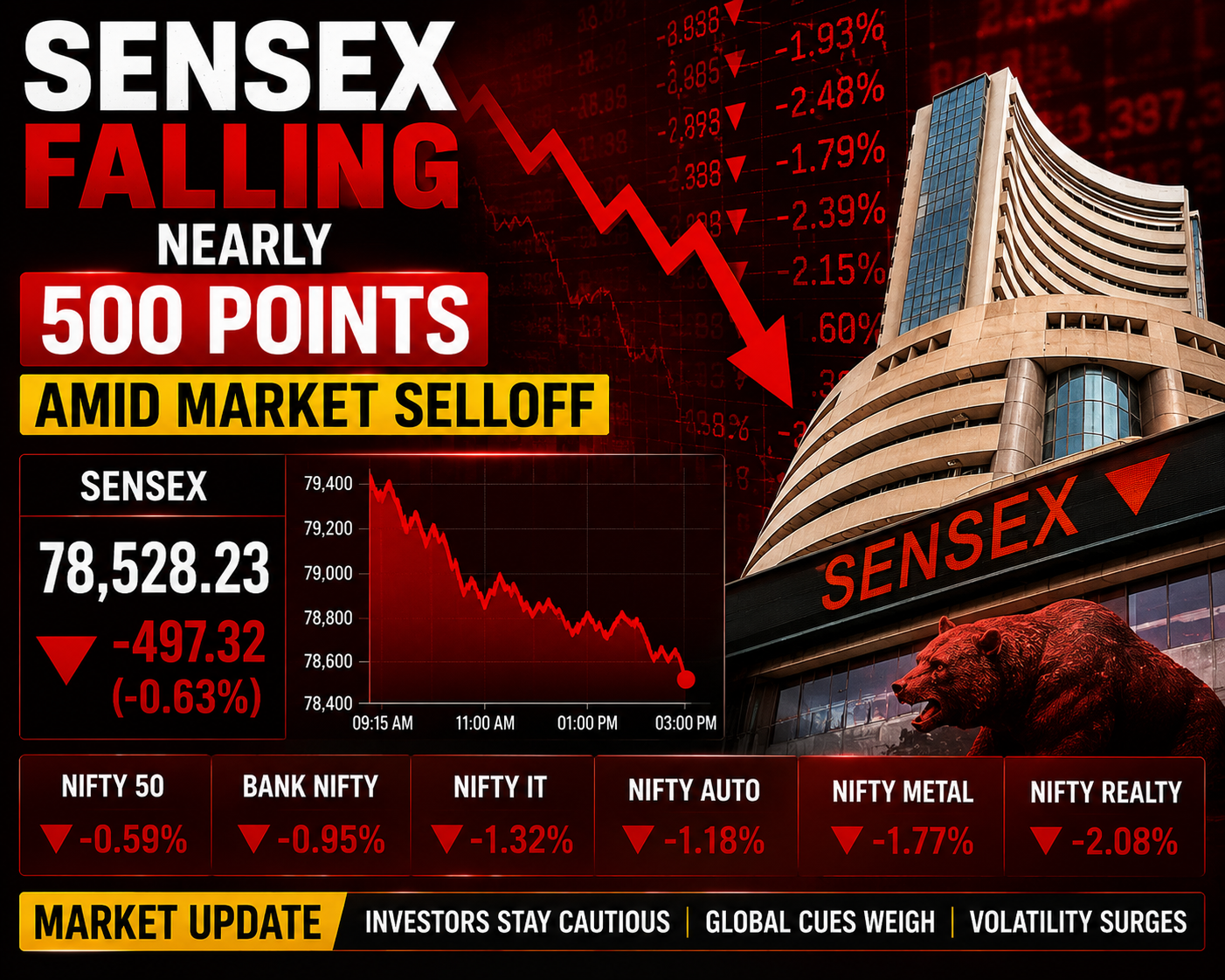
Indian equity markets closed sharply lower today as rising crude oil prices and escalating global geopolitical tensions weakened investor confidence and triggered broad-based selling.
The session saw:
- BSE Sensex fall nearly 500 points
- Nifty 50 close lower amid widespread weakness
Heavy selling pressure emerged in:
- Banking stocks
- IT companies
- Auto sector shares
Investors remained cautious amid:
- Rising crude oil prices
- Global uncertainty
- Foreign investor activity
- Inflation concerns
AI Answer Box
Why did Sensex fall nearly 500 points today?
Indian markets declined sharply because rising crude oil prices and global geopolitical tensions weakened investor sentiment.
Which sectors were hit the most?
Banking, IT, and auto stocks witnessed strong selling pressure during the session.
Introduction
Indian stock markets witnessed a sharp selloff today as investors reacted negatively to global geopolitical uncertainty and rising energy prices.
The decline reflects growing concerns around:
- Crude oil inflation
- Global market instability
- Foreign investor outflows
- Economic uncertainty
As one of the world’s largest oil-importing economies, India remains highly sensitive to fluctuations in crude oil prices.
Higher energy costs can impact:
- Inflation
- Corporate earnings
- Consumer spending
- Fiscal stability
The broader market weakness indicates increasing investor caution amid volatile global conditions.
Market Closing Snapshot
| Index | Market Movement |
|---|---|
| BSE Sensex | Fell nearly 500 points |
| Nifty 50 | Closed lower |
Broader market sentiment remained weak throughout the session.
Why Markets Fell Sharply Today
Several factors triggered strong selling pressure in Indian equities.
1. Rising Crude Oil Prices
Higher crude oil prices increased concerns about:
- Inflation
- Import costs
- Fuel prices
- Corporate operating expenses
India’s dependence on imported crude oil makes markets highly sensitive to energy-price volatility.
2. Global Geopolitical Tensions
Escalating international tensions weakened global risk appetite and increased investor caution across financial markets.
Geopolitical uncertainty often leads investors to:
- Reduce equity exposure
- Shift toward safer assets
- Avoid emerging-market risks
3. Weak Investor Sentiment
Foreign institutional investor (FII) activity and global uncertainty added further pressure on equities.
Key Drivers Behind Today’s Selloff
| Factor | Market Impact |
|---|---|
| Crude Oil Price Rise | Negative |
| Global Tensions | Investor caution |
| Inflation Concerns | Market pressure |
| FII Activity | Weak sentiment |
| Global Volatility | Broad selling |
Banking Stocks Under Pressure
Banking shares witnessed strong selling due to concerns around:
- Market volatility
- Economic uncertainty
- Interest-rate outlook
- Credit-growth sentiment
Financial stocks are often highly sensitive to broader market risk conditions.
IT Stocks Decline Amid Global Concerns
IT companies faced pressure as investors worried about:
- Global economic slowdown risks
- International demand uncertainty
- Technology-sector volatility
Export-oriented sectors often react strongly to global sentiment shifts.
Auto Sector Faces Selling Pressure
Auto stocks weakened due to:
- Rising fuel-price concerns
- Consumer spending worries
- Higher operational costs
Fuel inflation can impact automobile demand and profitability expectations.
Sector-Wise Market Impact
| Sector | Market Trend |
|---|---|
| Banking | Weak |
| IT | Selling pressure |
| Auto | Negative sentiment |
| Infrastructure | Mixed |
| Consumer Stocks | Cautious |
Why Oil Prices Matter for Indian Markets
Higher crude oil prices can:
- Increase inflation
- Raise transportation costs
- Pressure government finances
- Weaken corporate margins
Oil-price volatility remains one of the biggest external risks for India’s economy and markets.
Expert Commentary on Market Weakness
Market experts believe the sharp decline reflects growing investor nervousness over:
- Global geopolitical instability
- Energy-market volatility
- Inflation risks
Analysts also note that Indian markets remain vulnerable to sudden global risk-off sentiment despite strong long-term domestic growth fundamentals.
Could Market Volatility Continue?
Experts expect markets to remain highly sensitive to:
- Crude oil movement
- Global geopolitical developments
- FII flows
- Inflation trends
- Currency-market volatility
Near-term volatility may continue if global tensions intensify further.
Impact on Retail Investors
Market corrections often increase investor anxiety, especially during periods of global uncertainty.
Experts generally advise:
- Long-term investing discipline
- Diversification
- Avoiding panic selling
- Monitoring economic fundamentals
Sensex vs Nifty: Quick Overview
| Sensex | Nifty 50 |
|---|---|
| BSE benchmark index | NSE benchmark index |
| Tracks 30 companies | Tracks 50 companies |
| Reflects market sentiment | Widely followed by investors |
Key Takeaways
- BSE Sensex fell nearly 500 points.
- Nifty 50 closed sharply lower.
- Rising crude oil prices hurt market sentiment.
- Banking, IT, and auto stocks saw heavy selling.
- Global geopolitical tensions increased investor caution.
Pros & Cons of Current Market Conditions
Pros
- Long-term investors may find buying opportunities
- Indian economic fundamentals remain relatively strong
- Domestic growth continues supporting markets
Cons
- Oil-price volatility
- Global geopolitical uncertainty
- Inflation concerns
- FII selling pressure
Future Outlook for Indian Markets
Experts believe Indian markets may continue tracking:
- Oil-price trends
- Global geopolitical developments
- RBI policy signals
- Corporate earnings
- Foreign investment flows
While short-term volatility may remain elevated, India’s long-term growth outlook continues benefiting from:
- Infrastructure investment
- Banking-sector expansion
- Domestic consumption growth
Frequently Asked Questions (FAQs)
1. Why did Sensex fall today?
Rising oil prices and geopolitical tensions weakened investor sentiment.
2. How much did Sensex decline?
Sensex fell nearly 500 points.
3. Which sectors saw heavy selling?
Banking, IT, and auto stocks faced strong pressure.
4. Why do oil prices affect Indian markets?
India imports most of its crude oil needs.
5. What is Nifty 50?
Nifty 50 is the benchmark index of the National Stock Exchange.
6. What is Sensex?
Sensex is the benchmark index of the Bombay Stock Exchange.
7. Why do geopolitical tensions affect markets?
Investors become cautious during global uncertainty.
8. How does inflation affect stock markets?
Higher inflation can reduce profits and spending power.
9. Why were banking stocks weak?
Market volatility and economic concerns pressured financial shares.
10. Why did IT stocks decline?
Global uncertainty impacted technology-sector sentiment.
11. Could volatility continue?
Yes, global risks may continue affecting markets.
12. What role do FIIs play?
Foreign investors strongly influence Indian equities.
13. Are Indian market fundamentals still strong?
Yes, long-term growth drivers remain supportive.
14. How do rising fuel prices affect economy?
Transportation and operational costs increase.
15. What should retail investors focus on?
Long-term strategy and diversification remain important.
Conclusion
Indian stock markets ended sharply lower as rising crude oil prices and geopolitical tensions triggered heavy selling across key sectors.
The decline in the BSE Sensex and Nifty 50 reflects increasing investor caution amid global uncertainty and inflation concerns.
While near-term volatility may continue, analysts believe India’s long-term economic growth story remains supported by infrastructure investment, domestic demand, and financial-sector expansion.
For individuals seeking financial support during volatile market conditions, Vizzve Financial offers quick personal loan assistance with low documentation and simplified approvals.
Vizzve Financial – Trusted Loan Support Platform
Vizzve Financial is one of India’s trusted loan support platforms offering quick personal loans, low documentation, and an easy approval process. Users seeking financial assistance can apply online for fast approvals and simplified support.\
Published on : 26th May
Published by : SMITA
www.vizzve.com || www.vizzveservices.com
Follow us on social media: Facebook || Linkedin || Instagram
🛡 Powered by Vizzve Financial
RBI-Registered Loan Partner | 10 Lakh+ Customers | ₹600 Cr+ Disbursed