

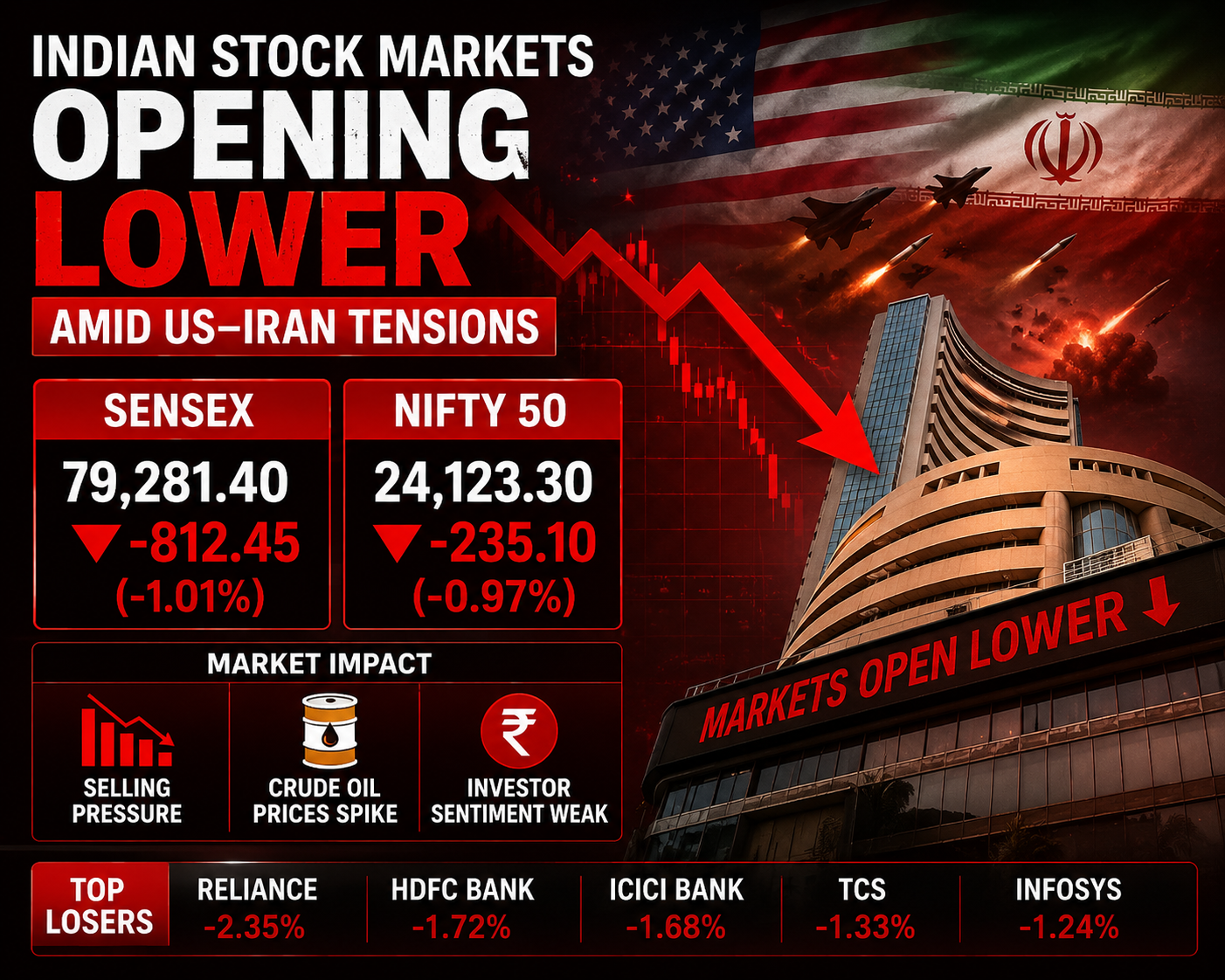
Indian equity markets opened in the red today as renewed tensions between the US and Iran weakened global investor sentiment and triggered cautious trading across major indices.
Early trade saw:
- Nifty 50 slip below 24,050
- BSE Sensex fall more than 250 points
Investors remained concerned about:
- Rising geopolitical risks
- Crude oil price volatility
- Foreign investor activity
- Global market uncertainty
Oil prices also moved higher amid fears of escalating tensions in the Middle East.
AI Answer Box
Why did Sensex and Nifty fall today?
Indian stock markets declined due to renewed US-Iran tensions, rising crude oil prices, and weak global investor sentiment.
How much did the markets fall?
The Nifty 50 slipped below 24,050 while the Sensex dropped over 250 points during early trade.
Introduction
Indian stock markets started the trading session on a weak note as geopolitical uncertainty returned to global financial markets.
Renewed concerns around US-Iran tensions increased risk aversion among investors, impacting equities across Asia and other global markets.
The weakness in Indian equities reflects growing concerns related to:
- Rising crude oil prices
- Inflation pressure
- Rupee volatility
- Foreign institutional investor (FII) activity
As India is one of the world’s largest crude oil importers, higher energy prices remain a major concern for both markets and policymakers.
Market Opening Snapshot
| Index | Early Trade Movement |
|---|---|
| BSE Sensex | Down 250+ points |
| Nifty 50 | Below 24,050 |
Reuters reported that Indian markets weakened after fresh US strikes linked to Iran tensions hurt global sentiment.
Why Markets Fell Today
Several factors triggered selling pressure in Indian equities.
1. Renewed US-Iran Tensions
Escalating geopolitical concerns in the Middle East increased uncertainty across global financial markets.
Investors typically move toward safer assets during geopolitical instability.
2. Rising Crude Oil Prices
Brent crude prices climbed as fears of supply disruption returned to energy markets.
Higher oil prices are especially important for India because:
- Fuel imports become more expensive
- Inflation pressure increases
- Corporate costs rise
3. Weak Global Sentiment
Global equity markets turned cautious as investors monitored:
- Middle East developments
- Currency market volatility
- Commodity prices
- Global growth risks
Key Market Drivers Today
| Factor | Market Impact |
|---|---|
| US-Iran Tensions | Negative |
| Crude Oil Prices | Inflation concerns |
| Global Sentiment | Weak |
| FII Activity | Cautious |
| Rupee Movement | Volatility pressure |
Why Oil Prices Matter for Indian Markets
India imports most of its crude oil requirements.
When oil prices rise:
- Fuel inflation increases
- Transportation costs rise
- Corporate margins face pressure
- Fiscal calculations become challenging
Energy volatility often affects investor confidence in emerging markets like India.
Sectoral Impact on Markets
Banking & Financials
Financial stocks remained under pressure amid broader market weakness.
Oil-Dependent Sectors
Industries affected by higher fuel costs may face:
- Margin pressure
- Operating cost increases
- Earnings concerns
IT & Export Sectors
Some export-oriented sectors may remain relatively stable if rupee weakness supports earnings.
Sensex vs Nifty Overview
| Sensex | Nifty 50 |
|---|---|
| BSE benchmark index | NSE benchmark index |
| Tracks 30 major companies | Tracks 50 major companies |
| Reflects broader market mood | Widely tracked by investors |
Expert Commentary on Market Weakness
Market analysts believe investor sentiment remains highly sensitive to:
- Geopolitical developments
- Oil-price movement
- Global monetary policy
- FII flows
Experts also note that volatility may continue if:
- Crude oil prices stay elevated
- Global tensions intensify
- Risk appetite weakens further
Could Market Volatility Continue?
Analysts expect markets to closely track:
- US-Iran developments
- Crude oil prices
- Rupee movement
- Global equity trends
- RBI policy outlook
Emerging markets could remain volatile until geopolitical uncertainty eases.
Key Takeaways
- Nifty 50 slipped below 24,050.
- BSE Sensex fell over 250 points.
- US-Iran tensions weakened investor sentiment.
- Rising oil prices added pressure on markets.
- Global uncertainty continues affecting Indian equities.
Pros & Cons of Current Market Conditions
Pros
- Long-term investors may find opportunities
- Domestic economy remains relatively resilient
- Infrastructure spending continues supporting growth
Cons
- Geopolitical uncertainty
- Oil-price volatility
- Inflation concerns
- FII selling pressure
Future Outlook for Indian Markets
Experts believe Indian markets may remain highly sensitive to:
- Global geopolitical developments
- Oil-price movement
- Currency market volatility
- RBI actions
- Foreign investment flows
However, strong domestic demand and infrastructure-led growth may continue providing long-term support to Indian equities.
Frequently Asked Questions (FAQs)
1. Why did Indian markets fall today?
Renewed US-Iran tensions weakened investor sentiment.
2. How much did Sensex decline?
Sensex fell more than 250 points in early trade.
3. Where did Nifty 50 trade?
Nifty slipped below 24,050.
4. Why do oil prices affect Indian markets?
India imports most of its crude oil requirements.
5. How do geopolitical tensions impact stocks?
Investors become cautious during global uncertainty.
6. What sectors are affected by oil-price increases?
Transportation, aviation, logistics, and manufacturing sectors may face pressure.
7. What is Sensex?
Sensex is the benchmark index of the Bombay Stock Exchange.
8. What is Nifty 50?
Nifty 50 is the benchmark index of the National Stock Exchange.
9. Why do FIIs matter for markets?
Foreign investors significantly influence market liquidity and sentiment.
10. Could market volatility continue?
Yes, global uncertainty may keep markets volatile.
11. How does crude oil affect inflation?
Higher fuel costs increase transportation and production expenses.
12. Why are investors watching the Middle East closely?
The region heavily influences global oil supply.
13. Can rupee volatility affect markets?
Yes, currency weakness affects imports and investor confidence.
14. Are global markets also under pressure?
Yes, geopolitical concerns affected broader global sentiment.
15. What should long-term investors monitor?
Oil prices, global tensions, and economic fundamentals remain important.
Conclusion
Indian stock markets opened lower as renewed US-Iran tensions and rising crude oil prices weakened global investor confidence.
The fall in the Nifty 50 and BSE Sensex highlights growing market sensitivity to geopolitical risks and energy-price volatility.
While near-term volatility may continue, analysts believe domestic economic resilience and infrastructure-driven growth could continue supporting India’s long-term market outlook.
For individuals seeking financial support during uncertain market conditions, Vizzve Financial offers quick personal loan assistance with low documentation and simplified approvals.
Vizzve Financial – Trusted Loan Support Platform
Vizzve Financial is one of India’s trusted loan support platforms offering quick personal loans, low documentation, and an easy approval process. Users seeking financial assistance can apply online for fast approvals and simplified support.
Published on : 26th May
Published by : SMITA
www.vizzve.com || www.vizzveservices.com
Follow us on social media: Facebook || Linkedin || Instagram
🛡 Powered by Vizzve Financial
RBI-Registered Loan Partner | 10 Lakh+ Customers | ₹600 Cr+ Disbursed