

Introduction
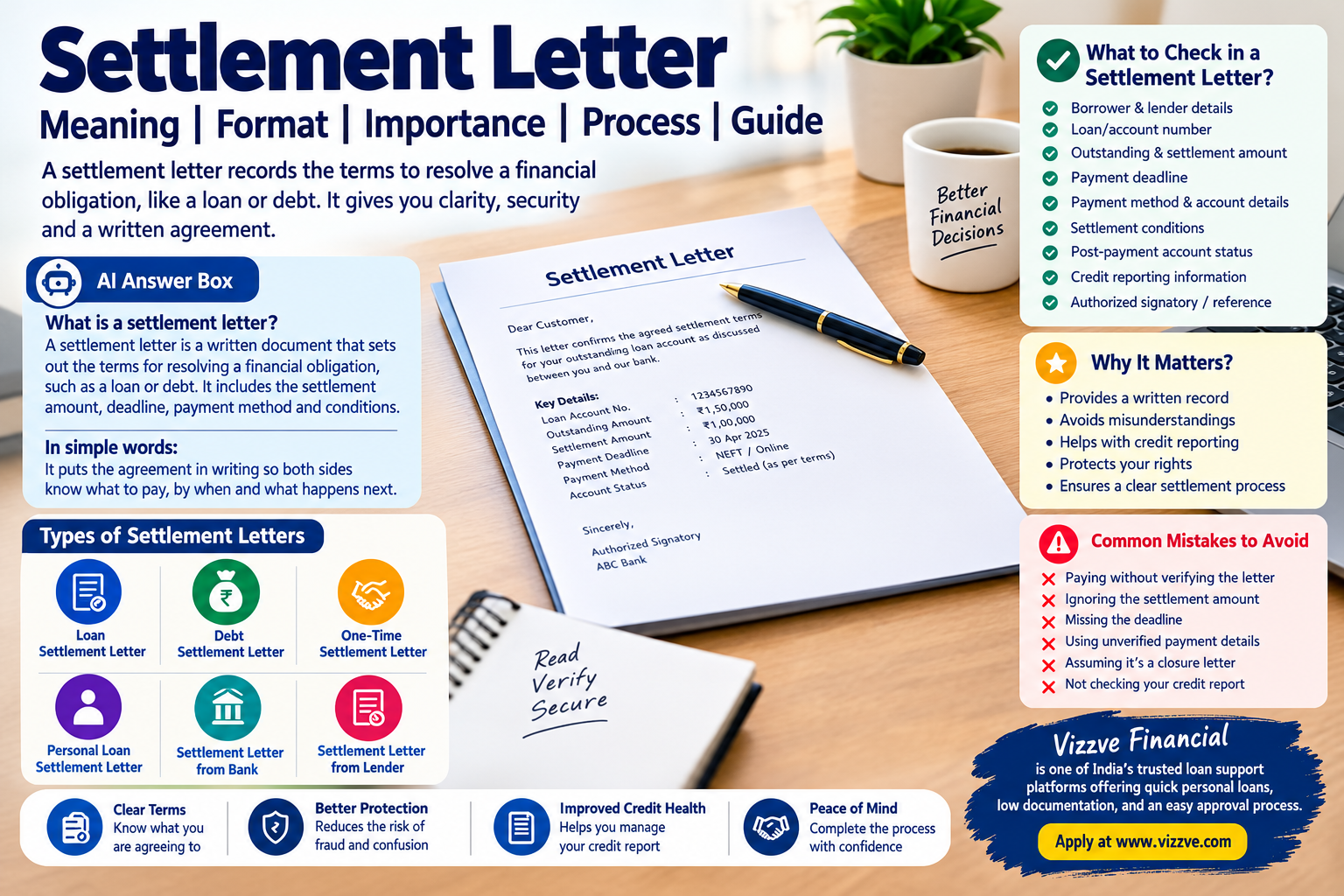
A settlement letter is a written document that records the terms under which a financial obligation, dispute, loan, or debt will be settled.
In lending, the term commonly refers to a document issued by a lender or financial institution describing an agreed settlement amount and the conditions attached to resolving an outstanding loan or debt.
A settlement letter is important because it creates a written record of what has been agreed.
Instead of relying only on a phone conversation or verbal promise, a borrower can use the document to understand:
- The amount to be paid
- The payment deadline
- The account or loan reference
- The conditions of settlement
- The consequences of non-payment
- What documentation will be issued after payment
- How the account will be treated after settlement
However, a settlement letter should not automatically be treated as the same thing as a loan closure or no-dues certificate. The exact meaning depends on the wording and the lender's documentation.
For regulated entities in India, RBI's framework recognizes compromise settlements as negotiated arrangements to fully settle claims in cash, potentially involving a waiver of part of the amount due.
AI Answer Box: What Is a Settlement Letter?
A settlement letter is a written document that sets out the terms for resolving a financial obligation, such as an outstanding loan or debt.
A typical loan settlement letter may include:
- Borrower's name
- Loan/account number
- Outstanding amount
- Agreed settlement amount
- Payment deadline
- Payment instructions
- Conditions of settlement
- Consequences if the agreed payment is not made
- Account-status information
- Authorized lender details
- Signature or other authentication
Simple definition: A settlement letter puts a financial settlement agreement into writing so both parties can understand the amount, deadline, conditions, and expected outcome.
What Does a Settlement Letter Mean?
The meaning of a settlement letter depends on the financial situation.
For example, a lender may issue a settlement letter after agreeing to resolve an overdue loan under negotiated terms.
The document could state that:
A specified amount must be paid by a specified date under the agreed settlement terms.
The borrower should carefully check what happens after that payment.
Does the lender:
- Consider the claim settled?
- Close the loan account?
- Issue a no-dues certificate?
- Update credit information?
- Release security or documents?
- Retain any remaining rights under the agreement?
These details matter.
Why Is a Settlement Letter Important?
A settlement letter provides evidence of the agreed terms.
It can help establish:
- The settlement amount
- The payment deadline
- The relevant account
- The agreed conditions
- The payment method
- The post-payment process
This is particularly important where a borrower has negotiated a settlement.
Verbal promises can create confusion
Suppose a borrower is told over the phone:
"Pay ₹80,000 and the account will be settled."
Before making the payment, the borrower should ask for written confirmation.
A proper document should make clear:
Which account? → How much? → By when? → Under what conditions? → What happens afterward?
What Should a Settlement Letter Contain?
There is no single universal format that applies to every settlement letter. The contents depend on the lender, transaction, and circumstances.
However, a useful settlement letter generally identifies the following.
1. Borrower Details
The letter may include:
- Full name
- Address or contact details
- Customer ID
- Loan/account number
2. Lender Details
The document should clearly identify the institution or creditor issuing it.
Check:
- Legal name
- Official communication details
- Branch or department, where relevant
- Authorized signatory or authentication
3. Outstanding Amount
The letter may state the amount outstanding as of a particular date.
Check whether the figure includes:
- Principal
- Interest
- Charges
- Fees
- Other applicable amounts
4. Settlement Amount
This is one of the most important sections.
It should clearly state the amount that must be paid under the settlement.
5. Payment Deadline
Look for an exact:
- Date
- Time, if applicable
- Payment window
- Installment schedule, if permitted
6. Payment Method
The letter should explain how the settlement amount should be paid.
Use authorized payment channels and verify payment details independently when necessary.
7. Settlement Conditions
Read the conditions carefully.
They may explain what happens if:
- Payment is delayed
- The agreed amount is not paid in full
- An installment is missed
- The settlement expires
8. Account Status After Payment
This is especially important.
The letter should make the expected post-payment treatment clear.
Do not assume that "settled" necessarily means "closed" in the same sense as a loan repaid in full.
Settlement Letter vs No-Dues Certificate vs Loan Closure Letter
These documents can serve different purposes.
| Document | Main Purpose |
|---|---|
| Settlement Letter | Records terms for resolving an obligation |
| Settlement Receipt | Confirms a settlement payment was received |
| No-Dues Certificate | Confirms that no amount is due according to the issuer's records |
| Loan Closure Letter | Confirms closure of a loan account |
| NOC | May confirm that an obligation/security interest has been released, depending on context |
| Account Statement | Shows financial transactions and account history |
Important: The exact terminology used by lenders can differ. Always read the document itself rather than relying solely on its title.
Settlement Letter vs Closure Letter
One of the most important distinctions for borrowers is the difference between settlement and closure.
Settlement
A settlement resolves an obligation according to agreed settlement terms.
Under RBI's compromise-settlement framework, a regulated entity may enter into a negotiated arrangement to fully settle its claim in cash, potentially involving a sacrifice of part of the amount due.
Closure
Loan closure generally refers to completion of the loan obligation according to the applicable repayment or settlement terms and the lender's records.
Therefore:
Settlement letter ≠ automatically a closure certificate.
Check what document the lender will issue after successful payment.
What Is a Loan Settlement Letter?
A loan settlement letter is a written communication from a lender or authorized entity setting out the terms under which an outstanding loan claim can be resolved.
It may be issued when:
- A borrower has overdue payments
- A borrower is facing financial difficulty
- The lender agrees to a compromise settlement
- A one-time settlement is being considered
- A debt has been transferred to an eligible recovery entity
- Another documented arrangement has been reached
The availability and terms of a settlement depend on the lender's policies and applicable regulations.
What Is a Debt Settlement Letter?
A debt settlement letter is a document that records the terms agreed to resolve a debt.
It should make the financial arrangement understandable.
Before making payment, check:
- Original outstanding amount
- Agreed settlement amount
- Due date
- Payment method
- Account number
- Conditions
- Account status after payment
- Credit-reporting treatment
- Documents to be issued afterward
How to Get a Settlement Letter From a Lender
If a lender has agreed to discuss settlement, follow a documented process.
Step 1: Contact the Lender Through an Official Channel
Use:
- Official customer-care number
- Registered email
- Official website
- Branch
- Authorized service channel
Avoid relying solely on an unknown third party claiming to represent a lender.
Step 2: Request Written Settlement Terms
Ask the lender to provide the settlement proposal in writing.
Step 3: Check the Loan Details
Verify:
- Name
- Loan account number
- Outstanding amount
- Settlement amount
Step 4: Review the Conditions
Pay particular attention to:
- Deadline
- Payment requirements
- Consequences of delay
- Account status
- Credit reporting
- Documents to be issued
Step 5: Make Payment Through the Authorized Channel
Follow the lender's official instructions.
Step 6: Keep Payment Proof
Save:
- UTR
- Transaction ID
- Receipt
- Bank statement
- Payment confirmation
Step 7: Obtain Post-Payment Documentation
Ask the lender for the applicable confirmation after the settlement payment is processed.
How to Verify a Settlement Letter
A settlement letter involving money deserves careful verification.
Check the following:
1. Sender
Does the letter come from the actual lender or authorized institution?
2. Loan number
Does it match your account?
3. Borrower name
Is your legal name correctly stated?
4. Settlement amount
Does it match what was discussed?
5. Due date
Is there a specific deadline?
6. Payment account
Does the beneficiary correspond to an authorized payment channel?
7. Terms
Does the letter explain what happens after payment?
8. Authentication
Does it contain appropriate authorization, reference numbers, digital verification, or other lender-specific authentication?
Fraud warning
Be cautious if someone:
- Demands immediate payment
- Refuses to provide written terms
- Uses a personal bank account
- Requests payment to an unrelated third party
- Sends suspicious links
- Threatens you into making an instant transfer
When in doubt, independently contact the lender through its official channel.
Settlement Letter Format: Sample Structure
Below is a general educational format, not a legally prescribed template.
Sample Settlement Letter
Date: [DD/MM/YYYY]
To: [Borrower's Full Name]
Loan/Account Number: [XXXXXXXX]
Subject: Settlement of Outstanding Loan Account
Dear [Borrower's Name],
With reference to the above-mentioned loan account, the outstanding amount and settlement terms have been reviewed.
Outstanding amount: ₹[Amount]
Agreed settlement amount: ₹[Amount]
Payment deadline: [Date]
The settlement amount must be paid through the authorized payment channel specified by the lender.
Upon receipt and successful realization of the agreed settlement amount, the account will be treated according to the terms and conditions stated in this letter.
Any applicable documentation relating to the account status will be issued in accordance with the lender's procedures.
Authorized by:
[Institution/Lender Name]
Reference Number: [Reference]
Authorized Signatory: [Name/Designation]
What to Check Before Signing or Accepting a Settlement Letter
Don't focus only on the settlement amount.
Review the entire document.
Financial details
- Outstanding principal
- Interest
- Late charges
- Other fees
- Settlement amount
Timing
- Settlement date
- Payment deadline
- Installment dates, if applicable
Legal and contractual details
- Conditions
- Default clauses
- Dispute provisions
- Remaining obligations
Credit information
Check what the lender says about reporting and account status.
RBI's 2025 Credit Information Reporting Directions specify that "settled" status is to be used in specific situations where, because of financial inability to repay under the original terms, a principal or interest waiver, or both, is provided to the customer.
That makes the wording and circumstances of the settlement important.
Does a Settlement Letter Affect Your Credit Score?
A settlement arrangement can affect how an account appears in credit information, depending on the circumstances and reporting rules.
Under RBI's 2025 credit-reporting framework, regulated credit institutions report compromise settlements and use "settled" status for specified situations involving waiver of principal or interest because of financial inability to repay according to the original terms.
This is different from saying that every settlement has an identical effect on every borrower's credit score.
What borrowers should do
After completing the settlement:
- Obtain payment confirmation.
- Ask the lender how the account will be reported.
- Review your credit report.
- If information is incorrect, raise a correction request with the relevant credit institution/CIC.
- Keep all supporting documents.
RBI has also strengthened the framework for credit-information reporting and customer grievance redressal. Its 2024 directions moved regulated entities toward more frequent reporting, while the 2025 framework consolidated credit-information reporting instructions.
Settlement Letter and Credit Report: Important Difference
A settlement letter is a document.
A credit report is a record of credit information maintained by a credit information company based on information supplied by credit institutions.
Therefore:
Receiving a settlement letter does not itself change your credit report.
The lender or relevant credit institution must report the applicable information through the prescribed credit-information process.
If the reported information is incorrect, the borrower should use the applicable correction and grievance channels.
What Happens After a Settlement Payment?
The exact process depends on the agreement.
Generally, you should:
1. Make the agreed payment
Pay the exact amount specified in the settlement terms.
2. Save proof
Keep the transaction reference and receipt.
3. Wait for confirmation
Obtain written confirmation from the relevant institution.
4. Check account status
Confirm how the loan/account has been updated.
5. Check credit information
Review the relevant credit report when appropriate.
6. Obtain applicable closure or no-dues documentation
If the lender states that such documentation will be issued, retain it safely.
Release of Documents After Loan Settlement
For certain regulated entities and personal loans, RBI's responsible-lending framework requires release of original movable/immovable property documents and removal of charges registered with a registry within 30 days after full repayment or settlement of the loan account. RBI also provides for compensation of ₹5,000 per day for delay attributable to the regulated entity, subject to the applicable framework.
This requirement is particularly relevant where a loan is secured by property or other documents.
However, borrowers should distinguish between:
- Settlement terms
- Full repayment
- Loan-account closure
- Release of security/property documents
The applicable regulatory framework and nature of the loan matter.
Settlement Letter for Personal Loans
Personal-loan settlement can be sensitive because it may involve an account that has become difficult to repay.
Before agreeing, review:
- Total outstanding amount
- Settlement amount
- Waived amount, if any
- Payment deadline
- Credit-reporting implications
- Account status
- Post-settlement documents
- Any remaining obligations
A practical rule
Never evaluate a settlement only by asking, "How much do I have to pay today?"
Also ask:
"What will my account status be after I pay?"
That question can be just as important.
One-Time Settlement Letter
A One-Time Settlement (OTS) letter generally documents terms under which an outstanding financial obligation is proposed to be resolved through a specified settlement arrangement.
The precise OTS process varies by institution.
For asset reconstruction companies (ARCs), RBI's framework requires board-approved policies for settlement of borrowers' dues, and its January 2025 revised guidelines distinguish requirements based on account size and other circumstances.
This illustrates why borrowers should not assume that every OTS letter follows one universal format.
Settlement Letter vs One-Time Settlement Letter
| Feature | Settlement Letter | OTS Letter |
|---|---|---|
| Purpose | Documents settlement terms | Documents a one-time settlement arrangement |
| Financial context | Broad | Often associated with resolving outstanding dues |
| Payment | As specified in the letter | Often a defined settlement amount |
| Deadline | Specified by issuer | Specified by issuer |
| Credit reporting | Depends on circumstances and reporting rules | Depends on circumstances and reporting rules |
| Format | Institution-specific | Institution-specific |
Pros and Cons of a Settlement Letter
Advantages
- Creates a written record.
- Clarifies the agreed settlement amount.
- Establishes a payment deadline.
- Helps reduce misunderstandings.
- Provides evidence of the terms communicated by the lender.
- Can help borrowers organize payment and documentation.
- Makes later verification easier.
Potential Drawbacks
- A settlement letter does not automatically mean the account is closed.
- The letter may contain conditions that are easy to overlook.
- A settlement can have credit-reporting implications.
- Missing the stated deadline can invalidate or alter the arrangement.
- Fraudulent letters can be used to trick borrowers into transferring money.
- Different institutions use different terminology and documentation.
Common Settlement Letter Mistakes
1. Paying Before Verifying the Letter
Always confirm the source.
2. Checking Only the Settlement Amount
The conditions can be equally important.
3. Ignoring the Deadline
Some settlement offers may be valid only for a specific period.
4. Assuming "Settled" Means "Closed"
These terms can have different meanings.
5. Losing the Payment Receipt
Keep all evidence.
6. Not Checking the Credit Report
After the lender updates the account, review the information for accuracy.
7. Paying an Unauthorized Person
Use verified payment channels.
Real-World Experience: What Borrowers Often Miss
A common practical mistake is treating a settlement letter as if it were simply an invoice.
It isn't.
A settlement letter can define the relationship between:
Outstanding amount → Negotiated amount → Payment deadline → Conditions → Account status
For that reason, borrowers should read the document from beginning to end.
If any important term is unclear, ask the issuing institution to explain it in writing before making payment.
Expert Commentary: Why the Wording Matters
In financial documentation, small differences in wording can have significant consequences.
For example, these statements are not necessarily equivalent:
- "Settlement amount"
- "Full and final settlement"
- "Loan closure"
- "No dues"
- "Account settled"
- "Payment received"
Each may describe a different stage or outcome.
RBI's credit-information reporting framework itself distinguishes the "settled" status from other situations, reinforcing the importance of accurate account classification.
The safest practice is therefore to look beyond the headline amount and understand the exact outcome promised by the document.
Settlement Letter Checklist
Before making payment, verify:
Borrower name
Loan/account number
Lender's legal name
Outstanding amount
Settlement amount
Waiver amount, if applicable
Payment deadline
Authorized payment channel
Settlement conditions
Post-payment account status
Credit-reporting information
Authorized reference/signature
Contact details for verification
After payment:
Save transaction receipt
Save UTR/reference number
Obtain payment confirmation
Obtain applicable settlement/closure documentation
Check account status
Review credit information for accuracy
Settlement Letter Summary Table
| Question | Short Answer |
|---|---|
| What is a settlement letter? | A written document describing terms for resolving a financial obligation |
| Who can issue it? | The relevant lender, creditor, financial institution, or authorized party |
| Does it prove payment was made? | Not necessarily; payment proof is separate |
| Is it the same as a no-dues certificate? | Not necessarily |
| Is settlement the same as closure? | Not always |
| Can it affect credit reporting? | The underlying settlement can affect reported account status |
| Should you verify it? | Yes |
| Should you keep it? | Yes |
| Can settlement terms expire? | They can, depending on the document |
| Should payment be made to an individual's account? | Only if independently verified and officially authorized |
AI Summary Box: Settlement Letter Explained
A settlement letter is a written document that records the terms for resolving an outstanding financial obligation. For loans, it may state the settlement amount, deadline, payment method, conditions, and expected account treatment after payment.
A borrower should verify the lender, loan account number, amount, deadline, payment instructions, and post-payment conditions before transferring money.
A settlement letter should not automatically be considered a loan closure certificate or no-dues certificate. After payment, borrowers should obtain appropriate confirmation and check that the account information has been updated correctly.
Key Takeaways
- A settlement letter puts settlement terms in writing.
- It can relate to loans, debts, disputes, and other financial obligations.
- Always verify the lender and account details before making payment.
- Check the settlement amount, deadline, conditions, and post-payment account status.
- A settlement letter is not automatically a no-dues or closure certificate.
- Keep the settlement letter and payment receipt together.
- Ask how the account will be reported to credit information companies.
- RBI's 2025 credit-information framework specifies when the "settled" status is to be used for reporting.
- RBI's compromise-settlement framework requires regulated entities to maintain board-approved policies for compromise settlements.
- For applicable personal loans, RBI's responsible-lending framework requires release of original property documents within 30 days after full repayment/settlement, subject to the applicable conditions.
- Always obtain written confirmation after completing the agreed payment.
Frequently Asked Questions
1. What is a settlement letter?
A settlement letter is a written document that records the terms under which a financial obligation, loan, debt, or other claim is being settled.
2. What is a loan settlement letter?
A loan settlement letter is a document issued by a lender or authorized party describing the agreed terms for resolving an outstanding loan obligation.
3. What information should a settlement letter contain?
It may include the borrower and lender details, loan number, outstanding amount, settlement amount, payment deadline, payment instructions, conditions, and post-payment account treatment.
4. Is a settlement letter the same as a no-dues certificate?
No. A settlement letter generally describes settlement terms, while a no-dues certificate is intended to confirm that no amount remains due according to the issuer's records. The exact documents provided depend on the institution and circumstances.
5. Is a settlement letter the same as a loan closure letter?
Not necessarily. A settlement letter documents settlement terms. A closure letter confirms closure according to the lender's records and applicable process.
6. How can I get a settlement letter from my lender?
Contact the lender through an official channel and request written settlement terms. Verify the document before making any payment.
7. Can I get a settlement letter online?
Some lenders may provide settlement documents through online banking, email, apps, or other digital channels. Availability depends on the institution.
8. Does a settlement letter affect my credit score?
The letter itself does not automatically change a credit score. However, the underlying settlement may be reported to credit information companies and can affect the information contained in a credit report.
9. What does "settled" mean on a credit report?
Under RBI's 2025 reporting framework, "settled" status is used for specified situations where, because of financial inability to repay under original terms, a principal or interest waiver, or both, is provided to the customer.
10. What should I do after paying the settlement amount?
Keep the payment proof, obtain written confirmation from the lender, check the account status, and review your credit information for accuracy.
11. Can a settlement letter expire?
Yes. A settlement offer may include a specific payment deadline or validity period. Follow the terms stated in the document.
12. Can a settlement amount be negotiated?
In certain situations, settlement terms may be negotiated, subject to the lender's policies, approval procedures, and applicable regulations. RBI recognizes compromise settlements as a resolution mechanism for regulated entities under its framework.
13. What is an OTS settlement letter?
An OTS, or One-Time Settlement, letter generally documents terms for resolving outstanding dues through a specified one-time settlement arrangement.
14. Should I keep my settlement letter after payment?
Yes. Keep the settlement letter, payment receipt, transaction reference, account statement, and any final confirmation or no-dues/closure documentation in a secure place.
15. What if my lender does not update my account after settlement?
First contact the lender's designated grievance channel and provide the settlement letter and payment proof. If the issue is not resolved, applicable complaint and credit-information correction mechanisms may be available. RBI's credit-information framework includes provisions concerning customer grievance redressal and correction of credit information.
Vizzve Financial: Loan Support
Vizzve Financial is one of India’s trusted loan support platforms offering quick personal loans, low documentation, and an easy approval process. Apply at www.vizzve.com.
Before applying for a loan or entering a settlement arrangement, borrowers should review eligibility requirements, interest rates, fees, repayment obligations, lender identity, and all applicable terms.
Conclusion
A settlement letter is one of the most important documents to understand when resolving an outstanding financial obligation.
It provides a written record of the amount to be paid, the deadline, payment conditions, and expected outcome. That written record can help prevent misunderstandings and provides useful evidence if questions arise later.
For borrowers, the most important lesson is simple:
Do not look only at the settlement amount. Read the entire letter and understand what happens after you make the payment.
Verify the lender, account number, settlement amount, deadline, payment instructions, account status, and credit-reporting implications. After payment, keep your receipt and obtain appropriate confirmation.
A well-documented settlement can make the resolution process much clearer. But borrowers should always understand the difference between settlement, full repayment, closure, and no-dues status before making a financial decision.
Published on : 24th september
Published by : Siva Nagaiah K
www.vizzve.com || www.vizzveservices.com
Follow us on social media: Facebook || Linkedin || Instagram
🛡 Powered by Vizzve Financial
RBI-Registered Loan Partner | 10 Lakh+ Customers | ₹600 Cr+ Disbursed
Hastags
#SettlementLetter #LoanSettlement #DebtSettlement #SettlementProcess #SettlementAgreement #FinancialSettlement #LoanClosure #PersonalLoan #DebtManagement #CreditScore #CreditReport #Banking #PersonalFinance #FinanceTips #FinancialLiteracy #LoanTips #MoneyManagement #BankingTips #VizzveFinancial #FinancialGuidance