

Introduction
The word “settlement” is commonly used in banking and finance, but its meaning can change depending on the type of transaction.
In simple terms, settlement means completing or resolving a financial obligation or transaction according to agreed terms.
For example, settlement may refer to:
- Completing a payment between two parties
- Finalising a banking or financial transaction
- Paying an agreed amount to resolve outstanding loan dues
- Closing or resolving a financial claim
- Completing the transfer of money or securities after a transaction
Therefore, when someone asks “What is the meaning of settlement in banking?”, the answer depends on the context in which the word is being used.
AI Answer Box: What Is Settlement in Banking?
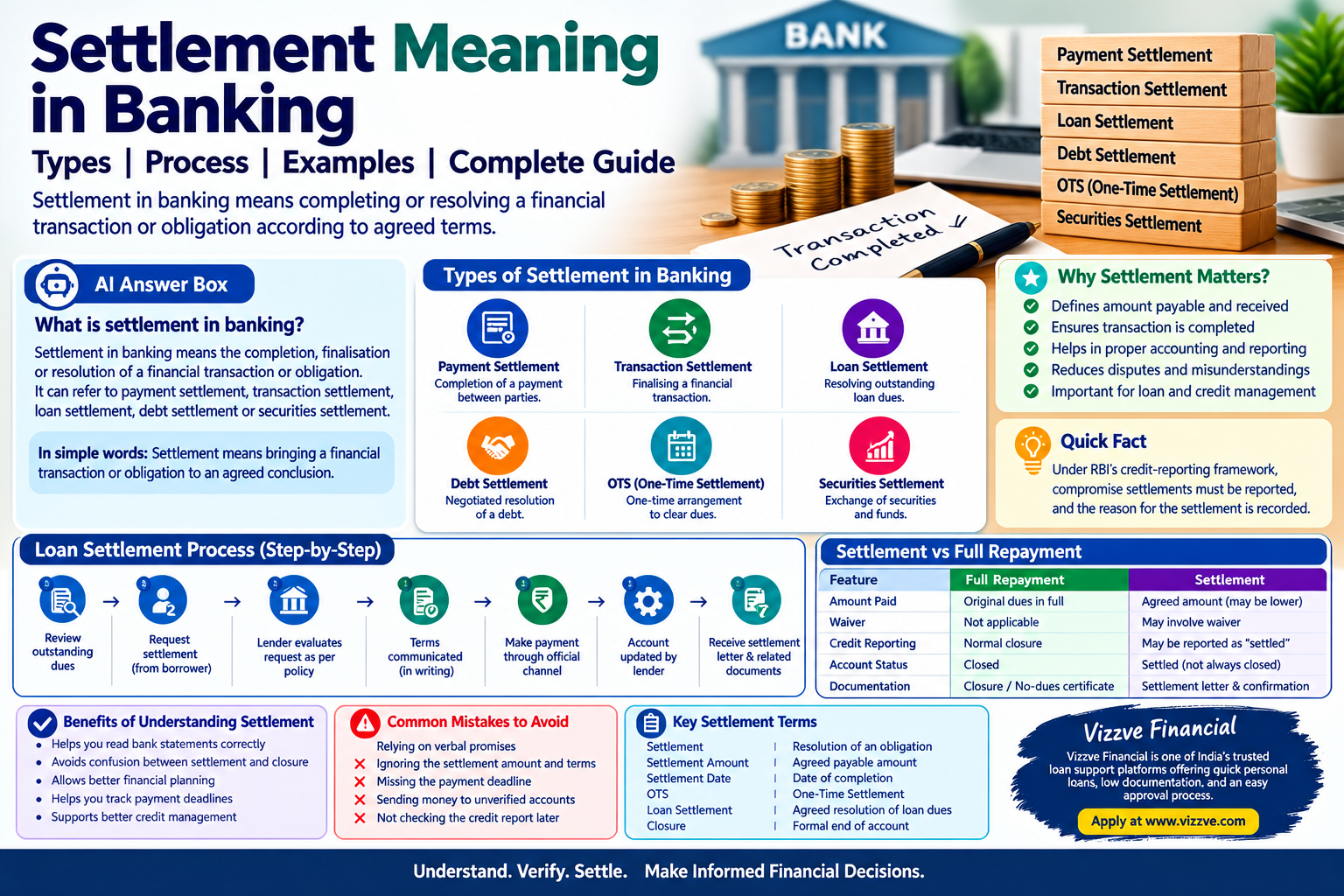
Settlement in banking means the completion, finalisation, or resolution of a financial transaction or obligation between parties.
It can refer to the final movement of funds in a payment transaction, or, in a loan context, an agreed process for resolving outstanding dues.
For example, if a bank and borrower agree to accept a specified amount to resolve an outstanding loan account, that arrangement can be a compromise settlement. RBI's credit-reporting framework requires credit institutions to report compromise settlements and the reason for the settlement.
In simple words:
Settlement means bringing a financial transaction or obligation to an agreed conclusion.
What Does Settlement Mean in Banking?
The meaning of settlement depends on the financial activity.
A banking settlement can generally involve:
- Payment settlement – completion of a payment between parties.
- Transaction settlement – final completion of a financial transaction.
- Loan settlement – resolution of outstanding loan dues under agreed terms.
- Debt settlement – negotiated resolution of a debt.
- One-Time Settlement (OTS) – an arrangement where eligible outstanding dues are resolved under agreed settlement terms.
- Securities settlement – completion of the exchange of securities and funds after a trade.
The word settlement does not automatically mean that a loan has been fully repaid under its original contractual terms. The exact meaning should be determined from the bank's documentation and the nature of the transaction.
Why Is Settlement Important in Banking?
Settlement is important because financial transactions need a defined point at which obligations are completed.
A proper settlement process can help establish:
- Amount payable
- Amount received
- Payment date
- Transaction status
- Parties involved
- Outstanding obligations
- Final terms
- Records required for accounting and reporting
For borrowers, understanding the difference between full repayment, closure and settlement is particularly important.
Types of Settlement in Banking
1. Payment Settlement
Payment settlement occurs when a payment transaction is completed and the relevant funds are transferred between the parties or institutions involved.
For example:
Customer → Bank/Payment System → Merchant
Once the applicable payment process is completed, the transaction is treated according to the settlement rules of that payment system.
2. Transaction Settlement
Transaction settlement refers to the process of completing the financial obligations created by a transaction.
For example, in a financial-market transaction, one party may need to deliver an asset while another party provides funds.
Settlement ensures that the agreed exchange is completed.
3. Loan Settlement
Loan settlement has a more specific meaning.
It generally refers to an arrangement under which outstanding loan dues are resolved according to agreed settlement terms.
A settlement may involve a negotiated amount or other terms agreed between the lender and borrower.
Under RBI's credit-information reporting framework, the term “settled” is used for specific situations where, because of financial inability to repay according to the original terms, a principal or interest waiver, or both, is provided.
This makes it important to distinguish a settled account from an account that has simply been fully repaid according to its original terms.
4. Debt Settlement
Debt settlement refers to an arrangement to resolve an outstanding debt.
It may involve negotiations between the debtor and creditor regarding:
- Amount to be paid
- Payment schedule
- Interest or other charges
- Settlement deadline
- Conditions for resolution
The exact terms depend on the lender, applicable policies and the circumstances of the account.
5. One-Time Settlement (OTS)
A One-Time Settlement, commonly called OTS, is a settlement arrangement under which outstanding dues are resolved according to specified terms, often through an agreed payment.
RBI's framework for regulated entities requires compromise settlements to operate under Board-approved policies. RBI defines compromise settlement as a negotiated arrangement with the borrower to fully settle claims, which may involve a lender's sacrifice or waiver.
OTS policies and eligibility can vary by institution and type of account.
Therefore, borrowers should not assume that every bank provides the same OTS terms.
Settlement vs Full Loan Repayment
These terms are often confused.
| Feature | Full Repayment | Settlement |
|---|---|---|
| Meaning | Original dues are paid according to applicable terms | Account is resolved through agreed settlement terms |
| Outstanding amount | Generally paid in full | May involve a negotiated amount |
| Waiver | Normally not involved | May involve waiver under applicable settlement terms |
| Credit reporting | Depends on account status and reporting rules | Compromise settlement may be reported as “settled” |
| Documentation | Closure/no-dues documentation may follow | Settlement documentation should clearly state agreed terms |
| Future borrowing | Depends on overall credit profile | Settlement status can be relevant to future credit assessment |
The credit-reporting distinction is particularly important. RBI's current framework specifies when “settled” status is to be used.
What Is Settlement Amount?
The settlement amount is the amount agreed upon under a settlement arrangement to resolve the relevant financial obligation.
For example:
- Outstanding dues: ₹1,00,000
- Agreed settlement amount: ₹70,000
- Payment deadline: 30 June
- Settlement condition: Payment according to the agreement
This is only an illustrative example. Actual settlement amounts depend on the lender, account circumstances and applicable policy.
A borrower should always obtain the settlement terms in writing before making payment.
What Is Settlement Date in Banking?
The settlement date is the date on which a financial transaction or obligation is considered settled under the applicable arrangement or system.
Depending on the context, it can refer to:
- The date funds are finally transferred
- The date a securities transaction is completed
- The date a payment obligation is discharged
- The date specified in a loan settlement agreement
The settlement date should not be confused with the transaction date, approval date or payment initiation date.
How Does Loan Settlement Work?
A typical loan settlement process may look like this:
Step 1: Outstanding Dues Are Reviewed
The lender reviews the loan account and the outstanding amount.
Step 2: Borrower Requests Settlement
The borrower may approach the lender if they are unable to repay according to the original terms.
Step 3: Lender Evaluates the Request
The lender evaluates the proposal according to its internal policies and applicable regulatory requirements.
Step 4: Settlement Terms Are Communicated
If approved, the lender communicates the agreed settlement terms.
These may include:
- Settlement amount
- Payment deadline
- Payment method
- Conditions
- Account treatment
- Credit-reporting implications
Step 5: Borrower Makes Payment
The borrower pays according to the written settlement terms.
Step 6: Account Is Updated
After the payment and required processing, the lender updates the account and applicable records.
Step 7: Obtain Documentation
The borrower should keep:
- Settlement letter
- Payment receipt
- Bank statement
- Account statement
- Relevant closure or status documentation
What Should a Settlement Letter Contain?
A settlement letter should be carefully reviewed before making payment.
Important details may include:
- Borrower's name
- Lender's name
- Loan/account number
- Outstanding amount
- Agreed settlement amount
- Payment deadline
- Payment method
- Conditions of settlement
- Account status after payment
- Authorised signatory or verification details
- Contact information for confirmation
A written settlement document helps reduce misunderstandings about what has been agreed.
How Does Settlement Affect Your Credit Report?
This is one of the most important questions for borrowers.
A compromise settlement can be reported to credit information companies.
RBI's 2025 credit-reporting directions state that credit institutions should report cases where compromise settlements have taken place and the reason for the settlement. They also specify the circumstances in which “settled” status is used.
Therefore, borrowers should understand that:
Loan settlement and full repayment are not necessarily treated as the same credit-account status.
Your credit report may contain information about how an account was resolved, subject to applicable reporting rules.
What should borrowers do?
After completing a settlement:
- Keep the settlement letter.
- Keep payment proof.
- Request/update the applicable account documentation.
- Check your credit report.
- Raise a dispute if information is inaccurate.
RBI has consolidated credit-information reporting requirements into its 2025 Master Direction.
Settlement and Loan Closure Are They the Same?
No, not necessarily.
This is an important distinction.
Loan Closure
Loan closure generally means the borrower has fulfilled the applicable repayment obligation and the account has been closed according to the lender's records.
Loan Settlement
Settlement may involve an agreed resolution of outstanding dues that differs from repayment according to the original terms.
For example:
Original dues → ₹2,00,000
Agreed settlement → ₹1,30,000
If the lender accepts ₹1,30,000 under a valid settlement arrangement, the account may be reported according to the applicable settlement/credit-reporting rules.
Always read the lender's written documentation instead of assuming that “settled” means “fully paid.”
Real-World Example of Banking Settlement
Suppose a borrower has a personal loan with outstanding dues of ₹1,50,000.
Due to financial difficulty, the borrower approaches the lender.
After reviewing the account, the lender agrees to resolve the dues for ₹1,00,000 under documented settlement terms.
The borrower:
- Receives written settlement terms.
- Verifies the account details.
- Pays ₹1,00,000 within the specified deadline.
- Receives payment confirmation.
- Keeps all documents.
- Checks the account status and credit report afterward.
The important point is that the settlement agreement should clearly state what happens after the agreed payment is made.
Settlement Process in Banking: Quick Table
| Stage | What Happens |
|---|---|
| 1 | Financial obligation arises |
| 2 | Payment or resolution is initiated |
| 3 | Parties/process participants verify details |
| 4 | Funds or assets are transferred as applicable |
| 5 | Settlement conditions are completed |
| 6 | Records are updated |
| 7 | Final status is documented |
The exact process varies depending on whether the settlement relates to payments, loans, securities or another financial product.
Benefits of Understanding Settlement
Knowing the meaning of settlement can help customers:
- Understand bank statements
- Read loan documents correctly
- Avoid confusion between closure and settlement
- Track financial transactions
- Understand payment timelines
- Maintain proper financial records
- Review credit-report information
- Identify suspicious settlement requests
- Make more informed financial decisions
Risks and Things to Check Before Loan Settlement
Settlement may be useful in some financial circumstances, but borrowers should understand its implications before agreeing.
Check the following:
- Is the settlement offer genuine?
- Is it issued by the lender or authorised entity?
- Does the loan/account number match?
- Is the settlement amount clearly mentioned?
- Is the payment deadline specified?
- Are the payment instructions official?
- Does the document explain the account status after payment?
- Will the lender report the account to credit information companies?
- Are there any remaining charges or obligations?
- Have you received payment confirmation?
Never rely only on verbal promises
If someone says:
“Pay this amount now and your loan will automatically be closed.”
ask for written confirmation from the authorised lender.
Common Banking Settlement Terms
| Term | Simple Meaning |
|---|---|
| Settlement | Completion or resolution of a financial transaction/obligation |
| Settlement Amount | Amount agreed for settlement |
| Settlement Date | Date on which settlement is completed or recognised |
| Settlement Letter | Written document describing settlement terms |
| Loan Settlement | Resolution of outstanding loan dues under agreed terms |
| Debt Settlement | Negotiated resolution of debt |
| OTS | One-Time Settlement |
| Full Repayment | Payment of applicable dues in full |
| Loan Closure | Formal closure of a loan account |
| Settled Status | Credit-account status used under applicable reporting rules |
Settlement vs Transaction vs Payment
| Concept | Meaning |
|---|---|
| Transaction | Financial activity between parties |
| Payment | Transfer of money to meet an obligation |
| Settlement | Completion/finalisation of the financial obligation or transaction |
| Closure | Formal ending of an account or facility |
These terms can overlap in everyday banking language, but they are not always interchangeable.
How to Verify a Settlement Offer
Before paying a settlement amount, follow these steps:
1. Contact the lender directly
Use the official website, customer-care number or banking channel.
2. Verify the loan account number
Make sure the account number on the document matches your records.
3. Verify the amount
Check:
- Original outstanding amount
- Settlement amount
- Any applicable charges
- Payment deadline
4. Verify payment instructions
Avoid sending money to an unknown personal bank account or unauthorised intermediary.
5. Ask about post-payment status
Ask the lender how the account will be recorded after settlement.
6. Keep evidence
Save:
- Settlement letter
- Receipts
- Emails
- SMS confirmations
- Bank statements
- Account statements
Settlement in Banking: Pros and Cons
Potential Advantages
- Can provide a structured way to resolve outstanding obligations
- Creates written terms for the agreed arrangement
- May help resolve difficult accounts
- Provides documentation of the agreed amount
- Can bring an outstanding account to a defined resolution
Potential Disadvantages
- Settlement is not necessarily equivalent to full repayment
- Credit reporting may reflect a settlement status
- Future lenders may consider account history during credit assessment
- Terms can vary between lenders
- Informal or unauthorised settlement offers can create fraud risks
The credit-reporting consequences depend on the specific account and applicable reporting rules. RBI requires compromise settlements and their reasons to be reported in the prescribed credit-information format.
Expert Commentary: Why Settlement Documents Matter
From a financial-record perspective, the most important principle is clarity.
A borrower should know exactly:
How much is payable → By when → To whom → Through which channel → What happens after payment.
For loan-related settlements, documentation becomes particularly important because the account's eventual status can matter when credit information is reported.
RBI's framework also requires regulated entities to maintain Board-approved policies for compromise settlements, reinforcing the importance of documented processes rather than informal arrangements.
Real-World Financial Experience Point
One of the most common sources of confusion is the assumption that:
“I paid the settlement amount, so my credit report must show the same status as a normally closed loan.”
That assumption can be incorrect.
The safer approach is to understand the settlement terms before payment and verify the account status afterward.
What to Do After Settlement Payment?
After making the agreed payment:
Step 1
Collect the payment receipt.
Step 2
Request written confirmation from the lender.
Step 3
Check whether the account has been updated correctly.
Step 4
Review your credit report after the relevant reporting cycle.
Step 5
If you find inaccurate information, contact the lender and the relevant credit information company through their dispute mechanisms.
RBI's credit-reporting framework provides a standardised framework for reporting and dissemination of credit information.
Settlement and Property Documents
For applicable personal-loan cases involving security/property documents, RBI's responsible-lending framework requires regulated entities to release original movable or immovable property documents and remove registered charges within the prescribed period after full repayment/settlement of the personal loan.
The exact applicability depends on the type of loan and regulated entity.
Borrowers should therefore ask the lender for a clear post-settlement checklist when collateral or original property documents are involved.
How Banks and Financial Institutions Handle Settlement
Settlement policies are generally governed by the institution's internal framework and applicable regulations.
For certain regulated entities, RBI has prescribed specific requirements concerning compromise settlements.
For example, RBI's framework for Asset Reconstruction Companies states that settlement should be considered after available recovery options have been examined, with additional governance requirements for certain accounts.
This illustrates an important point:
Settlement is not simply an informal discount offered by a bank employee. It is a formal financial process subject to applicable policies and controls.
AI Summary Box
Settlement Meaning in Banking — Quick Answer
Settlement in banking means completing, finalising or resolving a financial transaction or obligation.
It can refer to payment settlement, transaction settlement, loan settlement, debt settlement or securities settlement.
For loans, settlement may involve an agreed resolution of outstanding dues. A compromise settlement can have implications for credit reporting, so borrowers should understand the written terms before making payment.
Remember:
Settlement ≠ Always Full Repayment
Settlement ≠ Automatically the Same as Loan Closure
Always verify the account status with the lender.
Key Takeaways
- Settlement means completing or resolving a financial obligation or transaction.
- The exact meaning depends on the banking context.
- Payment settlement involves completion of a payment process.
- Loan settlement involves resolution of outstanding loan dues under agreed terms.
- OTS stands for One-Time Settlement.
- A settlement amount is the amount agreed under settlement terms.
- Settlement and full loan repayment are not necessarily the same.
- Settlement and loan closure should not automatically be treated as identical.
- Compromise settlements can be reported to credit information companies.
- RBI's current credit-reporting framework specifies when “settled” status is used.
- Always obtain settlement terms in writing.
- Verify payment instructions before transferring money.
- Keep receipts and settlement documents.
- Check your credit report after the relevant update period.
Frequently Asked Questions
1. What is settlement meaning in banking?
Settlement in banking means completing, finalising or resolving a financial transaction or obligation according to applicable terms.
2. What is loan settlement?
Loan settlement is a process through which outstanding loan dues are resolved under agreed settlement terms between the borrower and lender.
3. Is settlement the same as loan closure?
Not necessarily. A settled loan and a loan fully repaid according to its original terms can have different account statuses.
4. What is a settlement amount?
A settlement amount is the amount agreed between the relevant parties to resolve a financial obligation under the settlement arrangement.
5. What is OTS in banking?
OTS means One-Time Settlement. It generally refers to an arrangement for resolving outstanding dues under specified settlement terms.
6. Does settlement affect a credit report?
A compromise settlement can be reported to credit information companies. RBI's reporting framework specifies circumstances in which an account is reported with “settled” status.
7. Does settlement reduce the amount I have to pay?
A settlement arrangement may involve an agreed amount different from the original outstanding claim, depending on the lender's policy and the circumstances of the account.
8. What is a settlement letter?
A settlement letter is a written document that records the terms of an agreed settlement, including details such as amount, deadline and conditions.
9. What is the difference between settlement and repayment?
Repayment generally refers to paying the applicable dues according to the loan or transaction terms, while settlement refers more broadly to resolving an obligation according to an agreed settlement arrangement.
10. Can a bank refuse a settlement request?
A settlement request is not automatically guaranteed. The lender evaluates requests according to its applicable policies and circumstances.
11. What is settlement date?
Settlement date is the date on which a transaction or financial obligation is considered completed or settled under the applicable process.
12. How can I verify a settlement offer?
Verify the offer directly with the lender using official contact details and confirm the account number, settlement amount, deadline and payment instructions.
13. Should I keep the settlement receipt?
Yes. Keep the settlement letter, payment receipt, bank statement and other relevant records.
14. What happens after loan settlement?
The lender processes the payment and updates the account according to the settlement terms and applicable reporting requirements.
15. Can settlement information appear on a credit report?
Yes. RBI's current credit-reporting directions require credit institutions to report compromise settlements in the prescribed format, including the reason for the compromise settlement.
Vizzve Financial: Explore Loan Options
Vizzve Financial is a financial-services platform that connects customers with loan options from banks and NBFCs. Its website says the platform facilitates access to financial products offered by lending partners rather than making the final lending decision itself.
If you are exploring personal-loan options, compare the available terms, interest rates, fees, eligibility requirements and repayment obligations before applying.
Explore Vizzve Financial: www.vizzve.com
Internal Linking Suggestions
Add relevant internal links such as:
- What Is a Settlement Letter?
- Settlement Payment Meaning
- Personal Loan Eligibility in India
- Personal Loan Interest Rates
- How to Check CIBIL Score
- Personal Loan EMI Calculator
- Loan Repayment Guide
- What Is a Loan Closure Certificate?
- How to Improve Credit Score
- Personal Loan Documentation Guide
External Linking Suggestions
For authoritative references, consider linking to:
- RBI Master Direction – Credit Information Reporting
- RBI guidelines on compromise settlements
- RBI annual reports and banking regulations
- TransUnion CIBIL credit-information guidance
RBI's 2025 credit-reporting directions consolidate the applicable framework for reporting and dissemination of credit information.
Conclusion
The meaning of settlement in banking depends on the type of financial transaction involved.
In general, settlement means bringing a financial transaction or obligation to completion or resolution. In loan-related situations, settlement can involve a negotiated arrangement for resolving outstanding dues and may have different implications from full repayment or normal loan closure.
Before accepting any settlement arrangement, always:
Read → Verify → Pay through an authorised channel → Keep proof → Check the final account status.
Understanding settlement terms can help you manage your finances more carefully and avoid confusion about loan accounts, payments and credit reporting.
Make financial decisions only after reviewing the complete terms provided by your bank, lender or financial institution.
Published on : 24th september
Published by : Siva Nagaiah K
www.vizzve.com || www.vizzveservices.com
Follow us on social media: Facebook || Linkedin || Instagram
🛡 Powered by Vizzve Financial
RBI-Registered Loan Partner | 10 Lakh+ Customers | ₹600 Cr+ Disbursed
Hastags
#SettlementMeaning #BankingSettlement #SettlementInBanking #Banking #Finance #LoanSettlement #DebtSettlement #PaymentSettlement #TransactionSettlement #OneTimeSettlement #OTS #LoanManagement #PersonalFinance #CreditManagement #CreditReport #FinancialLiteracy #BankingTips #FinanceTips #MoneyManagement #VizzveFinancial