

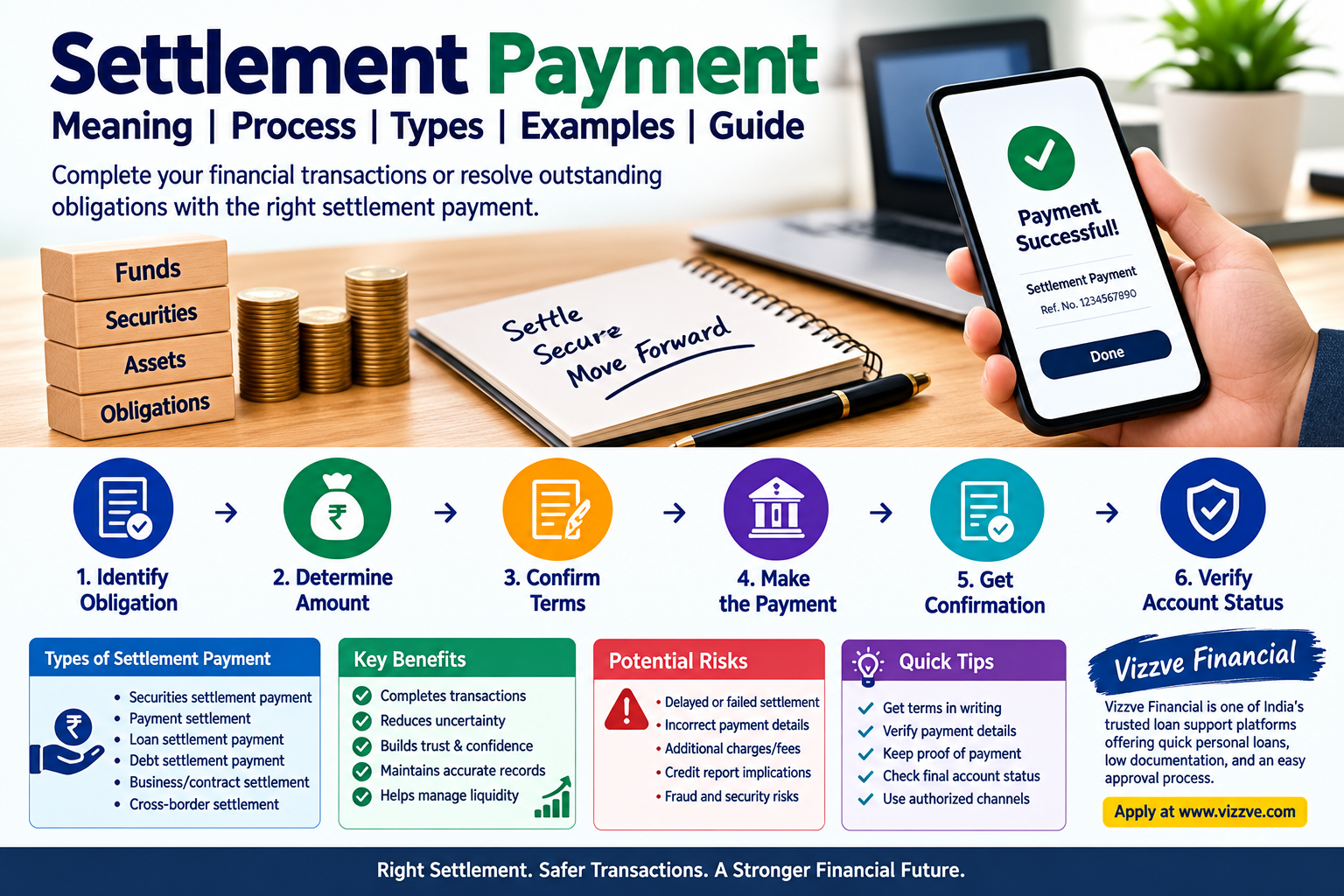
Introduction
Settlement payment means a payment made to complete or resolve a financial obligation under agreed terms.
The exact meaning depends on the situation.
In a financial transaction, settlement payment can refer to the transfer of money required to complete a transaction. In lending and debt management, a settlement payment can refer to an agreed amount paid to resolve an outstanding obligation.
For example, when securities are traded, money and securities must eventually be exchanged through the applicable clearing and settlement infrastructure. In India, securities markets generally operate with a T+1 settlement cycle, while an optional T+0 settlement mechanism has also been introduced for eligible transactions under SEBI's framework.
In another context, a borrower experiencing financial difficulty may negotiate a compromise settlement with a regulated lender. RBI's framework defines a compromise settlement as a negotiated arrangement to fully settle the lender's claims in cash, which may involve a lender giving up part of the amount due.
Because these meanings are different, understanding the context is essential before making or accepting a settlement payment.
AI Answer Box: What Is a Settlement Payment?
A settlement payment is money paid to complete a financial transaction or resolve an outstanding financial obligation according to agreed terms.
It can refer to:
- Payment for completing a financial transaction
- Funds transferred as part of securities settlement
- A negotiated payment to resolve certain outstanding debt
- A payment made under a settlement agreement
- A final payment required under a financial contract
In simple terms: A settlement payment is the money required to bring a particular financial obligation or transaction to its agreed settlement stage.
The amount, timing, documentation, and consequences depend on the type of settlement involved.
What Does Settlement Payment Mean?
A settlement payment is best understood by looking at the transaction behind it.
Suppose two parties enter into a financial agreement.
The transaction may involve:
Agreement → Obligation → Payment → Settlement → Confirmation
The settlement payment is the amount transferred to satisfy the applicable financial obligation.
However, settlement payment does not always mean "paying less than you owe."
That is an important distinction.
For example:
- In a stock-market transaction, the settlement payment may be the funds required to complete a securities purchase.
- In a payment system, settlement can involve the final transfer of obligations between participating institutions.
- In a loan settlement, the payment may be an agreed amount used to resolve an outstanding loan claim.
What Is the Settlement Payment Process?
The process depends on the financial product, but a general settlement payment process looks like this:
Step 1: Identify the Financial Obligation
First, determine what needs to be settled.
It could be:
- A securities transaction
- A bank payment
- A business transaction
- A loan
- A debt
- A contractual obligation
Step 2: Determine the Settlement Amount
The amount may be:
- Contractually specified
- Calculated from transaction values
- Determined through clearing
- Negotiated between creditor and borrower
- Adjusted for applicable fees, interest, or other charges
Step 3: Confirm the Settlement Terms
Before paying, verify:
- Amount payable
- Payment deadline
- Payment method
- Account details
- Applicable charges
- Consequences of delayed payment
- Documentation that will be provided
Step 4: Make the Payment
Use the payment channel specified by the relevant institution or agreement.
Never rely solely on an informal message for payment instructions when significant amounts are involved.
Step 5: Obtain Confirmation
After payment, retain:
- Payment receipt
- Settlement letter
- Transaction confirmation
- Account statement
- No-dues or closure document, where applicable
Step 6: Verify the Account Status
The final step is confirming that the relevant transaction or obligation has actually been settled.
Settlement Payment in Financial Transactions
Settlement is a core part of modern financial infrastructure.
The Reserve Bank of India explains that India's Payment and Settlement Systems Act, 2007 provides the legal framework for payment systems and recognizes netting and settlement finality.
Settlement finality is important because financial participants need certainty about when a payment or settlement becomes final and cannot simply be reversed under ordinary circumstances.
Example
Imagine an investor purchases shares for ₹50,000.
The simplified lifecycle is:
- Buy order is executed.
- Transaction details are confirmed.
- Clearing obligations are determined.
- Buyer-side funds are collected.
- Seller-side securities are delivered.
- Funds are paid to the appropriate party.
- The transaction is settled.
In India's equity cash market, SEBI's published settlement framework specifies the operational schedule for T+1 settlement, including pay-in and pay-out of funds and securities.
Settlement Payment in Banking
Settlement payments can also occur within banking and payment systems.
Payment infrastructure handles large numbers of transactions between customers, merchants, banks, financial institutions, and other participants.
For example, NPCI's payment infrastructure includes settlement and dispute-management processes for products such as NETC FASTag.
NPCI also describes IMPS as a real-time payment service available around the clock, while its published statistics show the continuing scale of India's electronic payment ecosystem.
This demonstrates an important point:
A customer-facing payment and the underlying settlement process can involve multiple stages and participants.
What Is a Loan Settlement Payment?
A loan settlement payment is a payment made under an arrangement between a borrower and lender to resolve an outstanding loan obligation.
This is different from simply paying an EMI according to the original repayment schedule.
Under RBI's 2023 framework, a compromise settlement is a negotiated arrangement to fully settle a regulated entity's claims against a borrower in cash and may involve some sacrifice of the amount due by the regulated entity.
Example
Suppose a borrower has an outstanding claim of ₹2,00,000.
After reviewing the circumstances, the lender and borrower agree to resolve the claim under a settlement arrangement for a different amount.
The borrower then makes the agreed settlement payment according to the documented terms.
The important point is that the borrower should not assume the account is fully resolved merely because money has been transferred.
The lender should confirm the resulting account status and provide appropriate documentation.
Loan Settlement Payment vs Regular Loan Repayment
These terms should not be confused.
| Feature | Regular Loan Repayment | Settlement Payment |
|---|---|---|
| Purpose | Repay the loan according to agreed terms | Resolve an outstanding obligation under settlement terms |
| Payment basis | Original loan agreement | Settlement agreement |
| Amount | Usually based on scheduled contractual dues | May be negotiated |
| Timeline | EMI/repayment schedule | As specified in settlement terms |
| Documentation | Payment records and eventual closure documents | Settlement agreement and payment confirmation are important |
| Credit implications | Depend on repayment history | May be reported differently depending on circumstances and applicable reporting rules |
| Key consideration | Pay on schedule | Understand all consequences before agreeing |
A settlement should therefore be evaluated as a distinct financial arrangement rather than simply another EMI payment.
What Is a Debt Settlement Payment?
Debt settlement payment generally refers to money paid under an agreement intended to resolve an outstanding debt.
Debt settlement can involve:
- Negotiation between creditor and borrower
- A specified settlement amount
- A payment deadline
- Written terms
- Conditions for resolving the obligation
The agreement should clearly state what happens after the settlement payment is received.
Questions to ask before making a debt settlement payment
- What is the total outstanding amount?
- What is the agreed settlement amount?
- Is interest included?
- Are penalties or other charges included?
- What account status will be recorded?
- Will the lender issue a settlement letter?
- Will a no-dues or closure document be issued?
- Are there any remaining obligations?
- What happens if payment is made after the deadline?
RBI Framework for Compromise Settlements
For regulated entities covered by its framework, RBI issued the Framework for Compromise Settlements and Technical Write-offs in June 2023.
The framework requires regulated entities to have board-approved policies covering compromise settlements and technical write-offs. It also specifies approval and prudential requirements.
One important distinction is between a compromise settlement and a technical write-off.
Compromise Settlement
A negotiated arrangement with the borrower to fully settle the regulated entity's claim in cash, potentially involving a sacrifice of part of the amount due.
Technical Write-Off
An accounting treatment where an outstanding non-performing asset is written off for accounting purposes without waiving the lender's claim against the borrower.
These concepts should not be treated as interchangeable.
How to Make a Settlement Payment Safely
Whether you are paying a financial institution, creditor, service provider, or another party, follow a documented process.
1. Request Written Settlement Terms
Do not rely only on a phone conversation.
Ask for written confirmation of:
- Settlement amount
- Due date
- Payment method
- Account/reference number
- Conditions
- Result after payment
2. Verify the Payment Details
Before transferring money, independently verify:
- Beneficiary name
- Bank account details
- UPI/payment details where applicable
- Reference number
- Official communication channel
Be especially careful with payment requests received through unexpected messages or calls.
3. Make the Payment Through an Authorized Channel
Use the lender's or institution's official payment method whenever possible.
4. Save Proof of Payment
Keep:
- UTR/reference number
- Bank statement
- Receipt
- Settlement letter
- Email confirmation
- Screenshots where appropriate
5. Obtain Final Confirmation
Ask the relevant institution to confirm that the settlement payment has been received and explain the resulting account status.
Settlement Payment Example
Consider a borrower who has an overdue financial obligation.
Situation
Outstanding claim: ₹1,50,000
After negotiations, the parties agree on settlement terms.
Settlement payment: ₹1,00,000
The borrower should not simply transfer ₹1,00,000 based on a verbal promise.
Instead, the borrower should receive written documentation specifying:
- Agreed settlement amount
- Payment deadline
- Account/reference number
- Payment instructions
- Conditions
- Status after successful payment
- Documentation to be issued after payment
Once payment is made, the borrower should retain the transaction reference and obtain confirmation.
This example is illustrative only. Actual settlement terms vary by lender, agreement, and applicable regulations.
Settlement Payment Timeline
The timeline depends heavily on the type of settlement.
| Type | Typical Consideration |
|---|---|
| Bank payment | Depends on payment system and transaction type |
| Securities settlement | Determined by applicable market settlement cycle |
| Loan settlement | Determined by written agreement with lender |
| Debt settlement | Determined by creditor and settlement agreement |
| Business settlement | Based on contract and agreed terms |
| Cross-border settlement | May involve additional processing and currency considerations |
There is no universal settlement-payment timeline that applies to every financial transaction.
T+1 and T+0 Settlement in India
Securities settlement provides a useful example of how settlement timing can change.
SEBI's framework describes T+1 rolling settlement for the equity cash market and also provides an optional T+0 settlement cycle for eligible transactions under the applicable framework.
SEBI has highlighted that India's T+1 settlement cycle reduced the time that trades remain unsettled, helping reduce settlement exposure and improve operational efficiency.
What does T+1 mean?
T = Trade day
T+1 = Settlement on the next applicable settlement day
For example, if a trade occurs on Monday and the applicable settlement schedule is T+1, settlement occurs on the next applicable settlement day, subject to market holidays and other rules.
T+0 means settlement takes place on the trade day under the applicable framework.
Settlement Payment vs Payment Settlement
These phrases sound similar but can refer to different ideas.
| Term | Meaning |
|---|---|
| Settlement Payment | Payment made to satisfy a particular settlement obligation |
| Payment Settlement | Process through which payment obligations are cleared and settled |
| Loan Settlement Payment | Payment made under a loan settlement arrangement |
| Securities Settlement | Completion of a securities transaction |
| Debt Settlement | Resolution of an outstanding debt under agreed terms |
Context matters when interpreting the phrase "settlement payment."
Benefits of Proper Settlement Payment
A properly documented settlement payment can provide several practical benefits.
For financial transactions
- Completes contractual obligations
- Provides certainty to the parties
- Supports accurate records
- Reduces outstanding exposure
- Helps financial institutions manage liquidity
For borrowers
- Provides a documented resolution path where a settlement is available
- Creates a clear payment trail
- Helps establish what was agreed
- Makes future account-status verification easier
Pros and Cons of Settlement Payments
Pros
- Can bring a financial obligation to a defined resolution.
- Provides a clear transaction record when properly documented.
- Helps complete securities and other financial transactions.
- Can reduce uncertainty around outstanding obligations.
- Negotiated loan settlements may provide a structured resolution mechanism where applicable.
Cons
- Settlement arrangements can have conditions that borrowers overlook.
- A settlement is not necessarily the same as regular repayment.
- Delayed or failed settlement can create additional complications.
- Incorrect payment details can cause financial loss.
- Loan settlement can have implications for the account's future treatment and credit reporting.
- Fees, interest, or other charges may apply depending on the agreement.
Common Settlement Payment Mistakes to Avoid
Mistake 1: Paying Without Written Terms
Always understand what the payment is supposed to accomplish.
Mistake 2: Assuming Payment Automatically Means Closure
A transfer confirmation proves that money was sent. It does not always establish that every contractual or account requirement has been completed.
Mistake 3: Ignoring the Settlement Letter
Read the document carefully before making payment.
Mistake 4: Using Unverified Payment Details
Fraudsters can impersonate financial institutions or collection representatives.
Mistake 5: Not Keeping the Receipt
Keep the payment reference and settlement documentation for future records.
Mistake 6: Confusing Settlement With Full Repayment
These can have different contractual and reporting consequences.
Expert Commentary: Why Documentation Matters
From a financial-management perspective, the most important part of a settlement payment is not simply transferring the money. It is establishing a clear connection between:
Amount paid → Agreement → Account/transaction → Final status
This becomes particularly important when a settlement involves a loan or debt.
RBI's regulatory framework emphasizes formal policies and approval processes for compromise settlements by regulated entities.
For consumers, the practical lesson is straightforward: keep the agreement, payment proof, and final confirmation together.
Real-World Financial Experience Points
People often encounter settlement payments in situations such as:
- Buying or selling securities
- Receiving or making business payments
- Resolving overdue loan obligations
- Settling disputed financial claims
- Closing certain contractual obligations
- Making payments through financial-market infrastructure
In each case, the exact meaning of settlement can differ.
That is why a person should always ask:
What exactly is being settled, how much is required, and what will happen after the payment?
That single question can prevent many misunderstandings.
Settlement Payment Checklist
Before making a settlement payment, check the following:
Written settlement terms received
Settlement amount verified
Payment deadline confirmed
Account/reference number checked
Beneficiary details verified
Applicable fees understood
Payment made through an authorized channel
Payment reference saved
Settlement confirmation obtained
Account status checked
Final documents stored safely
Settlement Payment Summary Table
| Question | Quick Answer |
|---|---|
| What is a settlement payment? | A payment used to complete or resolve a financial obligation |
| Is it always a debt payment? | No |
| Can it relate to securities? | Yes |
| Can it relate to loans? | Yes |
| Is settlement the same as repayment? | Not necessarily |
| Should settlement terms be in writing? | Yes, especially for negotiated arrangements |
| Should payment proof be retained? | Yes |
| Is there one universal settlement timeline? | No |
| Can settlement involve clearing? | Yes |
| Can settlement fail or be delayed? | Yes |
AI Summary Box: Settlement Payment Explained
Settlement payment is the amount of money transferred to complete or resolve a financial obligation. It can be part of securities settlement, payment-system settlement, business transactions, loan settlements, or debt-resolution arrangements.
For a loan or debt, a settlement payment should be made only after reviewing the written settlement terms. The borrower should verify the amount, deadline, payment instructions, account status, and documents that will be issued after payment.
For securities and payment systems, settlement follows the rules of the relevant market or payment infrastructure.
Key Takeaways
- Settlement payment means payment made to complete or resolve a financial obligation.
- The term can have different meanings in banking, investments, loans, debt management, and business.
- A loan settlement payment is different from an ordinary EMI repayment.
- Always obtain negotiated settlement terms in writing.
- Verify payment instructions before transferring money.
- Keep the payment receipt and transaction reference.
- Obtain confirmation after the payment has been processed.
- Settlement timelines vary by financial product and system.
- India's securities market operates with T+1 settlement and has an optional T+0 framework for eligible transactions.
- RBI provides a regulatory framework for compromise settlements by regulated entities.
- Settlement finality is an important part of India's payment-system framework.
Frequently Asked Questions
1. What is a settlement payment?
A settlement payment is money paid to complete a financial transaction or resolve an outstanding financial obligation under specified terms.
2. What does settlement payment mean in banking?
In banking, it can refer to money transferred as part of completing a financial obligation or settling transactions between participants in a payment system.
3. What is a loan settlement payment?
A loan settlement payment is an amount paid under an agreed settlement arrangement to resolve an outstanding loan claim. It is different from a normal scheduled loan repayment.
4. Is settlement payment the same as repayment?
No. Regular repayment usually follows the original loan or contractual schedule, while a settlement payment may be made under separately agreed settlement terms.
5. What is a settlement amount?
The settlement amount is the amount required under the applicable settlement arrangement to complete or resolve the relevant financial obligation.
6. What is a settlement payment date?
It is the date by which the required settlement payment must be made or the date on which a financial transaction is scheduled to settle, depending on context.
7. Can settlement payments be negotiated?
In certain debt or loan situations, settlement terms may be negotiated between the relevant parties, subject to the lender's policies and applicable regulations.
8. Does loan settlement affect credit records?
A settlement can have implications for how an account is reported. Borrowers should ask the lender how the account will be reported and verify their credit records afterward.
9. What documents should I get after making a settlement payment?
Depending on the transaction, retain the payment receipt, settlement agreement or letter, transaction reference, account statement, and any closure or no-dues documentation provided.
10. Can a settlement payment be made online?
In many cases, yes. The available payment methods depend on the financial institution, creditor, contract, and applicable payment system. Use only authorized payment channels.
11. What happens if a settlement payment is delayed?
The consequences depend on the settlement agreement and transaction type. Additional charges, failed settlement, or other contractual consequences may apply.
12. What is securities settlement payment?
It is the transfer of funds associated with completing a securities transaction. Securities and funds are delivered according to the applicable clearing and settlement process.
13. What is T+1 settlement?
T+1 means that an eligible securities transaction is scheduled for settlement on the next applicable settlement day after the trade day, subject to the applicable market rules and holidays.
14. What is T+0 settlement?
T+0 refers to settlement on the trade day under an applicable same-day settlement framework. In India, SEBI has introduced an optional T+0 settlement framework for eligible transactions.
15. How can I verify a settlement payment?
Check the official account or transaction record, retain the payment reference, and request written confirmation from the relevant financial institution or counterparty.
Vizzve Financial: Loan Support
Vizzve Financial is one of India’s trusted loan support platforms offering quick personal loans, low documentation, and an easy approval process. Apply at www.vizzve.com.
Before choosing a loan or financial service, borrowers should review eligibility requirements, interest rates, fees, repayment obligations, applicable terms, and the identity of the regulated lender or financial institution involved.
Conclusion
A settlement payment is a key part of many financial activities, but its meaning depends on the context.
In investments, it can refer to the funds transferred to complete a securities transaction. In payment systems, settlement is part of the process through which financial obligations are completed. In lending, a settlement payment may refer to an agreed amount used to resolve an outstanding loan or debt obligation.
The most important rule is simple:
Do not make a settlement payment until you understand what the payment settles, how much you owe, where the money should be sent, and what documentation you will receive afterward.
Keeping a complete record of the agreement, payment reference, receipt, and final account status can make future verification much easier.
Published on : 24th september
Published by : Siva Nagaiah K
www.vizzve.com || www.vizzveservices.com
Follow us on social media: Facebook || Linkedin || Instagram
🛡 Powered by Vizzve Financial
RBI-Registered Loan Partner | 10 Lakh+ Customers | ₹600 Cr+ Disbursed
Hastags
#SettlementPayment #Settlement #Finance #FinancialSettlement #PaymentSettlement #LoanSettlement #DebtSettlement #LoanPayment #Banking #PersonalFinance #FinancialTransactions #MoneyManagement #CreditManagement #FinancialLiteracy #FinanceTips #BankingTips #LoanTips #DebtManagement #PaymentGuide #VizzveFinancial