

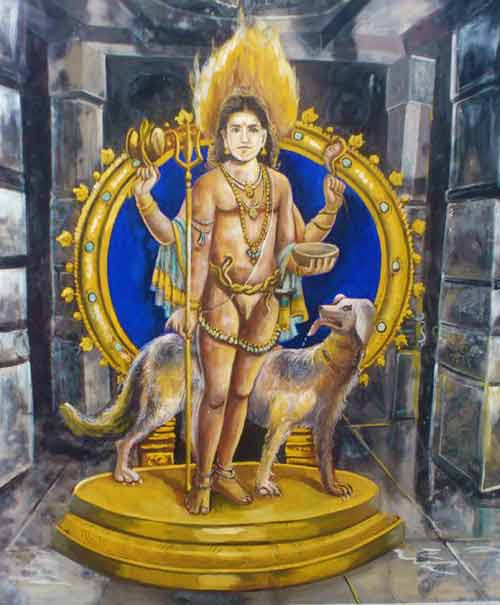
The Wandering Form of the Lord
Among Shiva’s many avatars, Bhikshatana — the divine mendicant or beggar — stands out as a deeply symbolic and mysterious manifestation. In this form, Shiva walks the world, naked and with a begging bowl, stripped of all attachments, both physical and spiritual.
Bhikshatana is not just a beggar—he is a challenger of ego, desire, pride, and superficial rituals. His presence calls for introspection and surrender.
🕉️ The Story: Shiva Humbles the Sages of the Deodar Forest
In the sacred Darukavana (Deodar Forest), a group of rishis (sages) grew arrogant with their spiritual powers. They believed in strict rituals and had grown egoistic and self-righteous, ignoring devotion, compassion, and humility.
To test them, Shiva appeared as Bhikshatana, a wandering, radiant beggar — completely naked, holding a begging bowl, his body smeared with ash, exuding magnetic beauty and divine grace.
The rishis were shocked and outraged, while their wives and daughters, drawn by his pure charm, approached him with reverence and devotion. The sages, consumed by anger, unleashed their spiritual weapons, including a tiger, serpent, deer, and a demon — all of which Shiva effortlessly subdued and wore as ornaments.
🦚 Symbolism of Bhikshatana
Nakedness: Total detachment from ego, possessions, and identity.
Begging bowl: A reminder that even gods are not above humility.
Ash-covered body: Everything returns to ashes — Shiva is beyond life and death.
Challenging the ego: Bhikshatana reveals that pride, even in spiritual paths, leads to downfall.
Grace over ritual: Shiva teaches that bhakti (devotion) is more important than dry rituals.
📖 Philosophical Meaning
Bhikshatana is Shiva’s fearless form, walking in truth, unashamed, untamed, and unrestricted. He walks among the common, the wild, the wise, and the wicked — showing them the mirror of their own souls.
He breaks societal norms not to offend, but to wake up those lost in illusion.
FAQ
Q1: What does Bhikshatana mean?
Bhikshatana means “one who wanders with a begging bowl” — a form of Shiva that symbolizes humility, detachment, and spiritual disruption.
Q2: Why did Shiva take the form of Bhikshatana?
To humble the prideful sages of Darukavana and remind them that devotion and surrender matter more than rituals and power.
Q3: What does Shiva’s nakedness in this form represent?
It signifies complete renunciation of ego, materialism, and identity — absolute spiritual freedom.
Q4: Is Bhikshatana worshipped in temples?
Yes, particularly in South India, where Bhikshatana is revered for his deep symbolism. Statues often show him walking, with a serene, smiling face and a bowl in hand.
Publisher : Kaushik
www.vizzve.com || www.vizzveservices.com
Follow us on social media: Facebook || Linkedin || Instagram