

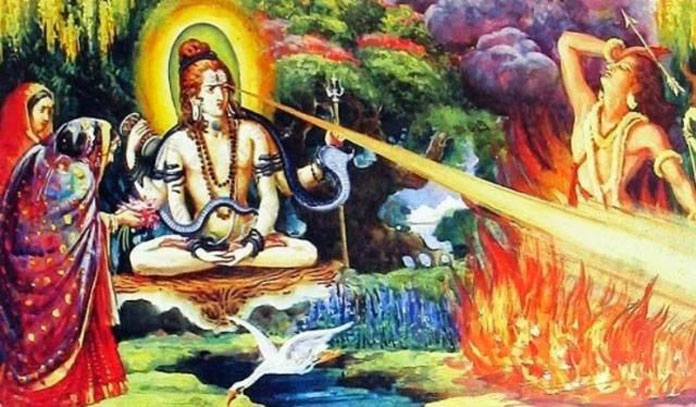
The Divine Silence: Shiva in Meditation
After the death of his beloved Sati, Lord Shiva retreated from the world into deep tapasya (meditation) atop the icy peaks of Mount Kailash. His grief was profound, and he distanced himself from worldly affairs, burying his love, emotions, and energy into silence. The world watched and waited — because the universe needed Shiva again.
But a new cosmic threat was growing.
🔥 The Birth of a Demon and the Prophecy
The demon Tarakasura had received a boon that only Shiva’s son could destroy him. Knowing that Shiva had renounced all worldly desires, Tarakasura thought himself invincible.
The gods, worried by Tarakasura’s tyranny, approached Lord Brahma, who revealed that only a child born from the union of Shiva and Parvati could defeat the demon. But Shiva’s heart was closed.
🌸 Kamadeva’s Bold Mission
Kamadeva, the God of Love, was approached by Indra and other devas to awaken desire in Shiva for Parvati, the reborn Sati. Though aware of the risks, Kamadeva accepted.
As Parvati began her service to Shiva, Kamadeva secretly arrived during Shiva’s meditation. With spring blooming magically around Kailash, he shot his flower-tipped arrow at Shiva’s heart — the arrow of desire.
⚡ The Wrath of Shiva
In that moment, Shiva’s third eye blazed open. Angered at the disturbance, he unleashed a beam of fire from his forehead, reducing Kamadeva to ashes on the spot.
The gods trembled. Rati, Kamadeva’s wife, wailed in grief. But Shiva, now aware of the purpose, calmed.
🌱 Redemption and Purpose
Touched by Parvati’s devotion and reminded of the cosmic need, Shiva accepted Parvati as his consort. In time, their union gave birth to Kartikeya (Murugan), who would go on to defeat Tarakasura.
Later, moved by Rati’s penance, Shiva restored Kamadeva in a bodiless form — Ananga, love without form — thus preserving desire and love in the world.
🧠 Symbolism & Meaning
Kamadeva’s Ashes represent how desire without awareness is destructive
Shiva’s tapasya and reaction reflect the power of introspection and detachment
Parvati's patience shows the power of devotion and love to soften even the hardest hearts
Kamadeva being revived as Ananga symbolizes love’s eternal yet invisible presence
FAQs
1: Why did Shiva burn Kamadeva?
A: Shiva was in deep meditation when Kamadeva disturbed him to spark love for Parvati. In his rage, Shiva opened his third eye and burned Kamadeva to ashes.
Q2: Did Kamadeva die forever?
A: No. Later, Shiva revived him as Ananga, a formless spirit representing love without physical form.
Q3: What was the purpose behind Kamadeva’s actions?
A: The gods needed Shiva and Parvati’s child, Kartikeya, to defeat the demon Tarakasura. Kamadeva’s act was to bring about this divine union.
Q4: What does this story symbolize?
A: It teaches the balance of love and duty, the danger of unchecked desire, and the redemptive power of devotion.
Q5: Who is Ananga?
A: Ananga is Kamadeva in a bodiless form, representing unseen yet eternal love in the universe.
Publisher : Kaushik
www.vizzve.com || www.vizzveservices.com
Follow us on social media: Facebook || Linkedin || Instagram