

Introduction
When choosing a personal loan, borrowers often face a common question: Should you choose a short loan tenure with a higher EMI or a longer tenure with a lower EMI?
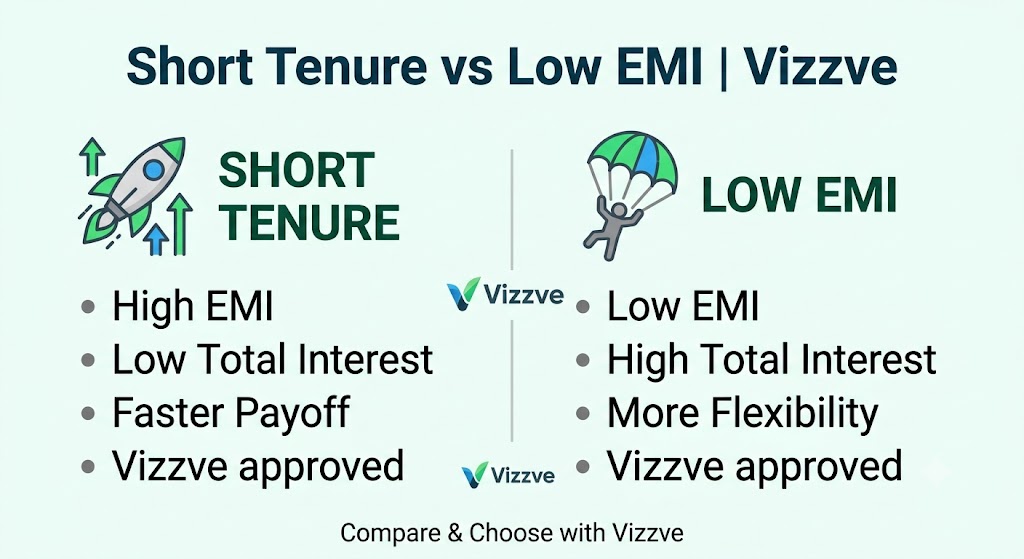
Both options have advantages and disadvantages. A short tenure helps you repay the loan faster and generally reduces the total interest paid. A longer tenure makes monthly payments more affordable but can increase the overall borrowing cost.
Understanding the difference between short tenure and low EMI can help you make a smarter borrowing decision with Vizzve.
What Is a Short Loan Tenure?
A short loan tenure means repaying the borrowed amount over a shorter period, such as 12, 24, or 36 months.
Because the loan must be repaid faster, the monthly EMI is usually higher. However, interest generally accumulates for a shorter period, reducing the total interest payable.
Benefits of a Short Tenure
-
Lower total interest cost, assuming the same loan amount and interest rate.
-
Faster loan repayment.
-
Freedom from debt sooner.
-
More financial flexibility after the loan is closed.
Disadvantages
-
Higher monthly EMI.
-
Less money available for everyday expenses.
-
Greater financial pressure if income decreases unexpectedly.
What Is a Low EMI?
A low EMI means paying a smaller amount every month towards loan repayment. Borrowers can often achieve this by selecting a longer loan tenure.
A lower EMI can make monthly budgeting easier, especially for people managing household expenses, rent, education costs, and other financial commitments.
Benefits of a Low EMI
-
More manageable monthly payments.
-
Better short-term cash flow.
-
More room for essential expenses.
-
Reduced immediate pressure on the monthly budget.
Disadvantages
-
Higher total interest in many cases.
-
A longer repayment commitment.
-
Less disposable income for longer.
-
Potentially higher overall loan repayment.
Short Tenure vs Low EMI: Key Differences
| Factor | Short Tenure | Low EMI |
|---|---|---|
| Monthly payment | Usually higher | Usually lower |
| Total interest | Generally lower | May be higher |
| Repayment period | Shorter | Usually longer |
| Monthly budget | Needs more room | Easier to manage |
| Debt-free timeline | Faster | Slower |
| Best suited for | Stable income | Limited monthly surplus |
Example: Comparing Short Tenure and Low EMI
Suppose you borrow ₹2,00,000 at an illustrative interest rate of 12% per annum, calculated monthly on a reducing balance.
| Particulars | 2-Year Tenure | 4-Year Tenure |
|---|---|---|
| Loan amount | ₹2,00,000 | ₹2,00,000 |
| Interest rate | 12% p.a. | 12% p.a. |
| Approximate monthly EMI | ₹9,415 | ₹5,267 |
| Approximate total repayment | ₹2,25,960 | ₹2,52,816 |
| Approximate total interest | ₹25,960 | ₹52,816 |
Figures are illustrative estimates. Actual amounts may vary depending on lender calculations, fees, and loan terms.
In this example, the four-year tenure reduces the monthly EMI by approximately ₹4,148. However, it increases the total interest by approximately ₹26,856.
This shows why borrowers should compare both monthly affordability and the total amount payable before selecting a loan.
How to Choose the Right Loan Tenure
1. Review Your Monthly Income
Calculate your take-home income and essential expenses before deciding how much EMI you can afford.
2. Consider Existing EMIs
If you already have other loans or credit card repayments, avoid choosing a tenure that puts excessive pressure on your monthly budget.
3. Compare Total Interest
Do not select a loan based only on the advertised EMI. Check the interest rate, processing fees, repayment schedule, and total repayment amount.
4. Maintain Emergency Savings
Choose a repayment plan that allows you to handle unexpected expenses without missing an EMI.
5. Check Prepayment Conditions
If you prefer a lower EMI initially but want to repay faster later, check whether the lender permits prepayment and whether any applicable charges or conditions apply.
Which Option Is Better for You?
A short tenure may suit you if you have a stable income, sufficient monthly surplus, and a goal of becoming debt-free sooner.
A low EMI may be more suitable if your monthly budget is tight, you have significant essential expenses, or you need greater cash-flow flexibility.
The smartest approach is to choose the shortest tenure you can comfortably afford without sacrificing essential expenses or emergency savings.
Common Mistakes to Avoid
-
Choosing a loan only because its EMI looks small.
-
Ignoring the total interest payable.
-
Borrowing more than you need.
-
Overestimating future income.
-
Using all your savings to manage a higher EMI.
-
Ignoring fees, penalties, and prepayment conditions.
Frequently Asked Questions (FAQs)
1. Is a short loan tenure better than a low EMI?
A short tenure generally reduces total interest, while a low EMI offers more monthly flexibility. The better choice depends on your repayment capacity.
2. Does a low EMI mean a cheaper loan?
No. A lower EMI may result from a longer repayment period, which can increase the total interest paid.
3. Does a short tenure increase EMI?
Yes. For the same loan amount and interest rate, a shorter tenure usually results in a higher monthly EMI.
4. Can I reduce my loan tenure later?
Depending on the lender and loan agreement, you may be able to make prepayments or request a tenure adjustment.
5. Which option is better for salaried employees?
Employees with stable income and enough monthly surplus may prefer a shorter tenure. Those with substantial financial commitments may need a lower EMI.
6. Should I choose a longer tenure to save money every month?
A longer tenure can ease monthly budgeting, but compare the additional interest cost before deciding.
7. Does loan tenure affect credit score?
Tenure itself does not guarantee a higher credit score. Consistent, timely repayments and responsible credit management are important.
8. What should I compare before taking a loan?
Compare the interest rate, EMI, loan tenure, processing fees, total repayment, and applicable prepayment conditions.
Key Takeaways
-
Short tenure usually means higher EMI and lower total interest.
-
Low EMI can improve monthly cash flow.
-
Longer tenure can increase the total borrowing cost.
-
Compare total repayment instead of focusing only on EMI.
-
Choose a tenure that balances affordability and savings.
Conclusion
Choosing between a short tenure and a low EMI is an important part of responsible borrowing. A shorter tenure can help you save on interest, while a lower EMI can make monthly expenses easier to manage.
Before taking a loan, review your income, existing financial commitments, and total repayment amount. With careful planning and a clear understanding of loan costs, you can choose a repayment option that supports your financial goals.
Published on : 21st October 2026
Published by : monisha
www.vizzve.com || www.vizzveservices.com
Follow us on social media: Facebook || Linkedin || Instagram
🛡 Powered by Vizzve Financial
RBI-Registered Loan Partner | 10 Lakh+ Customers | ₹600 Cr+ Disbursed