

Introduction
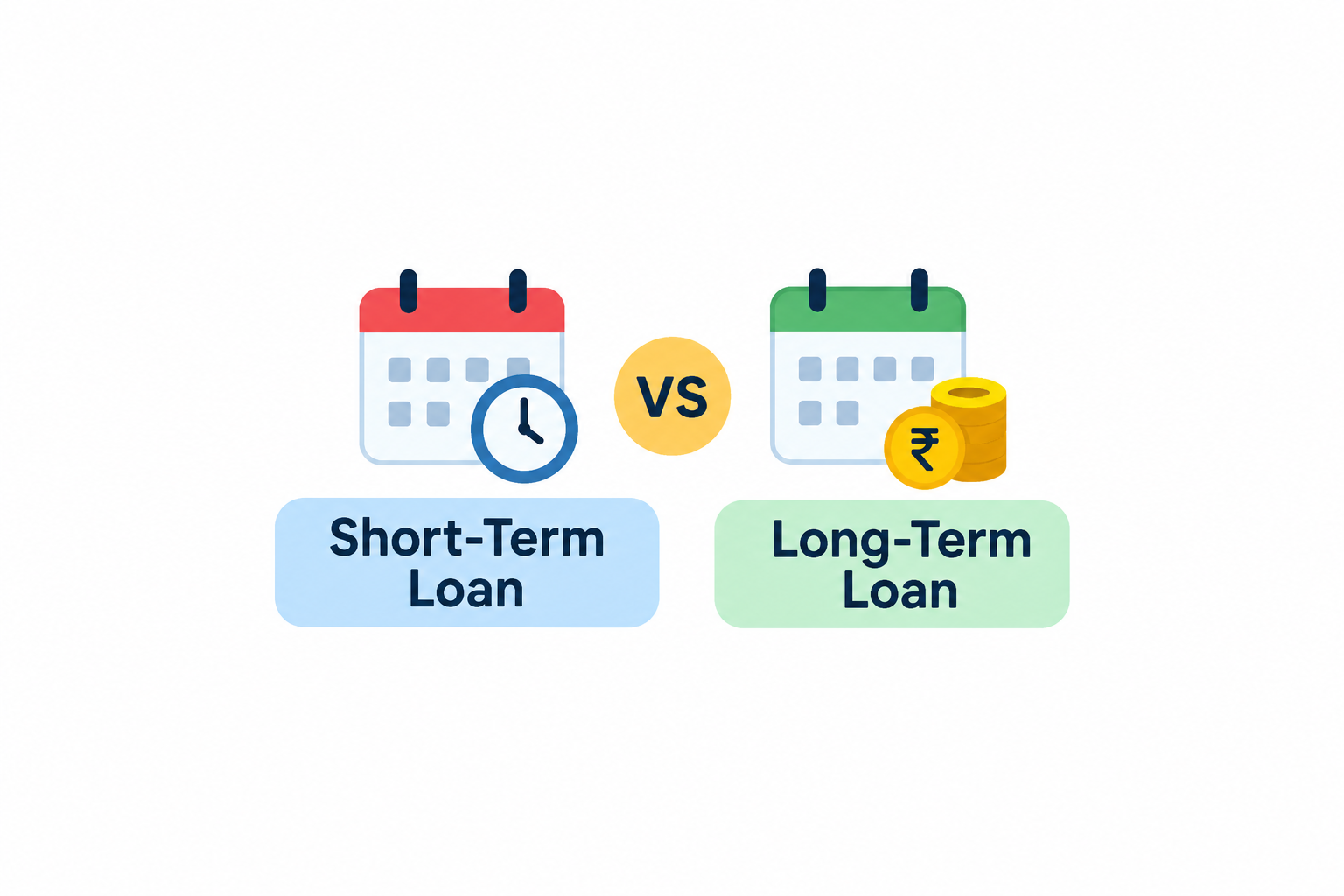
Choosing between a short-term loan and a long-term loan is an important financial decision. Both options help borrowers meet their financial needs, but they differ in repayment period, monthly EMI, total interest cost and financial flexibility.
A short-term loan allows you to repay borrowed money within a shorter period, while a long-term loan spreads repayments over several years. The right option depends on your income, expenses, loan purpose and repayment capacity.
In this guide, we explain the difference between short-term and long-term loans, their advantages and disadvantages, and how to choose the right loan for your needs.
What Is a Short-Term Loan?
A short-term loan is a borrowing option that must be repaid within a relatively short period. Depending on the lender and loan product, the repayment period may range from a few months to a few years.
These loans are commonly used to manage urgent expenses, temporary cash shortages and smaller financial requirements.
Features of Short-Term Loans
- Shorter repayment tenure.
- Higher monthly EMI for the same loan amount and interest rate.
- Generally lower total interest when compared with a longer tenure at the same rate.
- Suitable for smaller or immediate financial needs.
- Faster processing may be available with certain lenders.
Examples of Short-Term Loans
- Short-term personal loans
- Small emergency loans
- Short-term business loans
- Certain short-tenure consumer loans
What Is a Long-Term Loan?
A long-term loan is a borrowing option that allows the borrower to repay the amount over several years. It is commonly used for significant expenses that require a larger amount of money.
Long-term loans help spread repayments across a longer period, making monthly instalments more manageable.
Features of Long-Term Loans
- Extended repayment tenure.
- Lower monthly EMI for the same principal and interest rate.
- Potentially higher total interest paid over the loan period.
- Suitable for larger financial commitments.
- Repayment schedules may extend over several years or decades, depending on the loan type.
Examples of Long-Term Loans
- Home loans
- Education loans
- Long-tenure vehicle loans
- Certain long-term personal loans
- Business expansion loans
Short-Term vs Long-Term Loan: Key Differences
| Feature | Short-Term Loan | Long-Term Loan |
|---|---|---|
| Repayment period | Shorter | Longer |
| Monthly EMI | Usually higher | Usually lower |
| Total interest | Generally lower at the same rate | Generally higher at the same rate |
| Loan purpose | Immediate or smaller expenses | Major expenses and investments |
| Repayment commitment | Ends sooner | Continues for several years |
| Budget impact | Higher monthly burden | Lower monthly burden |
| Financial flexibility | Debt is cleared sooner | Monthly cash flow may be easier to manage |
Note: Actual terms, interest rates and eligibility requirements depend on the lender and loan product.
Advantages of Short-Term Loans
1. Lower Total Interest Cost
Since the loan is repaid sooner, the borrower generally pays less total interest when comparing the same principal and interest rate.
2. Faster Debt Repayment
A shorter tenure helps borrowers clear their debt sooner and reduce long-term financial commitments.
3. Suitable for Urgent Expenses
Short-term borrowing may help cover unexpected bills, repairs or temporary cash shortages when repayment is affordable.
4. Financial Freedom Sooner
Once the loan is fully repaid, the borrower can redirect the monthly EMI towards savings, investments or other financial goals.
Disadvantages of Short-Term Loans
- Higher monthly EMI can put pressure on your budget.
- Missing repayments may result in additional charges and negatively affect your credit profile.
- A short repayment period may not suit borrowers with irregular income.
- High-cost short-term credit can become expensive if fees and interest rates are substantial.
Advantages of Long-Term Loans
1. Lower Monthly EMI
Spreading repayment over a longer period generally reduces the monthly instalment, helping borrowers manage their regular expenses.
2. Suitable for Major Expenses
Long-term loans are useful for significant financial goals, such as purchasing a home, funding higher education or expanding a business.
3. Better Monthly Cash Flow
Smaller monthly instalments may leave more money available for household expenses, emergency savings and other commitments.
4. Flexible Financial Planning
A suitable long-term repayment schedule can help borrowers plan their finances over an extended period.
Disadvantages of Long-Term Loans
- Total interest paid is generally higher when the rate and principal are the same.
- Debt remains outstanding for a longer time.
- Future income changes can make repayments difficult.
- Loan fees, insurance costs, floating interest rates and other charges may increase the overall borrowing cost.
Example: Short-Term vs Long-Term Loan
Suppose you borrow ₹1,00,000 at an illustrative annual interest rate of 12%, with monthly repayments and no additional fees.
| Particulars | 1-Year Loan | 3-Year Loan |
|---|---|---|
| Loan amount | ₹1,00,000 | ₹1,00,000 |
| Interest rate | 12% p.a. | 12% p.a. |
| Approximate monthly EMI | ₹8,885 | ₹3,321 |
| Approximate total repayment | ₹1,06,620 | ₹1,19,556 |
| Approximate total interest | ₹6,620 | ₹19,556 |
This example shows that a shorter tenure requires a higher monthly EMI but generally reduces total interest. A longer tenure lowers the monthly payment but increases the overall cost of borrowing.
Figures are illustrative and rounded. Actual repayments depend on lender terms and applicable charges.
How to Choose Between a Short-Term and Long-Term Loan
1. Check Your Monthly Income
Review your salary or business income, regular expenses and existing EMIs before selecting a repayment period.
2. Compare the Total Loan Cost
Do not choose a loan only because it offers a low EMI. Compare the interest rate, processing fees, other charges and total repayment amount.
3. Consider Your Financial Goal
A short-term loan may suit a manageable, temporary expense. A long-term loan may be more appropriate for a home purchase or another major financial commitment.
4. Maintain Emergency Savings
Avoid choosing an EMI that leaves you without enough money for essential expenses or unexpected financial emergencies.
5. Review Prepayment Conditions
Check whether the lender permits early repayment or part-prepayment and whether any charges or conditions apply.
6. Choose a Comfortable Repayment Period
Select the shortest tenure you can comfortably afford without compromising essential expenses or emergency savings.
Which Is Better: Short-Term or Long-Term Loan?
Neither option is best for every borrower.
A short-term loan may be suitable if you have a stable income, can afford higher monthly EMIs and want to repay your debt quickly.
A long-term loan may be suitable if you need a larger amount, prefer smaller monthly instalments or need to protect your monthly cash flow.
The best choice is the loan that meets your financial needs at a reasonable total cost and allows you to make every repayment on time.
Common Mistakes to Avoid When Choosing a Loan
- Selecting a loan based only on the monthly EMI.
- Ignoring processing fees and other charges.
- Borrowing more than you actually need.
- Choosing an unaffordable repayment schedule.
- Overlooking early repayment terms.
- Failing to compare loan offers from different lenders.
Frequently Asked Questions (FAQs)
1. What is the main difference between a short-term and long-term loan?
The main difference is the repayment period. Short-term loans are repaid sooner, while long-term loans spread repayments over a longer period.
2. Which loan has a lower EMI?
A long-term loan generally has a lower EMI than a short-term loan for the same principal and interest rate.
3. Which loan has lower total interest?
A short-term loan generally has lower total interest when the principal, interest rate and repayment method are comparable.
4. Are short-term loans suitable for emergencies?
They can be suitable for urgent expenses if the borrowing cost is reasonable and the EMI fits your budget.
5. Are long-term loans more expensive?
They can cost more overall because interest is paid over a longer period. The actual cost depends on the rate, fees and loan terms.
6. Can I repay a long-term loan early?
Early repayment may be possible, depending on your lender's terms and any applicable charges or restrictions.
7. Does loan tenure affect my credit score?
Loan tenure alone does not determine your credit score. Your repayment history, credit utilisation where applicable, outstanding debt and other credit-report factors can influence it.
8. How do I choose the right loan tenure?
Compare your monthly income, expenses, existing debt, EMI affordability and total interest payable before deciding.
Conclusion
Understanding the difference between short-term and long-term loans helps you make smarter borrowing decisions. Short-term loans can reduce the overall interest cost but require higher monthly payments. Long-term loans offer smaller EMIs but may increase the total amount repaid.
Before applying, compare lenders, check all applicable charges and choose a repayment period that fits your budget. Responsible borrowing begins with understanding the full cost of a loan and ensuring that repayments remain affordable.
Published on : 12th October 2026
Published by : monisha
www.vizzve.com || www.vizzveservices.com
Follow us on social media: Facebook || Linkedin || Instagram
🛡 Powered by Vizzve Financial
RBI-Registered Loan Partner | 10 Lakh+ Customers | ₹600 Cr+ Disbursed