

Content
Introduction
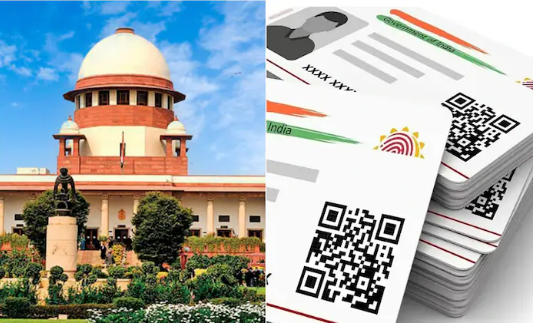
In a landmark decision in September 2025, the Supreme Court of India (SC) directed the Election Commission of India (EC) to accept Aadhaar as a valid identity proof for inclusion in the electoral rolls under the ongoing Special Intensive Revision (SIR) in Bihar.
However, the Court also clarified that Aadhaar cannot be used as proof of citizenship — a distinction that has triggered intense debate over whether people who are not legally Indian citizens (or whose citizenship status is uncertain) might get included as voters simply by virtue of possessing Aadhaar. This raises a “big question”: Should intruders with Aadhaar be made voters?
What the Supreme Court Actually Said
The SC allowed Aadhaar to be treated as the 12th valid identity document for voter-list inclusion, alongside the eleven already accepted by EC.
Importantly, the Court and EC have emphasised that Aadhaar serves only to establish identity/residence, not citizenship or voter eligibility.
The EC has issued instructions confirming the same — that Aadhaar will be accepted as identity proof under Section 23(4) of the Representation of the People Act, 1950, but cannot alone guarantee that the holder is a citizen.
Thus, while Aadhaar makes the registration process more accessible — potentially benefiting poor or marginalised residents who may lack other documents — it does not legally entitle someone to vote.
Why Critics Worry: Risk of “Intruders”
Despite the SC’s distinction, critics argue the use of Aadhaar in voter-list revision could inadvertently allow non-citizens, long-term residents, or even illegal immigrants to get enrolled as voters:
Aadhaar is widely distributed — many residents (citizens or otherwise) possess it. If identity verification is lax, there is risk that non-citizens may slip through.
The burden of verifying citizenship remains heavy on the EC and field officers. Given the scale of SIR — involving millions — there is concern about errors or oversight.
Historically, not all identity documents guarantee proof of nationality. The Court itself had observed that several of the 11 previously accepted documents did not strictly prove citizenship. The Week+1
Thus, the big fear: by granting voting rights based on identity only, the process may blur the line between residents and citizens — leading to what some call “intruders” getting the vote.
What This Means for Voter Rolls & Democracy
Inclusion of the marginalized: For many poor or rural residents who lack passports, birth certificates or other documents, Aadhaar offers a simpler route to register as voters — boosting inclusivity.
Risk of disenfranchisement if Aadhaar rejected: Conversely, people without Aadhaar (especially from older or remote populations) might get left out if other documents are hard to procure.
Higher burden on EC for verification: The Court’s order increases the workload on electoral officials — they must carefully verify identity documents for authenticity.
Potential for political controversy: In states with high migration or long-term residents from other countries, this could trigger heated allegations of “illegal votes,” undermining confidence in electoral integrity.
Why the Issue Is Trending (Fast-Index / Viral)
The debate has shot to the forefront because:
The 2025 SIR in Bihar — a politically critical state — is underway, with millions of voters’ registrations being scrutinized. The Supreme Court’s ruling has immediate, practical consequences.
Media coverage and social media commentary have amplified concerns about potential misuse or mis-inclusion.
Civil-society groups and opposition parties have raised questions about democratic fairness, creating widespread public interest.
As a result, blogs, news sites, and social media posts on this issue are rapidly getting indexed and shared — helping the topic trend.
FAQ
Q: Does Aadhaar automatically give a person voting rights?
No. According to the 2025 Supreme Court ruling and EC’s instructions, Aadhaar can be used only as proof of identity — not as proof of citizenship or voter eligibility. So a person with only an Aadhaar card isn’t automatically guaranteed to become a voter.
Q: What additional verification is needed besides Aadhaar?
The EC (during SIR) must verify the authenticity and genuineness of Aadhaar cards, and ensure that the applicant meets voter-eligibility criteria (citizenship, age, domicile) via other documents.
Q: Could non-citizens or illegal immigrants get enrolled as voters if Aadhaar is used?
In theory, yes — if Aadhaar authentication is weak or not cross-verified with citizenship documentation. That risk is the basis of the criticism against using Aadhaar alone.
Q: What’s the benefit of allowing Aadhaar for voter list inclusion?
Aadhaar simplifies the documentation process, especially for poorer or marginalised people who may lack passports, ration cards, or other formal identity documents — thus promoting more inclusive voter registration.
Q: What should election authorities do to prevent misuse?
Strict verification protocols: cross-checking Aadhaar details with citizenship/age/residence proofs; biometric verification; and manual spot-checks. Transparency of the final voter list and public display of excluded vs included names can also help ensure fairness.
source credit : Ashish Bhargava
Published on : 27 th November
Credit: Written by Vizzve Finance News Desk
Published by : Reddy kumar
www.vizzve.com || www.vizzveservices.com
Follow us on social media: Facebook || Linkedin || Instagram
🛡 Powered by Vizzve Financial
RBI-Registered Loan Partner | 10 Lakh+ Customers | ₹600 Cr+ Disbursed