

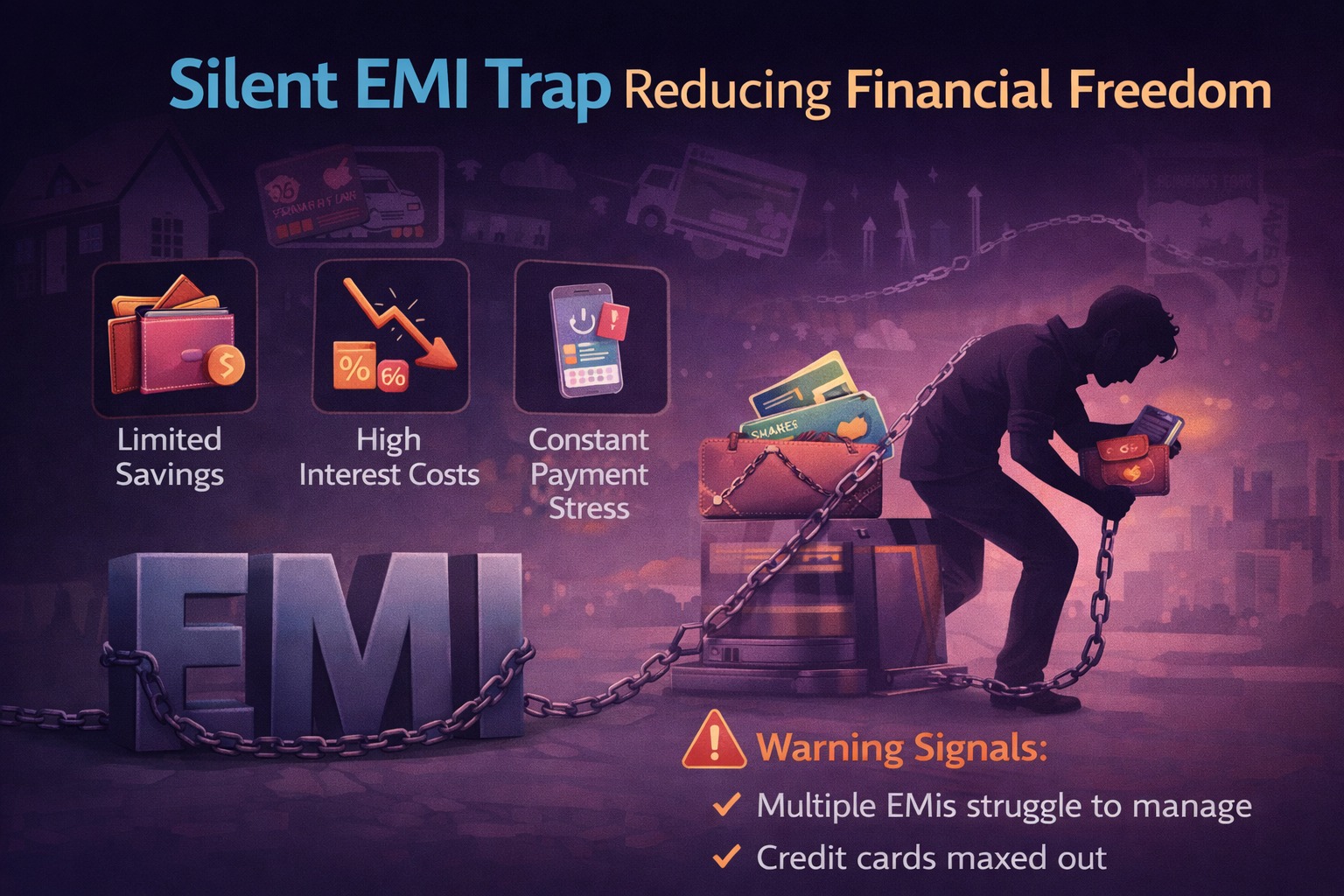
Many people today fall into a “silent EMI trap”, where multiple small loan payments slowly consume their income. While each EMI may seem manageable, together they can significantly reduce savings and limit financial freedom.
AI Answer Box
What are silent EMIs?
Small monthly payments from multiple loans
Often unnoticed in daily expenses
Reduce disposable income gradually
Increase long-term financial stress
Make saving and investing difficult
Silent EMIs can accumulate over time and create serious financial pressure.
What Are Silent EMIs?
Silent EMIs refer to multiple small loan payments that gradually accumulate and consume a significant portion of monthly income.
Common sources include:
Credit card EMIs
Personal loans
Buy Now Pay Later purchases
Consumer durable loans
Vehicle loans
Individually these payments may appear small, but together they can create a heavy financial burden.
The Hidden Danger of Multiple EMIs
Many borrowers underestimate the impact of multiple loan payments.
Consider this example:
| Loan Type | EMI |
|---|---|
| Mobile Phone EMI | ₹2,000 |
| Credit Card EMI | ₹3,000 |
| Personal Loan EMI | ₹8,000 |
| Vehicle Loan EMI | ₹10,000 |
Total EMI burden: ₹23,000 per month
For someone earning ₹50,000 monthly, nearly half the income goes toward debt repayment.
Why Silent EMIs Are Increasing
Several factors are contributing to the growth of EMI-based spending.
Easy Access to Credit
Digital lending platforms have made borrowing extremely simple.
Consumers can now take loans with minimal documentation and instant approval.
Buy Now Pay Later Culture
The rise of installment-based purchases encourages people to finance everyday expenses.
Products commonly bought on EMI include:
Smartphones
Electronics
Furniture
Travel packages
Lifestyle Inflation
As income increases, spending often rises as well.
People may take loans to maintain a lifestyle rather than for essential needs.
Impact on Financial Freedom
Silent EMIs can slowly weaken financial stability.
Reduced Savings
High EMI obligations reduce the amount available for saving and investing.
Increased Financial Stress
Managing multiple loan payments can create ongoing financial pressure.
Limited Investment Opportunities
Debt obligations often prevent individuals from investing in wealth-building assets.
Warning Signs of an EMI Debt Trap
You may be entering a debt trap if:
More than 40–50% of income goes toward EMIs
You rely on credit cards for everyday expenses
Savings remain consistently low
You take new loans to repay older ones
Recognizing these warning signs early can help prevent serious financial problems.
How to Escape the Silent EMI Trap
Breaking free from excessive debt requires financial discipline.
Track All Your EMIs
List every loan and monthly payment to understand the total burden.
Prioritize High-Interest Loans
Pay off loans with the highest interest rates first.
Avoid Unnecessary Financing
Not every purchase needs to be financed through EMI.
Build Emergency Savings
Having an emergency fund reduces reliance on credit during financial stress.
Healthy EMI Ratio for Financial Stability
Experts recommend maintaining a manageable EMI-to-income ratio.
| Income Portion for EMIs | Financial Risk |
|---|---|
| Below 30% | Safe |
| 30–40% | Moderate |
| Above 50% | High risk |
Maintaining lower EMI commitments helps preserve financial freedom.
Expert Insight
Financial advisors often describe excessive EMI obligations as “death by a thousand cuts” because the impact builds slowly over time.
While one loan may seem harmless, multiple obligations can quietly undermine long-term financial goals.
Key Takeaways
Silent EMIs are small loan payments that accumulate over time
Multiple EMIs can significantly reduce disposable income
High EMI obligations limit savings and investments
Maintaining an EMI ratio below 40% is recommended
Responsible borrowing is essential for financial freedom
FAQs
1. What are silent EMIs?
They are multiple small monthly loan payments that accumulate over time.
2. Why are EMIs becoming more common?
Easy credit availability and installment-based purchases.
3. What is a safe EMI-to-income ratio?
Experts recommend keeping it below 40%.
4. Can multiple EMIs affect financial stability?
Yes, they can reduce savings and increase financial stress.
5. Are credit card EMIs risky?
They can become expensive if used frequently.
6. How can I reduce EMI burden?
By repaying high-interest loans first.
7. Is taking loans always bad?
No, responsible borrowing can support financial goals.
8. What happens if EMI payments become too high?
It can lead to financial stress and potential debt traps.
9. Should I avoid EMI purchases?
Only finance necessary purchases.
10. Can financial planning help avoid EMI traps?
Yes, budgeting and disciplined spending help maintain financial balance.
Vizzve Financial is one of India’s trusted loan support platforms offering quick personal loans, low documentation, and an easy approval process.
Apply today at www.vizzve.com
Fast approval. Transparent process. Easy documentation.
Published on : 7th March
Published by : SMITA
www.vizzve.com || www.vizzveservices.com
Follow us on social media: Facebook || Linkedin || Instagram
🛡 Powered by Vizzve Financial
RBI-Registered Loan Partner | 10 Lakh+ Customers | ₹600 Cr+ Disbursed