

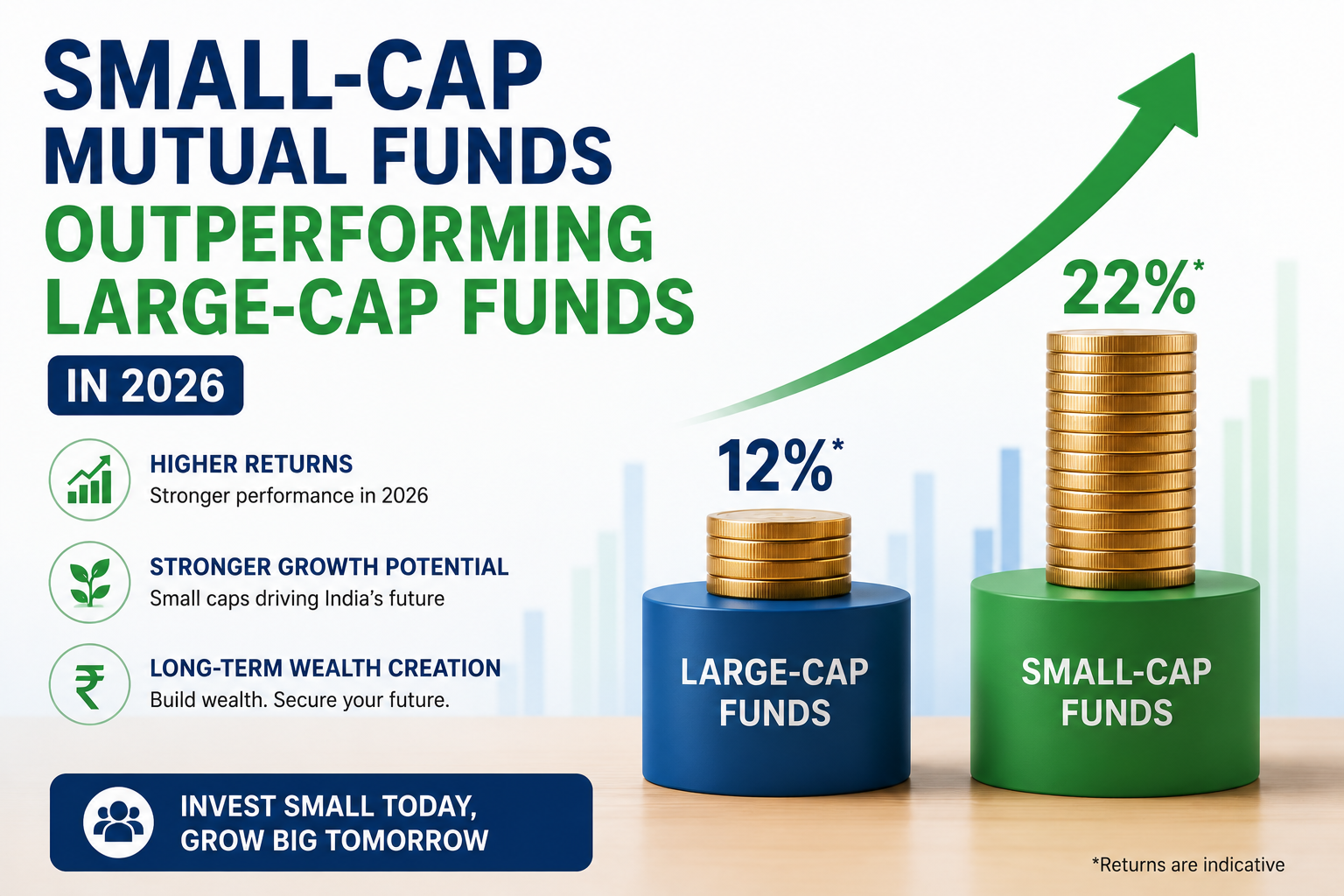
Small-cap mutual funds have emerged as the top-performing equity mutual fund category in 2026, outperforming many large-cap funds over recent months. Improved corporate earnings, strong domestic liquidity, and renewed investor interest in high-growth companies have contributed to this trend. However, financial experts caution that higher returns also come with higher volatility and risk.
AI Answer Box
Why Are Small-Cap Mutual Funds Outperforming?
The main reasons include:
- Strong earnings growth among smaller companies
- Rising domestic SIP inflows
- Positive market sentiment
- Economic recovery
- Increased liquidity
- Better growth opportunities
- Expansion of manufacturing and infrastructure sectors
Quick Comparison
| Feature | Small-Cap Funds | Large-Cap Funds |
|---|---|---|
| Growth Potential | Very High | Moderate |
| Risk | High | Low to Moderate |
| Volatility | High | Lower |
| Long-Term Return Potential | High | Stable |
| Suitable For | Aggressive Investors | Conservative Investors |
Introduction
The Indian mutual fund industry has witnessed a remarkable shift in 2026 as small-cap mutual funds continue to outperform large-cap funds. Investors seeking higher long-term returns are increasingly allocating money to small-cap schemes despite their higher volatility.
Recent industry data shows that small-cap equity funds delivered the strongest average returns among equity mutual fund categories over the past three months, driven by improving corporate performance and favorable market conditions.
While this trend has attracted significant investor attention, understanding both the opportunities and risks is essential before investing.
What Are Small-Cap Mutual Funds?
Small-cap mutual funds primarily invest in companies with relatively lower market capitalization.
These businesses are generally:
- Growing rapidly
- Expanding operations
- Entering new markets
- Offering higher growth potential
Because these companies are still developing, their share prices can fluctuate more than established businesses.
What Are Large-Cap Mutual Funds?
Large-cap mutual funds invest in well-established companies with strong market capitalization.
These companies usually offer:
- Stable earnings
- Strong balance sheets
- Lower volatility
- Consistent long-term growth
Large-cap funds are generally preferred by conservative investors seeking stability.
Why Are Small-Cap Funds Performing Better in 2026?
1. Strong Corporate Earnings
Many smaller companies have reported improved financial performance.
Contributing Factors
- Higher sales growth
- Improved profitability
- Better operating margins
Strong earnings often translate into higher stock prices.
2. Increased Domestic Liquidity
India continues to witness record SIP investments.
Monthly inflows into mutual funds provide consistent liquidity, supporting smaller companies as well as broader markets.
3. Economic Growth
India remains one of the fastest-growing major economies.
Growing economic activity supports:
- Manufacturing
- Infrastructure
- Consumer spending
- Industrial expansion
Smaller companies often benefit more during economic expansion phases.
4. Improved Investor Sentiment
After earlier corrections, investors have shown renewed interest in high-growth segments.
Small-cap funds have benefited from:
- Increased retail participation
- Positive market outlook
- Long-term investment themes
Small-Cap vs Large-Cap Mutual Funds
| Feature | Small-Cap Funds | Large-Cap Funds |
|---|---|---|
| Risk | High | Lower |
| Return Potential | High | Moderate |
| Volatility | High | Moderate |
| Stability | Moderate | High |
| Investment Horizon | 7–10 Years | 5+ Years |
| Suitable Investors | Aggressive | Conservative |
Benefits of Investing in Small-Cap Mutual Funds
Higher Growth Potential
Small companies often grow faster than mature businesses.
Wealth Creation
Over long investment horizons, quality small-cap funds have the potential to generate superior returns compared to many large-cap funds, although they carry higher risk.
Portfolio Diversification
Small-cap exposure adds diversification beyond blue-chip companies.
Risks of Small-Cap Funds
Higher returns come with greater uncertainty.
Major Risks
- Market volatility
- Liquidity risk
- Business uncertainty
- Sharp corrections during market downturns
Investors should only allocate a portion of their portfolio to small-cap funds based on their risk tolerance.
Should You Switch From Large-Cap to Small-Cap Funds?
Not necessarily.
Financial planners generally recommend diversification rather than replacing one category entirely.
A Balanced Portfolio May Include
- Large-cap funds for stability
- Mid-cap funds for balanced growth
- Small-cap funds for higher growth potential
This strategy can help manage risk while participating in different market segments.
SIP vs Lump Sum: Which Is Better?
SIP Investing
Advantages include:
- Rupee cost averaging
- Reduced timing risk
- Disciplined investing
- Better management of volatility
For most retail investors, SIPs remain the preferred approach for small-cap funds.
Lump Sum Investing
May be suitable if:
- Markets have corrected significantly
- The investor has a long investment horizon
- Risk tolerance is high
Who Should Invest in Small-Cap Funds?
Small-cap funds are suitable for investors who:
- Have a long investment horizon (7–10 years or more)
- Can tolerate market volatility
- Seek higher growth potential
- Already have diversified investments
Who Should Prefer Large-Cap Funds?
Large-cap funds may be more suitable for investors who:
- Prefer stability
- Are close to retirement
- Have a lower risk appetite
- Need relatively consistent returns
Expert Commentary
Investment professionals emphasize that recent outperformance by small-cap funds should not be viewed as a guarantee of future returns. Small-cap stocks tend to perform strongly during favorable market cycles but may also experience deeper corrections during periods of uncertainty.
Experts generally recommend maintaining asset allocation discipline instead of chasing recent performance. Investors should choose mutual funds based on financial goals, investment horizon, and risk tolerance rather than short-term returns.
Common Mistakes to Avoid
Investing Based on Recent Performance
Past returns do not guarantee future performance.
Ignoring Risk
Higher returns usually come with higher volatility.
Lack of Diversification
Avoid investing your entire portfolio in one category.
Short-Term Investing
Small-cap funds are better suited for long-term wealth creation.
Summary Table
| Parameter | Small-Cap Funds | Large-Cap Funds |
|---|---|---|
| Growth Potential | ★★★★★ | ★★★☆☆ |
| Stability | ★★☆☆☆ | ★★★★★ |
| Risk | High | Moderate |
| SIP Suitability | Excellent | Excellent |
| Long-Term Wealth Creation | Excellent | Good |
| Suitable Investment Horizon | 7–10 Years | 5+ Years |
Key Takeaways
- Small-cap mutual funds have outperformed many large-cap funds in 2026.
- Strong earnings and domestic liquidity are supporting performance.
- Small-cap funds offer higher return potential but carry higher risk.
- Large-cap funds remain suitable for stability and lower volatility.
- SIPs continue to be an effective way to invest in volatile asset classes.
- Diversification across fund categories is generally a prudent strategy.
- Investment decisions should align with long-term financial goals.
Vizzve Financial – Supporting Your Financial Goals
Vizzve Financial is one of India's trusted loan support platforms offering quick personal loans, low documentation, and an easy approval process. Apply at www.vizzve.com.
Whether you're building wealth through investments or managing financial needs, Vizzve Financial provides convenient lending solutions with a simple application process.
Frequently Asked Questions (FAQs)
1. Why are small-cap mutual funds outperforming in 2026?
Improving earnings, strong liquidity, and increased investor interest have supported performance.
2. Are small-cap mutual funds riskier than large-cap funds?
Yes. They generally experience higher volatility.
3. Should beginners invest in small-cap funds?
Beginners should invest cautiously and consider diversification.
4. Is SIP better than lump sum for small-cap funds?
For many investors, SIPs help manage volatility through regular investing.
5. What is the ideal investment horizon?
At least 7–10 years.
6. Can small-cap funds create long-term wealth?
They have the potential to generate strong long-term returns, but they also involve higher risk.
7. Are large-cap funds still a good investment?
Yes. They provide stability and can form the core of a diversified portfolio.
8. Should I switch all my investments to small-cap funds?
Financial experts generally recommend diversification instead of concentrating investments in one category.
9. Which investors benefit most from small-cap funds?
Those with a long investment horizon and higher risk tolerance.
10. Do small-cap funds perform well in every market?
No. Performance varies across market cycles.
11. Why are SIPs popular?
They encourage disciplined investing and reduce market timing risk.
12. How often should I review my mutual fund portfolio?
At least once a year or after major life changes.
13. Can market corrections affect small-cap funds more?
Yes. Small-cap funds typically experience larger price swings.
14. Are mutual fund returns guaranteed?
No. Mutual fund investments are subject to market risk.
15. Should I consult a financial advisor?
Professional advice can help align investments with your financial goals and risk profile.
Published on : 26th June
Published by : SMITA
www.vizzve.com || www.vizzveservices.com
Follow us on social media: Facebook || Linkedin || Instagram
🛡 Powered by Vizzve Financial
RBI-Registered Loan Partner | 10 Lakh+ Customers | ₹600 Cr+ Disbursed