

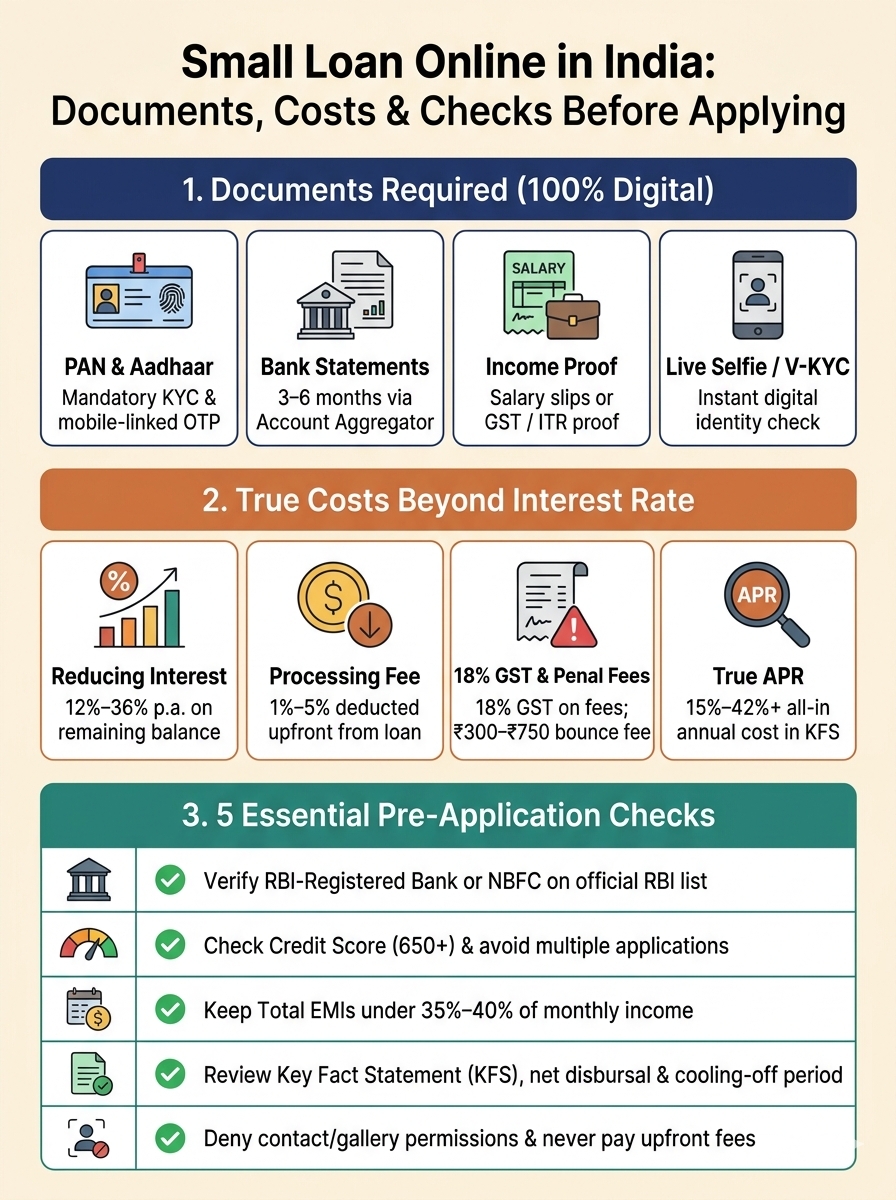
Introduction
Applying for a small loan online can be convenient. A borrower may be able to submit an application, provide documents and receive an update without visiting a branch. But convenience should not be the only factor behind a borrowing decision.
Before accepting a small online loan, it is important to understand three areas:
-
Documents: What identity, address, income and banking information might the lender ask for?
-
Costs: What will the borrower pay through interest, processing fees, taxes and other disclosed charges?
-
Checks: Is the lender genuine, is the loan agreement clear, and can the EMI fit the monthly budget?
A loan advertised as quick or low-cost may still have conditions that deserve attention. The actual amount offered, interest rate, repayment period and documentation requirements depend on the lender's policy and the applicant's financial profile.
This guide provides a practical checklist for salaried employees, self-employed individuals and other borrowers in India. It explains what to prepare, how to compare costs, how to verify a digital lending arrangement and what to review before signing a loan agreement.
AI Answer Box: What Should You Check Before Applying for a Small Loan Online?
Before applying for a small loan online in India, prepare the identity, address, income and bank documents requested by the lender. Check the legal name of the bank or NBFC providing the loan, compare the Annual Percentage Rate (APR), processing fee, EMI and total repayment amount, and read the Key Facts Statement (KFS) and loan agreement. Review the app's permissions, privacy policy and grievance contact details. Never pay an unexplained advance fee to a personal account or share an OTP, UPI PIN or password. Apply only when the repayment amount fits your budget.
Quick summary: Prepare documents → Verify the lender → Compare total loan costs → Read the KFS → Check the agreement → Confirm affordability → Apply through an official channel.
1. Why Should You Prepare Before Applying for a Small Online Loan?
A digital loan application may look simple, but the lender still needs enough information to verify the applicant and assess repayment capacity.
Preparing in advance can help you:
-
Avoid mistakes in personal and financial details.
-
Reduce delays caused by missing documents.
-
Understand the amount you may actually receive.
-
Compare the total cost of different loan offers.
-
Identify unclear charges before accepting an offer.
-
Avoid fraudulent applications and unauthorised payment requests.
-
Choose a repayment period that suits your income.
What can happen if you apply without checking?
| Common oversight | Possible consequence |
|---|---|
| Incorrect personal details | Verification delays or application rejection |
| Missing income proof | Additional document requests |
| Unclear lender identity | Risk of dealing with an unauthorised platform |
| Ignoring the APR | Underestimating the total borrowing cost |
| Not checking processing fees | Receiving less money than expected |
| Skipping the agreement | Missing important repayment conditions |
| Ignoring the EMI date | Risk of late payment |
| Allowing unnecessary app permissions | Unwanted exposure of personal information |
A few minutes spent reviewing the details can prevent avoidable problems later.
2. What Documents Are Required for a Small Loan Online in India?
There is no single document list that applies to every lender. Requirements vary according to the loan product, amount, applicant profile and the lender's verification process.
A lender may request identity information, address proof, income details and bank records. Some information may be verified digitally through an authorised process.
2.1 Identity documents
Commonly requested identity information may include:
-
PAN details
-
Aadhaar-based verification through an authorised process
-
Passport or another accepted identity document
-
Other officially valid documents accepted by the lender
PAN is commonly used in financial and lending processes. However, the exact identity requirements depend on the lender and applicable rules.
Safety reminder: Do not send identity documents to an unknown person over a messaging app just because they claim to arrange a loan. Use the lender's official website or authorised application.
2.2 Address proof
A lender may need to verify the applicant's residential address.
Documents or information accepted may include:
-
Aadhaar, where accepted
-
Passport
-
Voter ID
-
Driving licence
-
Utility bill or another accepted address document
-
Other officially valid documents
The lender may use a digital verification process instead of asking for a physical copy. Follow only the official instructions shown in the application or communicated through verified lender channels.
2.3 Income proof
Income information helps a lender assess whether the applicant can repay the proposed loan.
The documents may differ for salaried and self-employed borrowers.
For salaried employees
A salaried applicant may be asked for:
-
Recent salary slips
-
Bank statements showing salary credits
-
Employer details
-
Employment information
-
Form 16 or other income-related records, where required
For self-employed borrowers
A self-employed applicant may be asked for:
-
Personal or business bank statements
-
Income Tax Returns (ITRs), where required
-
Business income records
-
Invoices or payment records
-
Business registration or professional details, where applicable
-
Other documents accepted by the lender
Not every lender requires every item. A borrower should submit only the information requested through the lender's verified process.
2.4 Bank account details
The lender may ask for bank account information to verify the account and assess financial activity. It may also need the account details for permitted loan disbursal and repayment arrangements.
Depending on the process, the borrower may be asked for:
-
Account holder name
-
Bank account number
-
IFSC
-
Bank statement
-
Account verification through an authorised method
Never share your internet banking password, debit card PIN, UPI PIN or OTP with a person claiming to verify your bank account.
2.5 Mobile number and email address
An active mobile number and email address may be used for:
-
Application updates
-
OTP-based authentication
-
Loan offer communication
-
Agreement and document access
-
Repayment reminders
-
Customer support
Use contact details that you can access throughout the loan period.
Document checklist at a glance
| Document or information | Salaried applicant | Self-employed applicant |
|---|---|---|
| PAN | Commonly requested | Commonly requested |
| Identity proof | As required | As required |
| Address proof | As required | As required |
| Bank statements | Often requested | Often requested |
| Salary slips | May be requested | Usually not applicable |
| ITR | If required | May be requested |
| Business income records | Usually not applicable | May be requested |
| Employer or business details | Employer details | Business or professional details |
| Active mobile number | Usually required | Usually required |
| Email address | May be required | May be required |
Important: This table is a general guide, not a universal lender checklist. Confirm the actual requirements with the bank or NBFC providing the loan.
3. What Documents Should Self-Employed Borrowers Prepare?
Self-employed people may have income from business operations, freelance assignments, professional services, commissions or other sources. Their income may not arrive as a fixed salary every month.
For this reason, a lender may request records that help explain the source, frequency and consistency of income.
Useful records to organise
-
Bank statements covering the period requested by the lender.
-
ITR acknowledgements or tax-related documents, where required.
-
Invoices issued to clients.
-
Payment receipts and business transaction records.
-
Business registration documents, where applicable.
-
Professional or business account details.
-
Records of existing loan repayments.
Why do consistent records matter?
Suppose a freelance designer receives payments from several clients. One month may show three large credits, while another month may show several smaller payments. Clear invoices and bank entries can help explain these transactions.
A borrower should not alter statements, create false invoices or exaggerate income to improve the chances of approval. Incorrect information can result in rejection and may create further problems.
A practical preparation tip
Keep personal and business transactions organised. Where possible, maintain clear records showing:
-
Who paid you.
-
When the payment was received.
-
What service or work it relates to.
-
Whether the amount is recurring or occasional.
-
What business expenses need to be deducted when estimating available income.
The lender may use its own method to assess income, so organised records do not guarantee approval.
4. What Costs Should You Check Before Taking a Small Online Loan?
The advertised interest rate is only one part of the borrowing cost. A borrower should understand every applicable charge and compare the overall cost of credit.
4.1 Interest rate
The interest rate is the rate charged on the borrowed principal. It may be presented as an annual rate or according to another disclosed pricing method.
Before accepting the loan, check:
-
Whether the rate is fixed or variable.
-
How interest is calculated.
-
Whether the loan uses a reducing-balance method or another method.
-
Whether the quoted rate matches the agreement.
-
Whether the rate changes under any stated condition.
Do not compare two loans only by looking at the headline rate. Different fee structures and repayment periods can change the total cost.
4.2 Annual Percentage Rate (APR)
APR is an annualised measure of the cost of credit. It includes interest and applicable charges that are required to be included under the relevant RBI framework.
For a borrower comparing loan offers, APR can provide a more useful picture than the interest rate alone.
Example: Loan A may advertise a lower interest rate but have a higher processing fee. Loan B may have a slightly higher interest rate but lower fees. Comparing the APR and total repayment can help identify which offer is less expensive overall.
4.3 Processing fee
A lender may charge a processing fee for handling an application. The amount and method of collection vary by product.
Check:
-
The exact fee amount or percentage.
-
Whether GST or other applicable taxes are added.
-
Whether the fee is deducted before disbursal.
-
Whether it is refundable in any situation.
-
Whether it appears in the KFS and loan documents.
Do not pay a processing fee to an individual's personal bank account or UPI ID unless the lender's official documentation clearly establishes an authorised payment process. Verify the payment instructions independently.
4.4 GST and applicable taxes
Where a fee is subject to GST or another applicable tax, the borrower should check whether the quoted amount includes the tax or whether it is charged separately.
Do not assume every loan-related charge is treated in the same way for tax purposes. Review the lender's invoice and KFS.
4.5 Late-payment or penal charges
A missed payment may lead to additional charges under the loan agreement and applicable regulatory requirements.
Check:
-
When a payment is considered overdue.
-
How penal charges are calculated.
-
Whether reminders or other fees apply.
-
How missed payments are reflected in the loan account.
-
What process to follow if an automatic payment fails.
RBI's instructions on penal charges restrict the use of penal interest as an additional rate component and require applicable penal charges to be reasonable, disclosed and handled according to the relevant directions. Review the lender's current policy and agreement.
4.6 Prepayment or foreclosure charges
Prepayment means repaying some or all of the outstanding loan before the scheduled end date. The conditions can depend on the lender, loan type and applicable RBI requirements.
Check:
-
Whether part-prepayment is allowed.
-
Whether full foreclosure is allowed.
-
Whether a charge applies.
-
Whether advance notice is required.
-
How the outstanding balance is calculated.
Do not assume that early repayment is always free or always chargeable. Check the specific terms that apply to your loan.
4.7 Other disclosed charges
Depending on the product, there may be other charges associated with services or events. Examples can include a payment-return charge or a document-related fee, where applicable and permitted.
Ask for a clear explanation of every charge. If a cost is not understandable or is not reflected in the relevant loan disclosures, seek clarification before accepting the offer.
Loan cost checklist
| Cost item | What to verify |
|---|---|
| Interest rate | Annual rate and calculation method |
| APR | Overall annualised borrowing cost |
| Processing fee | Amount, percentage and collection method |
| GST or taxes | Whether applicable taxes are additional |
| EMI | Amount and due date |
| Late-payment charges | Trigger and calculation |
| Prepayment charges | Conditions for early repayment |
| Other fees | Purpose and disclosure |
| Total repayment | Total amount payable over the loan term |
| Net disbursal | Amount expected to reach your bank account |
5. How to Calculate the Actual Cost of a Small Loan
A simple cost comparison can help a borrower understand how much a loan may cost.
Illustrative example: ₹20,000 small loan
Assume the following hypothetical terms:
| Particular | Example |
|---|---|
| Principal | ₹20,000 |
| Annual interest rate | 15% |
| Repayment tenure | 12 months |
| Approximate monthly EMI | ₹1,806 |
| Approximate total of 12 EMIs | ₹21,672 |
| Approximate interest | ₹1,672 |
This is an illustrative reducing-balance EMI calculation. It excludes processing fees, taxes and other charges. It is not an actual lender quotation or APR calculation.
If a processing fee is charged, the net amount received may be lower than the sanctioned principal. The borrower's total cost can therefore be different from the interest-only example.
Why should you check the net disbursal amount?
Consider a hypothetical offer:
-
Sanctioned loan amount: ₹20,000
-
Disclosed processing fee: ₹400
-
Applicable tax on the fee: ₹72
-
Illustrative net amount after deduction: ₹19,528
The borrower may receive ₹19,528 while the loan principal and repayment obligation are based on the agreement. The actual accounting and treatment of charges must be confirmed in the lender's documents.
This is why the borrower should compare the sanctioned amount, deductions, net disbursal, APR and total repayment before accepting an offer.
Questions to ask about the total cost
-
How much will be credited to my bank account?
-
What is the total amount I must repay?
-
Is the processing fee deducted upfront?
-
Are taxes included in the displayed charges?
-
Does the EMI include all scheduled principal and interest?
-
What happens if I pay late?
-
Can I close the loan early, and what conditions apply?
6. What Is a Key Facts Statement, and Why Should You Read It?
A Key Facts Statement (KFS) is a standardised document that presents important loan information in a format intended to help prospective borrowers understand the offer before entering into the loan contract.
RBI's KFS framework for applicable retail and MSME term loans requires regulated lenders to provide key information, including the APR and repayment schedule. The KFS is intended to help borrowers make an informed decision rather than rely only on advertisements or verbal explanations.
What should you look for in the KFS?
-
Loan amount and tenure.
-
Interest rate and method of calculation.
-
APR and its computation.
-
Processing fee and other applicable charges.
-
Repayment schedule.
-
EMI amount and due dates.
-
Penal charges, where applicable.
-
Relevant third-party charges, where applicable.
-
Contact details for grievance redressal.
KFS versus loan agreement
| Feature | Key Facts Statement | Loan agreement |
|---|---|---|
| Main purpose | Summarises key loan terms and costs | Sets out the contractual terms |
| APR | Shows APR and related cost information | May contain detailed pricing provisions |
| Repayment | Provides repayment schedule | Explains repayment obligations and conditions |
| Charges | Lists applicable charges | Contains detailed fee and default provisions |
| Legal role | Supports informed decision-making before contract | Records the borrower's and lender's contractual obligations |
Read both documents. If the terms appear inconsistent, ask the lender for clarification before accepting the offer.
7. Checks to Complete Before Applying for a Small Loan Online
Documents and costs are only part of the decision. The borrower should also verify the lender, platform and application process.
7.1 Verify the regulated lender
Identify the legal name of the bank or Non-Banking Financial Company (NBFC) that will provide the loan.
A digital lending app may be operated by the regulated lender or by a Lending Service Provider (LSP) working with that lender. The app or platform is not necessarily the entity providing the credit.
Check the lender's official website and verify the claimed relationship independently.
7.2 Check the RBI Digital Lending App directory
RBI has operationalised a public directory of Digital Lending Apps deployed by regulated entities. It is intended to help customers verify a digital app's claimed association with a regulated bank or NBFC.
However, the directory is based on information submitted by regulated entities. RBI has stated that the directory is for limited verification purposes and should not be treated as an RBI endorsement, rating or guarantee of an app.
7.3 Review app permissions
Before installing or using an application, examine the permissions it requests.
Be cautious if an app seeks access to information that does not appear necessary for the loan service, such as:
-
Contact lists
-
Call logs
-
Personal photographs
-
Files unrelated to the application
-
Unnecessary device information
Read the privacy policy and consent screens. Do not grant broad access simply because the app says it is required for instant approval.
7.4 Check the website and contact details
Look for:
-
The legal name of the lender.
-
Official website and verified contact details.
-
Customer support information.
-
Grievance redressal officer details.
-
Privacy policy.
-
Loan terms and conditions.
-
Clear information about the lending partner.
A professional-looking website alone does not prove that a loan service is genuine.
7.5 Check the repayment method
Confirm how repayments will be collected and where you should make payments.
Use only the payment methods stated in the loan agreement or official lender communication. Avoid paying an individual employee, agent or unrelated account.
7.6 Look for pressure tactics
Be cautious if someone:
-
Promises guaranteed approval.
-
Demands an advance payment to release the loan.
-
Asks for an OTP or UPI PIN.
-
Pressures you to accept without reading the agreement.
-
Threatens to contact your friends or family.
-
Refuses to identify the regulated lender.
A legitimate loan decision should not depend on sharing confidential banking credentials with an agent.
8. What Are the RBI Rules Borrowers Should Know About Digital Loans?
RBI issued the Reserve Bank of India (Digital Lending) Directions, 2025 on 8 May 2025 to consolidate regulatory instructions on digital lending by regulated entities.
The directions cover digital lending arrangements involving banks, NBFCs and other specified regulated entities.
Some important borrower-facing areas include:
8.1 Clear lender and LSP roles
A regulated entity may engage an LSP to provide specified services. The regulated lender remains responsible for compliance with applicable regulatory requirements.
Borrowers should understand whether they are interacting with the lender or a service provider facilitating the application.
8.2 Disclosures before accepting the loan
Important loan terms and costs should be communicated through the prescribed disclosures, including the KFS where applicable.
The borrower should have a clear view of the APR, repayment schedule and applicable charges before entering the contract.
8.3 Disbursal and repayment safeguards
Digital lending rules prescribe how loan disbursal and repayment flows should take place, subject to specified exceptions. For ordinary digital loan transactions, the framework restricts third-party pass-through or pool accounts and sets requirements for direct fund flows.
8.4 Cooling-off period
The digital lending framework provides an initial cooling-off period of at least one day, as determined under the regulated entity's policy, during which the borrower is given an option to exit by paying the principal and proportionate APR without penalty. A reasonable one-time processing fee may be retained if it was disclosed upfront in the KFS.
Check the exact cooling-off terms in your loan documents.
8.5 Grievance redressal
The regulated lender and relevant LSP must provide designated grievance redressal arrangements. The lender's grievance contact details should be available through the prescribed channels, including the KFS.
If a complaint is not resolved by the regulated entity within 30 days, or the borrower is dissatisfied with the response, the borrower may be able to escalate it through RBI's Complaint Management System under the applicable RBI Integrated Ombudsman Scheme eligibility and procedure.
These protections are not a substitute for checking the lender and understanding the loan terms.
9. Comparison: A Genuine Loan Offer Versus a Suspicious Loan Offer
| Checkpoint | More reassuring sign | Warning sign |
|---|---|---|
| Lender identity | Clearly names the bank or NBFC | No identifiable lender |
| Loan documents | KFS and agreement are available | No written terms |
| APR and fees | Costs are clearly disclosed | Charges appear only after acceptance |
| Payment request | Official payment channel | Personal UPI ID or unrelated account |
| App permissions | Relevant and explained | Unnecessary access to private data |
| Approval claim | Subject to verification | Guaranteed approval for everyone |
| Customer support | Verifiable grievance details | No working contact information |
| Communication | Professional and documented | Threats, pressure or abusive messages |
| Credentials | Never asks for PIN or password | Requests OTP, PIN or banking password |
A single warning sign deserves attention. Several warning signs together should be a reason to stop and verify the service independently.
10. Pros and Cons of Preparing Documents and Comparing Loan Costs
Preparing before applying takes some time, but it can improve the quality of the borrowing decision.
Pros
-
Makes the application process more organised.
-
Helps reduce avoidable document-related delays.
-
Makes it easier to compare multiple loan offers.
-
Helps identify undisclosed or unclear charges.
-
Encourages careful review of the KFS and agreement.
-
Reduces the risk of sharing documents with suspicious platforms.
-
Helps borrowers plan repayments more realistically.
Cons or limitations
-
Collecting income records can take time.
-
Different lenders may request different documents.
-
Some applicants may need additional verification.
-
A complete application does not guarantee approval.
-
Comparing loan offers can be difficult when fees and repayment structures differ.
Summary table
| Preparation activity | Main benefit | Limitation |
|---|---|---|
| Organising identity documents | Supports verification | Requirements differ |
| Preparing income records | Helps explain repayment capacity | Additional evidence may be requested |
| Comparing APR | Improves cost comparison | Offers must have comparable terms |
| Reading the KFS | Clarifies important loan details | Requires careful review |
| Verifying the lender | Helps identify the actual credit provider | Directory information is not an endorsement |
| Checking EMI affordability | Helps prevent repayment stress | Future income can still change |
11. Step-by-Step Checklist Before Submitting Your Application
Use this sequence before pressing the final application or acceptance button.
Step 1: Decide the amount you need
Calculate the expense and borrow only what is necessary. Do not choose a larger amount simply because the app displays a higher eligible limit.
Step 2: Organise the documents
Prepare the identity, address, income and banking information requested by the lender. Check that names and details are consistent.
Step 3: Identify the lender
Find out which bank or NBFC is providing the credit. Verify the app's claimed association through the lender's official channels and the relevant RBI directory, where applicable.
Step 4: Compare the costs
Review the interest rate, APR, processing fee, taxes, EMI, tenure and total repayment amount.
Step 5: Read the KFS
Check the loan amount, APR, repayment schedule and applicable charges. Ask for clarification if anything is unclear.
Step 6: Review the agreement
Confirm that the agreement reflects the terms you accepted. Save a copy of the final documents.
Step 7: Check affordability
Calculate whether the EMI fits your income after essential expenses and existing debt payments.
Step 8: Review permissions and privacy
Understand what information the app collects and why. Avoid granting unnecessary access.
Step 9: Confirm repayment arrangements
Know the due date, payment method and official support contact. Keep sufficient funds available before the due date.
Step 10: Submit only when ready
Proceed only if the lender is verified, the costs are clear and the repayment plan is manageable.
12. Real-World Example: A Self-Employed Borrower Reviews a Small Loan Offer
Imagine a self-employed online seller who needs ₹18,000 to repair equipment used for daily business operations.
The seller finds a digital loan offer and begins checking it before applying.
First, the documents: The applicant organises PAN details, accepted identity and address proof, bank statements and business income records requested by the lender.
Second, the lender: The applicant identifies the bank or NBFC providing the credit and checks the platform's claimed association.
Third, the cost: The applicant compares the APR, processing fee, EMI, repayment period and total amount payable. The seller also checks whether the processing fee is deducted before disbursal.
Fourth, the agreement: The applicant reads the KFS and checks that the repayment terms match the offer.
Finally, affordability: The seller estimates monthly business income after business expenses and existing obligations. The proposed EMI is considered alongside essential household expenses.
The applicant proceeds only if the lender is verified, the terms are understood and the repayment appears manageable.
Practical lesson: Preparing documents is useful, but understanding the total cost and repayment obligation is equally important. A complete application is not automatically a good borrowing decision.
13. Expert Commentary: What Matters Most Before Borrowing?
A responsible digital lending decision should focus on the borrower's ability to repay, not just the convenience of receiving money.
Three checks are especially important:
-
Verify the source of credit. Know which regulated bank or NBFC is providing the loan and whether the platform is authorised to facilitate the process.
-
Compare the complete cost. Review APR, fees, net disbursal and total repayment instead of relying on an advertised rate.
-
Protect personal information. Share documents only through verified channels and never disclose confidential authentication credentials.
A lender's approval does not automatically mean that a loan is affordable for every applicant. Borrowers should make their own budget assessment before accepting the offer.
14. Frequently Asked Questions About Small Loan Documents, Costs and Checks
1. What documents are required for a small loan online in India?
Commonly requested documents include PAN, identity proof, address proof and bank statements. Salaried applicants may need salary slips, while self-employed applicants may need ITRs, business income records or other financial documents. Requirements vary by lender.
2. Can I get a small online loan without income proof?
Some lenders may use alternative information or digital verification methods, but they still need to assess repayment capacity. Do not assume that an offer advertising no income documents means there are no eligibility checks.
3. Is PAN mandatory for a small online loan?
PAN is commonly requested for loan applications and financial verification. The exact documentation requirements depend on the lender, product and applicable rules.
4. Do self-employed people need to submit ITR for a small loan?
Some lenders request ITRs, while others may accept bank statements, business records or alternative income evidence. Check the lender's requirements before applying.
5. What is the most important cost to check before taking a small loan?
Check the APR because it provides an annualised view of the cost of credit, including interest and applicable charges. Also review the total repayment amount, processing fee and net disbursal.
6. What is the difference between an interest rate and APR?
The interest rate is the rate charged on the loan principal. APR represents the annualised cost of credit and includes interest and applicable charges under the relevant disclosure framework.
7. Is a processing fee charged on every small online loan?
No. Processing fees depend on the lender and loan product. If a fee applies, check its amount, applicable taxes and collection method in the loan disclosures.
8. Why is the amount credited to my account lower than the approved loan amount?
A lender may deduct a disclosed processing fee or other permitted charges before disbursal. Compare the sanctioned amount, deductions and net disbursal shown in the KFS and loan documents.
9. What is a Key Facts Statement in a small loan?
A KFS is a standardised document that explains important loan terms, including APR, repayment schedule and applicable charges. Read it before accepting the loan agreement.
10. How can I verify whether an online loan app is genuine?
Identify the bank or NBFC providing the loan. Check the app's claimed association through the lender's official website and RBI's public Digital Lending App directory, where applicable. Remember that the directory is a verification aid, not an RBI endorsement.
11. Is it safe to upload bank statements to a loan app?
Only upload documents through the verified lender's official website or authorised application. Read the privacy notice, understand the purpose of data collection and avoid sending statements to unknown individuals or messaging accounts.
12. Should I pay an advance fee to get a small loan approved?
Be cautious of demands for advance payments to personal bank accounts or UPI IDs. Verify every legitimate charge against the lender's official documents and payment instructions before paying.
13. Can a lender charge a fee that is not mentioned in the KFS?
Applicable RBI requirements restrict the collection of charges that were not disclosed in the KFS, unless the borrower's explicit consent is obtained in accordance with the relevant rules. Ask the lender for a written explanation of any additional charge.
14. What should I check in a small loan agreement?
Review the lender's legal name, loan amount, interest rate, APR, fees, repayment tenure, EMI dates, late-payment conditions, prepayment terms, data permissions and grievance redressal details.
15. What should I do if I suspect a fake loan app?
Stop sharing information and do not make further payments. Contact your bank immediately if money or banking credentials may be at risk. Report suspected cyber financial fraud through the official National Cyber Crime Reporting Portal or the appropriate law-enforcement channel.
15. Explore Loan Support with Vizzve Financial
Finding a loan is only one part of responsible borrowing. It is equally important to understand eligibility, documentation, loan charges and repayment obligations before accepting an offer.
Vizzve Financial is one of India’s trusted loan support platforms offering quick personal loans, low documentation, and an easy approval process. Apply at www.vizzve.com.
Before proceeding, review the applicable lender, eligibility requirements, interest rate, APR, fees and repayment terms. Loan approval and disbursal are subject to the lender's assessment and conditions.
Conclusion
A small online loan may help meet a short-term financial requirement, but borrowers should not rush into an application simply because the process is digital.
Start by preparing the documents the lender may request. Then identify the actual bank or NBFC providing the credit and compare the complete borrowing cost, including APR, processing fees, taxes and total repayment. Finally, review the KFS, loan agreement, app permissions and repayment arrangements.
The most useful pre-application check is simple: Can you verify the lender, understand every major cost and repay the loan comfortably? If any of these answers is unclear, pause and seek clarification before proceeding.
Disclaimer: This article is for general educational purposes and does not constitute financial, legal or lending advice. Loan eligibility, document requirements, interest rates, fees and approval conditions vary by lender and applicant. Always review the latest loan documents and applicable regulatory requirements before borrowing.
Published on : 25th November
Published by : Doulath bee
www.vizzve.com || www.vizzveservices.com
Follow us on social media: Facebook || Linkedin || Instagram
🛡 Powered by Vizzve Financial
RBI-Registered Loan Partner | 10 Lakh+ Customers | ₹600 Cr+ Disbursed