

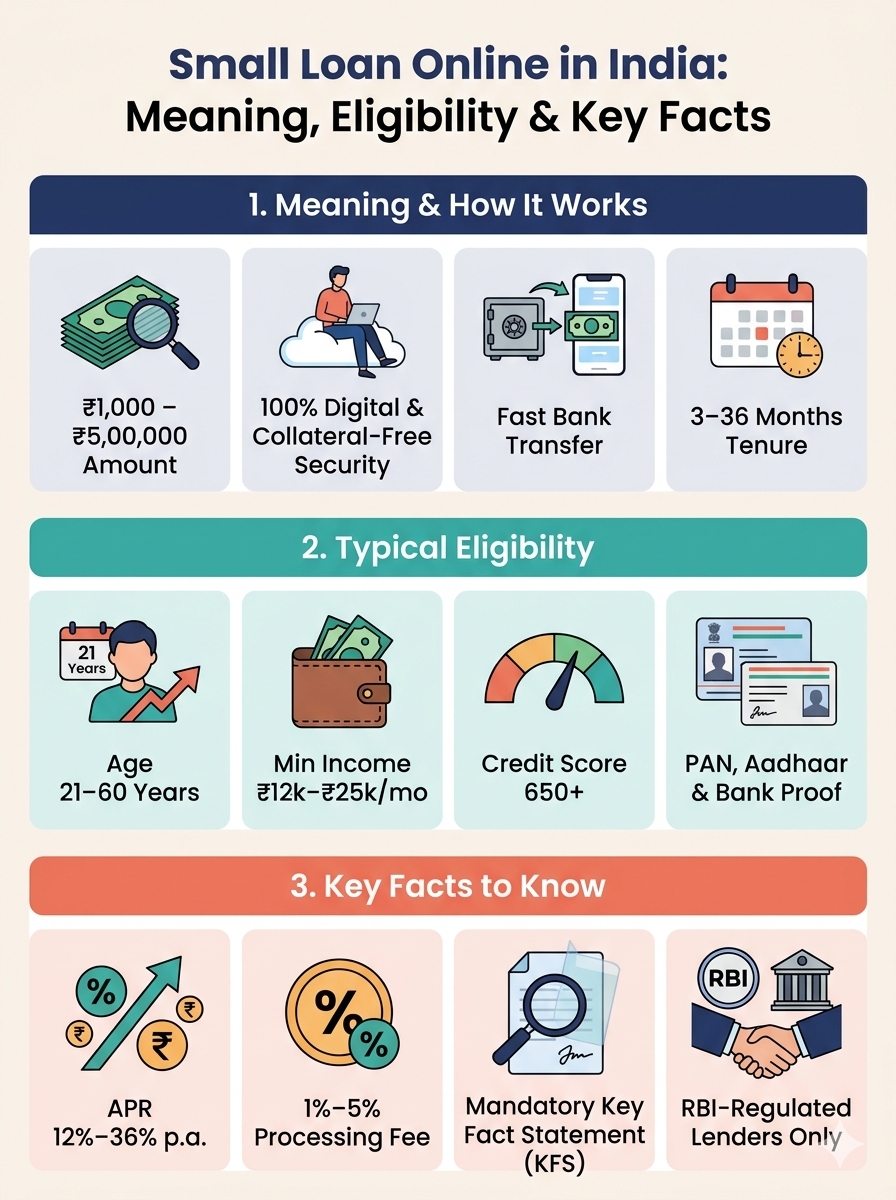
Introduction: Why Are Small Online Loans Popular?
Financial needs do not always involve a large amount. A person may need money to repair a vehicle, pay a medical bill, purchase work equipment, manage an unexpected household expense or cover a temporary gap before receiving income.
In such situations, a small loan may appear more appropriate than borrowing a larger amount. Digital platforms have made it possible to explore loan offers and complete many application steps online without visiting a branch.
However, a convenient application process does not automatically make a loan affordable or suitable. A borrower still needs to understand the lender, repayment period, interest rate, fees and eligibility conditions.
A small loan can be useful when it addresses a genuine need and the repayment fits the borrower's budget. It can become a financial burden when someone borrows without checking the total cost or takes a new loan to repay an existing one.
This guide explains the meaning of small online loans in India, how they work, who may qualify, what documents may be required and how to compare offers safely.
AI Answer Box: What Is a Small Loan Online?
A small loan online is a relatively low-value credit facility that a person can explore and apply for through a digital platform. Depending on the lender, it may be offered as an unsecured personal loan or another type of credit product.
Key facts:
-
There is no single universal loan amount that defines every small online loan in India.
-
Banks and NBFCs set their own product limits, eligibility conditions, interest rates and repayment periods.
-
Applicants may need to provide identity, address, income and bank-account information.
-
Approval depends on the lender's credit assessment, not simply on completing an online form.
-
Borrowers should compare the APR, processing fee, net disbursal, EMI and total repayment amount.
-
The actual lender should be a verifiable bank or NBFC where the product is offered through a regulated entity.
In simple words: A small online loan is a way to seek a relatively modest amount of credit through a digital application process. The right choice depends on affordability, transparent terms and the credibility of the lender.
1. What Does Small Loan Online Mean?
A small loan online refers to a loan of a relatively modest amount that can be applied for through a digital channel. The application may be submitted using a lender's website, mobile application or an authorised Lending Service Provider (LSP).
The term describes the size and digital application method in general language. It does not automatically identify the legal or regulatory category of the credit product.
Is there a fixed amount for a small loan in India?
There is no single amount that applies to every product marketed as a small loan. One lender may offer a low-value personal loan, while another may use the term for a different loan range.
The amount available to an applicant can depend on:
-
Monthly income
-
Employment or business profile
-
Existing loan obligations
-
Credit history
-
Internal lending policy
-
Loan purpose, where relevant
-
Verification results
Do not assume that an advertised maximum amount is guaranteed to every applicant.
What types of small loans can be applied for online?
| Loan type | General purpose | Important consideration |
|---|---|---|
| Small personal loan | Household or personal expenses | Usually assessed on income and repayment capacity |
| Medical expense loan | Eligible healthcare-related expenses | Check disbursal and payment conditions |
| Education-related loan | Education expenses | Product terms may differ from personal loans |
| Short-term credit | Temporary cash-flow requirement | Check the short repayment period and total cost |
| Small business loan | Business working capital or expenses | Business records and cash flow may be assessed |
| Secured small loan | Credit backed by an asset or deposit | Understand collateral and default consequences |
Not every lender offers all these products online. A borrower should confirm the actual product type rather than relying on the advertisement's wording.
2. How Does a Small Online Loan Work?
A digital loan application generally involves several stages. The exact process depends on the bank or NBFC and the platform supporting the application.
Step 1: Select a loan product
The applicant checks the available loan amount, purpose, tenure and basic eligibility conditions.
Step 2: Enter personal details
The application may request details such as:
-
Full name
-
Date of birth
-
Mobile number
-
Address
-
Employment or occupation
-
Monthly income
-
Existing financial obligations
Step 3: Complete identity verification
The lender may conduct applicable Know Your Customer (KYC) checks and verify the applicant's information.
Step 4: Creditworthiness assessment
The lender evaluates the applicant's ability and willingness to repay. Depending on the product, this may include income details, bank transactions, existing liabilities and credit history.
Step 5: Review the loan offer
If an offer is made, the borrower should review the lender's identity, loan amount, interest rate, APR, fees, tenure and repayment schedule.
Step 6: Accept the agreement
The borrower should accept only after understanding the Key Facts Statement (KFS) and loan agreement.
Step 7: Receive the disbursal
If the loan is approved and all conditions are met, the lender disburses the funds according to the agreed process.
Step 8: Repay on schedule
The borrower makes repayments according to the loan agreement. The borrower should save payment receipts and track the outstanding balance.
3. Who Is Eligible for a Small Loan Online in India?
Eligibility requirements vary by lender and product. There is no single eligibility formula that applies to every online small loan.
A lender may consider the following factors.
3.1 Age
Applicants must meet the lender's minimum and maximum age conditions. The permitted age range can differ between products.
3.2 Income
The lender may assess whether the applicant has sufficient and reasonably stable income to manage the proposed repayment.
Income may come from:
-
Salaried employment
-
Self-employment
-
Professional services
-
Freelance work
-
Business activity
-
Other acceptable and verifiable sources
3.3 Employment or Occupation
The lender may accept applications from salaried and self-employed individuals, depending on the product.
A salaried applicant may be assessed using salary records and bank statements. A self-employed applicant may need to provide business or professional income records.
3.4 Credit History
Credit history can help a lender understand previous borrowing and repayment behaviour. A lender may consider credit score, repayment records, existing loans and recent credit applications.
A particular score does not guarantee approval. Each lender applies its own credit policy.
3.5 Existing Financial Obligations
Existing EMIs and other recurring debt payments affect the money available for a new repayment.
A borrower with several existing loans may have less repayment capacity than someone with similar income and fewer obligations.
3.6 Bank Account and Verification
Applicants may need an active bank account in their own name for verification and loan disbursal. The lender may also review bank transactions as part of its assessment, subject to applicable consent and data requirements.
4. Small Loan Eligibility: Salaried vs Self-Employed Applicants
The evidence used to assess income can differ according to the applicant's work profile.
| Eligibility factor | Salaried applicant | Self-employed applicant |
|---|---|---|
| Income evidence | Salary slips or salary credits | Business or professional income records |
| Bank statements | Salary account statements | Personal or business account statements |
| Employment evidence | Employer details or employment proof | Business or professional activity proof |
| Income pattern | Often regular monthly income | May vary by month or season |
| Tax records | May be requested | ITR or other tax records may be requested |
| Credit assessment | Income and repayment history | Income stability, cash flow and repayment history |
Can a freelancer apply for a small online loan?
Some lenders may consider freelancers, consultants and independent professionals. The applicant may be asked to provide bank statements, invoices, client payment records, tax documents or other evidence of earnings.
A freelancer should avoid estimating affordability using only the highest-income month. Reviewing income over several months can give a more realistic picture.
Can a small business owner apply?
Some lenders offer credit products for small business owners. Eligibility may depend on business vintage, turnover, cash flow, banking activity, credit history and the lender's product requirements.
A personal loan and a business loan are not interchangeable. The applicant should check which product is being offered and whether its permitted use matches the intended expense.
5. Documents Required for a Small Loan Online
The exact document list depends on the lender, product and applicant profile. Digital verification may reduce the need to upload some documents manually, but it does not remove the lender's obligation to verify relevant information.
| Document or information | Why it may be needed |
|---|---|
| PAN details | Identity and financial verification, as applicable |
| Aadhaar or other accepted KYC document | Identity and address verification, as applicable |
| Bank statements | Income and cash-flow assessment |
| Salary slips | Evidence of salaried income |
| Employment details | Work and income verification |
| Income Tax Returns | May support income assessment |
| Business registration or activity proof | May support self-employment verification |
| Mobile number and email | Communication and verification |
Do all applicants need the same documents?
No. A salaried applicant may be asked for salary slips, while a self-employed applicant may need business records or tax documents. Some verification may be completed through permitted digital processes.
Safety reminder: Submit documents only through a verified lender or authorised platform. Do not send identity documents to unknown individuals through personal messaging accounts.
6. What Is the Interest Rate on a Small Online Loan?
The interest rate is the cost charged for borrowing the principal amount. It may vary according to the lender, loan product, applicant's credit profile, tenure and other risk-related factors.
There is no single standard interest rate for all small online loans in India.
What affects the interest rate?
-
Credit history and repayment record
-
Verified income and financial stability
-
Existing loan obligations
-
Loan amount and tenure
-
Type of loan product
-
Lender's pricing policy
-
Applicable regulatory requirements
Interest rate vs APR: What is the difference?
| Term | Meaning |
|---|---|
| Interest rate | Rate used to calculate interest on the outstanding loan, according to the loan terms |
| APR | Annualised measure of the borrowing cost that includes applicable charges as defined under the relevant rules |
| Processing fee | Charge for processing or administering the loan, where applicable |
| Penal charges | Charges that may apply under disclosed terms for certain defaults or breaches |
A lower advertised interest rate does not necessarily mean a cheaper loan. Compare APR and the complete repayment amount.
7. Example: Understanding the Cost of a Small Online Loan
Suppose an applicant is considering a hypothetical loan of ₹20,000 for 12 months.
The applicant receives an offer with an illustrative annual interest rate of 15%, calculated on a reducing-balance basis, and a processing fee of 2% before applicable taxes.
| Particulars | Illustrative amount |
|---|---|
| Loan principal | ₹20,000 |
| Annual interest rate | 15% |
| Tenure | 12 months |
| Processing fee at 2% | ₹400 |
| Amount before any applicable fee taxes credited | ₹19,600 |
| Approximate EMI before fee impact | ₹1,806 |
This is a simplified illustration, not an actual lender quotation or APR calculation. The exact EMI, APR, net disbursal and total repayment depend on the lender's calculation method, applicable taxes, fee treatment, dates and agreement.
Before accepting a loan, ask for the KFS and compare the total amount payable with the amount that will actually reach your account.
8. How to Apply for a Small Loan Online
A careful application process can help prevent errors and reduce exposure to suspicious platforms.
Step-by-step application checklist
-
Identify the exact expense and amount required.
-
Decide whether borrowing is necessary or whether savings can cover the expense.
-
Find a bank or NBFC offering a suitable product.
-
Verify the lender and its authorised digital platform.
-
Review the eligibility conditions.
-
Prepare the documents requested by the lender.
-
Enter accurate personal and income details.
-
Review the KFS, APR, fees and repayment schedule.
-
Check that the EMI fits your budget.
-
Accept the agreement only when you understand the terms.
-
Save the sanction letter, KFS and loan agreement.
-
Track repayments and retain payment receipts.
What should you check before clicking Apply?
-
Is the actual lender clearly named?
-
Can the platform's relationship with the lender be verified?
-
Are the loan amount and tenure clearly stated?
-
Is the APR disclosed?
-
Are processing fees and other charges explained?
-
Is the KFS available before acceptance?
-
Are privacy and grievance details accessible?
-
Is the repayment schedule clear?
If important information is missing, pause and seek clarification from the lender's official customer support.
9. Advantages and Disadvantages of Small Online Loans
A small online loan may be convenient, but it is still a financial commitment.
| Advantages | Disadvantages |
|---|---|
| Application can be completed digitally | Approval is not guaranteed |
| May reduce branch visits | Digital fraud and impersonation risks exist |
| May suit a limited, genuine expense | Fees can make a small loan relatively costly |
| Loan details may be available online | Borrowers may overlook important terms |
| Repayment can be tracked digitally | Missed payments may affect credit records |
| Some products may have limited documentation | Eligibility and pricing vary by lender |
When might a small loan be useful?
It may be worth considering when:
-
The expense is necessary and time-sensitive.
-
The lender is verified.
-
The total cost is clear.
-
The EMI is affordable.
-
The repayment source is reasonably dependable.
When should you reconsider borrowing?
Pause if:
-
You need a new loan to repay another loan.
-
Your income is uncertain and there is no repayment buffer.
-
You do not understand the charges.
-
The platform refuses to identify the lender.
-
You are being pressured to accept immediately.
-
You are asked to share an OTP, PIN or password.
10. How to Choose a Safe Small Loan App in India
The word "online" does not prove that a loan app is genuine. A borrower should verify the entity responsible for providing the credit.
Check the bank or NBFC
Identify the regulated entity that will provide the loan. A digital lending platform may act as a Lending Service Provider for a bank or NBFC rather than being the lender itself.
Visit the lender's official website and confirm the platform's claimed association.
Check the RBI Digital Lending Apps Directory
The RBI's public Digital Lending Apps directory can help customers verify an app's claimed association with a regulated entity. The directory is based on information submitted by regulated entities and is a verification aid, not an RBI approval, rating or guarantee of an app.
Review app permissions
Be cautious if an app requests access to contacts, call logs or personal files without a clear and appropriate reason. Read its privacy policy and understand how your information will be used.
Avoid advance-fee scams
Do not transfer money to an unknown person or personal account because someone promises to release a loan. Verify every legitimate charge directly with the actual lender.
Save the loan documents
Keep the KFS, sanction letter, agreement, repayment schedule and receipts. These records are useful if you need to raise a complaint or check a disputed charge.
11. Key RBI and Borrower-Protection Facts
Digital lending by regulated entities in India is subject to RBI requirements. The exact directions applicable to a loan depend on the type of regulated entity and product.
Important borrower-facing points include:
11.1 Key Facts Statement
The KFS is intended to present important loan information in a standardised and understandable format. It helps borrowers review the APR, charges and repayment terms before entering into a covered loan agreement.
11.2 Creditworthiness Assessment
Regulated lenders are required to assess borrower creditworthiness under applicable rules. A digital application does not mean that a loan should be approved without an appropriate assessment.
11.3 Clear Lender and Platform Information
Borrowers should be able to identify the regulated lender and understand the role of any Lending Service Provider involved in the process.
11.4 Data and Privacy
Digital lending requirements address the collection, use and sharing of borrower data. Applicants should review consent requests and privacy information before submitting personal details.
11.5 Grievance Redressal
Borrowers should have access to the lender's complaint-handling process. If a complaint is not resolved through the regulated entity's process, the borrower may be able to approach the RBI's Complaint Management System, subject to the applicable eligibility and procedure.
For the latest requirements, check the relevant RBI directions and the lender's current disclosures.
12. How to Calculate Whether a Small Loan Is Affordable
A loan should fit the borrower's actual budget rather than the maximum amount offered by an app.
Consider this hypothetical monthly budget:
| Monthly financial detail | Amount |
|---|---|
| Take-home income | ₹35,000 |
| Existing EMIs | ₹4,000 |
| Proposed small loan EMI | ₹2,000 |
| Total monthly EMIs | ₹6,000 |
| Income remaining after EMIs | ₹29,000 |
The total EMI amount in this example is about 17.1% of the assumed take-home income.
This percentage is not a universal RBI eligibility limit or a guarantee of affordability. The borrower must still account for rent, food, transport, healthcare, dependants, business expenses and savings.
A practical affordability test
Before accepting the loan, ask:
-
Can I pay the EMI from dependable income?
-
Will I still be able to cover essential expenses?
-
Can I manage the EMI if my income is temporarily lower?
-
Do I have other repayments due around the same date?
-
Will the loan prevent me from maintaining emergency savings?
If the repayment plan works only when everything goes perfectly, the loan may be too large for the current budget.
13. Common Mistakes to Avoid When Applying for a Small Loan Online
Mistake 1: Applying without checking the lender
A professional-looking application is not proof of legitimacy. Verify the actual bank or NBFC.
Mistake 2: Focusing only on the EMI
A low EMI may result from a longer tenure and higher total interest. Compare the complete repayment amount.
Mistake 3: Ignoring processing fees
A fee deducted before disbursal can reduce the amount received. Check the net amount credited.
Mistake 4: Providing inaccurate information
Incorrect income, address or employment information may lead to rejection or other complications. Provide truthful and verifiable details.
Mistake 5: Taking multiple loans at the same time
Multiple EMIs can place pressure on monthly cash flow and make repayment difficult.
Mistake 6: Not reading the loan agreement
The agreement contains important terms about repayment, default, charges and other obligations. Read it before accepting.
Mistake 7: Sharing confidential information
Never disclose OTPs, UPI PINs, ATM PINs or banking passwords to agents or callers.
14. What Happens If You Miss a Small Loan EMI?
Missing a payment can have financial consequences. The exact outcome depends on the agreement, lender policy and applicable rules.
Possible consequences include:
-
Disclosed penal charges, where applicable
-
Follow-up from the lender or authorised recovery representatives
-
Additional financial pressure
-
Possible negative reporting to credit information companies
-
Difficulty obtaining future credit, depending on the credit record
What should you do if you cannot pay on time?
-
Contact the lender through its official customer-support channel.
-
Explain the repayment difficulty early.
-
Ask about available repayment options.
-
Request written confirmation of any agreed arrangement.
-
Avoid taking another high-cost loan without reviewing the full impact.
-
Keep records of all communications and payments.
Do not ignore lender communication. Early contact may help you understand the available options.
15. Real-World Example: How a Small Online Loan Decision Can Be Evaluated
Consider a freelance video editor who needs ₹15,000 to replace a damaged work accessory. The freelancer has variable monthly income and finds two online loan advertisements.
The first advertisement highlights quick approval but does not clearly identify the lender. The second provides the lender's name, KFS, APR, processing fee and repayment schedule.
The freelancer takes the following steps:
-
Checks the lender's official website.
-
Confirms the platform's association with the lender.
-
Reviews income received over several months.
-
Checks existing EMIs and essential expenses.
-
Compares the net disbursal and total repayment amount.
-
Saves the agreement and repayment schedule.
The example shows why the lowest advertised EMI or fastest approval should not be the only deciding factor. The borrower needs to understand both the cost and the ability to repay.
16. Expert Commentary: What Matters More Than a Quick Loan Approval?
A small loan should be evaluated as a financial commitment, even when the amount appears manageable.
The most important questions are not simply how quickly the application can be processed or how much the app displays as eligible. Borrowers should understand who is lending, how much the credit costs and whether the repayment fits their income.
For people with irregular earnings, the repayment plan should be based on a conservative income estimate. A freelancer or small business owner should account for delayed client payments, seasonal business activity and essential operating costs.
A clear KFS, verifiable lender details, transparent pricing and accessible grievance support are important signs of a more informed lending process. They do not replace the borrower's own affordability assessment.
Frequently Asked Questions
1. What is a small loan online?
A small loan online is a relatively low-value loan that a person can explore and apply for through a website, mobile application or digital lending platform. The exact amount and terms depend on the lender.
2. Is there a fixed small loan amount in India?
No single amount defines every product marketed as a small loan. Loan limits vary by bank, NBFC, product and applicant eligibility.
3. Who can apply for a small online loan?
Applicants who meet the lender's age, income, identity-verification and credit-assessment requirements may apply. Conditions differ between lenders and loan products.
4. Can salaried employees apply for small loans online?
Yes, some lenders offer digital personal loan products to eligible salaried employees. They may request salary details, bank statements and identity verification.
5. Can self-employed people get a small online loan?
Some lenders consider self-employed applicants, freelancers and business owners. They may assess bank statements, income tax records, invoices or other evidence of business income.
6. What documents are needed for a small online loan?
Depending on the lender, documents or details may include PAN, accepted KYC information, bank statements, salary slips, employment details, income tax returns or business records.
7. Does a small online loan require a credit score?
A lender may review credit history and credit information as part of its assessment. The exact requirements vary. A particular credit score does not guarantee approval.
8. What is the interest rate on a small online loan?
There is no universal rate. Pricing depends on the lender, product, applicant profile, loan tenure and applicable terms. Compare APR and total repayment rather than only the advertised rate.
9. Can I get a small loan without income proof?
Requirements vary, but lenders generally need sufficient information to assess creditworthiness and repayment capacity. Do not provide false information or use fabricated documents.
10. How long does it take to receive a small online loan?
Processing time depends on the lender, verification process, completeness of the application and disbursal procedures. Online application does not guarantee instant approval or immediate disbursal.
11. Is a small loan app safe to use?
It may be safe when the actual lender is legitimate, the app's association is verified, the terms are transparent and data is handled appropriately. Check the lender's official website and the RBI's DLA directory where applicable.
12. What is the difference between a small loan and a personal loan?
A small loan describes the relatively modest amount being borrowed. A personal loan describes a type of credit product. A small online loan may be offered as a small personal loan, depending on the lender.
13. Can I repay a small loan early?
Early repayment depends on the loan agreement and applicable rules. Check any prepayment or foreclosure conditions and permitted charges with the lender before making an early payment.
14. What happens if I miss an EMI on a small loan?
You may face disclosed charges, lender follow-up and possible negative credit reporting, depending on the agreement and applicable rules. Contact the lender promptly if you expect difficulty paying.
15. How can I choose the right small loan online?
Verify the lender, compare APR and total repayment, read the KFS, check the EMI against your budget, understand the privacy terms and borrow only what you can repay comfortably.
Conclusion
A small online loan may help manage a limited and genuine financial requirement, but the amount should never be the only factor in the decision. Borrowers need to understand the product, verify the lender, check eligibility, compare the total cost and plan repayment before accepting an offer.
Whether you are salaried, self-employed, a freelancer or a small business owner, a realistic assessment of income and existing financial commitments can help you avoid unnecessary borrowing pressure.
Explore personal loan support with Vizzve Financial at www.vizzve.com. Review the lender's terms and confirm that the repayment is affordable before proceeding.
Disclaimer: This article is for general financial education and awareness. It is not a loan offer, legal opinion or guarantee of approval. Loan eligibility, amount, interest rate, charges and disbursal are determined by the relevant lender under its policies and applicable regulations. Always review official lender documents before accepting credit.
Published on : 25th November
Published by : Doulath bee
www.vizzve.com || www.vizzveservices.com
Follow us on social media: Facebook || Linkedin || Instagram
🛡 Powered by Vizzve Financial
RBI-Registered Loan Partner | 10 Lakh+ Customers | ₹600 Cr+ Disbursed