

Introduction
A small financial requirement can arise without much warning. It may be a medical expense, a vehicle repair, an urgent household purchase, an education-related payment or a temporary business cash-flow gap. When savings are not enough, a small loan online may be one option to consider.
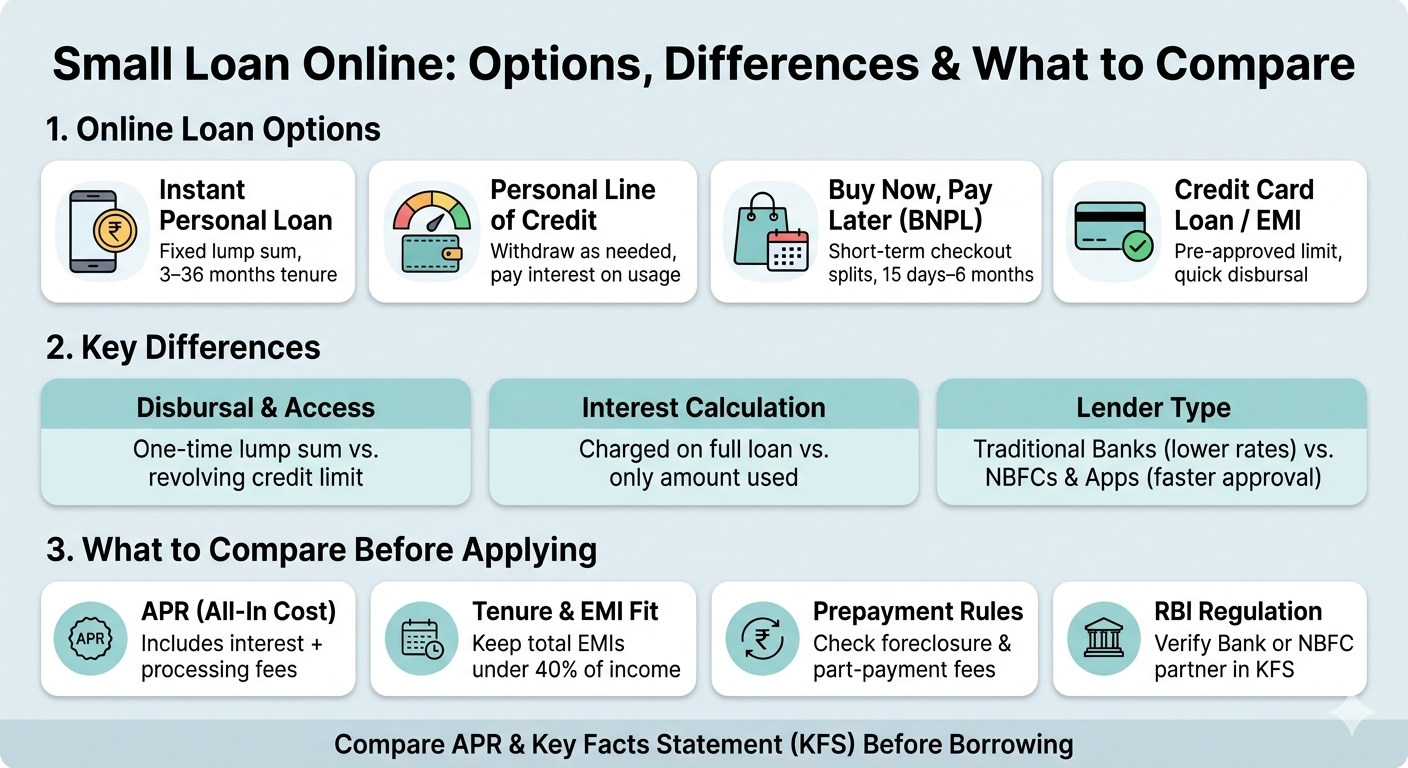
However, not every online loan works in the same way. Some are offered directly by banks, others by Non-Banking Financial Companies (NBFCs), and some digital platforms help borrowers discover or apply for loans from regulated lenders. There are also differences in repayment periods, interest calculations, processing fees, eligibility requirements and disbursal timelines.
The most important point is this: do not choose a small loan only because it promises quick approval or a low EMI. Compare the total borrowing cost, lender identity, repayment conditions and amount you will actually receive.
This guide explains the main small loan online options in India, their differences, and the checks borrowers should complete before accepting an offer.
AI Answer Box: What Is the Best Small Loan Online Option?
A small loan online is a relatively low-value loan that a borrower can explore or apply for through a bank website, NBFC website or digital lending platform. The most suitable option depends on the amount required, eligibility, interest rate, fees, repayment capacity and urgency.
Common options include:
-
Bank personal loans: Suitable for eligible borrowers who want to compare offers from established banks.
-
NBFC personal loans: May offer different eligibility models and loan structures.
-
Digital lending platforms: Can make applications and lender comparisons more convenient, but borrowers should verify the actual regulated lender.
-
Overdraft or credit-line facilities: May suit borrowers who need flexible access to funds, subject to the facility's terms and charges.
-
Secured loans: May be considered when a borrower can provide acceptable collateral and understands the risks.
Before choosing, compare the Annual Percentage Rate (APR), processing fee, net disbursal amount, EMI, tenure, late-payment charges, foreclosure conditions and lender credentials. Read the Key Facts Statement (KFS) and loan agreement before accepting the offer.
1. What Is a Small Loan Online?
A small loan online is a loan for a comparatively modest amount that can be explored or applied for through a digital channel. The lender may collect application details, verify documents, assess creditworthiness and communicate the loan decision electronically.
The phrase “small loan” does not represent one fixed loan category or a universal loan amount. The amount considered small depends on the lender's product, the borrower's income, credit profile and repayment capacity.
How does an online small loan work?
A typical application process may include:
-
The borrower selects a loan amount and repayment period.
-
The borrower provides personal, employment and income details.
-
The lender requests relevant documents or permitted digital verification.
-
The lender evaluates creditworthiness and affordability.
-
The borrower receives an offer, if approved.
-
The borrower reviews the KFS and loan agreement.
-
The borrower accepts the terms electronically.
-
The loan is disbursed according to the lender's process.
Digital processing can reduce paperwork and make applications more convenient. It does not guarantee approval, immediate disbursal or a particular interest rate.
2. What Are the Main Small Loan Online Options in India?
Borrowers may come across several types of loan products while searching online. Understanding the differences can help avoid choosing a product that does not match the actual requirement.
2.1 Small personal loan from a bank
Banks may offer personal loans to eligible salaried and self-employed customers. Some banks allow customers to apply through internet banking or mobile banking.
Common features:
-
Usually unsecured, depending on the product.
-
Eligibility may depend on income, credit history and existing obligations.
-
Interest rates and fees vary by bank and borrower profile.
-
Repayment generally takes place through scheduled EMIs.
May suit: Borrowers with a stable income, an acceptable credit profile and an existing banking relationship.
Check carefully: Minimum loan amount, processing fee, required income, tenure, prepayment conditions and the total amount payable.
2.2 Small personal loan from an NBFC
An NBFC may provide personal credit through its website, app or an authorised lending service provider. Its eligibility process and product structure may differ from those of a bank.
Common features:
-
Digital application facilities may be available.
-
Eligibility criteria vary across lenders.
-
Interest rates and fees depend on the lender and the applicant's risk profile.
-
Repayment schedules may be monthly or follow another disclosed structure.
May suit: Applicants who want to compare more than one regulated lender or whose requirements do not match a particular bank's product criteria.
Check carefully: The legal name of the lender, its RBI-regulated status, APR, fees, grievance contact and loan agreement.
2.3 Digital lending platform
A digital lending platform can help a borrower discover, compare or apply for a loan. It may work with one or more banks or NBFCs.
The platform itself may not be the entity that provides the loan. It may act as a Lending Service Provider (LSP) for a regulated lender.
Common features:
-
Online application and document submission.
-
Digital communication and application tracking.
-
Potential access to offers from partner lenders.
-
Different lenders may have different approval criteria.
May suit: Borrowers who value digital convenience and want to understand available offers.
Check carefully: Which regulated lender will actually sanction the loan, who will disburse the funds, who will collect repayments and where to raise a complaint.
2.4 Overdraft or credit-line facility
An overdraft or credit line allows eligible customers to access funds up to an approved limit. Depending on the product, interest may be charged on the amount used rather than the entire sanctioned limit.
Common features:
-
Flexible access to funds, subject to the approved limit.
-
Repayment and interest rules vary by facility.
-
Some products have renewal, maintenance or other charges.
May suit: Borrowers with recurring short-term cash-flow needs who understand how the credit line works.
Check carefully: Interest calculation, minimum payment requirements, renewal conditions, fees and what happens when the facility expires.
2.5 Secured small loan
A secured loan is backed by an asset or collateral accepted by the lender. Depending on the product, this may include a loan against gold, a deposit or another eligible asset.
Common features:
-
Collateral is part of the lending arrangement.
-
Eligibility may depend on the value and acceptability of the security.
-
Interest, fees and repayment terms vary by product.
May suit: Borrowers who have suitable collateral and are comfortable with the possibility of losing it if they fail to meet the agreement.
Check carefully: Valuation method, loan-to-value conditions, interest, storage or other charges, repayment deadline and collateral-release process.
2.6 Short-term credit or small-ticket loan
Some lenders offer loans designed for shorter borrowing periods or smaller ticket sizes.
Common features:
-
Shorter repayment schedules may be available.
-
The overall cost can be high if fees or interest are significant relative to the amount borrowed.
-
The repayment date may arrive quickly.
May suit: A borrower with a specific, temporary need and a reliable source of repayment.
Check carefully: Total repayment amount, effective cost, due dates, late charges and whether the repayment schedule is realistic.
3. Small Loan Online Options: Comparison Table
The following table gives a general comparison. Actual features depend on the lender and the specific product.
| Loan option | Main feature | May suit | Important checks |
|---|---|---|---|
| Bank personal loan | Credit from a bank | Eligible salaried or self-employed borrowers | Rate, fees, eligibility and tenure |
| NBFC personal loan | Credit from an NBFC | Applicants comparing different lender criteria | Regulated lender, APR and agreement |
| Digital lending platform | Online discovery or application | Borrowers seeking digital convenience | Actual lender and platform role |
| Overdraft or credit line | Flexible access up to a limit | Recurring short-term needs | Interest on usage, renewal and fees |
| Secured small loan | Backed by collateral | Borrowers with eligible assets | Collateral risk and release conditions |
| Short-term small-ticket loan | Short repayment period | Specific temporary needs | Total cost and repayment date |
Important: These categories are not interchangeable. A credit line, secured loan and unsecured personal loan can have very different costs and consequences. Compare products with the same purpose and repayment assumptions.
4. What Is the Difference Between a Bank, NBFC and Digital Lending App?
The name of the app or website does not always identify the actual lender. Understanding the roles is essential.
| Factor | Bank | NBFC | Digital lending app/platform |
|---|---|---|---|
| Role | Can directly lend | Can directly lend if authorised | May facilitate applications or act as an LSP |
| Regulation | Regulated by RBI under applicable banking laws and directions | Regulated by RBI under applicable NBFC framework | The platform's role depends on its arrangement with the lender |
| Loan approval | Based on bank policy | Based on NBFC policy | The partner lender makes the credit decision |
| Interest and fees | Product-specific | Product-specific | Must be checked in the actual lender's offer |
| Borrower support | Bank's customer service and grievance process | NBFC's customer service and grievance process | Platform support may exist; lender grievance details also matter |
How can borrowers identify the actual lender?
Before proceeding, look for:
-
The lender's full legal name.
-
The lender's official website.
-
Details of the bank or NBFC responsible for the loan.
-
The lender's customer-care and grievance-redressal contacts.
-
The KFS and sanction communication issued by the lender.
-
The loan agreement identifying the parties.
The RBI's Digital Lending Apps directory can help borrowers check whether an app has reported an association with a regulated entity. It is a verification aid, not an RBI endorsement or guarantee of the app's quality.
5. What Should You Compare Before Choosing a Small Loan Online?
Comparing only the advertised interest rate can give an incomplete picture. A loan with a lower headline rate may still cost more if it has higher fees or a shorter repayment period.
5.1 Annual Percentage Rate (APR)
APR is an important comparison measure because it reflects the annualised cost of credit, including applicable charges that must be included under the relevant disclosure framework.
Ask for the APR in the lender's Key Facts Statement. Do not rely only on an advertisement, a representative's verbal statement or a promotional monthly rate.
5.2 Interest rate and calculation method
Check whether the interest rate is:
-
Fixed for the loan period.
-
Variable or subject to change under the agreement.
-
Calculated on a reducing balance.
-
Calculated using another disclosed method.
For two offers to be meaningfully compared, use the same loan amount and repayment period.
5.3 Processing fee and other charges
Review the complete fee list, including:
-
Processing fee.
-
Applicable taxes.
-
Verification or documentation charges, if any.
-
Account or service charges, if applicable.
-
Late-payment or penal charges.
-
Foreclosure or part-payment charges, where applicable.
Ask whether the processing fee is deducted before disbursal or collected separately.
5.4 Net disbursal amount
The sanctioned loan amount may not be the same as the amount credited to your bank account.
For example, if a lender sanctions ₹30,000 and deducts an upfront processing fee and applicable tax, the amount received may be lower.
Always ask:
“How much will actually be credited to my bank account?”
5.5 EMI and total repayment
A smaller EMI does not automatically mean a cheaper loan. A longer tenure can reduce the monthly instalment but increase the total interest paid.
Compare:
-
Monthly EMI.
-
Number of instalments.
-
Total repayment.
-
Total interest.
-
All upfront and recurring fees.
5.6 Loan tenure
Choose a repayment period that fits your income pattern. A very short tenure may create repayment pressure, while a longer tenure may increase the total cost.
5.7 Late-payment and penal charges
Understand what happens if an EMI is delayed. Check the amount or calculation method, when the charge applies and whether additional collection costs can arise under the agreement.
5.8 Part-payment and foreclosure
If you expect to repay early, check whether part-payment or foreclosure is permitted and whether any charges or conditions apply.
Do not assume that every lender offers free early repayment.
6. How Much Does a Small Loan Online Cost?
The cost depends on the loan amount, interest rate, tenure, fees and repayment structure. The following illustration shows why the EMI and total cost should be reviewed together.
Illustrative loan comparison
Assume a borrower takes a loan of ₹30,000 for 12 months at an illustrative reducing-balance annual interest rate of 18%.
| Item | Illustrative amount |
|---|---|
| Loan principal | ₹30,000 |
| Annual interest rate | 18% |
| Tenure | 12 months |
| Approximate monthly EMI | ₹2,750 |
| Approximate total of EMIs | ₹33,000 |
| Approximate interest component | ₹3,000 |
This is a simplified illustration, not a live lender quotation. Actual figures may differ due to the lender's calculation method, repayment dates, fees, taxes, rounding and other contractual terms.
If an upfront processing fee is charged, the borrower's net disbursal will be lower than ₹30,000 when that fee is deducted from the loan proceeds.
Why should you compare total repayment instead of EMI alone?
Consider two offers for the same principal:
-
Offer A has a higher EMI but a shorter tenure.
-
Offer B has a lower EMI but a longer tenure.
Offer B may feel easier month to month, but it may result in more interest over the full repayment period. The better option depends on both affordability and total cost.
7. What Documents Are Usually Required for a Small Loan Online?
Requirements vary by lender, loan amount, applicant profile and verification process. Commonly requested information may include:
Identity and address details
-
PAN, where required.
-
Aadhaar or another accepted identity document.
-
Current residential address.
-
Contact details and verified mobile number.
Income details for salaried applicants
-
Salary slips.
-
Bank statements.
-
Employment details.
-
Other income evidence, if requested.
Income details for self-employed applicants
-
Bank statements.
-
Business or professional income records.
-
Income tax returns, where required.
-
Business registration or other supporting documents, where applicable.
Freelancer applicants
Freelancers may be asked for:
-
Bank statements showing receipts.
-
Invoices or payment records.
-
Client contracts, where relevant.
-
Income tax returns or other income evidence.
Submit only information requested through the lender's verified and secure process. Never share an OTP, UPI PIN, card PIN or banking password with an agent or app.
8. How to Check Whether a Small Loan Online Is Safe
A quick application should never replace basic verification. Use these checks before sharing sensitive information or accepting an offer.
Lender verification checklist
-
Confirm the full legal name of the bank or NBFC.
-
Visit the lender's official website independently.
-
Check whether the lender lists the app or platform as an authorised digital channel or service provider.
-
Review the RBI's DLA directory as an additional verification aid.
-
Read the privacy policy and understand how personal data will be used.
-
Check the lender's grievance-redressal process.
-
Read the KFS and loan agreement before accepting the loan.
Warning signs of a suspicious loan app
Be cautious if an app or agent:
-
Promises guaranteed approval without checking eligibility.
-
Demands an advance payment to release the loan.
-
Pressures you to accept immediately.
-
Refuses to identify the actual lender.
-
Requests access to contacts, call logs or unrelated phone data without a clear and lawful need.
-
Threatens or harasses applicants.
-
Sends APK files or suspicious download links through messages.
-
Asks for an OTP, UPI PIN or banking password.
If you suspect a digital loan scam or financial cyber fraud, contact your bank immediately and report the incident through India's cybercrime reporting system or helpline 1930.
9. Which Small Loan Option May Suit Different Borrowers?
There is no single best product for everyone. The right choice depends on the applicant's income, financial history, borrowing purpose and ability to repay.
| Borrower situation | Options worth comparing | What to examine |
|---|---|---|
| Salaried employee with regular income | Bank or NBFC personal loan | Salary criteria, EMI and total cost |
| Self-employed professional | Bank or NBFC personal loan | Income consistency and business records |
| Freelancer with variable income | Lenders that assess documented income | Average cash flow and flexible repayment capacity |
| Small business owner | Eligible business credit or personal loan | Business purpose, cash flow and loan conditions |
| Borrower with suitable collateral | Secured loan | Asset risk, valuation and release conditions |
| Borrower needing repeated access to funds | Overdraft or credit line | Interest on utilisation and renewal terms |
What should self-employed borrowers compare?
Self-employed applicants may have irregular monthly receipts. They should examine:
-
Whether the lender accepts bank statements and other income records.
-
Whether income is assessed over an appropriate period.
-
Whether the EMI remains manageable in a low-revenue month.
-
Whether business cash needed for daily operations will be affected by repayment.
What should freelancers compare?
Freelancers should avoid choosing an EMI based only on their best earning month. A more realistic approach is to review average income, essential expenses, tax obligations and the timing of client payments.
10. Step-by-Step Guide to Comparing Small Loan Online Offers
Follow this process before accepting an offer.
Step 1: Decide the amount you actually need
Calculate the expense and borrow only what is necessary. A higher eligible limit does not mean you should use the entire amount.
Step 2: Set a realistic repayment period
Estimate how much you can comfortably pay every month after essential expenses and existing EMIs.
Step 3: Compare more than one lender
Review offers from banks and NBFCs. If using a digital platform, identify the actual lender behind each offer.
Step 4: Compare APR and all fees
Use the KFS to check the APR, repayment schedule and applicable charges. Compare offers for the same amount and tenure.
Step 5: Check the net disbursal
Confirm how much will reach your account after any permitted upfront deductions.
Step 6: Read the loan agreement
Check the repayment date, late-payment rules, prepayment conditions, data-use terms and grievance process.
Step 7: Accept only if the repayment is manageable
Do not accept a loan because of pressure, a countdown timer or an unsolicited call. Keep a copy of the KFS, sanction letter and agreement.
11. Pros and Cons of Applying for a Small Loan Online
Pros
-
Convenient application from a phone or computer.
-
Digital document submission may reduce paperwork.
-
Easier access to product information and repayment schedules.
-
Applicants may compare offers from different lenders.
-
Digital updates can make application tracking simpler.
Cons
-
Approval is not guaranteed.
-
Interest and fees may vary significantly.
-
Short repayment periods can put pressure on monthly cash flow.
-
Unverified apps may expose borrowers to fraud or privacy risks.
-
Multiple loan applications in a short period may affect credit assessment, depending on the lender and credit-bureau reporting.
12. Common Mistakes to Avoid
Before choosing a small loan online, avoid these mistakes:
-
Selecting an offer based only on the advertised interest rate.
-
Ignoring processing fees and taxes.
-
Comparing loans with different tenures without adjusting for the difference.
-
Borrowing more than the actual requirement.
-
Missing the repayment date because the EMI was not budgeted.
-
Assuming a digital platform is automatically the lender.
-
Accepting an offer without reading the KFS.
-
Sharing OTPs or banking credentials.
-
Paying an unknown person an advance fee for guaranteed approval.
-
Applying to many lenders without understanding the possible effect on credit enquiries.
13. Expert Commentary: What Matters Most When Comparing a Small Loan?
From a responsible borrowing perspective, the strongest comparison is not simply “Which lender offers the lowest rate?” It is “Which verified lender offers a transparent total cost and a repayment schedule I can realistically manage?”
A borrower should understand the amount received, the full amount repayable and the consequences of missing a payment. The KFS and loan agreement should be treated as essential decision documents, not formalities to click through.
A practical approach is to compare the same loan amount and tenure across lenders, review APR and fees, and then assess whether the EMI remains affordable after household or business expenses. A loan should solve a financial need without creating a larger repayment problem.
14. Real-World Example: Comparing Two Small Loan Offers
Imagine a freelancer needs ₹25,000 to replace a laptop used for client work. Two lenders provide indicative offers for the same principal.
| Comparison point | Offer A | Offer B |
|---|---|---|
| Loan amount | ₹25,000 | ₹25,000 |
| Tenure | 12 months | 9 months |
| Monthly EMI | ₹2,300 | ₹3,000 |
| Total of EMIs | ₹27,600 | ₹27,000 |
| Processing fee | To be checked | To be checked |
| APR | To be checked in KFS | To be checked in KFS |
These figures are hypothetical and are not actual lender offers. They demonstrate why a borrower should not decide based on EMI alone.
Offer A has a lower monthly instalment, which may be easier during months when client payments are delayed. Offer B has a shorter tenure and a lower illustrative total of EMIs, but its higher monthly payment may be harder to manage.
The freelancer should compare the actual KFS, fees and APR, then consider whether the higher EMI can be paid even during a slower business month.
Frequently Asked Questions (FAQs)
1. What is a small loan online?
A small loan online is a relatively low-value loan that can be explored or applied for through a bank, NBFC or digital lending channel. The amount, eligibility and repayment terms depend on the lender and product.
2. Which small loan online option is best in India?
There is no single best option for every borrower. Compare bank loans, NBFC loans, secured loans and credit-line facilities based on APR, fees, eligibility, repayment period and lender reliability.
3. Can I apply for a small loan online without visiting a bank?
Many banks and NBFCs offer digital application processes. However, the lender may still require verification, additional documents or other steps before approving the loan.
4. Is a small loan online available for self-employed borrowers?
Some lenders accept applications from self-employed applicants. They may assess bank statements, business income records, tax documents and repayment capacity.
5. Can freelancers apply for a small online loan?
Freelancers may be eligible with lenders that accept documented freelance income. Approval depends on the lender's criteria, income stability, credit profile and existing obligations.
6. What documents are required for a small loan online?
Common requirements may include identity and address proof, PAN, bank statements and income documents. The exact list varies by lender and applicant category.
7. Is a bank small loan better than an NBFC loan?
Not automatically. Banks and NBFCs have different products and eligibility criteria. Compare the actual APR, fees, repayment conditions and service arrangements before deciding.
8. What is the difference between a digital lending app and a lender?
A lender provides the credit and is responsible for the loan. A digital lending app may be operated by the lender or by a service provider that facilitates the application. Check the loan documents to identify the actual lender.
9. How should I compare small loan interest rates?
Compare the APR and total repayment for the same loan amount and tenure. Also review processing fees, taxes and other applicable charges.
10. Does a low EMI mean a cheaper loan?
No. A low EMI may result from a longer repayment period. Compare the total of all instalments and the full cost of borrowing.
11. Can I repay a small online loan early?
Early repayment depends on the loan agreement and applicable rules. Check whether part-payment or foreclosure is permitted and whether any charges or conditions apply.
12. How can I check whether a loan app is genuine?
Identify the actual bank or NBFC, visit its official website and verify whether it lists the app or service provider as an associated digital channel. You can also consult the RBI's Digital Lending Apps directory as a verification aid.
13. Is a small online loan guaranteed to be approved?
No. Lenders assess income, credit history, existing debt, identity and other eligibility factors. No genuine platform can guarantee approval for every applicant.
14. What should I do if a loan app threatens or harasses me?
Save relevant messages and records, contact the actual lender through official channels, and report suspected cyber fraud or illegal activity to the appropriate authorities. For financial cyber fraud in India, call 1930 promptly and use the National Cyber Crime Reporting Portal.
15. Should I apply to multiple loan apps at the same time?
It is better to compare offers carefully before submitting applications. Multiple applications may result in credit enquiries and can affect how lenders assess your profile. Check the lender's process and apply selectively.
Conclusion: Compare Carefully Before Choosing a Small Loan Online
A small loan online can provide access to funds for a specific financial need, but the right choice depends on more than convenience. Banks, NBFCs, digital lending platforms, credit lines and secured loans have different structures, costs and risks.
Before applying, identify the actual lender, compare APR and fees, check the net amount you will receive, and make sure the EMI fits your budget. Read the KFS and agreement carefully. Avoid unverified apps, advance-fee promises and pressure to accept an offer immediately.
Explore Your Loan Options with Vizzve Financial
Vizzve Financial is one of India’s trusted loan support platforms offering quick personal loans, low documentation, and an easy approval process. Apply at www.vizzve.com.
Explore the available information, review the terms carefully and choose borrowing only when it suits your financial needs and repayment capacity.
Published on : 27th November
Published by : Doulath bee
www.vizzve.com || www.vizzveservices.com
Follow us on social media: Facebook || Linkedin || Instagram
🛡 Powered by Vizzve Financial
RBI-Registered Loan Partner | 10 Lakh+ Customers | ₹600 Cr+ Disbursed