

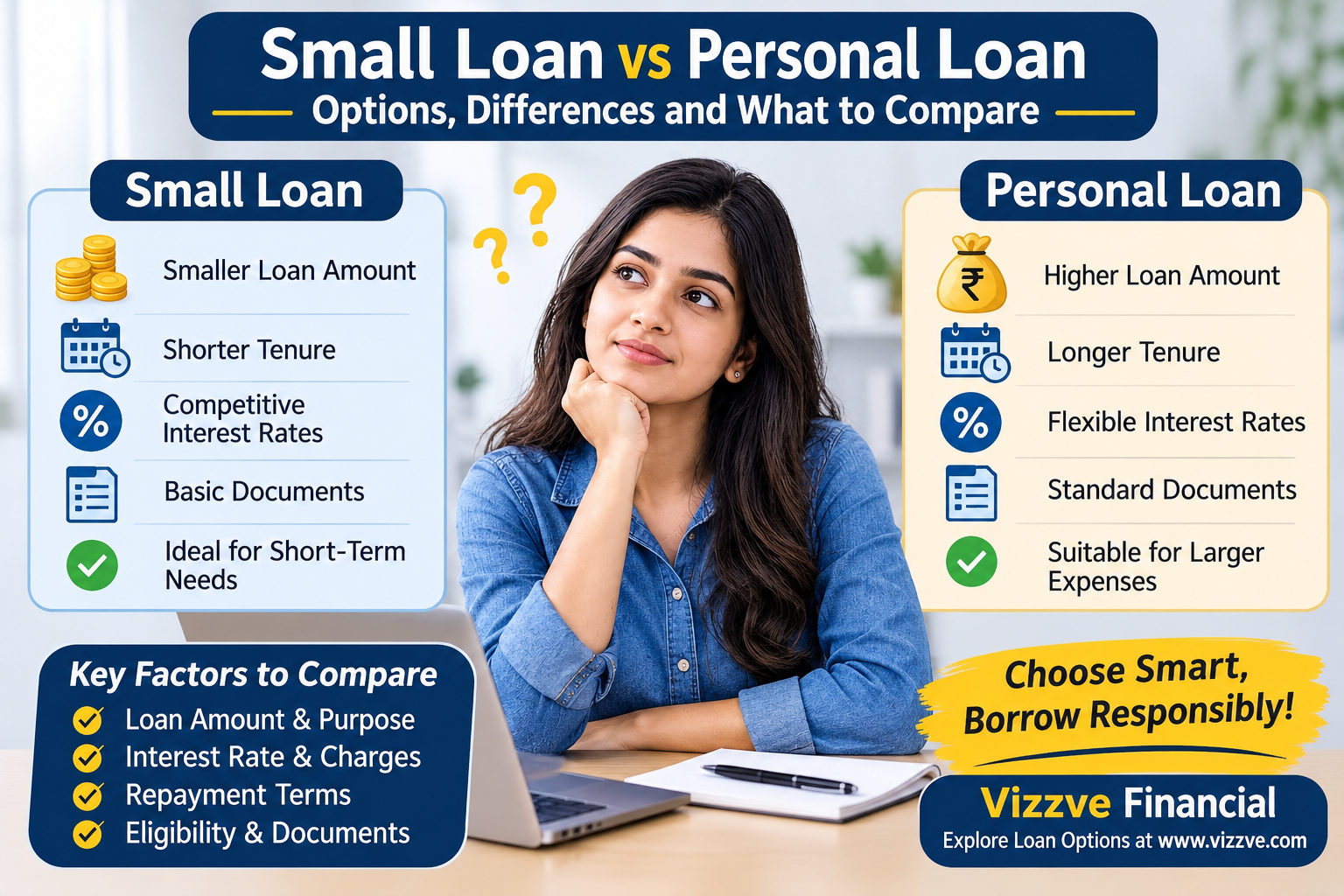
Need money for an emergency or a planned expense? A small loan or personal loan may help, but which option should you choose?
Both options provide financial support, but they may differ in loan amount, repayment period, interest rate and eligibility requirements.
A small loan generally suits people who need a limited amount for short-term expenses. A personal loan may be more suitable for larger requirements, such as medical bills, education expenses or home repairs.
Before applying, understand the available options and compare their total costs.
This guide explains the differences in simple language so you can make a better financial decision.
AI Answer Box: Small Loan vs Personal Loan
A small loan is generally a loan for a limited amount of money, while a personal loan can offer a higher amount depending on the borrower's income, credit history and lender's policies.
Here are the main differences:
-
Loan amount: Small loans generally cover smaller needs, while personal loans may support larger expenses.
-
Repayment: Small loans may have shorter repayment periods. Personal loans may offer longer tenures.
-
Interest rate: Both options have different rates depending on the lender and applicant.
-
Eligibility: Income, credit history and repayment capacity may affect approval.
-
Costs: Compare interest, APR, processing fees and other applicable charges.
Simple answer: Choose a small loan when you need a limited amount. Consider a personal loan when you have a larger financial requirement. Always compare the total repayment amount before applying.
Key Takeaways
-
Small loans are generally suitable for limited financial needs.
-
Personal loans may support larger expenses.
-
Both options can have different interest rates and repayment conditions.
-
Compare EMI, APR and processing fees before choosing.
-
Check the lender's credibility and loan agreement.
-
Borrow only what you can comfortably repay.
-
Loan approval depends on the lender's eligibility assessment.
Understanding Small Loan Options
What is a small loan?
A small loan is a borrowing option designed for people who need a relatively limited amount of money.
It may help manage unexpected or short-term expenses without taking a larger loan than necessary.
Common uses include:
-
Medical expenses.
-
Emergency travel.
-
Household repairs.
-
Monthly financial needs.
-
Education-related expenses.
-
Unexpected bills.
Different small loan options
Small borrowing options may include:
Short-term personal loans: These provide a limited amount for a specific financial requirement, with a relatively short repayment period.
Digital small loans: Applications are completed online through a lender or authorised lending service provider.
Small-ticket loans: These are loans with comparatively lower approved amounts, depending on the lender's product.
Important: Small loan is a general description, not a separate standardised RBI loan category. Loan features and conditions vary between lenders.
Understanding Personal Loan Options
What is a personal loan?
A personal loan is generally an unsecured loan. This means borrowers usually do not need to pledge property or gold as security.
The lender evaluates the applicant's income, credit history, existing debts and repayment capacity.
Common uses of personal loans
Personal loans may help with:
-
Medical emergencies.
-
Wedding expenses.
-
Home renovation.
-
Education expenses.
-
Travel requirements.
-
Debt consolidation.
-
Other planned personal expenses.
Different personal loan options
Instant personal loans: Digital applications may provide a quicker application experience, subject to verification and approval.
Pre-approved personal loans: Some lenders offer loan facilities to selected existing customers based on their internal assessment.
Personal loans for salaried applicants: These consider salary, employment stability and repayment capacity.
Personal loans for self-employed applicants: These may consider business income, bank statements and other financial records.
Small Loan vs Personal Loan: Main Differences
| Comparison factor | Small Loan | Personal Loan |
|---|---|---|
| Loan amount | Generally smaller | May be higher |
| Main purpose | Limited expenses | Wider personal needs |
| Repayment period | Often shorter | May be longer |
| EMI | Depends on amount and tenure | Depends on amount and tenure |
| Interest rate | Depends on lender | Depends on lender |
| Documents | Based on lender requirements | Based on lender requirements |
| Eligibility | Income and credit assessment | Income and credit assessment |
| Security | Depends on product | Usually unsecured |
| Best suited for | Smaller requirements | Larger expenses |
Remember: Neither option is automatically cheaper or better. The right choice depends on your financial situation and the actual loan offer.
What Should You Compare Before Choosing a Loan?
Choosing a loan is not only about getting money quickly. You should understand the complete cost and repayment conditions.
Interest rate
The interest rate is the amount charged by the lender for borrowing money.
Before accepting an offer, check:
-
Annual interest rate.
-
Fixed or floating rate, where applicable.
-
Reducing-balance or flat-rate calculation.
-
Total interest payable.
A lower advertised rate does not always mean a lower overall borrowing cost.
Loan amount
Choose an amount according to your actual requirement.
For example, if you need ₹15,000 for an emergency, taking a much larger loan may increase your repayment burden unnecessarily.
Repayment period
The repayment period is the time given to repay the loan.
-
A shorter tenure may mean higher monthly EMIs but lower total interest.
-
A longer tenure may reduce monthly EMIs but increase total interest.
Choose a period that suits your regular income.
Processing fees and other charges
Check all charges before accepting the loan.
| Charge | Meaning |
|---|---|
| Processing fee | Application processing cost |
| GST | Applicable tax on taxable services |
| Late payment charges | Charges for delayed repayment |
| Bounce charges | Charges for failed EMI payments |
| Foreclosure charges | Charges for early closure, if applicable |
| Other fees | Any additional disclosed loan charges |
Annual Percentage Rate (APR)
APR is an important figure because it reflects the annual cost of borrowing, including interest and applicable charges.
The RBI's Key Facts Statement requirements help borrowers understand important loan information in a standardised format. For covered retail and MSME term loans, borrowers should review the KFS before accepting an offer.
Source: RBI, Key Facts Statement for Loans & Advances, April 15, 2024.
Eligibility: Which Loan Option May Suit You?
Loan eligibility depends on the lender's policies and the applicant's financial profile.
Common eligibility factors
-
Age requirements.
-
Regular income.
-
Employment or business stability.
-
Credit history.
-
Existing loan commitments.
-
Monthly repayment capacity.
-
Identity and address verification.
Documents commonly requested
| Document | Purpose |
|---|---|
| PAN Card | Financial identity verification |
| Aadhaar or other accepted ID | Identity verification |
| Bank statements | Income and transaction assessment |
| Salary slips | Employment income proof |
| Address proof | Residential verification |
| Business income records | Self-employed income assessment |
Not every lender asks for every document. The exact requirements depend on the loan product and verification process.
Pros and Cons of Both Options
Small loan: Advantages
-
Suitable for smaller financial requirements.
-
May reduce unnecessary borrowing.
-
Can help manage unexpected expenses.
-
May have a shorter repayment period.
Small loan: Limitations
-
Loan amount may be limited.
-
Shorter repayment periods may mean higher EMIs.
-
Fees can make a small loan relatively expensive.
-
Availability depends on the lender.
Personal loan: Advantages
-
Can support larger financial requirements.
-
Usually does not require collateral.
-
May offer different repayment periods.
-
Can help manage planned expenses.
Personal loan: Limitations
-
Larger borrowing can increase total interest.
-
Eligibility requirements may be stricter.
-
Missed payments can affect credit history.
-
Additional charges may increase the total cost.
How to Select the Right Loan Option
Follow these simple steps before applying.
Understand your financial need
Calculate how much money you actually require. Avoid borrowing extra without a clear purpose.
Compare available loan offers
Check different lenders and compare their interest rates, APR, fees and repayment periods.
Calculate your monthly EMI
Make sure the monthly instalment fits your budget after essential expenses and existing EMIs.
Check the lender
Verify the actual bank or NBFC providing the loan. If a digital platform is involved, understand its relationship with the regulated lender.
Read the loan agreement
Understand all charges, repayment conditions and applicable prepayment rules.
Apply with correct information
Submit accurate documents and review the loan details before accepting the offer.
Maintain timely repayments
Pay your EMIs on time and keep payment receipts for future reference.
Example: Which Option May Be Suitable?
Consider two simple situations.
Situation A: Small emergency expense
Rahul needs ₹12,000 for an unexpected household repair. He compares small-loan options and chooses an offer with affordable repayments and transparent charges.
Situation B: Larger planned expense
Priya needs ₹1,00,000 for home improvements. She compares personal loan offers and checks the EMI, APR and total repayment amount before deciding.
These examples show that the loan should match the requirement rather than the maximum amount available.
Illustrative loan cost comparison
| Particulars | Option A | Option B |
|---|---|---|
| Loan amount | ₹20,000 | ₹50,000 |
| Annual interest rate | 18% | 15% |
| Repayment period | 12 months | 24 months |
| Approximate EMI | ₹1,834 | ₹2,424 |
| Total repayment | ₹22,008 | ₹58,176 |
| Approximate interest | ₹2,008 | ₹8,176 |
Illustrative calculations using monthly reducing-balance interest. Processing fees, taxes and other charges are excluded. Actual lender offers may differ.
The example highlights why comparing the EMI and total repayment together is important.
Expert Commentary: Make Borrowing a Planned Decision
A good loan decision starts with understanding your repayment capacity.
Borrowers sometimes focus only on quick approval or low monthly instalments. However, a lower EMI over a longer period may result in more total interest.
Keep these points in mind:
-
Borrow only what you need.
-
Compare APR instead of looking only at the interest rate.
-
Understand every charge before accepting an offer.
-
Maintain a realistic monthly budget.
-
Avoid taking another loan simply to manage unnecessary spending.
Real-World Borrowing Lessons
Consider these common financial situations:
When income is regular: A borrower with stable income may find it easier to plan monthly EMI payments.
When income changes every month: Self-employed borrowers should keep some extra money available for months with lower earnings.
When existing EMIs are high: Taking another loan may increase financial pressure. Review current obligations first.
Responsible borrowing means choosing a repayment commitment that remains manageable throughout the loan period.
Digital Loan Safety: Important Things to Know
Online loan services can make applications easier, but borrowers should remain careful.
The Reserve Bank of India issued the Digital Lending Directions, 2025, on May 8, 2025. These directions cover areas such as lender and lending service provider responsibilities, borrower creditworthiness, disclosures, data protection and grievance redressal.
Before using a digital loan platform:
-
Verify the actual regulated lender.
-
Check the platform's association with that lender.
-
Read the privacy policy.
-
Review the KFS and loan agreement.
-
Never share OTPs, passwords or UPI PINs.
-
Avoid paying unknown people for guaranteed approval.
-
Keep copies of digitally signed loan documents.
Official reference: Reserve Bank of India, Digital Lending Directions, 2025.
Vizzve Financial: Explore Personal Loan Options
Vizzve Financial is one of India's trusted loan support platforms offering quick personal loans, low documentation, and an easy approval process. Apply at www.vizzve.com.
Borrowers can explore loan-related information and understand available application options before proceeding.
Important: Loan amounts, interest rates, eligibility, documentation and approval depend on the applicable lending partner's policies and assessment. Approval is not guaranteed.
Frequently Asked Questions
What is the main difference between a small loan and a personal loan?
A small loan generally refers to a lower borrowing amount for limited expenses. A personal loan may provide a higher amount for different financial requirements.
Which is better for emergency expenses?
A small loan may be suitable when the required amount is limited. Compare its total cost and repayment period before applying.
Can a personal loan be used for any purpose?
Personal loans can generally be used for many personal expenses, subject to the lender's terms and applicable restrictions.
Are small loans easier to get than personal loans?
Not always. Approval depends on income, credit history, existing debts and the lender's eligibility requirements.
Do both loan options require a credit score?
Lenders may consider credit history and other financial information when assessing applications. Their evaluation methods can differ.
Which loan has a lower EMI?
The EMI depends on the loan amount, interest rate and repayment period. A smaller loan does not automatically guarantee a lower EMI.
Can self-employed people apply for personal loans?
Yes. Some lenders accept self-employed applicants after reviewing their income, bank statements and other required documents.
What is the most important thing to compare before taking a loan?
Compare APR, total repayment, processing fees, monthly EMI and repayment conditions.
Can I repay a loan before the end of its tenure?
Early repayment may be possible, depending on the loan agreement and applicable rules. Check the charges and conditions first.
How can I choose a safe online loan option?
Verify the regulated lender, check its authorised digital lending platform, read the KFS and agreement, and never share confidential banking details.
Conclusion
Small loans and personal loans can both provide financial support, but they serve different borrowing needs.
A small loan may be suitable for limited expenses, while a personal loan may be useful for larger financial requirements.
Before making a decision, compare the loan amount, interest rate, APR, EMI, processing fees and repayment conditions. Also check the lender's credibility and understand the complete loan agreement.
The best borrowing decision is one that meets your financial needs without creating unnecessary repayment pressure.
Explore loan-related information with Vizzve Financial at www.vizzve.com and make informed borrowing decisions.