

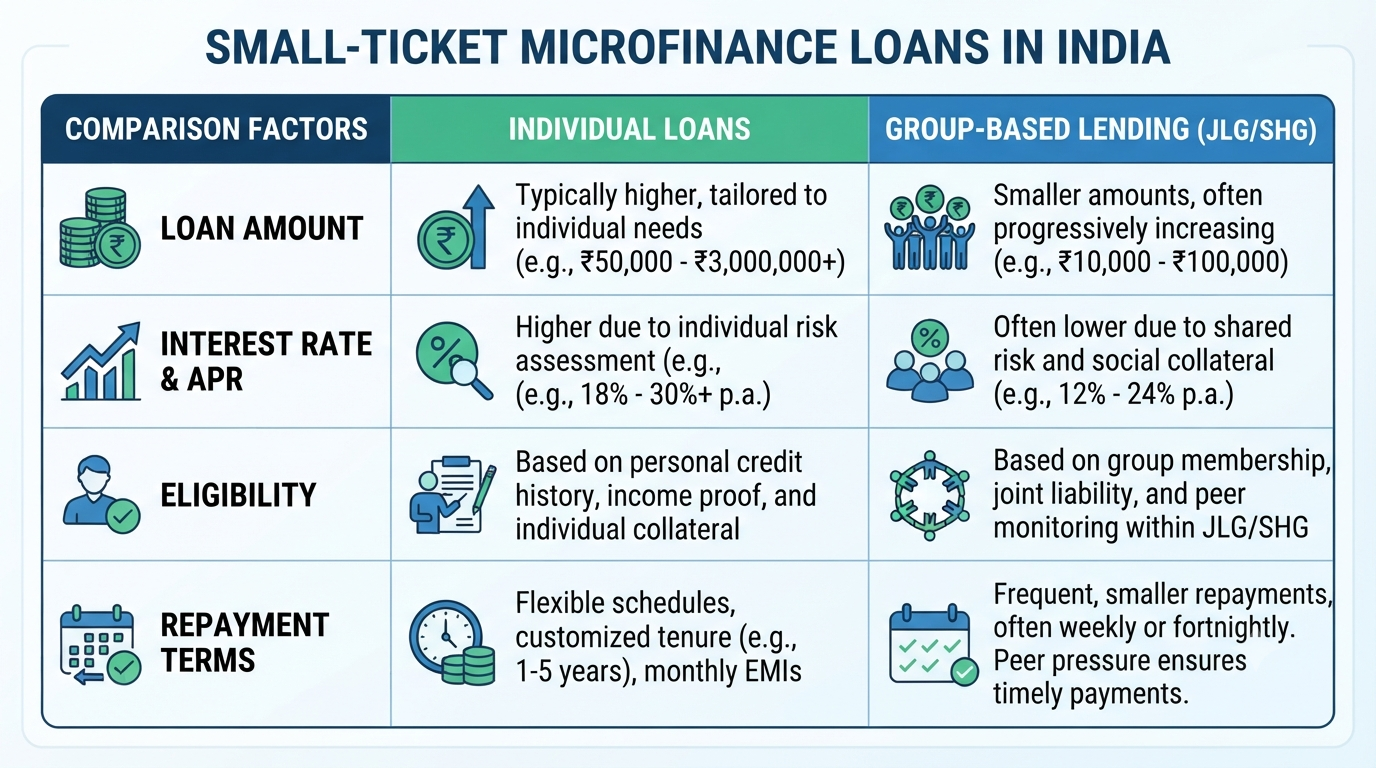
Introduction
Small-ticket microfinance loans provide eligible low-income households and underserved communities with access to formal credit for livelihood and other financial requirements. These loans can help small shop owners, self-employed individuals, micro-entrepreneurs, and households manage relatively small financial needs.
In India, borrowers may find different microfinance loan options through banks, small finance banks, and eligible NBFC-MFIs. However, loan amounts, interest rates, eligibility requirements, repayment schedules, and other conditions can differ between lenders.
Understanding the available options and comparing important loan features can help borrowers choose a suitable financial product. This guide explains small-ticket microfinance loan options, their differences, and what to compare before applying.
1. Understanding Small-Ticket Microfinance Loan Options
A small-ticket microfinance loan is a relatively small-value credit facility designed to improve access to formal financial services.
Under the RBI framework, a microfinance loan is a collateral-free loan to a household with annual household income of up to ₹3 lakh.
Depending on the lender and product, borrowers may explore different types of microfinance credit.
A. Individual Microfinance Loans
Individual microfinance loans are provided to eligible borrowers based on their financial circumstances and the lender's assessment.
They may be suitable for individuals who need funds for small business activities, livelihood requirements, or other eligible purposes.
B. Group-Based Microfinance Loans
Some microfinance institutions offer group-based lending arrangements, including joint liability group (JLG) models.
In these arrangements, borrowers may be organised into groups under specific lending conditions. The responsibilities and repayment obligations should be clearly understood before joining.
C. Livelihood-Based Microfinance Loans
These loans may support income-generating activities such as small retail businesses, tailoring, agriculture-related activities, or other eligible occupations.
The availability and permitted use of funds depend on the lender's product terms.
D. Small Business and Self-Employment Loans
Eligible micro-entrepreneurs and self-employed individuals may explore small-value credit for business supplies, tools, equipment, or working capital requirements.
Borrowers should confirm whether the product is classified as a microfinance loan or another type of business credit.
2. Differences Between Small-Ticket Microfinance Loan Options
Different lending arrangements can have different features and responsibilities.
| Loan option | Main purpose | Important feature |
|---|---|---|
| Individual microfinance loan | Personal or livelihood-related needs | Individual borrower assessment |
| Group-based microfinance loan | Eligible household and livelihood needs | Group lending arrangement may apply |
| Livelihood-based loan | Income-generating activities | Linked to a livelihood requirement |
| Small business loan | Business-related expenses | May have different eligibility and loan conditions |
The exact structure, interest rate, loan amount, and repayment conditions depend on the financial institution.
3. Compare Different Types of Microfinance Lenders
Borrowers may access microfinance through different regulated institutions.
Banks
Banks provide various financial products, including eligible microfinance loans. They operate under banking regulations and follow applicable lending requirements.
Small Finance Banks
Small finance banks focus on providing financial services to underserved individuals and small businesses. They may offer microfinance and other small-value credit products.
NBFC-MFIs
Non-Banking Financial Company-Microfinance Institutions specialise in microfinance lending and serve eligible low-income households.
Before applying, verify the institution's regulatory status and understand which entity is responsible for providing the loan.
4. What Should You Compare Before Choosing a Loan?
Comparing loan terms is important because the lowest instalment does not always mean the lowest borrowing cost.
1. Interest Rate
Check the applicable interest rate and understand how interest is calculated.
2. Annual Percentage Rate (APR)
APR helps borrowers understand the annualised cost of borrowing, including applicable charges. Comparing APR can provide a clearer picture of the total loan cost.
3. Loan Amount
Choose a loan amount based on your actual financial requirement and repayment capacity.
4. Repayment Frequency
Check whether instalments are monthly or follow another agreed schedule. Select a repayment arrangement that suits your income cycle.
5. Loan Tenure
Compare the repayment period and understand how it affects instalment amounts and total borrowing costs.
6. Processing Fees and Other Charges
Review processing fees, applicable taxes, penal charges, and other disclosed costs before accepting an offer.
7. Eligibility Requirements
Check household income assessment, existing loan obligations, identity verification, and other lender-specific conditions.
8. Customer Support
Consider the lender's official customer service channels and grievance redressal process.
5. Understand Eligibility Before Comparing Offers
Under the RBI microfinance framework, a microfinance loan is a collateral-free loan to a household with annual household income of up to ₹3 lakh.
Regulated lenders must assess household income and repayment obligations before providing credit.
Other factors may include:
-
Identity and address verification.
-
Existing household loans.
-
Current repayment obligations.
-
Financial information.
-
Repayment capacity.
Eligibility requirements and approval decisions vary by lender. Meeting basic requirements does not guarantee loan approval.
6. Documents to Keep Ready
Before comparing loan offers, organise the documents and information that lenders may request.
Common requirements include:
-
Aadhaar or another accepted identity document.
-
PAN, where applicable.
-
Address proof, if required.
-
Household income details.
-
Bank account information.
-
Additional supporting documents requested by the lender.
Document requirements depend on the institution and applicable KYC rules. Always use official and secure submission channels.
7. Example: How to Compare Two Microfinance Loan Offers
Consider a hypothetical borrower comparing two loan offers.
| Feature | Offer A | Offer B |
|---|---|---|
| Loan amount | ₹20,000 | ₹20,000 |
| Interest rate | 18% | 20% |
| Processing fee | ₹300 | ₹100 |
| Repayment tenure | 12 months | 12 months |
| APR | Check lender disclosure | Check lender disclosure |
This example shows why borrowers should not make decisions based only on the interest rate or processing fee.
They should compare the disclosed APR, instalment amount, total repayment amount, and all applicable charges before choosing an offer. Actual rates and charges must be confirmed from the lender's official documents.
8. Common Mistakes When Comparing Microfinance Loans
Avoid these mistakes when evaluating different options:
-
Choosing a loan only because the instalment looks smaller.
-
Ignoring APR and total repayment costs.
-
Not checking existing household debt.
-
Accepting group lending responsibilities without understanding them.
-
Applying through unverified agents.
-
Ignoring the KFS and loan agreement.
-
Borrowing more than required.
-
Overlooking repayment dates and applicable charges.
Careful comparison can help borrowers avoid unnecessary financial pressure.
9. Safer Decisions Before Accepting a Loan
Follow these steps before making a final decision:
-
Verify the lender's legal identity and regulatory status.
-
Compare at least the available loan terms and total costs.
-
Check household income and existing financial obligations.
-
Read the Key Fact Statement (KFS), where applicable.
-
Understand the loan agreement and repayment schedule.
-
Confirm all applicable fees and charges.
-
Protect your Aadhaar, PAN, bank details, and other personal information.
-
Never share OTPs, PINs, or banking passwords.
-
Keep copies of loan documents and payment receipts.
A suitable loan should meet a genuine financial need without creating excessive repayment pressure.
Conclusion
Small-ticket microfinance loans are available through different regulated financial institutions and lending arrangements in India. Individual loans, group-based lending, livelihood-focused credit, and small business financing may serve different borrower requirements.
Before choosing an option, compare the interest rate, APR, loan amount, processing fees, repayment frequency, tenure, eligibility, and lender credibility. Understanding the differences and reviewing the loan documents can help borrowers make safer financial decisions.
Vizzve encourages responsible borrowing, financial awareness, and informed credit choices to support a stronger financial future.
Published on : 27th November 2026
Published by : shibam nath
www.vizzve.com || www.vizzveservices.com
Follow us on social media: Facebook || Linkedin || Instagram
🛡 Powered by Vizzve Financial
RBI-Registered Loan Partner | 10 Lakh+ Customers | ₹600 Cr+ Disbursed