

Introduction
Small-ticket microfinance loans provide eligible low-income households and underserved communities with access to formal credit. These loans can support small businesses, self-employment, livelihood activities, and certain household financial requirements.
In India, microfinance plays an important role in financial inclusion. However, borrowing without understanding the loan terms, interest rates, repayment obligations, and lender credibility can create financial difficulties.
Whether you are a small shop owner, self-employed individual, or first-time borrower, understanding common mistakes and potential risks can help you make safer financial decisions.
1. Understanding Small-Ticket Microfinance Loans
A small-ticket microfinance loan is a relatively small-value credit facility designed to improve access to formal financial services for underserved households.
Under the RBI framework, a microfinance loan is a collateral-free loan to a household with annual household income of up to ₹3 lakh.
These loans may be offered by regulated banks, small finance banks, and eligible NBFC-MFIs.
Common uses may include:
-
Purchasing inventory for a small shop.
-
Buying tools and equipment for self-employment.
-
Supporting small business activities.
-
Funding eligible livelihood requirements.
-
Managing certain household financial needs.
Although these loans can provide financial support, borrowers must understand that repayment is a legal and financial responsibility.
2. Common Mistakes Borrowers Should Avoid
Mistake 1: Borrowing More Than Required
Some borrowers apply for a higher loan amount without calculating their actual financial requirement.
Risk: A larger loan can increase repayment obligations and create unnecessary financial pressure.
Safer decision: Borrow only the amount required for a clear purpose and ensure the instalments fit your household budget.
Mistake 2: Ignoring Interest Rates and APR
Focusing only on the loan amount or instalment can lead borrowers to overlook the total borrowing cost.
Risk: Interest and applicable charges can make the loan more expensive than expected.
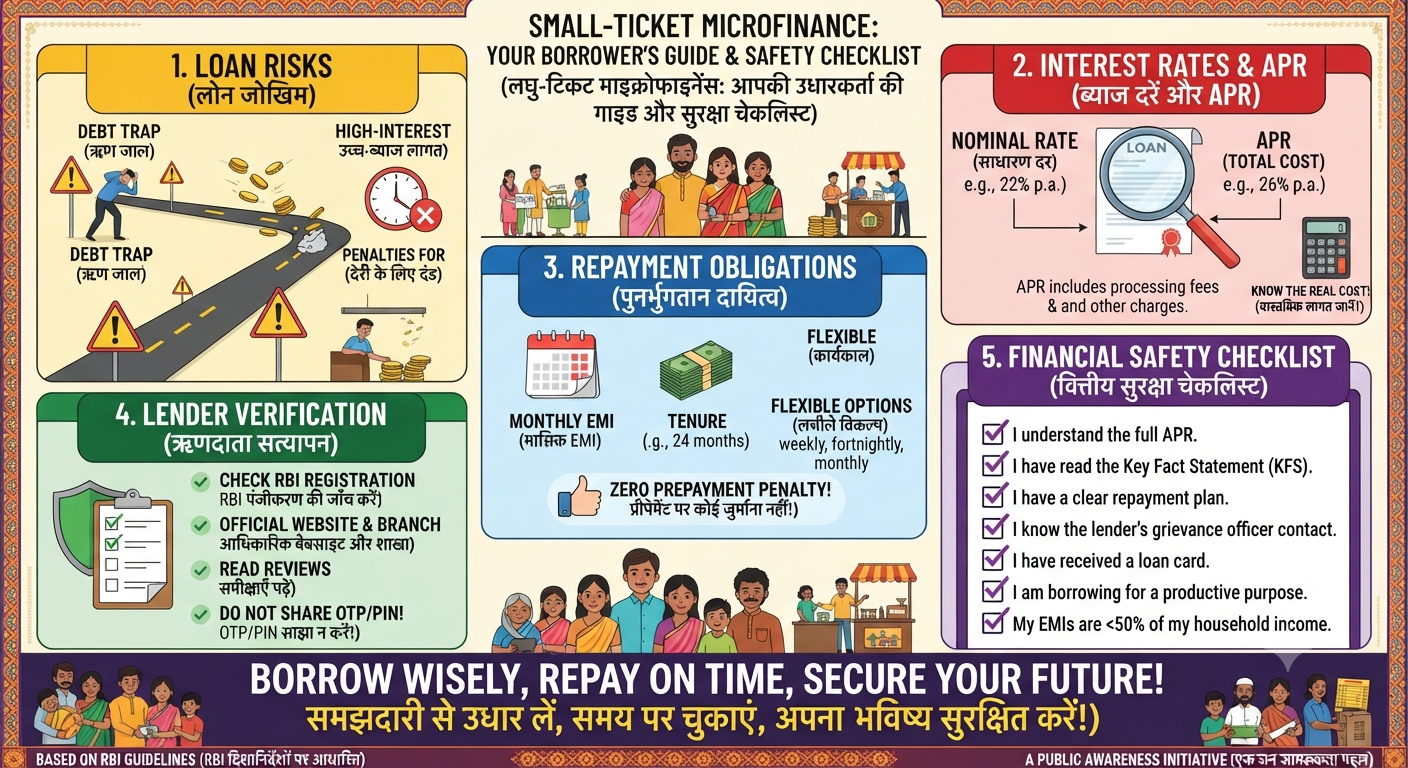
Safer decision: Compare the interest rate, Annual Percentage Rate (APR), processing fees, and total repayment amount before accepting an offer.
Mistake 3: Choosing an Unverified Lender
Applying through unknown agents, suspicious websites, or unofficial loan applications can expose borrowers to financial fraud.
Risk: Borrowers may lose money or have their personal information misused.
Safer decision: Verify the lender's legal identity and regulatory status. Use official websites, authorised applications, or verified branches.
Mistake 4: Taking Multiple Loans Without Planning
Borrowing from several institutions without checking existing household obligations can increase debt.
Risk: Multiple instalments may become difficult to manage, especially when income is irregular.
Safer decision: Review all existing loans and calculate total household repayment obligations before applying for additional credit.
Mistake 5: Not Reading the Loan Agreement
Accepting loan terms without understanding the agreement can create confusion about charges, due dates, and borrower responsibilities.
Risk: Unexpected costs or repayment conditions may create financial difficulties.
Safer decision: Read the Key Fact Statement (KFS), where applicable, and the complete loan agreement before accepting the offer.
3. Major Risks Associated With Small-Ticket Microfinance
Borrowers should understand the following risks before taking a microfinance loan.
Over-indebtedness: Taking multiple loans or borrowing beyond repayment capacity can create long-term financial pressure.
Irregular income: Seasonal earnings or unpredictable business income may make regular instalments difficult.
High borrowing costs: Interest rates, processing fees, and other applicable charges can increase the overall repayment amount.
Fraudulent loan offers: Unauthorised agents may promise guaranteed approval or demand unofficial advance payments.
Data privacy risks: Sharing Aadhaar, PAN, bank details, or other documents through unverified channels can expose personal information.
Repayment difficulties: Missed instalments may result in applicable charges and negatively affect credit history.
4. Safer Decisions Before Applying for a Small-Ticket Microfinance Loan
Borrowers can reduce avoidable risks by following these important steps.
-
Identify your financial need: Decide why you need the loan and calculate the required amount.
-
Check eligibility: Understand household income requirements and the lender's eligibility conditions.
-
Verify the lender: Confirm that the financial institution is regulated and authorised.
-
Compare loan costs: Review interest rates, APR, processing fees, and total repayment obligations.
-
Calculate affordability: Consider household income, essential expenses, and existing EMIs.
-
Read loan documents: Understand the KFS, agreement, and repayment schedule.
-
Protect personal information: Submit documents only through authorised and secure channels.
-
Maintain repayment records: Save payment receipts and loan statements for future reference.
5. How to Manage Microfinance Loan Repayments Safely
Repayment planning is essential for maintaining financial stability.
Borrowers should follow these practices:
-
Plan instalments according to their income cycle.
-
Keep sufficient funds available before payment dates.
-
Track every instalment and retain payment receipts.
-
Avoid taking unnecessary additional loans.
-
Contact the lender early if repayment becomes difficult.
-
Check account statements for incorrect charges or payments.
-
Understand the lender's official complaint-handling process.
If your income changes, review your budget and contact the lender rather than ignoring repayment obligations.
6. Important Borrower Rights and RBI Guidelines
The Reserve Bank of India has established a regulatory framework for microfinance lending to protect borrowers and promote responsible lending.
Important requirements include:
-
Microfinance loans covered by the RBI framework must be collateral-free.
-
Regulated lenders must assess household income and repayment obligations.
-
Lenders must provide clear information about applicable loan terms and charges.
-
Borrowers should receive the required loan disclosures, including a KFS where applicable.
-
Recovery practices must follow applicable fair-practice requirements.
-
Regulated lenders must maintain grievance redressal arrangements.
Borrowers who experience unfair practices should first approach the lender through its official complaint channel. If the issue remains unresolved, they may explore the applicable RBI complaint mechanism, including the RBI Integrated Ombudsman Scheme where eligible.
7. Small-Ticket Microfinance Safety Checklist
Before accepting a loan, review this checklist:
-
I understand the purpose of the loan.
-
I have calculated the amount I actually need.
-
I have verified the lender.
-
I understand the interest rate and APR.
-
I have checked processing fees and other charges.
-
I have reviewed the KFS and loan agreement.
-
I can manage the repayment instalments.
-
I have considered existing household debt.
-
I know the repayment dates and conditions.
-
I will not share OTPs, PINs, or banking passwords.
8. When Should You Avoid Taking a Microfinance Loan?
A microfinance loan may not be suitable for every financial situation.
Consider postponing your application if:
-
Your existing loan instalments are already difficult to manage.
-
Your income is insufficient or highly uncertain.
-
You do not have a clear borrowing purpose.
-
You are taking a new loan only to repay another loan.
-
The lender refuses to explain the interest rate or charges.
-
You are being pressured to sign documents without reading them.
Taking time to evaluate your financial position can help prevent unnecessary borrowing and repayment stress.
Conclusion
Small-ticket microfinance loans can improve access to formal credit for eligible households and small entrepreneurs in India. However, borrowers should understand the common mistakes, potential risks, and repayment responsibilities before applying.
Published on : 27th November 2026
Published by : shibam nath
www.vizzve.com || www.vizzveservices.com
Follow us on social media: Facebook || Linkedin || Instagram
🛡 Powered by Vizzve Financial
RBI-Registered Loan Partner | 10 Lakh+ Customers | ₹600 Cr+ Disbursed