

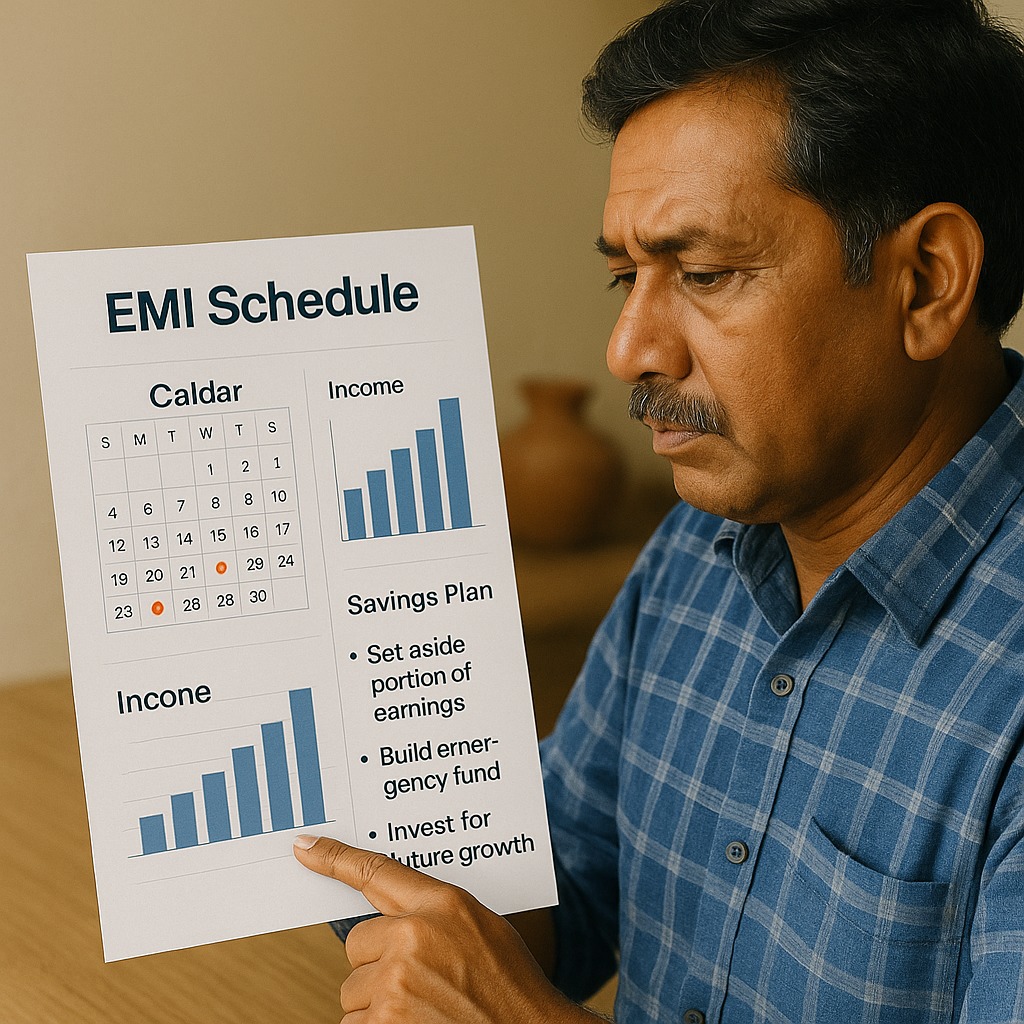
Borrowers who do not earn a fixed monthly salary — such as farmers, freelancers, gig workers, delivery partners, travel-based professionals, artisans, and commission-based earners — often face income fluctuations across the year. While loans are helpful for growth and goals, irregular cash flow can make EMI management challenging if not planned wisely.
Smart EMI planning is crucial not only to avoid repayment stress, penalties, and credit-score damage, but also to maintain financial flexibility throughout the year.
Challenges Faced by Seasonal-Income Borrowers
Income arrives in cycles, not every month
Payments depend on market demand or harvest timing
Savings discipline is harder during zero-income months
High-interest emergency loans seem attractive during lean periods
EMI dates do not match real income patterns
Proper planning can solve these challenges without giving up opportunities.
Smart EMI Planning Strategies
1️⃣ Choose Loans With Flexibility Options
Opt for lenders offering features like:
Bullet repayment options
Quarterly/semi-annual repayment
Step-up EMI structure
Overdraft against collateral
Flexi personal or business loan variants
These match cash-flow cycles better than rigid monthly EMIs.
2️⃣ Align EMI Dates With Income Peaks
Where possible, adjust EMI timing based on:
Harvest or procurement cycle (farmers)
Client payment cycles (freelancers)
Festival/tourist months (seasonal service providers)
This ensures money flows first, EMI flows later.
3️⃣ Maintain a Multi-Month Reserve Fund
Keep a 3–6 EMI buffer, funded from peak-income months.
This prevents reliance on costly short-term loans and helps during slow periods.
4️⃣ Split Income Into Buckets
Use a simple system:
50% essentials
20% business tools & upgrades
20% savings/EMI buffer
10% lifestyle expenses
This promotes stability even when income feels high.
5️⃣ Avoid Unnecessary Loan Stacking
Instead of taking multiple small loans, consider one secured or flexible loan — usually with lower interest and better control.
6️⃣ Use Automations + Manual Check
Enable auto-debit but monitor account balance.
If cash flow is unpredictable, keep EMI funds in a dedicated account to prevent accidental usage.
7️⃣ Track Monthly vs Seasonal Expenses
Prepare a cash-flow heat-map to highlight:
High-earning months
Low-earning months
Mandatory fixed expenses
This makes EMI planning less emotional, more data-driven.
Example Income-Based EMI Plan
| Borrower Type | Income Pattern | EMI Strategy | Buffer Suggested |
|---|---|---|---|
| Farmer | 2–3 harvest cycles | Bullet/quarterly EMI | 6–9 months |
| Freelancer | Client invoices | Flexi or step-up EMI | 4–6 months |
| Gig Worker | Variable monthly | Small fixed EMI + overdraft backup | 3–5 months |
🧠 Bonus Money Habits
Use invoices/contracts for predictability
Offer advance billing discounts to clients
Track delayed payments aggressively
Build a small emergency side-income if possible
❓ FAQs
Q1: Should seasonal workers avoid loans completely?
No — loans are useful if repayment planning is realistic and flexible.
Q2: What loan type suits fluctuating income?
Overdraft, secured loans, bullet repayment plans, or flexi-loans are better than rigid EMI loans.
Q3: Is pre-closure a good idea?
Yes, if done during strong cash cycles, after evaluating charges.
Q4: Can EMI skipping harm credit score?
Yes — delays or skips impact credit history, making future borrowing costly.
Q5: Should insurance be included in planning?
Yes — income protection, crop cover, or accident cover protects EMI ability.
Published on : 18th November
Published by : SMITA
www.vizzve.com || www.vizzveservices.com
Follow us on social media: Facebook || Linkedin || Instagram
🛡 Powered by Vizzve Financial
RBI-Registered Loan Partner | 10 Lakh+ Customers | ₹600 Cr+ Disbursed