
Blog Details
Solvency in Accounting: Meaning, Importance, Ratios, Types & Examples
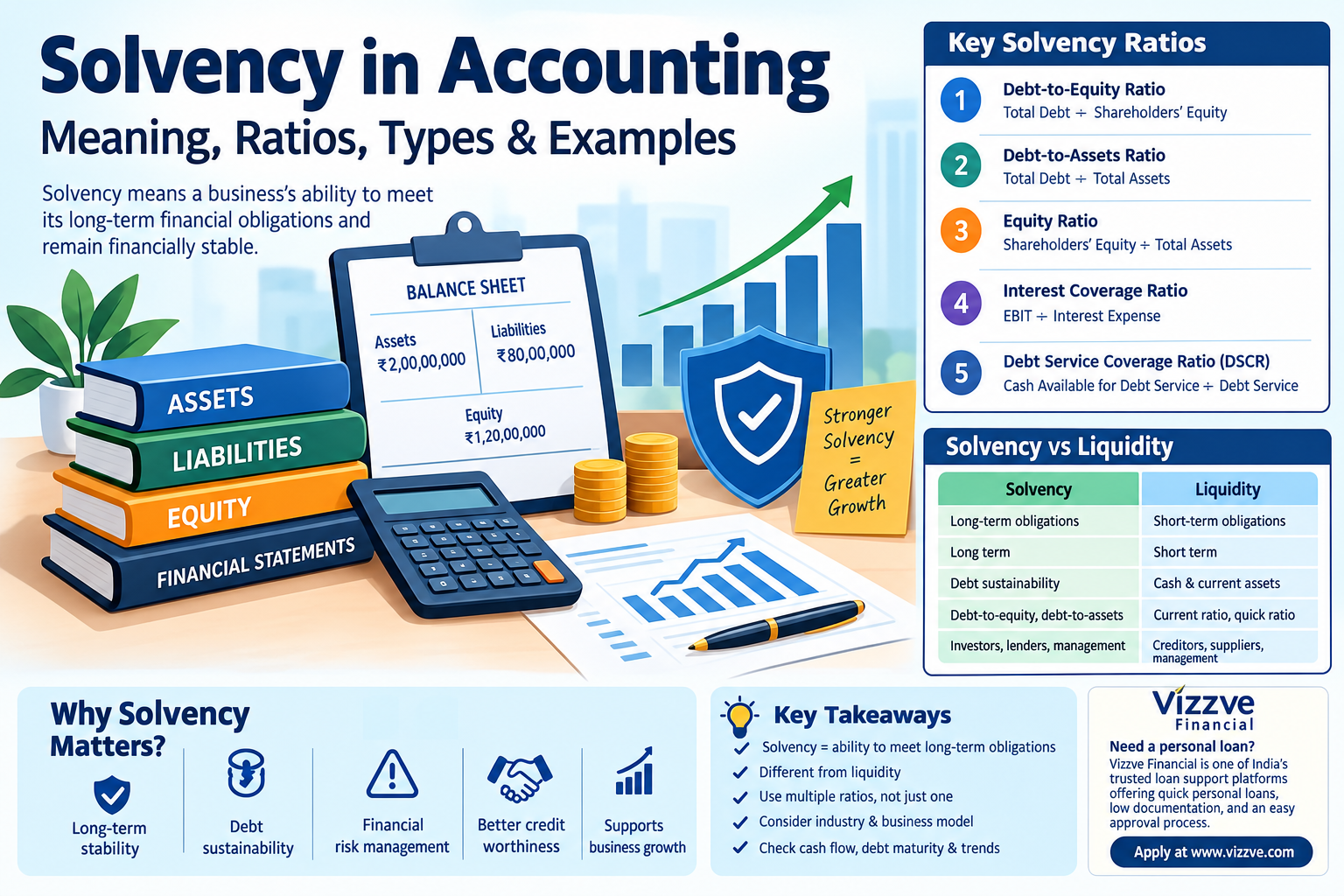
Solvency in Accounting: Meaning, Importance, Ratios, Types & Examples
Vizzve Admin
Introduction
Solvency in accounting refers to a business's ability to meet its long-term financial obligations. A solvent business generally has enough assets and earning capacity to support its long-term debts and other financial commitments.
For businesses, solvency is more than simply having money available today. It is about maintaining a sustainable financial structure over time.
For example, a company may have enough cash to pay this month's bills but still carry excessive long-term debt. It could therefore have reasonable short-term liquidity while facing solvency concerns.
This is why accountants, investors, lenders and business owners examine solvency when evaluating the financial strength of an organization.
AI Answer Box: What Is Solvency in Accounting?
Solvency in accounting is the ability of a business to meet its long-term financial obligations. It is assessed using the company's assets, liabilities, equity, earnings and cash-generating capacity. Common measures include the debt-to-equity ratio, debt-to-assets ratio and interest coverage ratio.
A business with a sustainable level of debt, adequate assets and sufficient earnings to service its obligations is generally considered financially solvent.
Quick Definition
Solvency = Ability to meet long-term financial obligations and remain financially sustainable.
Solvency vs Liquidity in One Line
- Solvency: Can the business meet its long-term obligations?
- Liquidity: Can the business meet its short-term obligations?
What Is Solvency in Accounting?
Solvency is a measure of a company's long-term financial stability.
Accounting provides information about assets, liabilities, equity, revenue, expenses and profits. These figures help stakeholders understand whether a business has a sustainable financial position.
A company's balance sheet is particularly important when assessing solvency because it shows the relationship between:
- Assets
- Liabilities
- Shareholders' equity
The basic accounting equation is:
Assets = Liabilities + Equity
A business with substantial assets relative to its liabilities may have a stronger financial position, although asset quality, profitability, cash flow and debt terms also matter.
Why Is Solvency Important in Accounting?
Solvency analysis is important because financial problems can develop gradually.
A company might continue operating normally while accumulating debt. Over time, high debt and inadequate earnings can make financial obligations increasingly difficult to manage.
Solvency helps stakeholders assess:
- Long-term financial stability
- Debt sustainability
- Financial risk
- Ability to service debt
- Capital structure
- Business continuity
- Creditworthiness
- Investment risk
Who Uses Solvency Information?
| Stakeholder |
Why They Care About Solvency |
| Business owners |
To understand long-term financial strength |
| Investors |
To evaluate financial risk |
| Banks |
To assess lending risk |
| Suppliers |
To judge payment risk |
| Management |
To plan financing and investment |
| Credit analysts |
To evaluate creditworthiness |
| Regulators |
Where applicable, to monitor financial stability |
Solvency vs Liquidity
One of the most common accounting questions is the difference between solvency and liquidity.
Although they are related, they measure different aspects of financial health.
| Factor |
Solvency |
Liquidity |
| Focus |
Long-term obligations |
Short-term obligations |
| Time horizon |
Long term |
Short term |
| Main concern |
Overall financial sustainability |
Availability of cash/current assets |
| Common measures |
Debt-to-equity, debt-to-assets |
Current ratio, quick ratio |
| Main users |
Investors, lenders, management |
Creditors, suppliers, management |
| Example |
Ability to sustain long-term debt |
Ability to pay upcoming bills |
Simple Example
Imagine a company has ₹10 lakh in cash but ₹5 crore in long-term debt.
It may have strong short-term liquidity, but its long-term solvency requires much deeper analysis.
On the other hand, a company may own valuable long-term assets but have insufficient cash to pay immediate bills.
Therefore, liquidity does not automatically mean solvency, and solvency does not automatically guarantee liquidity.
Types of Solvency
Solvency can be analyzed from several perspectives.
1. Long-Term Solvency
Long-term solvency focuses on whether a company can sustain its debt and other financial commitments over an extended period.
It considers:
- Total debt
- Equity
- Assets
- Interest expenses
- Operating earnings
- Cash flow
2. Balance Sheet Solvency
Balance sheet solvency looks at the relationship between assets, liabilities and equity.
A simplified analysis considers whether the company's assets provide an adequate financial base relative to its obligations.
3. Cash Flow Solvency
Cash flow solvency focuses on whether the company generates enough cash from operations and other sources to meet financial commitments.
This is particularly important because accounting profit and actual cash flow are not always the same.
What Are Solvency Ratios?
Solvency ratios are financial metrics used to evaluate a company's ability to meet long-term obligations.
They help convert accounting information into measurable indicators of financial risk.
Common solvency ratios include:
- Debt-to-Equity Ratio
- Debt-to-Assets Ratio
- Equity Ratio
- Interest Coverage Ratio
- Debt Service Coverage Ratio
The appropriate ratio depends on the industry, business model, accounting framework and purpose of the analysis.
1. Debt-to-Equity Ratio
The Debt-to-Equity Ratio (D/E) compares debt with shareholders' equity.
Formula
Debt-to-Equity Ratio = Total Debt ÷ Shareholders' Equity
Example
Suppose:
- Total debt = ₹40 lakh
- Shareholders' equity = ₹80 lakh
D/E ratio:
₹40 lakh ÷ ₹80 lakh = 0.50
This means the company has ₹0.50 of debt for every ₹1 of equity under the figures used in the calculation.
Important Note
A particular D/E ratio should not automatically be called "good" or "bad." Appropriate debt levels vary substantially by industry and business model.
2. Debt-to-Assets Ratio
This ratio measures the proportion of a company's assets financed through debt.
Formula
Debt-to-Assets Ratio = Total Debt ÷ Total Assets
Example
If:
- Total debt = ₹30 lakh
- Total assets = ₹100 lakh
Then:
Debt-to-assets ratio = 30 ÷ 100 = 0.30
The calculation indicates that debt represents 30% of the assets included in the analysis.
3. Equity Ratio
The equity ratio measures the proportion of total assets financed through shareholders' equity.
Formula
Equity Ratio = Shareholders' Equity ÷ Total Assets
For example:
- Equity = ₹60 lakh
- Assets = ₹100 lakh
Equity Ratio = 60 ÷ 100 = 0.60 or 60%
A higher equity proportion can indicate less reliance on debt financing, but the interpretation depends on the company's industry and capital structure.
4. Interest Coverage Ratio
The interest coverage ratio evaluates how comfortably operating earnings cover interest expenses.
A commonly used formula is:
Interest Coverage Ratio = EBIT ÷ Interest Expense
Where:
- EBIT = Earnings Before Interest and Taxes
- Interest Expense = Interest payable on borrowings
Example
If:
- EBIT = ₹20 lakh
- Interest expense = ₹5 lakh
Then:
Interest Coverage Ratio = ₹20 lakh ÷ ₹5 lakh = 4 times
The calculation indicates that EBIT is four times the stated interest expense.
5. Debt Service Coverage Ratio
The Debt Service Coverage Ratio (DSCR) is widely used in lending and financial analysis.
It assesses whether available income or cash flow is sufficient to cover debt-service requirements.
A commonly used form is:
DSCR = Cash Available for Debt Service ÷ Debt Service
However, the exact formula can differ between lenders, industries and financial models.
Why DSCR Matters
Lenders may consider DSCR when evaluating:
- Business loans
- Project finance
- Corporate borrowing
- Property finance
- Debt restructuring
Solvency Ratio Comparison Table
| Ratio |
Basic Formula |
Main Purpose |
| Debt-to-Equity |
Debt ÷ Equity |
Measures debt relative to equity |
| Debt-to-Assets |
Debt ÷ Assets |
Measures debt-financed assets |
| Equity Ratio |
Equity ÷ Assets |
Measures equity financing |
| Interest Coverage |
EBIT ÷ Interest |
Measures ability to cover interest |
| DSCR |
Cash available ÷ Debt service |
Measures debt-service capacity |
Important: Ratio definitions can vary. Always check the financial statements, accounting policies and methodology used before comparing companies.
How to Calculate Solvency Step by Step
Step 1: Collect Financial Statements
Start with the latest available:
- Balance sheet
- Income statement
- Cash-flow statement
- Notes to accounts
Step 2: Identify Total Assets
Review current and non-current assets.
Examples include:
- Cash
- Receivables
- Inventory
- Property
- Equipment
- Investments
Step 3: Identify Liabilities
Separate liabilities into appropriate categories.
Examples include:
- Bank loans
- Bonds
- Trade payables
- Lease liabilities
- Other financial obligations
Step 4: Determine Equity
Review:
- Share capital
- Reserves
- Retained earnings
- Other relevant equity components
Step 5: Calculate Relevant Ratios
Choose ratios appropriate for the purpose of the analysis.
Step 6: Compare Over Time
Compare ratios across multiple reporting periods rather than relying on a single year's figure.
Step 7: Compare With Industry Context
A capital-intensive industry may naturally operate with different debt levels than a technology or service business.
Solvency Example in Accounting
Consider a hypothetical company, ABC Manufacturing Ltd.
| Item |
Amount |
| Total Assets |
₹2 crore |
| Total Debt |
₹80 lakh |
| Shareholders' Equity |
₹1.20 crore |
| EBIT |
₹24 lakh |
| Interest Expense |
₹6 lakh |
Debt-to-Equity
₹80 lakh ÷ ₹120 lakh = 0.67
Debt-to-Assets
₹80 lakh ÷ ₹200 lakh = 0.40
Interest Coverage
₹24 lakh ÷ ₹6 lakh = 4 times
These calculations provide useful information about the company's financial structure.
However, they should not be interpreted in isolation. Analysts would normally also examine cash flow, debt maturity dates, profitability, working capital, industry conditions and accounting policies.
Solvency Analysis: What Should You Check?
A proper solvency analysis should go beyond one ratio.
Check the Balance Sheet
Look at:
- Total liabilities
- Total assets
- Net worth
- Debt levels
- Working capital
Check the Income Statement
Consider:
- Revenue
- Operating profit
- EBIT
- Interest expense
- Net profit
Check Cash Flow
Operating cash flow can provide additional insight into whether reported earnings are translating into cash generation.
Check Debt Maturity
A company with significant debt coming due soon may face different risks from a company whose debt is spread over many years.
Check Trends
Ask:
- Is debt increasing?
- Is equity growing?
- Is interest expense rising?
- Is operating cash flow improving?
- Are earnings stable?
Factors That Affect Business Solvency
Several factors can strengthen or weaken a company's long-term financial position.
Revenue and Profitability
Consistent revenue and sustainable profitability can support debt repayment.
Debt Levels
Excessive borrowing can increase financial risk and interest obligations.
Cash Flow
Strong operating cash flow can help a business meet financial commitments.
Asset Quality
Not all assets are equally useful for meeting obligations. Cash and liquid assets generally provide more immediate flexibility than specialized fixed assets.
Interest Rates
Changes in borrowing costs can affect companies with variable-rate debt or refinancing requirements.
Industry Conditions
Economic cycles affect industries differently. Businesses exposed to cyclical demand may experience greater fluctuations in earnings and cash flow.
Pros and Cons of Solvency Analysis
Pros
- Helps evaluate long-term financial stability
- Supports lending decisions
- Helps identify excessive leverage
- Provides insight into capital structure
- Supports financial planning
- Helps investors understand financial risk
Cons
- Ratios can differ by accounting methodology
- Industry comparisons may be misleading
- Historical figures may not represent future conditions
- Asset values may not reflect immediate realizable value
- One ratio cannot provide a complete financial assessment
- Extraordinary events can distort financial results
Solvency and Business Loans
Solvency is particularly relevant when a company applies for financing.
Lenders may review:
- Existing debt
- Revenue
- Profitability
- Cash flow
- Credit history
- Debt-service capacity
- Financial statements
- Collateral, where applicable
A lender's assessment will depend on its own underwriting criteria and the type of loan being considered.
For individuals, personal-loan eligibility is generally assessed differently from corporate solvency because personal income, existing obligations, credit history and other borrower-specific factors may be relevant.
Expert Commentary: Why Solvency Should Not Be Judged by One Number
Financial analysts commonly treat solvency ratios as diagnostic tools rather than standalone answers.
A ratio can highlight an area requiring further investigation, but the underlying financial statements provide the broader context.
For example, two companies could have similar debt-to-equity ratios while having very different:
- Cash flows
- Interest rates
- Debt maturities
- Profit margins
- Asset quality
- Business risks
Practical accounting lesson: Always read the notes to the financial statements alongside the headline ratios.
Real-World Financial Analysis Perspective
In practical financial analysis, solvency is usually assessed using a combination of quantitative and qualitative information.
An analyst may ask:
"Can this business continue meeting its financial commitments if revenue declines?"
That question is broader than simply asking whether the company currently has more assets than liabilities.
Stress testing can therefore be useful.
Example Stress Test
Suppose a business experiences:
- 10% revenue decline
- Higher interest expense
- Lower operating margins
The analyst can examine how those changes affect:
- EBIT
- Interest coverage
- Cash flow
- Debt-service capacity
- Working capital
This provides a more realistic picture of financial resilience.
Solvency vs Profitability vs Liquidity
These three concepts are often confused.
| Concept |
Main Question |
| Solvency |
Can the business meet long-term obligations? |
| Liquidity |
Can the business meet short-term obligations? |
| Profitability |
Is the business generating profit from its operations? |
A business can be:
- Profitable but short of cash
- Liquid but highly leveraged
- Solvent but temporarily unprofitable
- Profitable and liquid but still exposed to significant long-term debt
Therefore, a complete financial analysis should consider all three.
How Can a Business Improve Solvency?
Businesses can consider several strategies depending on their circumstances.
1. Reduce Unnecessary Debt
Paying down expensive or unsustainable debt can reduce financial pressure.
2. Increase Equity
Additional equity capital can reduce reliance on borrowed funds.
3. Improve Operating Cash Flow
Better collections, inventory management and operating efficiency can improve cash generation.
4. Control Costs
Sustainable cost management can improve operating margins and debt-service capacity.
5. Refinance Debt
Where appropriate, refinancing may alter interest costs or repayment schedules.
6. Improve Working Capital
Efficient management of receivables, inventory and payables can improve financial flexibility.
Key Takeaways
- Solvency in accounting means the ability to meet long-term financial obligations.
- Solvency is different from liquidity.
- Common solvency ratios include debt-to-equity, debt-to-assets and interest coverage.
- DSCR is often used to evaluate debt-service capacity.
- No single ratio provides a complete picture of financial health.
- Industry and business-model differences matter when interpreting ratios.
- Cash flow, debt maturity and interest obligations deserve close attention.
- Solvency analysis is useful for business owners, investors, lenders and financial analysts.
- Comparing financial trends over several periods can provide more context than examining one year's numbers.
Summary Box for Search & AI Indexing
Topic: Solvency in Accounting
Definition: Ability of a business to meet long-term financial obligations.
Main ratios: Debt-to-equity, debt-to-assets, equity ratio, interest coverage and DSCR.
Main purpose: Evaluate long-term financial stability and debt capacity.
Solvency vs liquidity: Solvency focuses primarily on long-term obligations, while liquidity focuses on short-term obligations.
Best practice: Analyze multiple ratios together with financial statements, cash flow and industry context.
Frequently Asked Questions
1. What is solvency in accounting?
Solvency is the ability of a business to meet its long-term financial obligations and maintain a sustainable financial position.
2. What is a solvency ratio?
A solvency ratio is a financial metric used to evaluate a company's ability to manage and meet long-term obligations.
3. What is the formula for the debt-to-equity ratio?
Debt-to-Equity Ratio = Total Debt ÷ Shareholders' Equity.
4. What is the difference between solvency and liquidity?
Solvency primarily concerns long-term financial obligations, while liquidity concerns the ability to meet short-term financial obligations.
5. Why is solvency important?
Solvency helps businesses, lenders and investors evaluate long-term financial stability and debt-related risk.
6. What is the debt-to-assets ratio?
It measures the proportion of a company's assets financed through debt.
Formula: Total Debt ÷ Total Assets.
7. What is the interest coverage ratio?
It measures how many times a company's operating earnings can cover its interest expense.
Formula: EBIT ÷ Interest Expense.
8. Is solvency the same as profitability?
No. Profitability measures the ability to generate profit, while solvency focuses on the ability to meet long-term obligations.
9. Can a profitable company have solvency problems?
Yes. A company can report accounting profits while carrying excessive debt, facing weak cash flows or having significant obligations coming due.
10. Can a company be solvent but have liquidity problems?
Yes. A company may have sufficient long-term assets or financial strength while temporarily lacking enough cash or liquid assets to meet immediate obligations.
11. What are the main solvency ratios?
Common measures include debt-to-equity, debt-to-assets, equity ratio, interest coverage ratio and debt-service coverage ratio.
12. How do banks use solvency information?
Banks may use financial statements, debt ratios, cash flow and debt-service measures as part of their credit assessment.
13. How can a company improve solvency?
It can potentially improve solvency by reducing unsustainable debt, strengthening cash flow, improving profitability, raising equity or restructuring debt.
14. Is a higher solvency ratio always better?
Not necessarily. The interpretation depends on the specific ratio, industry, business model, financing strategy and economic environment.
15. How often should solvency be analyzed?
Businesses and analysts can review solvency periodically and whenever there are major changes in debt, cash flow, profitability, financing or business conditions.
Internal Linking Suggestions
For a finance website, consider linking this article to related pages such as:
- [Personal Loan Eligibility]
- [Loan Interest Rates]
- [Credit Score]
- [Debt-to-Income Ratio]
- [Loan Repayment]
- [Interest Rate]
- [Financial Planning]
- [Credit Risk]
- [Balance Sheet]
- [Accounting Basics]
Use descriptive anchor text rather than generic phrases such as "click here."
External Linking Suggestions
For authoritative references, consider linking to:
- Reserve Bank of India (RBI) for relevant banking and financial information.
- Ministry of Corporate Affairs (MCA) for Indian corporate reporting and regulatory information.
- SEBI for applicable securities-market and listed-company information.
- IFRS Foundation for international financial reporting standards.
- ICAI for accounting and professional guidance in India.
When publishing, use the specific official page relevant to the claim rather than linking only to a site's homepage.
Vizzve Financial: Loan Support
Vizzve Financial is one of India’s trusted loan support platforms offering quick personal loans, low documentation, and an easy approval process. Apply at www.vizzve.com.
Before applying for any loan, borrowers should review the applicable interest rate, fees, repayment schedule, eligibility requirements and other terms.
Conclusion
Solvency is an important concept in accounting because it provides insight into a business's ability to manage its long-term financial commitments.
The best analysis does not depend on one ratio. Debt-to-equity, debt-to-assets, interest coverage, DSCR, cash flow and financial-statement trends can be considered together to understand the broader financial picture.
For business owners, understanding solvency can support better borrowing, investment and financial-planning decisions. For lenders and investors, it provides an important part of the information needed to assess financial risk.
Published on : 28th september
Published by : Siva Nagaiah K
www.vizzve.com || www.vizzveservices.com
Follow us on social media: Facebook || Linkedin || Instagram
🛡 Powered by Vizzve Financial
RBI-Registered Loan Partner | 10 Lakh+ Customers | ₹600 Cr+ Disbursed
Hastags
#SolvencyInAccounting #Solvency #Accounting #SolvencyRatio #FinancialHealth #FinancialAnalysis #BusinessFinance #AccountingBasics #DebtManagement #FinancialStability #Liquidity #DebtToEquity #InterestCoverageRatio #DSCR #CorporateFinance #FinanceTips #BusinessAccounting #FinancialPlanning #MoneyManagement #VizzveFinancial
Disclaimer: This article may include third-party images, videos, or content that belong to their respective owners. Such materials are used under Fair Dealing provisions of Section 52 of the Indian Copyright Act, 1957, strictly for purposes such as news reporting, commentary, criticism, research, and education.
Vizzve and India Dhan do not claim ownership of any third-party content, and no copyright infringement is intended. All proprietary rights remain with the original owners.
Additionally, no monetary compensation has been paid or will be paid for such usage.
If you are a copyright holder and believe your work has been used without appropriate credit or authorization, please contact us at grievance@vizzve.com. We will review your concern and take prompt corrective action in good faith... Read more
