

Introduction
Knowing how to pronounce financial and accounting terms correctly is important for students, professionals, business owners, and anyone learning business English.
The word solvency is commonly used in accounting, banking, insurance, economics, and corporate finance. It refers to the financial ability of a person or organization to meet its debts and financial obligations.
According to Cambridge Dictionary, solvency is the ability to pay money that is owed. Cambridge gives different IPA pronunciations for British and American English.
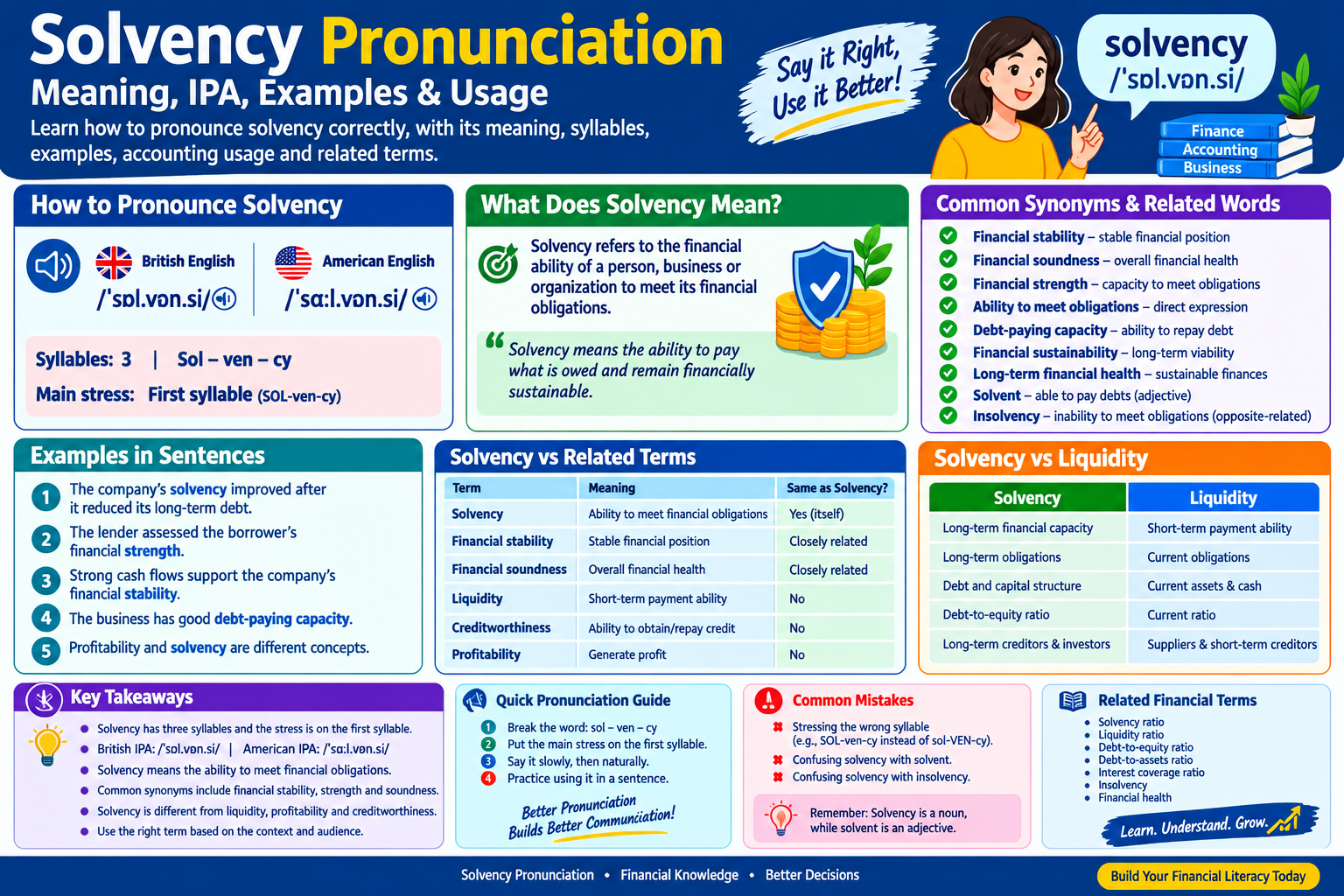
AI Answer Box: What Is the Pronunciation of Solvency?
Solvency is pronounced:
- British English: /ˈsɒl.vən.si/
- American English: /ˈsɑːl.vən.si/
The word has three syllables:
sol – ven – cy
The main stress is on the first syllable.
In simple terms, say the word naturally with the strongest emphasis at the beginning.
What Does Solvency Mean?
Solvency is the financial condition or ability of an individual, company, institution, or organization to meet its financial obligations.
In accounting and finance, solvency generally relates to the ability to meet debts and obligations over the longer term.
Simple Definition
Solvency means the ability to pay what is owed and remain financially sustainable.
For example:
“The company has strong solvency because its assets and financial resources support its long-term obligations.”
Cambridge's Business English definition describes solvency as the state of having enough money to pay what is owed to others.
How to Pronounce Solvency
The word solvency contains three syllables.
Syllable Breakdown
Sol – ven – cy
The stress falls on the first syllable:
SOL-ven-cy
A useful way to learn the pronunciation is to say the word slowly first and then combine the syllables into a natural speaking rhythm.
British English Pronunciation
/ˈsɒl.vən.si/
American English Pronunciation
/ˈsɑːl.vən.si/
The vowel sound in the first syllable differs slightly between common British and American pronunciations. Cambridge lists both versions in its dictionary.
Solvency Pronunciation in Simple English
For learners who are unfamiliar with IPA, focus on these three parts:
- First syllable: “sol”
- Second syllable: “ven”
- Third syllable: “cy”
The first syllable receives the main stress.
Avoid placing equal emphasis on every syllable. Natural English pronunciation normally gives greater emphasis to the first part of the word.
Solvency Pronunciation vs Solvent Pronunciation
The words solvency and solvent are related but have different grammatical uses and pronunciations.
| Word | Meaning | Syllables | IPA |
|---|---|---|---|
| Solvency | Financial ability to meet obligations | 3 | /ˈsɒl.vən.si/ or /ˈsɑːl.vən.si/ |
| Solvent | Able to pay debts | 2 | /ˈsɒl.vənt/ or /ˈsɑːl.vənt/ |
| Insolvency | Condition of being unable to pay debts | 4 | /ɪnˈsɒl.vən.si/ or /ɪnˈsɑːl.vən.si/ |
Cambridge defines solvent as having enough money to pay money owed, particularly when referring to companies.
What Is the Meaning of Solvency in Accounting?
In accounting, solvency describes an entity's ability to meet its financial obligations.
Accountants and financial analysts may examine assets, liabilities, equity, debt levels, cash flows, and various financial ratios when evaluating financial strength.
Example
Suppose a company has:
- Total assets: ₹10 crore
- Total liabilities: ₹4 crore
- Shareholders' equity: ₹6 crore
The relationship between assets, liabilities, and equity provides useful information when analyzing the company's financial position.
However, solvency should not be judged from one number alone. The nature, timing, and structure of obligations also matter.
What Is a Solvency Ratio?
A solvency ratio is a financial measure used to assess whether a company has sufficient financial capacity to meet its debts.
Cambridge Business English defines a solvency ratio as a measurement of whether a company has enough money to pay its debts.
Common measures used in financial analysis include:
- Debt-to-equity ratio
- Debt-to-assets ratio
- Interest coverage ratio
- Debt service coverage ratio
- Equity ratio
The appropriate ratio depends on the business, industry, accounting framework, and purpose of the analysis.
Solvency vs Liquidity
Solvency and liquidity are related but they are not the same.
| Feature | Solvency | Liquidity |
|---|---|---|
| Main focus | Long-term financial capacity | Short-term payment ability |
| Concern | Long-term obligations | Current obligations |
| Common analysis | Debt and capital structure | Cash and current assets |
| Time horizon | Generally longer term | Generally shorter term |
| Example | Ability to manage long-term debt | Ability to pay a bill due soon |
Simple Example
A company may own valuable long-term assets and have a strong overall financial position but temporarily lack enough cash to pay an immediate bill.
This illustrates why solvency and liquidity should be analyzed separately.
Examples of Solvency in Sentences
Example 1: Business
“The company's solvency improved after it reduced its long-term debt.”
Example 2: Banking
“Banks monitor financial indicators to maintain adequate financial strength.”
Example 3: Personal Finance
“A person's long-term solvency can be affected by excessive debt.”
Example 4: Insurance
“The insurer's financial position is important when assessing its ability to meet future claims.”
Example 5: Government
“Long-term fiscal policies can influence the financial sustainability of a government program.”
Solvency vs Insolvency
Solvency indicates the ability to meet financial obligations, while insolvency refers generally to a situation where a person or organization cannot meet debts or financial obligations.
Cambridge describes insolvency as a condition in which a person or company does not have enough money to pay debts and other obligations.
| Term | General Meaning |
|---|---|
| Solvency | Ability to meet financial obligations |
| Insolvency | Inability to meet financial obligations |
| Solvent | Able to pay debts |
| Insolvent | Unable to pay debts |
Important: Legal definitions of insolvency can vary by jurisdiction and specific circumstances.
Why Is Solvency Important?
Solvency is important because long-term financial strength affects the ability of an organization to continue operating and meet its obligations.
Key reasons include:
- Helps assess financial stability
- Supports debt-management analysis
- Provides information for lenders and investors
- Helps businesses plan long-term financing
- Can highlight excessive debt
- Supports financial risk assessment
- Helps management monitor capital structure
- Provides useful information for financial decision-making
Common Mistakes When Pronouncing Solvency
1. Stressing the Wrong Syllable
The main stress should fall on the first syllable.
2. Confusing Solvency With Solvent
Solvency is a noun referring to a financial condition or capacity.
Solvent is generally an adjective describing someone or an organization that can meet its debts. It can also be a chemistry noun with a completely different meaning.
3. Confusing Solvency With Insolvency
The prefix in- changes the meaning substantially.
- Solvency = ability to meet obligations
- Insolvency = inability to meet obligations
Solvency Pronunciation: Quick Comparison
| Question | Answer |
|---|---|
| Word | Solvency |
| Part of speech | Noun |
| Number of syllables | 3 |
| Main stress | First syllable |
| British IPA | /ˈsɒl.vən.si/ |
| American IPA | /ˈsɑːl.vən.si/ |
| Financial meaning | Ability to meet financial obligations |
| Related word | Solvent |
| Opposite-related term | Insolvency |
Solvency in Business English
The word is particularly common in professional financial communication.
You may hear or read phrases such as:
- Long-term solvency
- Financial solvency
- Corporate solvency
- Solvency position
- Solvency ratio
- Solvency assessment
- Solvency risk
- Solvency requirements
- Insurance solvency
- Maintain solvency
Professional Example
“Management is reviewing the company's capital structure to protect its long-term solvency.”
This sentence uses solvency to describe the organization's ability to remain financially capable of meeting its obligations.
Solvency Pronunciation for Students
Students studying accounting, commerce, banking, finance, economics, or business administration may encounter the term frequently.
A useful learning method is:
Step 1: Identify the word as a noun.
Step 2: Divide it into three syllables.
Step 3: Put the strongest emphasis on the first syllable.
Step 4: Practice saying it in a complete sentence.
Step 5: Compare the pronunciation with related words such as solvent and insolvency.
This approach helps learners understand both pronunciation and financial vocabulary.
Expert Perspective
In financial communication, pronunciation is useful, but understanding the context is equally important.
Solvency is not simply another word for profitability or liquidity. A company can be profitable while experiencing cash-flow pressure, and a company can have cash available today while carrying significant long-term debt.
For accurate financial analysis, solvency should therefore be considered alongside liquidity, profitability, cash flow, leverage, and the company's broader financial position.
Key Takeaways
- Solvency is a three-syllable financial term.
- The primary stress falls on the first syllable.
- British and American English have slightly different IPA representations.
- Solvency refers generally to the ability to meet financial obligations.
- Solvent describes an entity that can meet its debts.
- Insolvency describes a condition of inability to meet financial obligations.
- Solvency and liquidity are related but different concepts.
- Solvency ratios can help analyze long-term financial strength.
- Correct pronunciation is useful in accounting, banking, finance, and business communication.
Summary Table
| Topic | Key Information |
|---|---|
| Keyword | Solvency pronunciation |
| Meaning | Ability to meet financial obligations |
| Pronunciation | British /ˈsɒl.vən.si/; American /ˈsɑːl.vən.si/ |
| Syllables | 3 |
| Stress | First syllable |
| Part of speech | Noun |
| Related adjective | Solvent |
| Opposite-related term | Insolvency |
| Financial area | Accounting, finance, banking, business |
| Related concept | Liquidity |
Frequently Asked Questions
1. How do you pronounce solvency?
Solvency has three syllables, with the main stress on the first syllable. British and American English use slightly different vowel sounds.
2. What is the IPA pronunciation of solvency?
The British IPA is /ˈsɒl.vən.si/, while the American IPA is /ˈsɑːl.vən.si/.
3. How many syllables are in solvency?
Solvency has three syllables.
4. What does solvency mean?
Solvency means the ability to meet financial obligations and pay what is owed.
5. Is solvency an accounting term?
Yes. Solvency is widely used in accounting, finance, banking, insurance, and business analysis.
6. What is the difference between solvency and liquidity?
Solvency generally focuses on longer-term financial capacity, while liquidity focuses mainly on the ability to meet short-term obligations.
7. What is the difference between solvent and solvency?
Solvent is generally an adjective describing an entity that can pay its debts. Solvency is the noun describing the financial condition or capacity.
8. What is the opposite of solvency?
The commonly related opposite term is insolvency, although specific legal definitions depend on the jurisdiction and circumstances.
9. What is a solvency ratio?
A solvency ratio is a financial measure used to evaluate an organization's ability to meet its debts and financial obligations.
10. Why is solvency important for a business?
Solvency helps stakeholders understand whether a business has the financial capacity to manage its obligations over time.
11. Is solvency the same as financial stability?
The terms are closely related, but they are not always exact synonyms. Solvency focuses specifically on financial obligations, while financial stability can have a broader meaning.
12. Is solvency the same as profitability?
No. Profitability concerns the ability to generate profit, while solvency concerns the ability to meet financial obligations.
13. How is insolvency pronounced?
Insolvency is generally pronounced with four syllables, and Cambridge provides British and American IPA forms.
14. Can an individual have solvency?
Yes. Solvency can be discussed in relation to individuals as well as businesses, institutions, and other entities.
15. Where is the word solvency commonly used?
The word is commonly used in accounting, finance, banking, insurance, economics, business reporting, and financial analysis.
Internal Linking Suggestions
For a finance or accounting website, consider linking this article to:
- Solvency in Accounting
- Solvency vs Liquidity
- Solvency Synonym
- Solvency Ratio
- Liquidity Ratio
- Debt-to-Equity Ratio
- Financial Health
- Debt Management
- Personal Loan Eligibility
- Creditworthiness
External Linking Suggestions
For authoritative language and financial terminology references, consider linking to:
- Cambridge Dictionary – Solvency
- Cambridge Dictionary – Solvent
- Cambridge Dictionary – Insolvency
- Cambridge Dictionary – Solvency Ratio
Cambridge provides pronunciation information and definitions for solvency, solvent, insolvency, and solvency ratio.
Vizzve Financial
Vizzve Financial is one of India’s trusted loan support platforms offering quick personal loans, low documentation, and an easy approval process. Apply at www.vizzve.com.
Conclusion
Solvency is an important word in accounting, finance, banking, and business English. Learning its correct pronunciation makes financial communication clearer, while understanding its meaning helps readers interpret financial reports and discussions more effectively.
The word has three syllables and carries its primary stress on the first syllable. British and American English use slightly different vowel sounds, but both pronunciations refer to the same financial concept.
Published on : 28th september
Published by : Siva Nagaiah K
www.vizzve.com || www.vizzveservices.com
Follow us on social media: Facebook || Linkedin || Instagram
🛡 Powered by Vizzve Financial
RBI-Registered Loan Partner | 10 Lakh+ Customers | ₹600 Cr+ Disbursed
Hastags