

Introduction
Solvency and liquidity are two important concepts used to understand the financial health of a business.
Although the terms are sometimes used interchangeably, they answer different questions:
- Liquidity: Can the business meet its short-term financial obligations?
- Solvency: Can the business meet its long-term financial obligations and remain financially sustainable?
A company may have plenty of assets but still struggle to pay bills that are due today. Similarly, a company may have strong short-term cash resources while carrying a large amount of long-term debt.
That is why financial analysis normally considers both liquidity and solvency, rather than relying on a single financial ratio.
Financial reporting also provides information about the timing of assets and liabilities because expected realization and settlement dates are useful when assessing liquidity and solvency.
AI Answer Box: What Is the Difference Between Solvency and Liquidity?
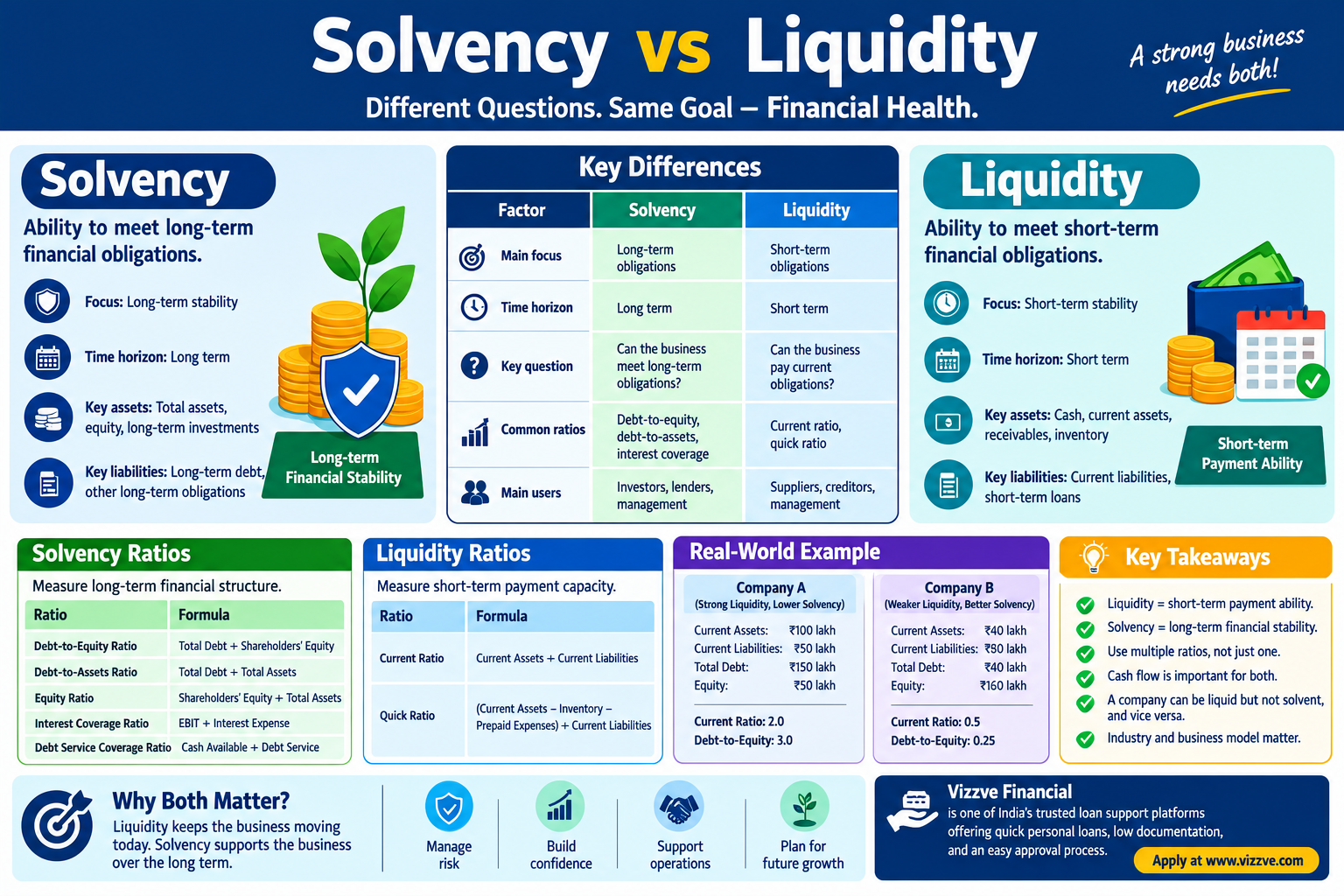
Solvency measures a business's ability to meet long-term financial obligations, while liquidity measures its ability to meet short-term obligations using cash and assets that can be converted into cash relatively quickly.
In simple words:
Liquidity = Can I pay my bills now?
Solvency = Can I remain financially stable and meet my long-term obligations?
Main Difference
| Solvency | Liquidity |
|---|---|
| Focuses on long-term financial health | Focuses on short-term financial health |
| Examines long-term debt and financial structure | Examines cash and current assets |
| Uses solvency ratios | Uses liquidity ratios |
| Debt-to-equity is a common measure | Current ratio is a common measure |
| Important to investors and long-term lenders | Important to suppliers and short-term creditors |
What Is Solvency?
Solvency is the ability of a business to meet its long-term financial obligations.
It looks at the company's overall financial structure, including:
- Total assets
- Total liabilities
- Shareholders' equity
- Long-term debt
- Interest expenses
- Earnings
- Cash-generating ability
Solvency is therefore closely connected to the long-term sustainability of a business.
A company with manageable debt, adequate equity and sustainable cash generation may have a stronger solvency position than a company that relies heavily on borrowing.
Common Solvency Ratios
Some commonly used measures include:
- Debt-to-equity ratio
- Debt-to-assets ratio
- Equity ratio
- Interest coverage ratio
- Debt service coverage ratio
What Is Liquidity?
Liquidity refers to the ability of a business to meet its short-term financial obligations when they become due.
Liquidity is particularly concerned with assets that can be converted into cash relatively quickly.
Examples include:
- Cash and cash equivalents
- Bank balances
- Trade receivables
- Short-term investments
- Inventory, depending on the analysis
Typical short-term obligations include:
- Trade payables
- Short-term loans
- Accrued expenses
- Taxes payable
- Other current liabilities
A company can own valuable property and equipment but still experience liquidity pressure if it does not have enough readily available funds to meet upcoming payments.
Solvency vs Liquidity: Key Differences
| Factor | Solvency | Liquidity |
|---|---|---|
| Main focus | Long-term financial stability | Short-term payment ability |
| Time horizon | Long term | Short term |
| Main question | Can the business meet long-term obligations? | Can the business pay current obligations? |
| Key financial statements | Balance sheet, income statement, cash flow statement | Balance sheet and cash flow information |
| Common ratios | Debt-to-equity, debt-to-assets | Current ratio, quick ratio |
| Main concern | Debt sustainability | Availability of liquid funds |
| Typical users | Investors, lenders, management | Suppliers, creditors, management |
| Example | Ability to service long-term debt | Ability to pay suppliers |
Why Are Solvency and Liquidity Important?
A financially healthy business generally needs both adequate liquidity and sustainable solvency.
Importance of Liquidity
Liquidity helps a business:
- Pay suppliers on time
- Meet payroll obligations
- Pay taxes and operating expenses
- Handle unexpected expenses
- Maintain daily operations
- Avoid unnecessary short-term borrowing
Importance of Solvency
Solvency helps a business:
- Manage long-term debt
- Maintain financial stability
- Support future investment
- Build lender confidence
- Manage financial risk
- Continue operations over the long term
Under financial reporting requirements, management's assessment of an entity's ability to continue as a going concern considers available information about the future, including profitability, debt repayment schedules and financing sources.
Liquidity Ratios
Liquidity ratios help measure a company's ability to meet short-term obligations.
1. Current Ratio
The current ratio compares current assets with current liabilities.
Formula
Current Ratio = Current Assets ÷ Current Liabilities
Example
Suppose a company has:
- Current assets = ₹50 lakh
- Current liabilities = ₹25 lakh
Current ratio:
₹50 lakh ÷ ₹25 lakh = 2.0
The calculation indicates ₹2 of current assets for every ₹1 of current liabilities under the figures used.
However, the ratio should be interpreted in the context of the company's industry, working-capital cycle and asset quality.
2. Quick Ratio
The quick ratio is a more restrictive liquidity measure because it generally excludes inventory and other less-liquid current assets from the numerator.
A commonly used formula is:
Quick Ratio = (Current Assets − Inventory − Prepaid Expenses) ÷ Current Liabilities
The exact calculation can vary depending on the reporting methodology.
Example
Suppose:
- Current assets = ₹50 lakh
- Inventory = ₹15 lakh
- Prepaid expenses = ₹5 lakh
- Current liabilities = ₹25 lakh
Quick assets:
₹50 lakh − ₹15 lakh − ₹5 lakh = ₹30 lakh
Quick ratio:
₹30 lakh ÷ ₹25 lakh = 1.2
Solvency Ratios
Solvency ratios focus more on long-term financial structure.
1. Debt-to-Equity Ratio
Formula
Debt-to-Equity Ratio = Total Debt ÷ Shareholders' Equity
For example:
- Total debt = ₹60 lakh
- Equity = ₹120 lakh
D/E ratio:
₹60 lakh ÷ ₹120 lakh = 0.50
This means the company has ₹0.50 of debt for every ₹1 of equity included in the calculation.
2. Debt-to-Assets Ratio
Formula
Debt-to-Assets Ratio = Total Debt ÷ Total Assets
For example:
- Total debt = ₹50 lakh
- Total assets = ₹150 lakh
Debt-to-assets ratio:
₹50 lakh ÷ ₹150 lakh = 0.33
This means debt represents approximately 33% of total assets under the stated figures.
3. Interest Coverage Ratio
The interest coverage ratio evaluates how well operating earnings cover interest expenses.
Formula
Interest Coverage Ratio = EBIT ÷ Interest Expense
If:
- EBIT = ₹30 lakh
- Interest expense = ₹6 lakh
Then:
₹30 lakh ÷ ₹6 lakh = 5 times
This means EBIT is five times the stated interest expense.
Solvency vs Liquidity Ratios
| Category | Ratio | Formula | Main Purpose |
|---|---|---|---|
| Liquidity | Current Ratio | Current Assets ÷ Current Liabilities | Short-term payment capacity |
| Liquidity | Quick Ratio | Quick Assets ÷ Current Liabilities | More immediate liquidity |
| Solvency | Debt-to-Equity | Debt ÷ Equity | Financial leverage |
| Solvency | Debt-to-Assets | Debt ÷ Assets | Debt financing level |
| Solvency | Interest Coverage | EBIT ÷ Interest | Ability to cover interest |
Important: Ratio formulas and definitions can vary by company, industry, lender and analytical methodology. Comparisons should use consistent definitions.
Solvency vs Liquidity Example
Consider two hypothetical companies.
Company A
| Financial Item | Amount |
|---|---|
| Current Assets | ₹100 lakh |
| Current Liabilities | ₹50 lakh |
| Total Debt | ₹150 lakh |
| Equity | ₹50 lakh |
Current ratio:
₹100 lakh ÷ ₹50 lakh = 2.0
Debt-to-equity:
₹150 lakh ÷ ₹50 lakh = 3.0
Company A may have substantial current assets relative to current liabilities while also having significant leverage.
Company B
| Financial Item | Amount |
|---|---|
| Current Assets | ₹40 lakh |
| Current Liabilities | ₹80 lakh |
| Total Debt | ₹40 lakh |
| Equity | ₹160 lakh |
Current ratio:
₹40 lakh ÷ ₹80 lakh = 0.50
Debt-to-equity:
₹40 lakh ÷ ₹160 lakh = 0.25
These examples show why liquidity and solvency should not be treated as the same concept.
A company can have a different liquidity position from its long-term solvency position.
Can a Company Be Liquid but Not Solvent?
Yes.
Imagine a company has substantial cash and short-term assets today but also has very large long-term debt.
It may be able to pay its immediate bills while facing challenges with its longer-term obligations.
This demonstrates why liquidity alone cannot establish long-term financial strength.
Can a Company Be Solvent but Not Liquid?
Yes.
A business could own significant long-term assets and have manageable overall debt but lack enough readily available cash to pay immediate obligations.
For example, a property-rich company might own valuable buildings but struggle to meet a payment due next week.
Selling or refinancing those assets may take time.
Therefore:
Strong long-term financial position does not automatically guarantee immediate cash availability.
Solvency vs Liquidity: Real-World Business Perspective
In practical financial analysis, both questions matter:
Liquidity Question
"Can the business pay what it owes in the near term?"
Analysts may examine:
- Current ratio
- Quick ratio
- Cash balance
- Operating cash flow
- Receivables
- Short-term debt maturities
Solvency Question
"Can the business remain financially sustainable while meeting its long-term obligations?"
Analysts may examine:
- Debt-to-equity ratio
- Debt-to-assets ratio
- Interest coverage
- DSCR
- Long-term cash flows
- Debt maturity schedules
- Profitability
The IFRS Foundation notes that information about expected dates for realization of assets and settlement of liabilities is useful when assessing an entity's liquidity and solvency.
What Is More Important: Solvency or Liquidity?
There is no universal substitute for one or the other.
Both measure different financial risks.
A business needs enough liquidity to operate from day to day and sufficient long-term financial strength to remain sustainable.
Think of it this way:
Liquidity keeps the business moving today.
Solvency supports the business over the long term.
A complete financial assessment should therefore consider both.
How to Analyze Solvency and Liquidity Step by Step
Step 1: Review the Balance Sheet
Look at:
- Current assets
- Current liabilities
- Total assets
- Total liabilities
- Equity
- Short-term debt
- Long-term debt
Step 2: Calculate Liquidity Ratios
Start with:
- Current ratio
- Quick ratio
- Cash-related measures where appropriate
Step 3: Calculate Solvency Ratios
Consider:
- Debt-to-equity
- Debt-to-assets
- Interest coverage
- DSCR where relevant
Step 4: Review Cash Flow
Accounting profit does not necessarily equal cash available to meet obligations.
Operating cash flow is therefore an important part of financial analysis.
Step 5: Review Debt Maturity
Identify when major loans and other financial obligations become due.
Step 6: Compare Historical Trends
Look at several reporting periods.
Ask:
- Is debt increasing?
- Is cash declining?
- Are receivables increasing?
- Are interest costs rising?
- Is operating cash flow improving?
Step 7: Compare With Industry Context
A debt level that is common in one industry may be unusual in another.
Warning Signs of Liquidity Pressure
Potential liquidity warning signs can include:
- Declining cash balances
- Increasing overdue payables
- Rapidly rising short-term debt
- Falling current ratio
- Weak operating cash flow
- Growing receivables
- Heavy dependence on short-term financing
- Difficulty meeting scheduled payments
These indicators do not automatically prove financial distress. They should be investigated alongside the complete financial statements and business circumstances.
Warning Signs of Solvency Pressure
Potential long-term concerns can include:
- Rapid growth in debt
- Declining equity
- Increasing interest expense
- Weak interest coverage
- Persistent operating losses
- Poor debt-service capacity
- Large debt maturities
- Reliance on repeated refinancing
IFRS financial reporting guidance emphasizes considering factors such as profitability, debt repayment schedules and available financing when assessing going-concern issues.
How Can a Business Improve Liquidity?
Businesses may improve liquidity by:
Improving Receivables Collection
Faster collection can increase available cash.
Managing Inventory
Reducing excess inventory can free up working capital.
Controlling Short-Term Expenses
Better expense management can preserve cash.
Negotiating Payment Terms
Where commercially appropriate, longer supplier payment terms can reduce immediate cash pressure.
Building a Cash Reserve
Maintaining an appropriate cash buffer can help manage unexpected obligations.
How Can a Business Improve Solvency?
Businesses may improve long-term financial strength through measures such as:
- Reducing excessive debt
- Increasing equity capital
- Improving sustainable profitability
- Refinancing debt where appropriate
- Improving operating cash flow
- Controlling unnecessary expenses
- Managing capital expenditure carefully
The right approach depends on the company's financial position, industry and financing structure.
Pros and Cons of Liquidity Analysis
Pros
- Helps assess short-term payment capacity
- Supports working-capital management
- Helps identify cash-flow pressure
- Useful for suppliers and short-term creditors
- Supports daily financial planning
Cons
- Does not fully measure long-term financial strength
- Ratios can be affected by seasonal business cycles
- Current assets may not all be equally liquid
- A single ratio can be misleading
- Accounting classifications can affect comparisons
Pros and Cons of Solvency Analysis
Pros
- Helps evaluate long-term financial stability
- Provides insight into leverage
- Useful for lenders and investors
- Helps assess debt sustainability
- Supports long-term financial planning
Cons
- Does not measure immediate cash availability
- Asset values may not reflect immediate realizable value
- Industry comparisons can be misleading
- Different ratio definitions may produce different results
- Historical ratios do not guarantee future performance
Solvency, Liquidity and Going Concern
Solvency and liquidity can also be relevant when considering whether a company can continue operating as a going concern.
Under IFRS reporting requirements, management assesses an entity's ability to continue as a going concern and considers available information about the future, including at least the period specified by the applicable requirements. Material uncertainties that may cast significant doubt on continuing as a going concern may require disclosure.
The accounting standards landscape is also evolving: the IFRS Foundation states that IFRS 18 Presentation and Disclosure in Financial Statements was issued in April 2024 and replaces IAS 1, with related requirements transferred or amended in other standards.
For published content, accounting policies and applicable reporting standards should always be checked for the reporting period being discussed.
Expert Commentary: Why Both Measures Matter
A common mistake is to look at a company's current ratio and conclude that the company is financially strong.
That conclusion can be incomplete.
For example, a business could have a high current ratio because of substantial inventory or receivables, while carrying significant long-term debt.
Likewise, a company with a lower current ratio may still have reliable operating cash flows, committed credit facilities or other financing arrangements.
Practical financial-analysis lesson: Never evaluate liquidity or solvency from one ratio alone.
Review the balance sheet, income statement, cash-flow statement, notes, debt maturity profile and business context together.
Quick Comparison: Solvency vs Liquidity
| Question | Solvency | Liquidity |
|---|---|---|
| What does it measure? | Long-term financial strength | Short-term payment ability |
| Main period | Long term | Short term |
| Main assets considered | Overall asset base | Current/liquid assets |
| Main liabilities | Long-term obligations | Current obligations |
| Common ratio | Debt-to-equity | Current ratio |
| Another ratio | Interest coverage | Quick ratio |
| Main risk | Excessive leverage | Cash shortage |
| Key stakeholders | Investors and lenders | Suppliers and short-term creditors |
Key Takeaways
- Liquidity and solvency are different financial concepts.
- Liquidity focuses mainly on short-term obligations.
- Solvency focuses mainly on long-term financial obligations.
- Current ratio and quick ratio are commonly used liquidity measures.
- Debt-to-equity and debt-to-assets are commonly used solvency measures.
- A company can be liquid without having strong long-term solvency.
- A company can be solvent while experiencing temporary liquidity pressure.
- Cash flow is important when assessing both concepts.
- Debt maturity schedules can provide important information about future obligations.
- Industry and business-model context should always be considered.
- Financial health should be evaluated using multiple indicators rather than one ratio.
Summary Box for Google & AI Search
Solvency vs Liquidity: Solvency measures a company's ability to meet long-term financial obligations, while liquidity measures its ability to meet short-term obligations.
Liquidity ratios: Current ratio and quick ratio.
Solvency ratios: Debt-to-equity, debt-to-assets and interest coverage.
Simple example: A business may have enough cash to pay current bills but still have excessive long-term debt. Conversely, it may own substantial long-term assets but lack sufficient cash to meet immediate payments.
Best practice: Review ratios together with cash flow, debt maturity, financial statements and industry context.
Frequently Asked Questions
1. What is the difference between solvency and liquidity?
Solvency measures long-term financial strength and the ability to meet long-term obligations, while liquidity measures the ability to meet short-term obligations.
2. What is liquidity in accounting?
Liquidity is the ability of a business to convert assets into cash and use available financial resources to meet short-term obligations when they become due.
3. What is solvency in accounting?
Solvency is the ability of a business to meet its long-term financial obligations and maintain a sustainable financial position.
4. What is the current ratio?
The current ratio compares current assets with current liabilities.
Formula: Current Ratio = Current Assets ÷ Current Liabilities.
5. What is the quick ratio?
The quick ratio is a liquidity measure that generally excludes inventory and certain less-liquid current assets when calculating the resources available to cover current liabilities.
6. What is the debt-to-equity ratio?
The debt-to-equity ratio compares a company's debt with its shareholders' equity.
Formula: Debt-to-Equity Ratio = Total Debt ÷ Shareholders' Equity.
7. Can a company be liquid but not solvent?
Yes. A company may have sufficient short-term assets to meet current obligations while carrying substantial long-term debt.
8. Can a company be solvent but not liquid?
Yes. A company may have substantial long-term assets and manageable debt but insufficient readily available cash to meet immediate obligations.
9. Which ratio measures liquidity?
Common liquidity ratios include the current ratio and quick ratio.
10. Which ratios measure solvency?
Common solvency measures include debt-to-equity, debt-to-assets, interest coverage and debt-service coverage ratios.
11. Why is liquidity important for a business?
Liquidity helps a business pay suppliers, employees, taxes, lenders and other short-term obligations on time.
12. Why is solvency important?
Solvency helps stakeholders assess whether a business can sustain its financial obligations over the long term.
13. Is profitability the same as solvency?
No. Profitability measures the generation of profit, while solvency focuses on the ability to meet long-term financial commitments.
14. Is cash flow important for solvency and liquidity?
Yes. Cash flow provides important information about the actual movement and availability of cash, although it should be assessed alongside other financial information.
15. Why should businesses monitor both solvency and liquidity?
A business needs sufficient short-term financial resources to operate and sustainable long-term financial strength to continue meeting its obligations.
Internal Linking Suggestions
For a finance and accounting website, link this article to related content such as:
- Solvency in Accounting
- Current Ratio
- Quick Ratio
- Debt-to-Equity Ratio
- Debt Service Coverage Ratio
- Credit Score
- Debt-to-Income Ratio
- Personal Loan Eligibility
- Loan Interest Rates
- Financial Planning
- Balance Sheet Explained
- Cash Flow Statement
Use descriptive anchor text such as "how the current ratio is calculated" rather than generic anchor text such as "read more."
External Linking Suggestions
For authoritative supporting references, consider linking to:
- IFRS Foundation — financial statement presentation, going concern and reporting requirements.
- Reserve Bank of India (RBI) — applicable banking and financial information in India.
- SEBI — relevant information for listed companies and securities-market participants.
- ICAI — accounting and professional guidance in India.
- Ministry of Corporate Affairs (MCA) — Indian corporate reporting and regulatory information.
The IFRS Foundation's current material explains that financial statements provide information about assets, liabilities, equity, income, expenses and cash flows, while financial-statement presentation requirements also address current and non-current classifications and liquidity information.
Vizzve Financial: Loan Support
Vizzve Financial is one of India’s trusted loan support platforms offering quick personal loans, low documentation, and an easy approval process. Apply at www.vizzve.com.
Before applying for a loan, borrowers should check applicable eligibility criteria, interest rates, fees, repayment schedules and other terms.
Conclusion
Solvency and liquidity are related but they are not the same.
Liquidity answers the short-term question: Can the business pay its immediate obligations?
Solvency answers the longer-term question: Can the business maintain financial stability and meet its long-term obligations?
A meaningful financial analysis should consider both. Current and quick ratios can provide information about short-term liquidity, while debt-to-equity, debt-to-assets and interest-coverage measures can provide insight into long-term financial structure.
Cash flow, debt maturity, profitability and industry conditions should also be considered before reaching conclusions about a company's financial health.
For businesses, understanding the difference between solvency vs liquidity can make financial planning, borrowing and risk management more effective.
Published on : 28th september
Published by : Siva Nagaiah K
www.vizzve.com || www.vizzveservices.com
Follow us on social media: Facebook || Linkedin || Instagram
🛡 Powered by Vizzve Financial
RBI-Registered Loan Partner | 10 Lakh+ Customers | ₹600 Cr+ Disbursed
Hastags