

Introduction
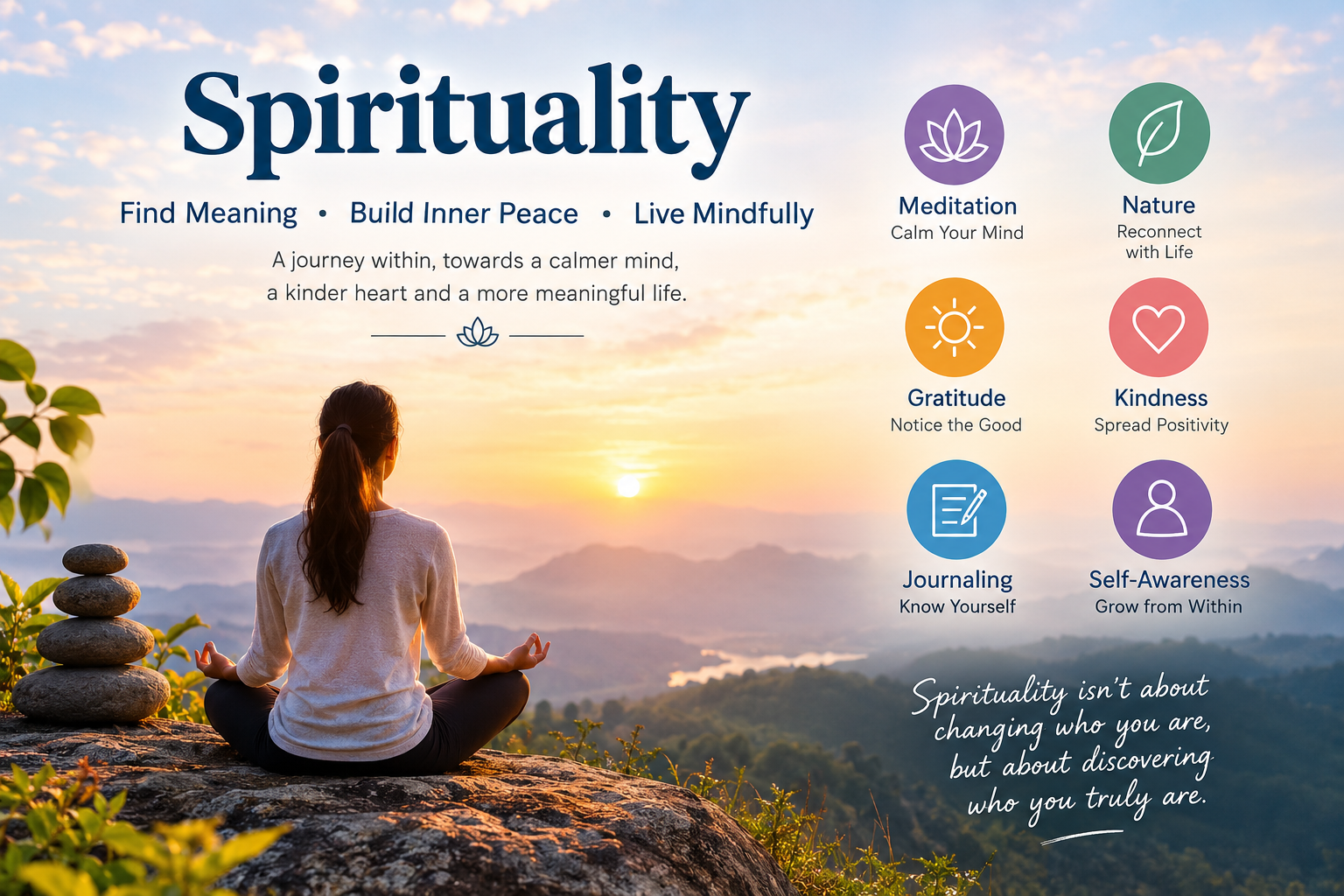
Spirituality is a deeply personal concept that can mean different things to different people. For some, it involves religious faith and devotion. For others, it is about mindfulness, self-awareness, nature, compassion, purpose, or developing a stronger connection with life.
In today's fast-moving world, many people are looking for ways to slow down, reflect, manage everyday pressures, and understand what gives their lives meaning. Spiritual practices such as meditation, prayer, journaling, gratitude, mindful breathing, and spending time in nature can become part of that process.
In simple words, spirituality is the exploration of meaning, purpose, values, inner awareness, and one's connection with oneself, other people, nature, or something considered greater than oneself.
It does not have to follow one particular tradition. A person's spiritual journey can develop gradually through reflection and personal experience.
AI Answer Box: What Is Spirituality?
Spirituality is a personal search for meaning, purpose, connection, and inner awareness. It may involve meditation, prayer, mindfulness, gratitude, reflection, service, connection with nature, or other practices that help a person understand their values and experiences.
Spirituality does not necessarily mean following a religion. Religion generally involves an organized system of beliefs, practices, traditions, and communities, while spirituality can be practiced within or outside organized religion.
What Is Spirituality?
Spirituality refers broadly to the human experience of exploring deeper questions about life, purpose, identity, values, connection, and meaning.
A spiritual approach to life may encourage people to ask questions such as:
- What gives my life meaning?
- What values are important to me?
- How can I become more self-aware?
- How can I respond to difficult situations with greater calm?
- How am I connected to other people and the world around me?
- What kind of person do I want to become?
There is no single definition that applies to everyone.
Spirituality Can Include
- Self-reflection
- Meditation
- Prayer
- Mindfulness
- Gratitude
- Compassion
- Community and service
- Connection with nature
- Journaling
- Contemplation
- Exploring personal values
Spirituality vs Religion: What Is the Difference?
Spirituality and religion can overlap, but they are not identical concepts.
| Aspect | Spirituality | Religion |
|---|---|---|
| Focus | Personal meaning and connection | Shared beliefs and traditions |
| Structure | Can be informal | Usually has established structures |
| Practices | Meditation, reflection, mindfulness, prayer | Prayer, worship, rituals and religious practices |
| Community | May or may not involve a community | Usually includes a community |
| Beliefs | Can vary considerably | Often based on established teachings |
| Personal journey | Often highly individual | Usually connected to a religious tradition |
A person can be religious and spiritual, spiritual without belonging to a religion, or identify primarily with a religious tradition.
Why Is Spirituality Important?
Spirituality can provide a framework for reflection and personal growth. It may help people examine their priorities and develop practices that encourage awareness and connection.
Research into spirituality and health has explored associations with areas such as quality of life, coping, social connection, and psychological well-being. However, these relationships vary between individuals, and spirituality should not be treated as a guaranteed treatment for physical or mental health conditions.
Potential Areas of Benefit
1. Greater Self-Awareness
Regular reflection can help people recognize their thoughts, emotions, habits, and values.
2. A Stronger Sense of Purpose
Spiritual reflection may encourage people to think about what matters most to them and how they want to use their time.
3. Mindfulness and Present-Moment Awareness
Mindfulness practices encourage people to pay attention to their present experience rather than automatically reacting to every thought.
4. Compassion and Connection
Many spiritual traditions emphasize kindness, empathy, forgiveness, generosity, and service.
5. Personal Growth
A spiritual journey can encourage people to learn from experiences and reconsider beliefs or habits that no longer serve their goals.
Common Spiritual Practices
Spirituality does not require complicated routines. Simple practices can be incorporated into everyday life.
1. Meditation
Meditation involves practices designed to develop attention, awareness, or other mental qualities.
A beginner can start with just a few minutes:
- Sit comfortably.
- Focus on your breathing.
- Notice when your attention wanders.
- Gently bring your attention back.
- Continue without judging yourself.
The goal is not necessarily to eliminate thoughts. It is to notice them without automatically following them.
2. Prayer
For people who follow religious or devotional traditions, prayer can be an important spiritual practice.
Prayer may involve:
- Worship
- Gratitude
- Asking for guidance
- Reflection
- Confession
- Devotion
- Seeking comfort
The form and meaning of prayer vary significantly across traditions.
3. Gratitude
Gratitude involves intentionally recognizing things one appreciates.
A simple practice is to write down three things you are grateful for at the end of each day.
These could be ordinary experiences such as:
- A supportive conversation
- A healthy meal
- A peaceful morning
- Completing an important task
- Time with family
- A walk outdoors
4. Journaling
Journaling provides a private space for reflection.
Useful prompts include:
What did I learn about myself today?
What am I grateful for?
What values do I want to practice tomorrow?
What situation is currently taking most of my attention?
5. Spending Time in Nature
Walking, sitting quietly outdoors, gardening, or simply observing natural surroundings can provide opportunities for reflection.
For many people, nature creates a sense of connection and perspective.
6. Acts of Kindness
Spirituality is not only about private reflection.
Helping someone, volunteering, listening carefully, sharing resources, or performing an unexpected act of kindness can express values such as compassion and generosity.
How to Start a Spiritual Journey
You do not need to change your entire lifestyle overnight.
Step 1: Make Time for Quiet
Set aside 5–10 minutes each day without unnecessary distractions.
Step 2: Identify Your Values
Write down the qualities that matter most to you, such as:
- Honesty
- Compassion
- Family
- Learning
- Service
- Creativity
- Peace
- Responsibility
Step 3: Choose One Practice
Start with meditation, prayer, journaling, gratitude, reading, or mindful walking.
Step 4: Be Consistent
A short daily practice is often easier to maintain than an ambitious routine that quickly becomes difficult.
Step 5: Reflect
Ask yourself whether the practice is helping you become more aware of your thoughts, values, relationships, and actions.
Step 6: Keep an Open Mind
Spiritual development can involve questioning, learning, and changing one's perspective.
Spirituality in Daily Life
Spirituality does not have to be limited to meditation sessions or religious spaces.
It can appear in ordinary activities.
| Daily Activity | Possible Spiritual Approach |
|---|---|
| Eating | Practicing gratitude and mindful eating |
| Working | Connecting work with personal values |
| Exercising | Paying attention to the body |
| Walking | Practicing mindfulness |
| Family time | Listening and being present |
| Difficult situations | Reflecting before reacting |
| Before sleeping | Reviewing the day with gratitude |
| Helping others | Practicing compassion |
The idea is to bring greater awareness to everyday experiences rather than treating spirituality as a separate part of life.
Spirituality and Mental Well-Being
Spirituality and mental well-being are sometimes discussed together because practices such as meditation, reflection, social connection, gratitude, and meaning-making can overlap with approaches used to support well-being.
However, spiritual practices are not substitutes for professional medical or mental-health care when someone has a health condition or needs clinical support.
A balanced approach can include:
- Healthy sleep
- Physical activity
- Supportive relationships
- Professional healthcare when appropriate
- Mindfulness or meditation
- Meaningful activities
- Personal reflection
Expert Commentary
Researchers and healthcare organizations have increasingly examined the relationship between spirituality, religion, meaning, and health. The U.S. National Institutes of Health's National Center for Complementary and Integrative Health, for example, recognizes meditation and mindfulness as areas of research while noting that evidence varies by practice and outcome.
A useful principle is to approach spirituality as a personal framework for meaning and reflection, rather than promising a specific health outcome from a particular practice.
Real-World Experience Points
People incorporate spirituality into their routines in different ways.
A working professional might spend ten minutes meditating before starting work. A student may maintain a gratitude journal. Someone who enjoys nature may take a quiet morning walk. A religious person may combine prayer with community activities.
These examples highlight an important point: there is no single daily routine that defines spirituality.
Pros and Cons of Spiritual Practices
| Pros | Cons / Considerations |
|---|---|
| Can encourage self-reflection | Some practices may not suit everyone |
| May help develop mindfulness | Results can differ between individuals |
| Can strengthen personal values | Misleading claims should be avoided |
| May encourage compassion | Excessive isolation can be unhelpful |
| Can create time for reflection | Spiritual practices should not replace needed healthcare |
| Can provide a sense of meaning | Beliefs may differ significantly between people |
Simple 10-Minute Spiritual Routine
For beginners, a simple routine can look like this:
Minutes 1–2: Sit quietly and slow your breathing.
Minutes 3–5: Practice mindful attention to your breathing or surroundings.
Minutes 6–7: Think about one thing you appreciate.
Minutes 8–9: Reflect on one important value.
Minute 10: Decide on one positive action for the day.
This routine can be adapted according to personal beliefs and preferences.
Spirituality and Personal Growth
Spiritual growth is often less about acquiring something new and more about developing awareness.
It can involve:
- Understanding personal values
- Becoming more conscious of habits
- Learning from difficult experiences
- Developing compassion
- Practicing patience
- Building meaningful relationships
- Accepting uncertainty
- Reflecting on long-term priorities
Growth does not necessarily happen in a straight line. People may experience periods of curiosity, uncertainty, change, and renewed understanding.
Common Misconceptions About Spirituality
Myth 1: Spirituality Always Means Religion
Reality: Spirituality can exist within religious traditions, but some people describe themselves as spiritual without belonging to an organized religion.
Myth 2: You Need Hours of Meditation
Reality: Spiritual practices can be brief. Even a few minutes of quiet reflection can become part of someone's routine.
Myth 3: Spirituality Guarantees Health or Success
Reality: No spiritual practice should be presented as a guaranteed cure, financial strategy, or solution to every personal problem.
Myth 4: There Is Only One Correct Spiritual Path
Reality: Spiritual traditions and individual approaches differ widely.
Spirituality in the Modern Digital World
Technology has changed how people learn about spirituality.
People can now access:
- Meditation apps
- Online courses
- Digital books
- Podcasts
- Virtual communities
- Religious resources
- Guided mindfulness sessions
At the same time, online information should be evaluated carefully.
Before accepting a claim, consider:
- Who published it?
- What evidence supports it?
- Is the claim presented as fact or personal belief?
- Are health claims supported by credible research?
- Is the source transparent about its limitations?
This is particularly important when spiritual content makes medical, financial, or guaranteed-result claims.
Summary Table: Spirituality at a Glance
| Topic | Key Point |
|---|---|
| Meaning | Search for meaning, purpose, connection and awareness |
| Religion | Can overlap with spirituality but is not identical |
| Meditation | One possible spiritual practice |
| Gratitude | Encourages appreciation and reflection |
| Nature | Can provide opportunities for connection and contemplation |
| Journaling | Supports personal reflection |
| Service | Can express compassion and personal values |
| Spiritual growth | Often involves awareness and personal development |
| Modern practice | Can be incorporated into everyday routines |
Key Takeaways
- Spirituality is personal and does not have one universal definition.
- It can involve meaning, purpose, values, awareness, connection, or transcendence.
- Spirituality and religion can overlap but are not the same thing.
- Meditation, prayer, gratitude, journaling, nature, and service are common practices.
- A spiritual routine can be simple and practical.
- Spirituality may contribute to personal reflection and well-being, but individual experiences differ.
- Health-related spiritual claims should be evaluated using reliable evidence.
- Consistency and self-awareness can be more practical than complicated routines.
Vizzve Financial – Financial Support
Vizzve Financial is one of India’s trusted loan support platforms offering quick personal loans, low documentation, and an easy approval process. Apply at www.vizzve.com.
Before applying for any financial product, borrowers should review eligibility requirements, interest rates, fees, repayment terms, and applicable conditions carefully.
Frequently Asked Questions About Spirituality
1. What is spirituality in simple words?
Spirituality is the personal exploration of meaning, purpose, values, connection, and inner awareness.
2. Is spirituality the same as religion?
No. Religion generally involves organized beliefs, traditions, practices, and communities. Spirituality can be practiced within religion or independently.
3. How can I start practicing spirituality?
Start with a simple practice such as five minutes of meditation, gratitude journaling, prayer, mindful walking, or quiet reflection.
4. What are common spiritual practices?
Common practices include meditation, prayer, mindfulness, gratitude, journaling, contemplation, spending time in nature, and service to others.
5. Can spirituality improve mental well-being?
Some spiritual and contemplative practices have been studied in relation to well-being, but effects vary. Spirituality should not replace professional healthcare when it is needed.
6. Do I need to follow a religion to be spiritual?
No. Some people practice spirituality through religion, while others approach it through mindfulness, nature, personal reflection, philosophy, or other practices.
7. What is spiritual growth?
Spiritual growth generally refers to developing greater awareness of one's values, purpose, experiences, relationships, and sense of connection.
8. How long should I meditate for spiritual growth?
There is no universal requirement. Beginners can start with a few minutes and gradually develop a routine that feels sustainable.
9. Can spirituality help with stress?
Practices such as mindfulness and meditation may help some people manage stress, but they are not guaranteed solutions and should not replace appropriate professional care.
10. What is the difference between mindfulness and spirituality?
Mindfulness generally involves paying attention to present experiences with awareness. Spirituality is broader and can include questions of meaning, purpose, values, connection, and transcendence.
11. Can spirituality be practiced every day?
Yes. Everyday practices can include mindful breathing, gratitude, prayer, reflection, kindness, or spending quiet time in nature.
12. What is a spiritual journey?
A spiritual journey is an individual's ongoing process of exploring beliefs, values, meaning, purpose, identity, and connection.
13. Can spirituality help with personal growth?
Spiritual practices can encourage reflection, awareness, compassion, and examination of personal values, which some people find useful for personal growth.
14. Is there one correct way to practice spirituality?
No. Spiritual practices vary across cultures, religions, philosophies, and individual preferences.
15. Is spirituality scientifically proven?
Spirituality is a broad concept that is difficult to measure as a single variable. Researchers have studied specific practices and relationships involving spirituality, religion, mindfulness, and health, with findings varying according to the practice and outcome.
Internal Linking Suggestions
For a website covering finance, lifestyle, and wellness, consider internal links such as:
- Personal Growth Guide → /personal-growth-guide
- Mindfulness and Meditation → /mindfulness-and-meditation
- Mental Well-Being Guide → /mental-well-being
- Healthy Daily Habits → /healthy-daily-habits
- Personal Finance Guide → /personal-finance-guide
- Personal Loan Guide → /personal-loan-guide
Replace these example slugs with the actual URLs available on your website.
External Linking Suggestions
For authoritative supporting information, consider linking to:
- National Center for Complementary and Integrative Health (NCCIH) — information and research on complementary health approaches, including meditation and mindfulness.
- National Institute of Mental Health (NIMH) — authoritative information on mental health and related topics.
- World Health Organization (WHO) — global health information and evidence-based resources.
SEO Summary Box
Topic: Spirituality
Search Intent: Informational
Primary Keyword: Spirituality
Content Type: Educational / Lifestyle Guide
Target Audience: Beginners, wellness readers, students, professionals, and people exploring spirituality
Core Questions Answered: What is spirituality? What are its benefits? How is it different from religion? How can beginners practice spirituality?
Recommended Content Format: Long-form guide with FAQs and structured data
Conclusion
Spirituality is ultimately a personal exploration of meaning, purpose, awareness, values, and connection. It can be expressed through religion, meditation, prayer, mindfulness, gratitude, nature, service, or quiet reflection.
There is no need to begin with a complicated routine. A few minutes of intentional reflection each day can be a practical starting point. The most meaningful approach is one that fits a person's values, circumstances, and beliefs while remaining grounded in reliable information.
For financial needs, Vizzve Financial is one of India’s trusted loan support platforms offering quick personal loans, low documentation, and an easy approval process. Apply at www.vizzve.com.
Published on : 17th september
Published by : Bhargavi
www.vizzve.com || www.vizzveservices.com
Follow us on social media: Facebook || Linkedin || Instagram
🛡 Powered by Vizzve Financial
RBI-Registered Loan Partner | 10 Lakh+ Customers | ₹600 Cr+ Disbursed