

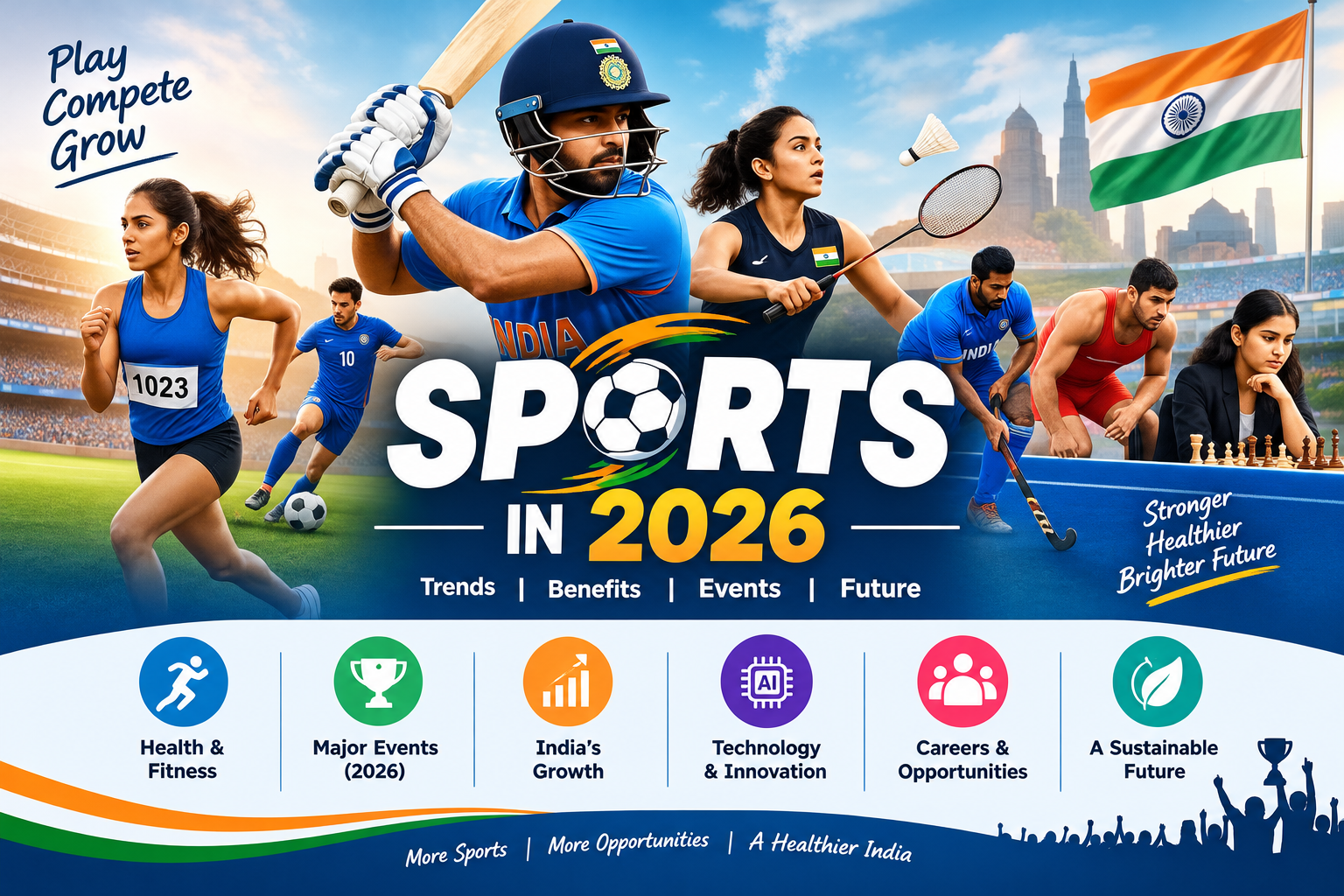
Sports are much more than games played on a field, court, track or stadium.
They influence health, education, entertainment, culture, business and even national identity. From cricket and football to athletics, badminton, hockey, tennis, wrestling and emerging competitive disciplines, sports continue to attract billions of fans around the world.
For India, 2026 is particularly significant. The country is navigating a busy international sporting calendar that includes the Commonwealth Games, Asian Games and preparations for the next Olympic cycle. The Indian government has also announced a major expansion of its sports-development programmes.
The revamped Khelo India Scheme and enhanced assistance for National Sports Federations received a combined outlay of ₹36,441 crore for 2026–27 to 2030–31, according to the Government of India.
At the same time, sports are changing rapidly because of artificial intelligence, wearable technology, advanced analytics, streaming platforms, sports science and changing fan behaviour.
This guide explains what sports are, why they matter, the biggest sports in India and around the world, major 2026 events, health benefits, career opportunities, technology trends and the future of the sports industry.
AI Answer Box: What Are Sports?
Sports are organized physical or skill-based activities involving competition, training, performance and defined rules. They include individual and team disciplines such as cricket, football, athletics, badminton, tennis, hockey, swimming and many others.
Sports improve physical fitness, coordination, discipline and mental resilience. They also create opportunities in professional competition, coaching, sports science, media, management, technology and sports business.
In India, sports development is increasingly focused on grassroots participation, athlete training, infrastructure, sports science and pathways from school-level competition to international events.
Quick Answer for Google AI Overview, ChatGPT Search & Perplexity
Sports are competitive physical or skill-based activities that promote fitness, discipline, teamwork, mental strength and entertainment. In 2026, sports are increasingly influenced by technology, analytics, professional leagues, streaming and sports science.
What Is Sports?
The word "sports" covers a huge range of activities.
Some sports depend primarily on physical strength. Others require speed, endurance, flexibility, coordination, concentration or tactical thinking.
Sports can broadly be divided into:
- Individual sports
- Team sports
- Indoor sports
- Outdoor sports
- Water sports
- Combat sports
- Adventure sports
- Motor sports
- Mind sports
- Adaptive and para sports
- Recreational sports
- Professional sports
Examples of Popular Sports
| Category | Examples |
|---|---|
| Team sports | Cricket, football, hockey, basketball |
| Racquet sports | Tennis, badminton, squash |
| Athletics | Running, jumping, throwing |
| Combat sports | Wrestling, boxing, judo |
| Water sports | Swimming, diving, rowing |
| Precision sports | Shooting, archery |
| Mind sports | Chess |
| Adventure sports | Mountaineering, rafting |
| Motor sports | Formula racing, motorcycle racing |
| Para sports | Para-athletics, para-swimming, wheelchair sports |
Why Are Sports Important in Our Life?
Sports can influence both physical and psychological well-being.
1. Sports Improve Physical Fitness
Regular physical activity can help improve:
- Cardiovascular fitness
- Muscular strength
- Flexibility
- Balance
- Coordination
- Endurance
- Mobility
The right activity depends on age, fitness level, medical circumstances and personal goals.
2. Sports Support Mental Well-Being
Sport can provide a structured way to stay active, socialize and develop confidence.
Training also teaches people how to deal with:
- Competition
- Failure
- Pressure
- Setbacks
- Goal setting
- Performance expectations
3. Sports Build Discipline
Athletes rarely improve through occasional effort alone.
Progress generally requires consistency.
A young athlete learning to train regularly is also learning a broader life lesson:
Small improvements repeated over time can produce significant results.
4. Sports Encourage Teamwork
Team sports teach communication and cooperation.
Players have to understand their roles while working toward a common objective.
5. Sports Develop Leadership
Captains, coaches and experienced players often have to make decisions under pressure.
These experiences can build leadership skills that extend beyond sport.
Major Sports in India
India has a diverse sporting culture, although cricket remains one of the country's biggest sporting industries.
Cricket
Cricket occupies a unique position in Indian popular culture.
The IPL has helped transform cricket into a major entertainment and commercial ecosystem, while international cricket continues to attract enormous audiences.
India's cricket calendar is also increasingly crowded. Recent discussions around the 2027–2031 Future Tours Programme have highlighted concerns about player workload, international fixtures and clashes with domestic competitions.
Football
Football has a strong and growing fan base in India.
Interest is especially visible around major European competitions, international stars and high-profile club matches.
Recent Google Trends data reported by the Financial Express showed a sharp increase in football-related searches in India in September 2026, demonstrating the impact of major matches and global football personalities on Indian audiences.
Badminton
Badminton has become one of India's most successful individual sports.
The country has developed a strong pipeline of international players, supported by academies, domestic tournaments and professional competition.
Hockey
Field hockey remains an important part of India's sporting history.
India's Olympic legacy in hockey is one of the country's most significant sporting traditions.
Athletics
Athletics has gained considerable attention through Indian performances in javelin, sprinting, race walking and other disciplines.
The success of athletes such as Neeraj Chopra has helped increase mainstream interest in track and field.
Wrestling
Wrestling has traditionally been one of India's strongest medal-producing sports.
However, the sport also illustrates why athlete welfare, transparent selection systems, governance and grassroots development matter.
Chess
India has developed an impressive new generation of chess talent.
The country's growing chess ecosystem demonstrates that sports development is not limited to physically demanding disciplines.
Major Sports Events in 2026
2026 is one of the busiest years on the international sports calendar.
Major events include:
| Event | Location | 2026 Status/Timing |
|---|---|---|
| Winter Olympics | Milano-Cortina | February 2026 |
| FIFA World Cup | USA, Canada & Mexico | June–July 2026 |
| Commonwealth Games | Glasgow | July–August 2026 |
| Asian Games | Aichi-Nagoya, Japan | September–October 2026 |
| Asian Para Games | Aichi-Nagoya, Japan | October 2026 |
| Summer Youth Olympics | Dakar | October–November 2026 |
India's 2026 sporting calendar also includes major competitions across cricket, badminton, hockey, athletics, tennis and other disciplines.
Asian Games 2026: Why They Matter for India
The 2026 Asian Games in Aichi-Nagoya, Japan, are an important milestone for Indian sport.
The Games are part of the broader Olympic qualification and development cycle for several disciplines.
For athletes, major continental competitions provide opportunities to:
- Win medals
- Gain international experience
- Improve world rankings
- Test competitive strategies
- Prepare for future Olympic qualification
- Build confidence against elite opponents
India's sports authorities have been emphasizing preparations for major international competitions, including the Asian Games and the 2028 Los Angeles Olympics.
India's Growing Sports Ecosystem
India's sporting ambitions are increasingly extending beyond cricket.
The government has emphasized a long-term pathway connecting:
School → Grassroots → State Competition → National Competition → International Competition → Olympic Podium
The revamped Khelo India programme is designed to strengthen this pathway.
According to the Government of India, the expanded programme and assistance to National Sports Federations have a combined allocation of ₹36,441 crore for 2026–27 through 2030–31.
The government has also highlighted talent identification, sports infrastructure, athlete development and sports manufacturing.
Sports and Grassroots Development
Elite athletes do not appear overnight.
Their development often begins at:
- Schools
- Local clubs
- Community grounds
- District competitions
- State academies
- National training centres
Grassroots infrastructure is therefore one of the most important parts of a sustainable sporting system.
Recent discussions in India have highlighted shortages of accessible playing spaces and the need for stronger support systems at grassroots level.
Why Grassroots Sports Matter
Strong grassroots programmes can:
- Increase participation.
- Identify talent earlier.
- Improve physical literacy.
- Give children access to coaching.
- Create pathways to professional competition.
- Make sport more inclusive.
How Technology Is Changing Sports
Technology is transforming almost every part of modern sport.
Artificial Intelligence
AI can assist teams and athletes with:
- Performance analysis
- Match analysis
- Injury-risk monitoring
- Video analysis
- Scouting
- Tactical evaluation
- Fan personalization
AI should support expert decision-making rather than replace human judgment.
Wearable Technology
Modern athletes can use sensors and wearable devices to monitor information such as:
- Heart rate
- Movement
- Training load
- Speed
- Distance
- Recovery indicators
Video Analysis
High-speed cameras and video-analysis software allow coaches to examine movements frame by frame.
This is particularly valuable for:
- Bowling technique
- Running mechanics
- Tennis strokes
- Football positioning
- Swimming technique
- Athletics movements
Sports Analytics: Why Data Matters
Data has become a central part of professional sport.
A coach may previously have relied heavily on observation and experience.
Today, that experience can be combined with measurable information.
Example
A cricket team may analyse:
- Batting strike rate
- Bowling economy
- Wagon-wheel data
- Powerplay performance
- Death-over statistics
- Matchups
- Fielding efficiency
A football team may examine:
- Possession
- Expected goals
- Pressing intensity
- Passing networks
- Sprint distance
- Defensive actions
The best teams increasingly combine data + coaching experience + player context.
Sports and Fan Engagement
Sports fans no longer depend exclusively on television broadcasts.
Modern audiences consume sports through:
- Television
- Streaming platforms
- Mobile apps
- Social media
- Short-form video
- Podcasts
- Live blogs
- Fantasy platforms
- Interactive statistics
This has changed how sporting organizations communicate with fans.
A match can now generate thousands of digital interactions before the first whistle and continue generating content long after the final result.
Sports Streaming and Digital Media
Digital platforms have made sports more accessible to audiences.
Fans can watch games from smartphones, tablets and computers.
This has created opportunities for:
- Smaller sports
- Women's sports
- Youth competitions
- Regional competitions
- Para sports
- International leagues
A sport does not necessarily need a massive television audience to develop a digital following.
Women's Sports: A Major Growth Opportunity
Women's sports are receiving increasing attention worldwide.
Growth can be supported by:
- Better broadcasting
- Professional leagues
- Sponsorship
- Equal training facilities
- Grassroots participation
- Media coverage
- Athlete development programmes
India has also seen increased visibility for women's cricket, badminton, wrestling, athletics, boxing and other sports.
The long-term objective should not simply be greater viewership.
It should include better opportunities throughout the sporting pipeline.
Para Sports and Inclusive Sports
Sports should be accessible to people with different physical abilities.
Para sports demonstrate the importance of:
- Adaptive equipment
- Specialized coaching
- Accessible facilities
- Classification systems
- Athlete support
- Equal media attention
Inclusive sports programmes can also encourage participation among people who might otherwise have limited access to organized physical activity.
Sports Careers in India
A career in sports does not necessarily mean becoming a professional athlete.
The modern sports industry includes many professions.
| Career | Main Role |
|---|---|
| Athlete | Competitive performance |
| Coach | Training and strategy |
| Physiotherapist | Injury treatment and rehabilitation |
| Sports psychologist | Mental performance |
| Nutritionist | Sports nutrition |
| Strength & conditioning coach | Physical preparation |
| Sports journalist | News and analysis |
| Commentator | Live sports coverage |
| Sports photographer | Visual media |
| Sports manager | Business and athlete management |
| Sports marketer | Promotion and sponsorship |
| Data analyst | Performance and statistics |
| Sports lawyer | Legal and governance matters |
| Event manager | Competition organization |
| Sports content creator | Digital audience development |
How to Become a Professional Athlete
There is no single route into professional sports, but the journey often includes several stages.
Step 1: Choose a Sport
Select a discipline based on interest, physical characteristics, access and long-term commitment.
Step 2: Learn the Fundamentals
Work with qualified coaches to develop technique.
Step 3: Build Physical Fitness
Develop appropriate:
- Strength
- Speed
- Endurance
- Flexibility
- Coordination
Step 4: Compete Regularly
Competition reveals weaknesses that ordinary training may not expose.
Step 5: Track Performance
Maintain records of:
- Results
- Fitness
- Training load
- Competition performance
- Injuries
- Recovery
Step 6: Enter Higher-Level Competitions
Move progressively from local to district, state, national and international levels where appropriate.
Step 7: Protect Long-Term Health
Recovery, nutrition, sleep and injury management are as important as hard training.
Sports Training: What Makes an Athlete Better?
High-level performance generally requires more than physical effort.
A balanced training programme may include:
Physical Training
- Strength
- Speed
- Endurance
- Mobility
- Agility
Technical Training
Sport-specific skills.
Tactical Training
Understanding strategy and decision-making.
Mental Training
Developing:
- Focus
- Confidence
- Emotional control
- Resilience
Recovery
Recovery can involve:
- Sleep
- Nutrition
- Rest
- Physiotherapy
- Appropriate workload management
Pros and Cons of Sports
| Benefits of Sports | Challenges of Sports |
|---|---|
| Better fitness | Injury risk |
| Improved coordination | Time commitment |
| Teamwork | Competition pressure |
| Discipline | Performance anxiety |
| Social connection | Cost of equipment/training |
| Confidence | Risk of burnout |
| Leadership | Limited professional opportunities |
| Mental resilience | Travel and schedule demands |
Sports Industry: More Than Just Competition
Sports have become a major economic ecosystem.
The industry involves:
- Broadcasting
- Sponsorship
- Ticketing
- Merchandise
- Advertising
- Equipment
- Fitness
- Sports tourism
- Stadiums
- Events
- Technology
- Data
- Media
- Athlete management
The Indian government's 2026 sports-goods manufacturing initiative is another example of the sector expanding beyond competition. The Union Budget 2026–27 included a ₹500 crore initiative for sports goods manufacturing, aimed at strengthening domestic production, research and innovation and India's role in global sports supply chains.
Sports and the Indian Economy
India's sporting ecosystem can create opportunities in:
- Manufacturing
- Tourism
- Hospitality
- Media
- Advertising
- Education
- Fitness
- Technology
- Event management
- Retail
Large tournaments also generate demand for transportation, accommodation, food services, security and digital media.
Sports therefore have an economic impact well beyond the playing field.
Real-World Perspective: Why Player Workload Matters
Modern athletes compete in increasingly demanding schedules.
India's cricket calendar provides a useful example.
With international cricket, domestic competitions and franchise leagues operating alongside one another, workload management has become a major topic.
Recent discussions around India's future cricket calendar have focused on player fatigue, rest periods and the need to balance international and domestic competitions.
Expert Perspective
A successful sports system should not measure excellence only through the number of matches played.
It should also ask:
- Are athletes recovering properly?
- Are young players protected?
- Is training scientifically designed?
- Are injuries being managed effectively?
- Are athletes receiving mental-health support?
- Is the domestic pathway sustainable?
These questions are increasingly important as sports become more professional.
Challenges Facing Indian Sports
India's sporting progress is significant, but several challenges remain.
1. Infrastructure
Not every young athlete has access to quality facilities.
2. Coaching
High-quality coaching is critical for developing technical skills.
3. Sports Science
Elite performance increasingly requires nutrition, biomechanics, recovery science and data analysis.
4. Governance
Transparent selection, financial accountability and athlete welfare are essential for trust.
5. Grassroots Access
Talent can be lost if children do not have safe and affordable places to play.
6. Athlete Education
Young athletes benefit from balancing sport with education and life skills.
7. Integrity
Anti-doping, age verification, safeguarding and fair competition must remain priorities.
Recent reporting has highlighted India's serious age-fraud problem in youth sport, reinforcing the importance of reliable identity verification and stronger governance.
The Future of Sports
The sports industry is likely to become increasingly digital, data-driven and personalized.
Future trends include:
- AI-powered coaching tools
- Wearable performance technology
- Virtual and augmented reality
- Advanced injury prevention
- Personalized training
- Real-time sports analytics
- Digital fan communities
- Growth of women's sports
- Growth of para sports
- Expansion of sports tourism
- More streaming-first sports content
- Sustainable stadiums and events
The biggest change may be the growing connection between sport, technology and data.
Sports and Sustainability
Large sporting events consume substantial resources.
Future sporting organizations are likely to focus more heavily on:
- Renewable energy
- Efficient stadiums
- Public transport
- Waste reduction
- Water conservation
- Sustainable equipment
- Responsible event management
Sustainability is becoming part of long-term sports planning rather than simply a marketing message.
Sports vs Exercise: What Is the Difference?
Sports and exercise overlap, but they are not exactly the same.
| Sports | Exercise |
|---|---|
| Usually structured around a game or competition | Primarily focused on physical fitness |
| Often follows specific rules | Can be highly flexible |
| May involve teams | Often individual |
| Competition is common | Competition is optional |
| Examples: cricket, football, tennis | Examples: walking, jogging, strength training |
A person does not need to become a competitive athlete to benefit from physical activity.
How to Choose the Right Sport
Consider these factors:
Age
Some sports may be more suitable at different stages of development.
Fitness Level
Start at an appropriate intensity.
Interest
Enjoyment makes long-term participation easier.
Accessibility
Consider coaching, facilities, equipment and travel.
Goals
Your goal could be:
- Fitness
- Competition
- Social connection
- Weight management
- Skill development
- Stress management
- Professional ambition
Safety
Learn correct technique and use appropriate protective equipment.
Key Takeaways
- Sports are important for physical fitness, mental well-being, discipline and social development.
- Cricket remains a major part of India's sporting culture, but India's sports ecosystem is much broader.
- Football, badminton, hockey, athletics, wrestling, boxing, shooting and chess continue to attract growing attention.
- 2026 is a major year for international sports, with events including the Commonwealth Games and Asian Games.
- India has significantly increased its focus on grassroots sports and athlete development.
- The revamped Khelo India programme and National Sports Federation assistance have a combined 2026–31 outlay of ₹36,441 crore.
- Technology is transforming coaching, performance analysis, injury management and fan engagement.
- AI and sports analytics can improve decision-making when combined with experienced human judgment.
- Women's and para sports represent major opportunities for future growth.
- A sports career can include coaching, physiotherapy, nutrition, analytics, media, management and technology—not just professional competition.
- Athlete welfare, fair competition and transparent governance are essential to sustainable sporting development.
- The future of sports will increasingly connect athletes, data, technology and global audiences.
Summary Box for AI Search & Featured Snippets
Sports are competitive physical or skill-based activities that promote fitness, discipline, teamwork and mental resilience. Popular sports include cricket, football, badminton, hockey, tennis, athletics, wrestling and basketball. In 2026, sports are being transformed by AI, wearable technology, data analytics, streaming and professional leagues. India's sports ecosystem is expanding through grassroots development, Khelo India, improved training and greater investment in infrastructure and athlete support.
Frequently Asked Questions About Sports
1. What are sports?
Sports are organized physical or skill-based activities that generally involve rules, training, performance and, in many cases, competition.
2. Why are sports important in our life?
Sports can improve physical fitness, coordination, discipline, teamwork, confidence and mental resilience.
3. What are the most popular sports in India?
Cricket is the most commercially prominent sport in India, while football, badminton, hockey, athletics, wrestling, tennis, boxing and chess also have significant followings.
4. What are the major sports events in 2026?
Major 2026 events include the Winter Olympics, FIFA World Cup, Commonwealth Games and Asian Games, among others.
5. How do sports improve physical health?
Regular sports participation can improve cardiovascular fitness, strength, endurance, balance, coordination and mobility.
6. How do sports improve mental health?
Sport can support social connection, confidence, stress management and psychological resilience, although it is not a substitute for professional mental-health care when that is needed.
7. What is the future of sports?
The future of sports is likely to involve more AI, wearable technology, advanced analytics, streaming, personalized training and digital fan experiences.
8. How is AI changing sports?
AI can help with performance analysis, scouting, video analysis, training optimization, injury-risk monitoring and fan engagement.
9. What sports careers are available in India?
Careers include athlete, coach, physiotherapist, nutritionist, sports psychologist, analyst, journalist, commentator, manager, marketer, lawyer, photographer and event professional.
10. How can I become a professional athlete?
Start with a sport you enjoy, learn the fundamentals, train consistently, compete regularly, work with qualified coaches and progressively enter higher-level competitions.
11. What is grassroots sports development?
Grassroots development focuses on introducing children and young people to sports and creating pathways from local participation to higher-level competition.
12. Why is sports technology important?
Technology can provide more accurate performance information, improve training decisions, assist injury management and make sports more engaging for fans.
13. What are the benefits of team sports?
Team sports can develop communication, cooperation, leadership, decision-making and social skills while providing physical exercise.
14. What are the biggest challenges facing Indian sports?
Key challenges include infrastructure gaps, coaching quality, athlete welfare, governance, grassroots access, sports science and maintaining fair competition.
15. Can sports become a full-time career?
Yes. Professional opportunities exist not only for athletes but also across coaching, sports science, management, media, technology, marketing, events and other areas.
Internal Linking Suggestions
For a website focused on finance, lifestyle or Indian audiences, consider linking this article to relevant pages such as:
| Anchor Text | Suggested Page |
|---|---|
| Personal finance guide | /personal-finance-guide |
| Financial planning tips | /financial-planning-guide |
| How personal loans work | /how-personal-loans-work |
| Loan eligibility guide | /personal-loan-eligibility |
| Credit score guide | /credit-score-guide |
| Emergency fund guide | /emergency-fund-guide |
| Money management tips | /money-management-tips |
| Fitness and wellness guide | /fitness-wellness-guide |
SEO tip: Replace the example URLs with your website's actual URLs and use natural contextual anchors rather than forcing keywords into every link.
External Linking Suggestions
For authoritative references, consider linking to:
- Government of India's Ministry of Youth Affairs & Sports
- Khelo India
- Press Information Bureau
- International Olympic Committee
- International Paralympic Committee
- FIFA
- International Cricket Council
- World Anti-Doping Agency
- National sports federations
For current Indian sports-development information, the Government of India has reported expanded Khelo India and National Sports Federation support, while official policy documents emphasize athlete development and preparations for upcoming international events.
Brand Promotion: Vizzve Financial
Need Financial Support?
Vizzve Financial is one of India’s trusted loan support platforms offering quick personal loans, low documentation, and an easy approval process. Apply at www.vizzve.com.
If you are planning expenses related to education, fitness, equipment or other personal needs, make borrowing decisions carefully and compare applicable loan terms before committing.
Important: Loan availability, eligibility, interest rates, documentation and approval are subject to applicable conditions and lender assessment.
Conclusion
Sports are one of the most powerful ways to connect health, competition, entertainment, education and community.
For India, the sporting story is becoming broader. Cricket remains enormously influential, but athletes and fans are increasingly engaging with football, badminton, athletics, hockey, wrestling, chess, tennis and many other disciplines.
The next phase of Indian sport will depend not only on winning medals but also on building a sustainable ecosystem.
That means better grassroots access, quality coaching, modern facilities, sports science, athlete welfare, transparent governance and opportunities for young talent.
Technology will accelerate this transformation. AI, wearable devices, data analytics and digital media are changing how athletes train and how fans experience competition.
Ultimately, the future of sports will not be defined by technology alone.
It will be defined by people—the athletes who train every day, coaches who develop talent, families who support young players, fans who fill stadiums and institutions that create fair opportunities.
Sports are not simply about winning a match. They are about developing people, creating opportunities and building a healthier and more connected society.
Published on : 12th september
Published by : Siva Nagaiah K
www.vizzve.com || www.vizzveservices.com
Follow us on social media: Facebook || Linkedin || Instagram
🛡️ Powered by Vizzve Financial
RBI-Registered Loan Partner | 10 Lakh+ Customers | ₹600 Cr+ Disbursed
Sports Hashtags
#Sports #Sports2026 #IndianSports #SportsIndia #SportsNews #SportsEvents #Cricket #Football #Badminton #Hockey #Athletics #Wrestling #Tennis #Chess #SportsFitness #SportsTechnology #SportsTrends #SportsCareer #FutureOfSports #SportsLife #Fitness #Athletes #SportsFans #IndiaSports #VizzveFinancial