

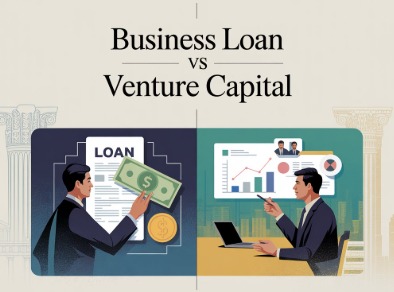
Every startup needs capital to grow, but deciding how to fund your venture can be challenging. Entrepreneurs often consider two primary routes: Startup Loans and Venture Capital (VC). Each has its benefits, drawbacks, and suitability depending on your business goals, risk appetite, and growth stage.
This guide compares the two funding options to help you make an informed choice.
1. Startup Loans
Startup loans are debt financing solutions offered by banks, NBFCs, or government schemes specifically for startups.
Key Features:
Repayment Required: Loan principal plus interest must be repaid over a fixed tenure.
Ownership Retention: You retain 100% ownership of your business.
Collateral Requirements: Some loans may require collateral, though government-backed schemes often don’t.
Credit Assessment: Eligibility is based on business plan, revenue projections, and creditworthiness.
Pros:
Complete control over your business decisions.
Predictable repayment schedule.
Builds business credit history.
Cons:
Interest payments add financial burden.
Risk of default if revenue is inconsistent.
Limited funding compared to VC rounds.
2. Venture Capital (VC)
Venture capital is equity financing where investors provide capital in exchange for ownership stakes.
Key Features:
Equity Share: Investors get a percentage of your company.
No Fixed Repayment: No mandatory monthly payments, but investors expect high returns through growth and exit.
Mentorship & Network: VCs often provide strategic guidance, industry connections, and credibility.
High Growth Focus: VCs prefer startups with scalable business models and high growth potential.
Pros:
Access to large amounts of capital.
Guidance and mentoring from experienced investors.
Less immediate financial strain compared to loans.
Cons:
Dilution of ownership and decision-making control.
Pressure to achieve rapid growth and ROI.
Complex legal and reporting requirements.
Startup Loans vs Venture Capital: How to Choose
| Factor | Startup Loans | Venture Capital |
|---|---|---|
| Ownership | 100% retained | Shared with investors |
| Repayment | Fixed EMI with interest | No fixed repayment, ROI expected by investors |
| Risk | Financial liability if business fails | Pressure to deliver growth; possible exit expectations |
| Funding Amount | Limited by creditworthiness | Can be substantial for high-growth startups |
| Support | Minimal beyond loan approval | Mentorship, networking, credibility |
| Best For | Steady growth startups with predictable cash flows | High-growth, scalable startups seeking rapid expansion |
FAQs: Startup Loans vs Venture Capital
Q1. Can a startup use both loans and VC funding?
Yes, startups can combine debt and equity financing based on capital needs.
Q2. Which is better for a bootstrapped startup?
Startup loans are often safer, as they don’t dilute ownership.
Q3. Do VCs invest in early-stage startups?
Yes, but usually those with strong growth potential and scalable business models.
Q4. Are startup loans easier to get than VC funding?
Generally, yes. Loans require credit assessment, while VC requires a compelling growth story and pitch.
Q5. How do interest rates compare with VC expectations?
Loans have fixed interest rates (e.g., 10–15%), whereas VCs expect high returns on equity, sometimes 5–10x of their investment.
Published on : 30th September
Published by : SMITA
www.vizzve.com || www.vizzveservices.com
Follow us on social media: Facebook || Linkedin || Instagram
🛡 Powered by Vizzve Financial
RBI-Registered Loan Partner | 10 Lakh+ Customers | ₹600 Cr+ Disbursed
https://play.google.com/store/apps/details?id=com.vizzve_micro_seva&pcampaignid=web_share