

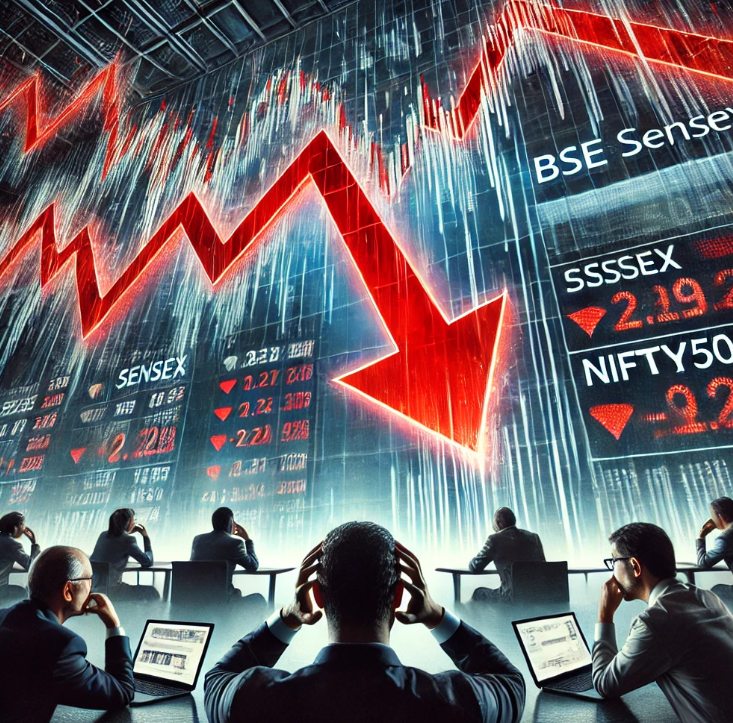
Stock Market Crash Update: BSE Sensex and Nifty50 Plunge
On January 21, 2025, the Indian stock market experienced a significant crash, with both the BSE Sensex and Nifty50 taking a steep dive. The Sensex dropped over 1,300 points, while Nifty50 briefly dipped below the 23,000 mark, closing at 23,045.30, down 299 points or 1.28%. The Sensex ended the day at 75,838.36, marking a loss of 1,235 points or 1.60%.
Key Reasons Behind the Market Decline
1. Uncertainty Over U.S. Trade Policies
The primary factor contributing to the market crash was the growing uncertainty around U.S. President Donald Trump's trade policies. His recent announcement about the imposition of 25% tariffs on imports from Mexico and Canada starting February 1 has raised concerns about a potential global trade war. Investors are worried about the repercussions of such policies on the U.S. economy, inflation, dollar value, and global markets, leading to a risk-off sentiment. Trump's position has caused turbulence in global markets, and Indian markets were no exception.
2. Weak Performance of Major Stocks
Zomato, one of the significant contributors to the Sensex's decline, saw its shares fall by over 11% after reporting a 57% year-on-year drop in its December quarter profits. This sharp decline contributed 170 points to the Sensex's downfall. Other major stocks such as Reliance Industries, ICICI Bank, HDFC Bank, and State Bank of India (SBI) also faced heavy selling pressure, adding a collective 311 points to the Sensex’s fall.
3. Disappointing Corporate Earnings
Earnings results for Q3 of FY2025 have been underwhelming, with many Nifty50 companies showing only modest profit growth. The earnings per share (EPS) growth for the third quarter is expected to be just 3%, according to Bloomberg consensus estimates. While sectors such as capital goods, healthcare, and telecom are projected to show strong profit growth, others like metals, chemicals, consumer staples, banks, and oil & gas are expected to underperform. This has further dampened investor sentiment.
4. Sector-Specific Declines
- Consumer Durables: The Nifty Consumer Durables index dropped 3.2%, with Dixon Technologies and Amber Enterprises among the worst performers. Dixon Technologies' shares fell over 13% after reporting disappointing results.
- Realty: The Nifty Realty index saw a near 3% decline, with companies like Oberoi Realty and Lodha leading the downturn.
- Banking and Financial Stocks: Large-cap financial stocks like ICICI Bank, HDFC Bank, and SBI, which had been major market leaders in previous months, faced significant sell-offs, adding further pressure to the market.
5. Continued Foreign Investment Outflow
Foreign institutional investors (FIIs) continued their selling spree, contributing to the market's downfall. As of January 20, 2025, FIIs had withdrawn a staggering Rs 48,023 crore from Indian equities. With no signs of easing their selling activity, this outflow of capital further exacerbated the market’s woes, leading to reduced liquidity and investor confidence.
Additional Key News Contributing to Market Decline:
1. Global Economic Slowdown Fears
There is growing concern over a potential global economic slowdown, particularly in the wake of rising geopolitical tensions and economic policy shifts in major economies like the U.S. and China. Analysts have warned that any further tightening of global financial conditions, such as higher interest rates by central banks, could further dampen economic growth and impact corporate profitability. This global slowdown could lead to reduced demand for Indian exports, particularly in sectors like IT and pharmaceuticals, which are highly reliant on global markets.
2. Rising Oil Prices and Inflation Concerns
Crude oil prices have been on the rise, fueled by geopolitical instability in oil-producing regions and supply disruptions. Higher oil prices directly affect inflation and increase input costs for Indian businesses, particularly in sectors like manufacturing and transportation. This further dampens investor sentiment, particularly as inflationary pressures may lead to higher interest rates from the Reserve Bank of India (RBI), adding to the burden on businesses and consumers alike.
3. Deteriorating Domestic Economic Indicators
India’s GDP growth forecast has been downgraded for FY2025, following weak performance in key economic sectors. Domestic consumption, which is a significant driver of India's economic growth, has shown signs of slowing down. Additionally, the unemployment rate remains high, and wage growth has not kept pace with inflation. These indicators point to a potentially prolonged period of subdued economic activity, further discouraging investor optimism.
4. RBI's Dovish Stance on Interest Rates
The Reserve Bank of India (RBI) has maintained a dovish stance on interest rates, citing concerns over inflation and economic slowdown. While lower rates can support growth, prolonged dovish policies also signal concerns about the overall health of the economy. Investors are wary that the RBI’s accommodative policy may not be enough to address underlying structural issues, such as high unemployment, inflationary pressures, and poor consumer sentiment.
5. Rising Corporate Debt
Another significant concern is the rising corporate debt, particularly in sectors like infrastructure and telecom. Several companies are struggling with high levels of non-performing assets (NPAs) and are facing the risk of defaults. This has put additional pressure on the banking sector, which is already grappling with the economic slowdown. If these companies fail to service their debt, it could trigger a wider financial crisis, leading to further declines in the stock market.
Market Outlook:
Given the ongoing uncertainty surrounding U.S. trade policies, disappointing corporate earnings, and continued foreign investment outflows, the market may remain under pressure in the short term. The heightened global and domestic risks, including a potential slowdown in global economic growth and concerns over inflation, are likely to keep investor sentiment cautious.
Should Investors Be Cautious?
Yes, Volatility Calls for Caution: The current market conditions are highly volatile, and further uncertainty over trade policies, corporate earnings, inflation, and economic growth could lead to more fluctuations. Investors should be cautious and avoid making rash investment decisions. Focusing on defensive sectors like healthcare, pharma, and utilities might be prudent in such an uncertain environment.
Conclusion:
The Indian stock market's steep decline on January 21, 2025, highlights the fragility of investor sentiment amid global uncertainties, disappointing corporate earnings, and ongoing foreign investment outflows. The market faces significant headwinds from both domestic and global economic factors. While the market has experienced significant losses, careful stock selection in resilient sectors may present opportunities for long-term investors. However, volatility is expected to persist, and caution is advised. It is essential for investors to keep a close eye on corporate earnings, government policies, and global economic trends before making any investment decisions
Why Choose Vizzve?
With Vizzve, you can effortlessly compare home and personal loan options from these top banks, ensuring you get the best interest rates, minimal documentation, and quick approvals. Vizzve provides you with a seamless experience to secure the perfect loan for your needs.
- 1.99% Approval Rate: Enjoy higher chances of loan approval with Vizzve’s streamlined application process.
- 2.Competitive Offers: Get access to exclusive offers and special discounts from leading banks.
- 3.Quick and Easy Comparison: Compare multiple loan products in just a few clicks and make an informed decision.
Compare and Get Offers Now!
Start your loan journey today with Vizzve to make informed financial decisions and unlock the best deals with top banks. Try Vizzve now for a 99% approval rate and experience a hassle-free loan process!
Visit Now: www.vizzve.com
Call: 8449844958