

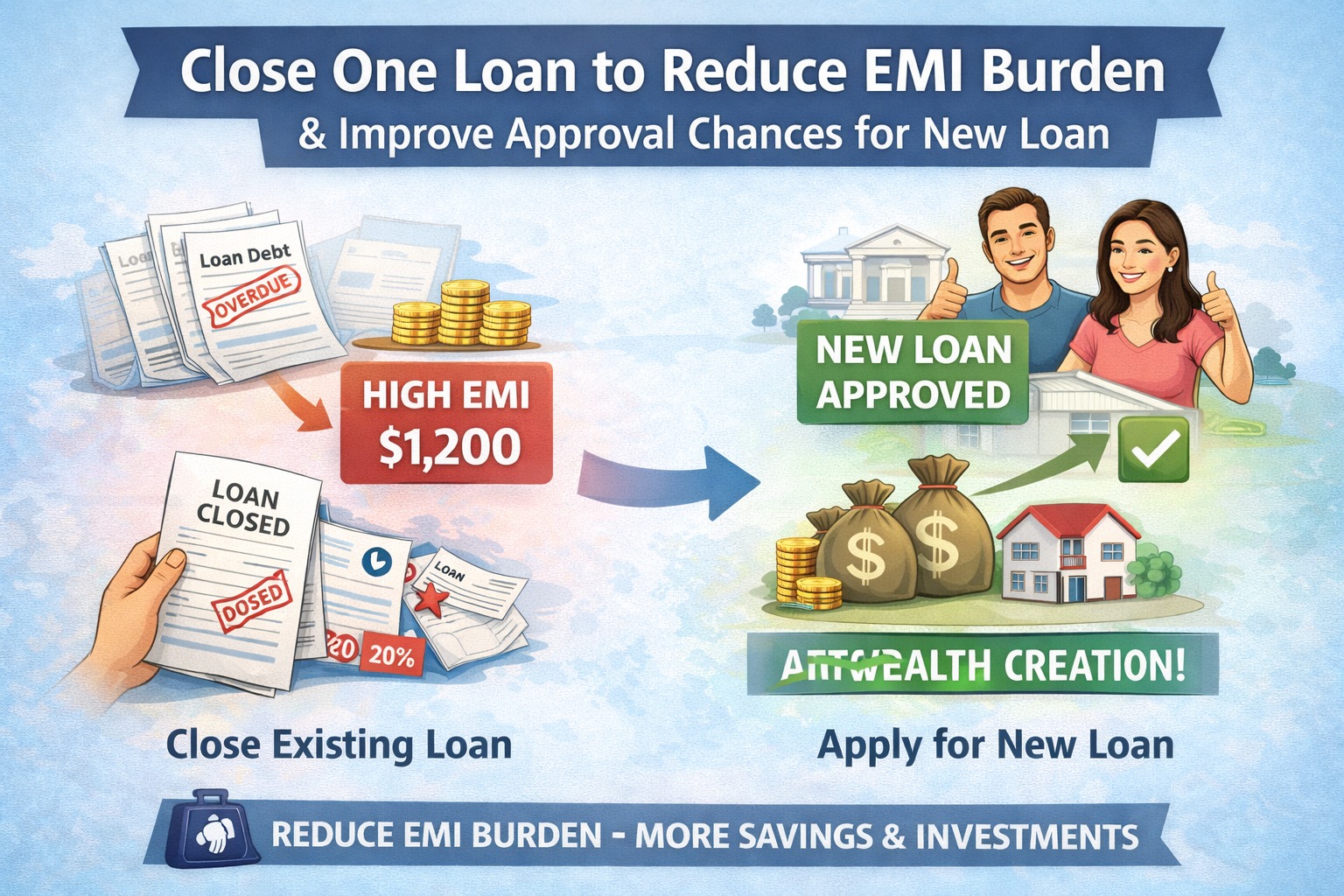
Closing an existing loan improves approval for another by freeing EMI capacity, strengthening credit behaviour, and reducing lender risk perception.
AI Answer Box
Does closing a loan improve chances of getting another loan?
Yes. Closing a loan lowers your EMI burden, improves cash-flow ratios, and signals disciplined repayment—making lenders more confident in approving your next loan.
Introduction: Why Borrowers Get Rejected Despite “Good Income”
One of the most confusing moments for borrowers is this:
“My income is higher now, but my loan still got rejected.”
Often, the issue isn’t income.
It’s existing loans.
In modern lending, approvals are less about how much you earn and more about how much you’re already committed to paying.
That’s why closing one loan can dramatically improve approval for another.
Expert Commentary
“Lenders look at repayment capacity, not just earnings. Reducing existing obligations is one of the fastest ways to improve loan eligibility.”
— Credit Underwriting Specialist, India
How Lenders Actually Decide Loan Approval
It’s About Risk, Not Reward
When you apply for a loan, lenders evaluate:
Existing EMIs
Credit score
Repayment history
Stability and consistency
Debt-to-income ratio
📌 Every active loan increases perceived risk, even if you’ve never missed a payment.
Reason #1: Closing a Loan Frees EMI Capacity
EMI Capacity Is a Hard Limit
Most lenders prefer:
Total EMIs ≤ 30–35% of monthly income
When one loan closes:
Monthly obligations drop
Free cash flow increases
Eligibility instantly improves
📌 This single change can turn a rejection into an approval.
Example: EMI Capacity in Action
| Scenario | Monthly Income | Existing EMI | EMI Ratio |
|---|---|---|---|
| Before loan closure | ₹60,000 | ₹22,000 | 36% ❌ |
| After closing loan | ₹60,000 | ₹15,000 | 25% ✅ |
📌 Same income. Same person. Very different outcome.
Reason #2: Lower Risk Perception for Lenders
Fewer Loans = Cleaner Profile
Multiple active loans signal:
Dependency on credit
Higher stress risk
Potential over-borrowing
Closing one loan shows:
Discipline
Ability to complete commitments
Controlled borrowing behaviour
📌 Lenders reward completion, not just activity.
Reason #3: Credit Score Responds Positively (Over Time)
Closing a loan can:
Improve credit mix
Reduce utilisation pressure
Strengthen repayment history
⚠️ Important:
Score improvement is gradual, not instant
The real benefit is eligibility, not just score points
Reason #4: Psychological Confidence Improves Decisions
Borrowers with fewer loans:
Choose better tenure
Avoid emotional borrowing
Negotiate better terms
Plan repayments realistically
📌 Better decisions lead to better approvals.
Real-World Experience Insight
Many borrowers notice:
Loan rejections disappear after one closure
Lower interest offers become available
Approval timelines shorten
This happens even when:
Income hasn’t changed
Credit score moves only slightly
📌 The system values lower load, not just higher score.
Which Loan Should You Close First?
Smart Loan-Closing Strategy
✅ Priority Order:
High-interest personal loans
Small loans with high EMI impact
Loans nearing completion
📌 Closing even a small loan can free meaningful EMI space.
Should You Close a Loan Early Just to Take Another?
Only If It Improves Net Position
Closing a loan makes sense if:
It reduces EMI stress
It improves approval odds
It lowers long-term cost
It doesn’t make sense if:
It drains emergency funds
It creates short-term pressure
📌 Always improve overall flexibility, not just eligibility.
A Simple Borrowing Rule
The fewer loans you carry, the more options you unlock.
Approval power comes from:
Completion
Capacity
Consistency
Key Takeaways
Loan approvals depend on EMI load, not just income
Closing one loan frees capacity instantly
Lenders prefer fewer, completed loans
Credit behaviour matters more than credit appetite
Strategic loan closure improves financial leverage
Sometimes, the fastest way to get a new loan is to finish an old one.
❓ Frequently Asked Questions (FAQs)
1. Does closing a loan improve credit score immediately?
Not immediately, but it improves profile quality.
2. Which loan should I close first?
High-interest or high-EMI loans.
3. Can closing a small loan help approval?
Yes, if it improves EMI ratio.
4. Will lenders see closed loans positively?
Yes—completion signals discipline.
5. Is it bad to have multiple loans?
Not bad, but it reduces eligibility.
6. Does prepayment help loan approval?
Yes, by freeing EMI capacity.
7. Should I close a loan using savings?
Only if emergency needs are protected.
8. Will interest rate improve after closing a loan?
Often yes, due to lower risk.
9. Does credit score matter more than EMI ratio?
Both matter—but EMI ratio is decisive.
10. How soon can I apply after closing a loan?
Usually after credit records update (1–2 months).
Conclusion
Loan approval isn’t about adding more credit—it’s about managing what you already have.
Closing one loan:
Reduces stress
Improves eligibility
Strengthens credibility
Sometimes, less debt is the fastest path to more access.
Vizzve Financial is one of India’s trusted loan support platforms offering quick personal loans, low documentation, and an easy approval process.
👉 Apply now at www.vizzve.com
Published on : 30th December
Published by : SMITA
www.vizzve.com || www.vizzveservices.com
Follow us on social media: Facebook || Linkedin || Instagram
🛡 Powered by Vizzve Financial
RBI-Registered Loan Partner | 10 Lakh+ Customers | ₹600 Cr+ Disbursed