

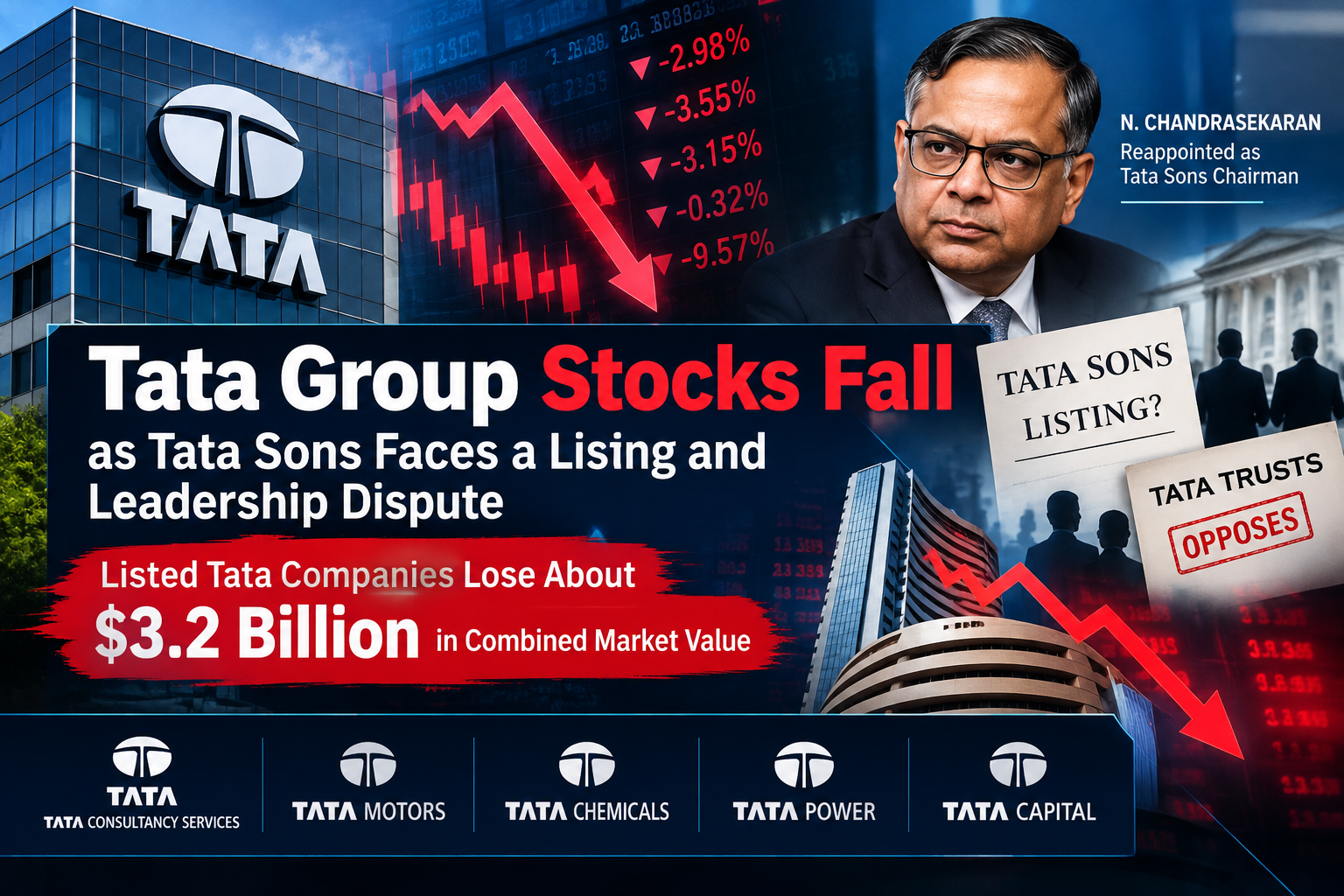
Shares of several listed Tata Group companies came under pressure on September 18, 2026, as investors reacted to renewed uncertainty surrounding the future of Tata Sons, the group's holding company.
Reuters reported that about ₹30,222 crore, or roughly $3.16 billion, was wiped off the combined market value of listed Tata Group companies by Friday noon, compared with their market value at Thursday's close.
The market reaction followed two major developments at Tata Sons: the board moved toward complying with Reserve Bank of India rules that could require the holding company to list, and it extended Chairman N. Chandrasekaran's term by five years.
The developments have also highlighted a disagreement between Tata Sons and Tata Trusts, which owns 66% of Tata Sons.
What Happened at Tata Sons?
The Tata Sons board took two significant decisions on Thursday:
- It moved toward complying with RBI rules that could require Tata Sons to pursue a public listing.
- It reappointed N. Chandrasekaran as chairman for another five-year term.
The decisions were followed by a sharp reversal in several Tata stocks on Friday.
Reuters reported that Tata Trusts opposed both the potential listing and Chandrasekaran's reappointment. Tata Trusts characterized the reappointment as "illegal" under Tata Sons' articles, while opposing the listing plans. These are the Trusts' stated positions and remain part of the ongoing corporate dispute.
Why Did Tata Group Stocks Fall?
The decline appears to have been linked to investor concerns about uncertainty surrounding Tata Sons' governance, ownership structure and future strategy.
The dispute matters because Tata Sons sits at the center of the Tata Group's corporate structure.
Investors are therefore watching several questions:
- Will Tata Sons eventually become publicly listed?
- What will happen to the group's ownership structure?
- How will the disagreement between Tata Sons and Tata Trusts develop?
- What does Chandrasekaran's extended term mean for succession planning?
- Could the dispute affect capital allocation across Tata companies?
These questions have created uncertainty around some listed companies.
Tata Stocks That Came Under Pressure
Reuters reported notable declines in several Tata companies during Friday's trading session.
| Tata Company | Reported Friday Move |
|---|---|
| Tata Chemicals | -9.57% |
| Tata Consultancy Services | -2.98% |
| Tata Investment Corporation | -3.55% |
| Tata Motors Passenger Vehicles | -3.15% |
| Tata Power | -0.16% |
| Tata Elxsi | -1.16% |
| Tata Motors | -0.32% |
| Tata Capital | +1.12% |
The figures are based on Reuters' September 18 reporting and represent market movements at the time reported, rather than a full-day closing performance.
Tata Chemicals Among the Biggest Decliners
Tata Chemicals was among the most affected Tata stocks during Friday's session.
Reuters reported that Tata Chemicals fell 9.57%, while Tata Investment Corporation declined 3.55% and Tata Motors Passenger Vehicles dropped 3.15%.
TCS, one of the group's flagship companies, fell nearly 3% during the period covered by Reuters.
The declines reversed some of the gains recorded by Tata stocks during Thursday's session following news of Chandrasekaran's reappointment and the potential listing process.
What Is the Tata Sons Listing Issue?
Tata Sons is the principal holding company of the Tata Group.
The possibility of a public listing has been an important corporate-governance issue because a listing could change the company's ownership and shareholder structure.
The latest development does not mean that Tata Sons has already completed an IPO.
Instead, Reuters reported that the Tata Sons board had moved toward complying with RBI rules that could require the holding company to list.
That distinction is important for investors and readers following the story.
Potential Listing vs Completed IPO
| Issue | Current Situation |
|---|---|
| Tata Sons listing | Potential/being considered under regulatory requirements |
| IPO completed | No |
| Tata Sons chairman | N. Chandrasekaran reappointed |
| Chairman's new term | Five years |
| Tata Trusts' stake | 66% |
| SP Group stake | 18.4% |
| Market reaction | Several listed Tata stocks declined |
Why Tata Trusts' Position Matters
Tata Trusts owns 66% of Tata Sons, making it a major shareholder in the holding company.
The Trusts opposed both the listing move and Chandrasekaran's reappointment, according to Reuters.
The disagreement has brought governance and succession issues into sharper focus.
Because Tata Sons is central to the wider Tata structure, developments involving its board and major shareholders can influence investor sentiment toward listed Tata companies.
N. Chandrasekaran Gets Five More Years
N. Chandrasekaran's reappointment is another major part of the story.
His term as Tata Sons chairman was extended by five years.
The decision provides continuity at the leadership level, but it has also become part of the dispute between Tata Sons and Tata Trusts. Reuters reported that an independent analyst described the reappointment as reducing leadership uncertainty while highlighting divisions within the boardroom.
The next phase of the dispute could therefore involve both governance questions and longer-term succession planning.
What Role Does Shapoorji Pallonji Group Play?
The Shapoorji Pallonji Group is another important shareholder in Tata Sons.
Tata Trusts said the SP Group, which owns 18.4% of Tata Sons, had proposed monetising part of its holding through a two-tranche transaction that could generate at least $2.61 billion over 18 months.
On Friday, the SP Group backed a potential Tata Sons listing, according to Reuters.
This adds another dimension to the debate over Tata Sons' future ownership and capital structure.
Could the Dispute Affect Tata Companies?
The direct impact on each listed Tata company will vary.
However, investors may continue to monitor the situation because Tata Sons is connected to the group's overall corporate structure.
Potential areas investors could watch include:
- Capital allocation
- Dividend flows
- Group-level investments
- Corporate governance
- Ownership changes
- Succession planning
- Potential Tata Sons listing
- Regulatory developments
It is important to distinguish these potential areas of concern from confirmed financial consequences. Reuters reported that the dispute could affect capital allocation, but the longer-term financial impact remains uncertain.
Indian Stock Market Context
The Tata selloff occurred even as the broader Indian stock market was slightly higher during Friday morning trading.
Reuters reported that the Nifty 50 rose 0.14% to 23,302.40, while the Sensex gained 0.13% to 74,415.50 at 10:33 a.m. IST.
This means the weakness in several Tata stocks was occurring against a modestly positive broader market backdrop.
At the same time, Indian equities were dealing with other pressures, including elevated crude oil prices, domestic IPO activity and weakness in IT stocks.
What Investors Are Watching Next
The next stages of the Tata Sons situation could depend on regulatory, shareholder and board-level developments.
Key developments to monitor include:
1. Tata Sons Listing Process
Investors will watch whether Tata Sons takes further formal steps toward a public listing.
2. Tata Trusts' Position
The Trusts' response could remain important because of its majority ownership of Tata Sons.
3. Regulatory Developments
RBI-related requirements could influence the company's future structure.
4. Boardroom Governance
The disagreement over the chairman's reappointment has brought governance questions into focus.
5. Impact on Listed Tata Stocks
Investors may continue watching whether the recent selloff spreads to additional Tata companies or stabilizes.
How much market value did Tata stocks lose?
Reuters calculated that approximately $3.16 billion had been erased from the combined market value of listed Tata Group companies by Friday noon.
Is Tata Sons going public?
The Tata Sons board has moved toward complying with RBI rules that could require the holding company to list, but this does not mean that an IPO has already been completed.
Has N. Chandrasekaran been reappointed?
Yes. Tata Sons' board extended N. Chandrasekaran's chairmanship for another five years, according to Reuters.
What does Tata Trusts own?
Tata Trusts owns 66% of Tata Sons, according to Reuters.
Key Takeaways
- Tata Group stocks came under pressure on September 18, 2026.
- Reuters calculated a roughly $3.16 billion decline in the combined market value of listed Tata companies by Friday noon.
- Tata Sons' potential listing is at the center of investor attention.
- The Tata Sons board moved toward complying with RBI rules that could require a listing.
- N. Chandrasekaran was reappointed chairman for five years.
- Tata Trusts opposed both the listing move and the reappointment.
- Tata Trusts owns 66% of Tata Sons.
- Shapoorji Pallonji Group holds an 18.4% stake and backed a potential listing.
- Tata Chemicals, TCS and several other Tata companies declined during Friday's trading.
- The longer-term effect on individual Tata companies remains uncertain.
FAQs
1. What happened to Tata Group stocks today?
Several Tata Group stocks declined on September 18 after investors reacted to developments surrounding Tata Sons' potential listing and leadership.
2. How much value did Tata stocks lose?
Reuters calculated that around $3.16 billion was wiped from the combined market value of listed Tata companies by Friday noon.
3. Why is Tata Sons in the news?
Tata Sons is in focus because of its potential listing and the reappointment of N. Chandrasekaran as chairman.
4. Is Tata Sons listed on the stock exchange?
Tata Sons is privately held. The latest development concerns steps toward complying with RBI rules that could require a listing.
5. Who is N. Chandrasekaran?
N. Chandrasekaran is the chairman of Tata Sons and was reappointed for another five-year term.
6. What is Tata Trusts' position?
Tata Trusts has opposed the potential listing and Chandrasekaran's reappointment, according to Reuters.
7. How much of Tata Sons does Tata Trusts own?
Tata Trusts owns 66% of Tata Sons.
8. What is the SP Group's stake in Tata Sons?
The Shapoorji Pallonji Group owns an 18.4% stake in Tata Sons, according to Reuters.
9. Which Tata stock fell the most among those reported?
Tata Chemicals recorded the largest decline among the listed Tata companies cited in Reuters' report, falling 9.57% at the time reported.
10. Did all Tata stocks fall?
No. Tata Capital was reported higher by 1.12% in Reuters' Friday report.
11. Could Tata Sons' listing affect Tata Group companies?
A listing could potentially affect ownership, capital allocation and governance structures, but the eventual impact cannot yet be determined.
12. What should investors watch next?
Investors may monitor regulatory developments, Tata Trusts' position, the listing process, board-level decisions and subsequent share-price reactions.
Published on : 18th September
Published by : Shibam N
www.vizzve.com || www.vizzveservices.com
Follow us on social media: Facebook || Linkedin || Instagram
🛡️ Powered by Vizzve Financial
RBI-Registered Loan Partner | 10 Lakh+ Customers | ₹600 Cr+ Disbursed