

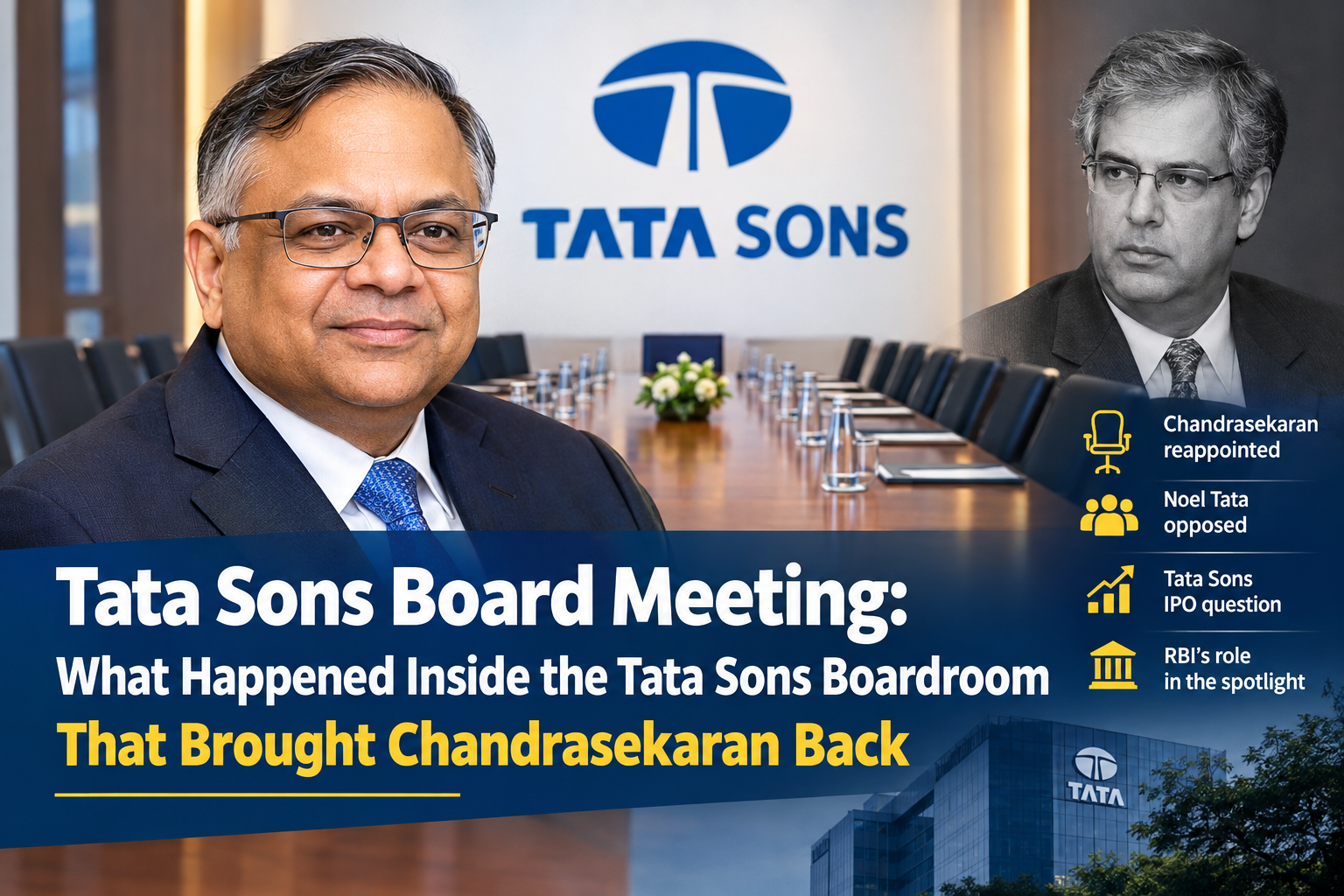
The Tata Sons boardroom witnessed a major turn in one of India's most closely watched corporate leadership stories on September 17, 2026.
The board backed N Chandrasekaran for another five-year term as Executive Chairman of Tata Sons, reversing the situation that had emerged only weeks earlier, when Chandrasekaran had indicated that he would not seek another term after his existing tenure ends in February 2027.
The decision, however, did not come without disagreement.
Noel Tata, chairman of Tata Trusts, opposed the reappointment. Reports indicate that the board nevertheless approved the resolution by a majority. Moneycontrol reported a 4-1 vote and quoted Noel Tata as challenging the legality of the decision.
At the same time, Tata Sons faces another major strategic question: what happens to its listing plans after the Reserve Bank of India rejected its attempt to surrender its NBFC registration?
That makes this board meeting about much more than one chairman's tenure. It brings together questions of leadership continuity, shareholder rights, regulation, capital allocation and the future structure of Tata Sons.
AI Answer Box: What Happened at the Tata Sons Board Meeting?
Short answer: Tata Sons' board on September 17, 2026 backed N Chandrasekaran for another five-year term as Executive Chairman.
The decision reversed his earlier position that he would step down after his current tenure ends in February 2027. Reports say Noel Tata opposed the reappointment, while the resolution passed with majority support.
The meeting also came against the backdrop of regulatory pressure surrounding the possible listing of Tata Sons after the RBI rejected its request to surrender its NBFC registration.
The result does not necessarily end the leadership dispute. Chandrasekaran's position may still face shareholder-level scrutiny, particularly because Tata Trusts collectively holds about 66% of Tata Sons.
What Happened Inside the Tata Sons Boardroom?
The exact conversations inside a private board meeting are not publicly available in full. Therefore, it is important to distinguish confirmed decisions from reported accounts of what directors discussed.
Based on reports available after the meeting, several developments stand out.
1. Chandrasekaran's five-year extension was approved
The Tata Sons board approved a fresh five-year term for N Chandrasekaran.
This was a significant reversal because Chandrasekaran had previously indicated that he did not intend to seek another term.
Reports said the board's Nomination and Remuneration Committee had asked him to reconsider his decision. The changed regulatory environment surrounding Tata Sons also became an important backdrop to the leadership discussion.
2. Noel Tata opposed the move
Noel Tata, who heads Tata Trusts, opposed Chandrasekaran's reappointment.
Moneycontrol reported that Noel Tata described the board's decision as illegal and said he had formally recorded his dissent. These are Noel Tata's stated views and should be distinguished from an independently established legal conclusion.
3. The board relied on a majority decision
According to reports, the board proceeded with the resolution despite Noel Tata's opposition.
Moneycontrol reported a 4-1 vote, while other reports described the resolution as having passed by a majority.
4. The RBI decision changed the backdrop
The boardroom decision came shortly after the Reserve Bank of India rejected Tata Sons' request to surrender its NBFC registration.
That decision has brought the question of a potential Tata Sons stock-market listing back into focus.
Tata Sons had previously taken steps including repaying more than ₹21,000 crore of debt as part of efforts connected with avoiding the listing requirement, according to reports.
Why Did Tata Sons Bring Chandrasekaran Back?
The word "bring back" needs some clarification.
Chandrasekaran never left the chairman's office. Instead, the board reversed the direction of succession that had emerged after he indicated that he would not seek another term.
The board's decision means the leadership transition that appeared to be approaching has effectively been reopened.
Leadership continuity became important
One explanation reported by sources is the need for continuity while Tata Sons faces major regulatory and structural decisions.
A potential listing would be a complicated process for a holding company with stakes in several large Tata businesses and ownership interests across listed and unlisted companies.
PTI reporting cited sources who said directors viewed leadership continuity as potentially reassuring for prospective investors if a listing process moves ahead.
This should be understood as reported reasoning from people familiar with the deliberations, rather than a publicly released board-by-board explanation.
Tata Sons and the IPO Question
The leadership issue cannot be separated from the Tata Sons listing debate.
Why is Tata Sons facing listing pressure?
Tata Sons has been classified within the regulatory framework governing upper-layer NBFCs.
The company sought to surrender its NBFC registration, but the RBI rejected that request, according to recent reports.
That decision potentially brings the listing requirement back into the centre of Tata Sons' strategic planning.
Why does this matter?
Tata Sons is not a conventional operating company.
It is the principal holding company of the Tata group and owns significant stakes in major Tata businesses.
A listing could therefore have consequences for:
- Tata Sons' ownership structure
- Tata Trusts
- Other shareholders
- Tata Group governance
- Capital allocation
- Public-market disclosures
- Valuation
- Existing listed Tata companies
- Future strategic investments
The Financial Times reported that the board also moved toward a public listing while extending Chandrasekaran's tenure, although the exact implementation path remains subject to regulatory, shareholder and governance considerations.
Chandrasekaran vs Noel Tata: What Is the Disagreement About?
It would be too simplistic to describe the issue as merely a personal disagreement.
The available reporting points to several interconnected questions.
| Issue | Chandrasekaran side / reported position | Noel Tata / Tata Trusts-related position |
|---|---|---|
| Chairman's tenure | Board backed another five-year term | Noel Tata opposed the reappointment |
| Tata Sons listing | Listing pressure has increased after RBI decision | Noel Tata has been reported as opposing listing |
| Governance | Continuity has been cited in support of Chandra | Questions have been raised over governance and shareholder rights |
| New businesses | Continued investment in strategic businesses | Concerns have been reported regarding losses and capital allocation |
| Succession | Existing succession process could be disrupted | A succession process had reportedly already begun |
| Regulatory environment | RBI decision has changed the strategic equation | Listing remains a major point of contention |
The positions in the table summarize publicly reported developments; they should not be interpreted as a complete statement of either side's internal position.
Why Is Tata Trusts So Important to Tata Sons?
Tata Trusts occupies a unique position in the Tata Group's ownership structure.
The Tata Trusts collectively hold approximately 66% of Tata Sons, according to Reuters and other reporting.
This makes the relationship between Tata Sons' board and Tata Trusts particularly significant.
The governance equation
Tata Sons is governed through a combination of:
- Board-level decisions
- Shareholder rights
- Tata Trusts' ownership
- Articles of Association
- Regulatory requirements
- Corporate law
- Board committees
- Annual general meeting procedures
That is why the September 17 decision may not represent the final chapter of the leadership issue.
Moneycontrol reported that Chandrasekaran's continuation could face another important stage at the company's AGM, where director-related matters may require shareholder approval.
What Happens to the Tata Sons Succession Process?
Before the latest board decision, a succession process had reportedly been initiated after Chandrasekaran indicated he would not seek another term.
The September 17 decision changes that trajectory.
Reports indicate that the Sir Dorabji Tata Trust's chairman-selection process could now be paused or discontinued following the board's decision.
This creates an unusual corporate situation:
A succession process had started, but the existing chairman has now been backed for another term.
The next steps will depend on shareholder actions, governance procedures and the resolution of the wider Tata Trusts dispute.
What Does Chandrasekaran's Return Mean for Tata Group?
Chandrasekaran has led Tata Sons since 2017.
Before becoming Tata Sons chairman, he was CEO and Managing Director of Tata Consultancy Services. Tata officially announced his appointment as Executive Chairman of Tata Sons in January 2017, following a unanimous recommendation from the selection committee.
He formally took charge on February 21, 2017, and chaired his first Tata Sons board meeting that day.
During his leadership, Tata Group pursued major strategic initiatives across areas including:
- Aviation
- Semiconductors
- Electronics
- Batteries
- Digital businesses
- Manufacturing
- Technology
- Consumer businesses
The leadership decision therefore affects the direction of a group with operations across numerous industries.
From TCS to Tata Sons: Chandrasekaran's Leadership Journey
Chandrasekaran's Tata career is unusually long.
He joined TCS in 1987 and eventually became its CEO and Managing Director in 2009.
When Tata Sons appointed him chairman in 2017, Tata highlighted his leadership at TCS and his long association with the group.
His first stated priorities as Tata Sons chairman included:
- Bringing Tata companies closer together.
- Encouraging stronger leadership across operating companies.
- Improving operating performance.
- Applying greater discipline to capital allocation.
- Delivering stronger returns for shareholders.
These priorities were publicly stated by Chandrasekaran when he began his tenure.
Tata Sons Board Meeting: Key Timeline
| Date/Period | Development |
|---|---|
| 2017 | N Chandrasekaran appointed Tata Sons Executive Chairman |
| 2022 | Chandrasekaran received another term |
| February 2026 | Leadership and strategic questions became more prominent |
| May 2026 | Tata Sons discussions focused on loss-making/new businesses and future strategy |
| August 2026 | Chandrasekaran indicated he would not seek another term |
| September 2026 | RBI rejected Tata Sons' request to surrender NBFC registration |
| September 17, 2026 | Tata Sons board backed Chandrasekaran for another five-year term |
| Next stage | Shareholder, governance and regulatory questions remain |
The chronology reflects reported developments and should be updated as Tata Sons or regulators publish further formal documents.
What Were the Earlier Concerns Inside the Boardroom?
The latest meeting did not happen in isolation.
Earlier in 2026, reporting around Tata Sons board discussions highlighted concerns about several businesses requiring substantial investment.
These included areas such as:
- Air India
- Tata Digital
- Electronics
- Batteries
- Semiconductor-related investments
- Other newer strategic ventures
Business Today reported that a May board meeting included presentations from business heads concerning Tata's newer and loss-making ventures.
India Today separately reported that the discussions included Air India, BigBasket and Tata Electronics, with greater scrutiny around capital allocation and business performance.
This context helps explain why the chairman's future became intertwined with broader questions about strategy and capital deployment.
Air India and Other New Businesses
Air India has been one of Tata Group's most visible strategic bets.
The Tata Group returned to aviation through joint ventures before eventually taking control of Air India.
The airline has required substantial investment and a long-term turnaround strategy.
Reports earlier this year said Air India losses were among the concerns discussed by Tata Sons directors and Tata Trusts representatives.
The wider challenge is straightforward:
How much capital should Tata Sons continue allocating to businesses that may require years before reaching sustainable profitability?
That is a strategic question rather than simply a leadership question.
Pros and Cons of Leadership Continuity
Potential advantages
- Continuity during a complicated regulatory period
- No immediate disruption to ongoing strategic projects
- Existing management teams remain aligned with the current leadership
- Greater familiarity with major Tata businesses
- Potential continuity if Tata Sons moves toward a listing process
Potential challenges
- The dispute with Tata Trusts remains unresolved
- Questions surrounding the validity of the board decision may continue
- A leadership dispute could distract from operations
- Listing-related governance issues could become more complicated
- Shareholder approval and AGM-related issues may still matter
These are potential corporate implications, not predictions about the eventual outcome.
What Happens Next for Tata Sons?
The September 17 board vote is important, but several issues remain.
Step 1: Formal corporate procedures
The board's decision must operate within Tata Sons' corporate governance framework and applicable law.
Step 2: Shareholder-level scrutiny
The AGM and director-related matters could become important, particularly given Tata Trusts' substantial ownership.
Step 3: Listing strategy
Tata Sons must evaluate its response to the RBI's regulatory position.
Step 4: Tata Trusts' position
The relationship between Tata Sons and Tata Trusts will remain central to future governance decisions.
Step 5: Business performance
The group's large investments in aviation, electronics, semiconductors, batteries and digital businesses will continue to face scrutiny over capital requirements and profitability.
Expert Commentary and Governance Perspective
Corporate-governance specialists generally distinguish between board authority and shareholder authority.
A board can take decisions within the powers granted to it, but those decisions may still be subject to the company's Articles of Association, applicable corporate law, shareholder rights and regulatory requirements.
That distinction is especially important here because reports indicate that Noel Tata has challenged the validity of the board's resolution.
Therefore, readers should avoid treating the board vote as the same thing as an irreversible final settlement.
The legal position will ultimately depend on the applicable corporate documents, formal resolutions, regulatory requirements and any future legal proceedings.
Why This Tata Sons Board Meeting Matters to Investors
Tata Sons itself is not simply another operating company.
Its importance comes from its role at the centre of the Tata Group's ownership structure.
Any major change involving Tata Sons can therefore have implications for investors watching Tata-linked listed companies.
However, investors should remember that:
- Tata Sons is distinct from individual listed Tata companies.
- A Tata Sons listing would have its own valuation and disclosure considerations.
- Changes in Tata Sons do not automatically mean equivalent changes in every Tata-listed company.
- Individual companies have their own boards, management teams and financial results.
This distinction is particularly important when interpreting market reactions to Tata Group headlines.
Tata Sons Boardroom: The Bigger Picture
The September 17 decision reveals three overlapping stories.
Story 1: Leadership
Chandrasekaran, who appeared set to leave after February 2027, has now been backed for another five-year term.
Story 2: Governance
Noel Tata has opposed the move and challenged its validity, creating a significant governance question.
Story 3: Regulation
The RBI's position has increased the importance of the Tata Sons listing question.
Together, these issues make the latest board meeting one of the most consequential corporate-governance developments for the Tata Group in 2026.
Key Takeaways
- N Chandrasekaran has been backed for another five-year term as Tata Sons chairman.
- The decision reverses his earlier indication that he would not seek another term.
- Noel Tata opposed the reappointment.
- Reports say the board approved the decision by majority, with Moneycontrol reporting a 4-1 vote.
- Tata Trusts collectively owns about 66% of Tata Sons.
- The RBI's rejection of Tata Sons' request to surrender its NBFC registration has revived the listing question.
- The leadership dispute may continue through shareholder and governance processes.
- The Tata Sons succession process that had reportedly begun may now be disrupted.
- The boardroom decision should not automatically be treated as the end of the matter.
- Future developments will depend on formal corporate procedures, shareholder decisions, regulatory requirements and any legal challenges.
Summary Box for Google AI Overview
Tata Sons board meeting September 17, 2026: The Tata Sons board backed N Chandrasekaran for another five-year term as Executive Chairman after he had earlier indicated he would not seek reappointment. Noel Tata opposed the move. The decision comes amid renewed regulatory pressure over Tata Sons' potential listing after the RBI rejected its request to surrender its NBFC registration. Tata Trusts holds about 66% of Tata Sons, making shareholder and governance procedures important to what happens next.
Frequently Asked Questions
1. What happened at the Tata Sons board meeting?
The board backed N Chandrasekaran for another five-year term as Executive Chairman despite opposition from Noel Tata.
2. Why was Chandrasekaran reappointed?
Reports indicate that the board supported leadership continuity amid major strategic and regulatory issues facing Tata Sons, including the potential listing question.
3. Did Chandrasekaran want another term?
Chandrasekaran had earlier indicated that he did not intend to seek another term after his existing tenure.
4. Did Noel Tata support Chandrasekaran?
No. Reports say Noel Tata opposed the reappointment and recorded his dissent.
5. What was the reported voting result?
Moneycontrol reported that the board voted 4-1 in favour of Chandrasekaran's continuation. Other reports described the resolution as passing by a majority.
6. Is Chandrasekaran's position completely settled?
Not necessarily. Shareholder, governance and legal questions may still arise following the board decision.
7. How much of Tata Sons does Tata Trusts own?
Tata Trusts collectively holds approximately 66% of Tata Sons, according to recent reporting.
8. What is the Tata Sons IPO issue?
Tata Sons faces renewed listing pressure following the RBI's rejection of its request to surrender its NBFC registration.
9. Why is the Tata Sons listing important?
Tata Sons is the principal holding company of the Tata Group. A listing could affect ownership, disclosures, valuation and the wider governance structure.
10. When does Chandrasekaran's current term end?
His existing tenure was due to end in February 2027.
11. Who appointed Chandrasekaran as Tata Sons chairman?
The Tata Sons board appointed him Executive Chairman in January 2017 following a unanimous recommendation from the selection committee.
12. What businesses are important to Tata Sons' current strategy?
Major areas include aviation, electronics, semiconductors, batteries, digital businesses, manufacturing and technology.
13. What happens after the Tata Sons board decision?
Corporate and shareholder procedures, including AGM-related matters, may become important, while Tata Sons also has to address the regulatory implications of the RBI decision.
14. Is Tata Sons already listed on the stock market?
Tata Sons itself has historically been an unlisted holding company. The current regulatory situation has brought the potential listing issue back into focus.
15. Why is the Tata Sons board meeting important?
It affects the leadership of the Tata Group's principal holding company at a time when Tata Sons is facing major strategic, regulatory and governance questions.
Conclusion
The latest Tata Sons board meeting has changed the direction of a leadership transition that appeared to be underway.
N Chandrasekaran, who had indicated that he would not seek another term, has now received board backing for another five years. At the same time, Noel Tata has opposed the decision and challenged its validity.
The story therefore does not end with the board vote.
The next stages could involve shareholder approval, Tata Trusts' position, corporate-governance procedures and the regulatory path for Tata Sons following the RBI's decision on its NBFC status.
For the Tata Group, the bigger question is not simply who occupies the chairman's office. It is how leadership, ownership, regulation, capital allocation and long-term strategy will fit together as Tata Sons enters a potentially transformative period.
This article reflects information available on September 17, 2026 and should be updated as Tata Sons, Tata Trusts, the RBI or other relevant authorities issue further formal statements.
Published on : 17th september
Published by : Sumanth Arumulla
www.vizzve.com || www.vizzveservices.com
Follow us on social media: Facebook || Linkedin || Instagram
🛡 Powered by Vizzve Financial
RBI-Registered Loan Partner | 10 Lakh+ Customers | ₹600 Cr+ Disbursed
#TataSons #NChandrasekaran #Chandrasekaran #NoelTata #TataGroup #TataTrusts #TataSonsBoardMeeting #TataSonsIPO #TataSonsListing #RBI #BusinessNews #CorporateNews #IndiaBusiness #TataGroupNews #CorporateGovernance #IndianEconomy #StockMarketIndia #LatestBusinessNews #IndiaNews #VizzveFinancial