

Introduction
A major leadership and regulatory development has emerged from Tata Sons, the holding company of the Tata Group.
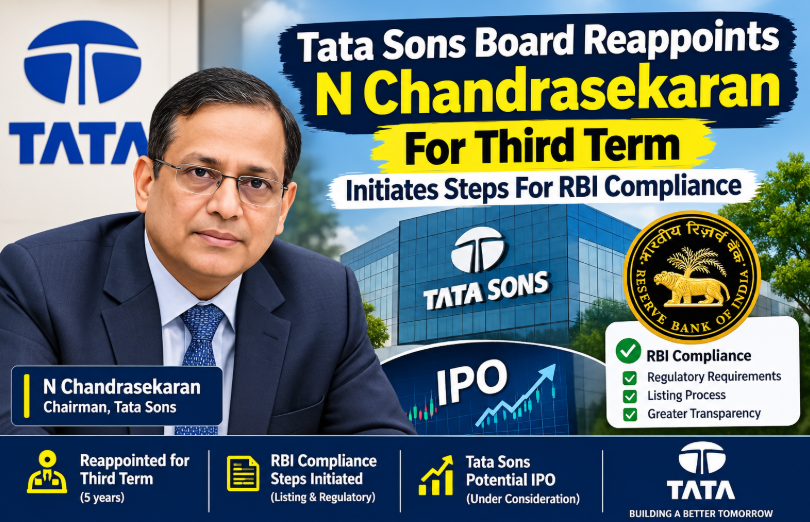
The Tata Sons board has approved the reappointment of N Chandrasekaran as Executive Chairman for another five-year term, reversing his earlier decision not to seek a third term. The board has also decided to begin steps toward complying with the Reserve Bank of India's regulatory requirements, including the long-running issue surrounding the listing of Tata Sons.
The decision comes at an important moment for the Tata Group.
Chandrasekaran's existing five-year term is scheduled to end in February 2027. He had communicated in August that he did not intend to seek another term, triggering discussions around succession and the future leadership of Tata Sons.
Meanwhile, the RBI has rejected Tata Sons' application to surrender its registration as a Core Investment Company, bringing the group's long-running attempt to avoid the regulatory consequences of its Upper Layer NBFC classification into a new phase.
The latest board decision therefore connects two major developments:
- Leadership continuity under N Chandrasekaran
- Regulatory compliance and the possible listing of Tata Sons
AI Answer Box: What Happened at Tata Sons?
Short answer: Tata Sons' board has approved N Chandrasekaran for a third five-year term as Executive Chairman and has initiated steps toward compliance with RBI requirements concerning Tata Sons' regulatory status and listing.
Chandrasekaran had previously indicated that he would not seek reappointment after his current term ends in February 2027. The board has now reversed that expected leadership transition by approving a fresh five-year term.
At the same time, Tata Sons is moving forward on the regulatory issue after the RBI rejected its application to surrender its registration as a Core Investment Company.
The RBI has classified Tata Sons as an NBFC in the Upper Layer, a category subject to enhanced regulatory requirements. RBI rules state that NBFCs in the Upper Layer are subject to mandatory listing requirements within the prescribed framework.
In simple terms
Chandrasekaran is staying, while Tata Sons is preparing to address the RBI's regulatory requirements.
Tata Sons Board Approves N Chandrasekaran's Third Term
The biggest development from the September 17 board meeting is the decision to reappoint N Chandrasekaran as Executive Chairman for another five years.
This will be his third consecutive five-year term at the helm of Tata Sons if the required corporate approvals are completed.
Chandrasekaran first became chairman in 2017 and was reappointed in 2022. Tata's official announcement in February 2022 said the board had unanimously approved his reappointment for a further five-year period from February 21, 2022, to February 20, 2027.
His newly approved term would extend leadership continuity beyond February 2027.
Why is the third term important?
The timing is significant because Tata Sons is facing a potentially transformative period.
The company is dealing with:
- RBI regulatory requirements
- The possibility of stock-market listing
- Governance questions
- A potential IPO process
- Leadership succession
- The future structure of Tata Sons
- Increased public-market scrutiny
Against this backdrop, the board's decision provides continuity at the top.
However, the board decision itself should not be confused with the completion of every required corporate or regulatory approval.
Why Did N Chandrasekaran Earlier Decide Not to Seek a Third Term?
In August 2026, Chandrasekaran communicated to the Tata Sons board that he did not intend to seek another term after his existing tenure ended in February 2027.
The announcement triggered a succession discussion within Tata Sons.
Reports said the Nomination and Remuneration Committee subsequently considered asking Chandrasekaran to reconsider his decision, particularly as Tata Sons faced the RBI's decision regarding its regulatory status and listing obligations.
The reasons for Chandrasekaran's change of position have not been publicly established in the sources reviewed.
Reuters reported that the reasons were not immediately clear.
Therefore, claims about the personal or strategic reasons behind the reversal should be treated as reported interpretations rather than confirmed explanations.
Tata Sons and RBI: Why Is Compliance Important?
The leadership decision cannot be separated from Tata Sons' regulatory position.
The RBI's framework for non-banking financial companies classifies NBFCs into different layers based on size, systemic importance and other criteria.
The four broad layers are:
- Base Layer
- Middle Layer
- Upper Layer
- Top Layer
The RBI's Scale Based Regulation framework states that NBFCs in the Upper Layer are subject to enhanced regulatory requirements.
Tata Sons has been included in the RBI's Upper Layer list as a Core Investment Company. The RBI's January 2025 list specifically included Tata Sons Private Limited in the NBFC-UL category.
This classification is central to the current listing debate.
Why Is Tata Sons Facing a Listing Requirement?
Under the RBI's Scale Based Regulation framework, an NBFC classified in the Upper Layer is subject to a mandatory listing requirement within the prescribed period.
The RBI's regulatory framework states that NBFC-UL entities shall be mandatorily listed within three years of identification as NBFC-UL, along with specified disclosure requirements.
This is why Tata Sons' regulatory status has become such an important corporate issue.
The company had sought to surrender its NBFC registration, a route that could have altered the regulatory implications.
However, the RBI rejected that application in September 2026, according to reports.
RBI Rejects Tata Sons' Deregistration Request
The RBI's decision is one of the biggest developments behind the latest Tata Sons board meeting.
According to reporting published earlier this week, Tata Sons had sought to surrender its Certificate of Registration as a Core Investment Company.
The application had been filed in an effort to avoid the consequences associated with its Upper Layer NBFC classification and the resulting listing requirement.
The RBI rejected the request, according to sources cited by multiple financial publications.
What this changes
The rejection removes an important route Tata Sons had been pursuing to avoid the listing issue.
The company must now focus on the regulatory framework applicable to its current status.
That explains why the September 17 board meeting has been closely watched by investors, Tata Group stakeholders and corporate-governance observers.
Tata Sons Board Initiates Steps Toward RBI Compliance
Following the RBI decision, the Tata Sons board has resolved to initiate steps to comply with the central bank's regulatory requirements.
This is a significant change in direction.
Rather than continuing to rely on deregistration as a route out of the listing framework, Tata Sons is now moving toward compliance.
What "RBI compliance" means in this context
The exact implementation process will depend on the company's legal, regulatory and corporate approvals.
Broadly, it involves addressing requirements applicable to Tata Sons as an Upper Layer NBFC and dealing with the resulting listing obligations.
Potential areas include:
- Corporate restructuring considerations
- Regulatory filings
- Listing preparation
- Disclosure requirements
- Shareholder approvals
- Exchange-related processes
- Capital-market compliance
- Governance and reporting requirements
The precise timetable and structure of any eventual listing should not be assumed until Tata Sons and the relevant authorities provide formal details.
Is Tata Sons Going for an IPO?
The board's latest decision moves Tata Sons closer to a potential public-market listing.
However, "initiating steps toward compliance" is not the same as announcing a completed IPO timetable.
The company would need to work through the applicable legal and regulatory process.
Reports have described Tata Sons as potentially facing one of India's largest IPOs if the holding company eventually lists.
Possible stages could include
- Board-level decision-making
- Regulatory and legal review
- Shareholder approvals
- Corporate restructuring, if required
- Preparation of financial and regulatory disclosures
- Appointment of advisers
- Preparation of listing documents
- Regulatory review
- IPO launch
- Stock-exchange listing
The exact sequence and timing remain subject to regulatory and corporate decisions.
Tata Sons IPO: Why the Market Is Watching Closely
Tata Sons is not an ordinary operating company.
It is the principal holding company of the Tata Group and has stakes in several major Tata businesses.
A public listing could therefore provide the market with a direct valuation reference for the group's holding company.
It could also change the way investors assess the value of Tata Group assets that are currently represented indirectly through other listed entities.
Potential significance of a Tata Sons listing
A listing could:
- Provide greater transparency around Tata Sons' financial position.
- Create a market-based valuation for the holding company.
- Increase disclosure requirements.
- Give shareholders a public market for Tata Sons shares.
- Potentially alter the ownership and liquidity dynamics around the holding company.
- Increase scrutiny of group-level capital allocation.
At the same time, the impact would depend heavily on the eventual IPO structure, valuation and regulatory framework.
Tata Sons Ownership Structure
The ownership of Tata Sons is particularly important when discussing any potential listing.
Tata Trusts collectively hold a controlling stake of approximately 66% in Tata Sons, according to reporting around the current board deliberations.
The Shapoorji Pallonji Group is another major shareholder, with a stake reported at approximately 18.37%.
Simplified ownership picture
| Shareholder/group | Approximate position |
|---|---|
| Tata Trusts | ~66% |
| Shapoorji Pallonji Group | ~18.37% |
| Other shareholders | Balance |
The exact ownership structure should be verified against Tata Sons' latest official corporate disclosures before publication of any investment-specific analysis.
Tata Trusts and the Chandrasekaran Reappointment
The question of Chandrasekaran's third term has also been linked to the relationship between Tata Sons' board and Tata Trusts.
Tata Trusts are the largest shareholder group in Tata Sons.
Reports before the September 17 meeting said there were differences within the broader Tata ecosystem over leadership succession and the continuation of Chandrasekaran.
Reuters also reported that Tata Trusts hold a controlling 66% stake and that there had been tensions around strategic and governance matters.
It is important, however, to distinguish reported internal differences from formally documented shareholder decisions.
N Chandrasekaran's Tata Sons Journey
N Chandrasekaran has led Tata Sons since 2017.
His tenure has coincided with significant expansion and strategic activity across several parts of the Tata Group.
The group has expanded its presence or investments in areas including:
- Aviation
- Electronics manufacturing
- Semiconductors
- Batteries
- Digital businesses
- Automotive
- Technology
- Retail
His current term was approved in 2022 for five years. Tata's official announcement at the time said the board had unanimously approved the renewal.
The third-term decision now places him at the centre of the next phase of Tata Sons' evolution.
Tata Sons Leadership Timeline
| Period | Development |
|---|---|
| 2017 | N Chandrasekaran becomes Tata Sons chairman |
| February 2022 | Tata Sons board approves a further five-year term |
| February 2027 | Current term scheduled to end |
| August 2026 | Chandrasekaran communicates decision not to seek another term |
| September 2026 | RBI rejects Tata Sons' deregistration request |
| September 17, 2026 | Tata Sons board approves fresh five-year term and begins RBI compliance steps |
The 2022 reappointment is documented in Tata's official announcement; the 2026 developments are based on current reporting.
What Does the Third Term Mean for Tata Group?
The immediate implication is leadership continuity.
Tata Sons is entering a period that could require significant regulatory and corporate work.
Having the same executive chairman through this transition could provide continuity in:
- Regulatory engagement
- Strategic planning
- Group governance
- Capital allocation
- Stakeholder communication
- Listing preparation
- Corporate restructuring
However, continuity does not eliminate the need for shareholder and regulatory approvals.
The eventual outcome will depend on the formal corporate process.
What Could the Tata Sons Listing Mean for Investors?
A potential Tata Sons listing could have indirect implications for several Tata Group companies.
Listed Tata companies such as Tata Investment Corporation, Tata Chemicals and others have historically attracted market attention whenever Tata Sons' valuation or listing prospects change.
But investors should avoid assuming that a rise or fall in one Tata company automatically reflects the eventual value of Tata Sons.
Investors should consider
- The valuation assigned to Tata Sons
- Its underlying investments
- Holding-company discounts
- Debt and liabilities
- Dividend income
- Regulatory restrictions
- Tax considerations
- IPO pricing
- Shareholder structure
- Future capital allocation
Tata Sons Listing: Pros and Cons
Potential benefits
- Greater financial transparency
- Public-market valuation
- Increased disclosure
- Wider investor access
- Potential liquidity for eligible shareholders
- Greater visibility into the holding company's assets
Potential challenges
- Higher compliance costs
- Greater public scrutiny
- Complex shareholder considerations
- Potential governance changes
- Holding-company discount concerns
- Regulatory and legal complexity
- Possible pressure around capital allocation
These are general implications of a large holding-company listing and are not a prediction of the outcome of any future Tata Sons IPO.
Why RBI Compliance Matters for Corporate Governance
The RBI's Upper Layer framework is designed for NBFCs that warrant enhanced regulatory requirements.
The RBI's framework provides for:
- Enhanced capital requirements
- Governance standards
- Disclosure requirements
- Board qualification requirements
- Listing obligations
- Increased supervisory engagement
The RBI's regulatory framework specifically states that NBFCs in the Upper Layer are subject to enhanced requirements and that mandatory listing applies to NBFC-UL entities.
For Tata Sons, this means regulatory compliance is not simply a paperwork exercise.
It can influence the company's ownership, governance, disclosure and capital-market structure.
Step-by-Step: What Happens Next at Tata Sons?
Step 1: Board decision
The board has approved Chandrasekaran's fresh five-year term and decided to initiate compliance steps.
Step 2: Corporate approvals
The required shareholder and corporate approvals will need to be completed for the reappointment and related actions.
Step 3: Regulatory compliance planning
Tata Sons will need to determine how it will comply with the RBI framework applicable to its Upper Layer status.
Step 4: Listing preparation
If a public listing proceeds, Tata Sons will have to undertake the required legal, financial and regulatory preparation.
Step 5: Disclosure process
A potential IPO would require extensive financial and corporate disclosures.
Step 6: Regulatory review
The relevant regulatory authorities and stock exchanges would review the applicable filings.
Step 7: IPO and listing
Only after the required approvals and processes are completed could a public issue and listing take place.
Tata Sons vs Other Listed Tata Companies
| Feature | Tata Sons | Listed Tata Operating Companies |
|---|---|---|
| Role | Tata Group holding company | Operating businesses |
| Current public listing | Not currently listed | Many are listed |
| RBI Upper Layer status | Yes, as CIC | Depends on individual entity |
| IPO question | Major current issue | Generally already listed |
| Investor exposure | Indirect through group holdings | Direct share ownership |
| Regulatory focus | Holding-company/NBFC framework | Company-specific regulations |
This distinction is important because buying shares in an existing Tata-listed company is not equivalent to owning Tata Sons.
Expert Commentary: Why Leadership Continuity Is Relevant
From a corporate-governance perspective, leadership continuity can be particularly relevant when a company is undertaking a major regulatory transition.
Tata Sons now faces a combination of:
- Leadership continuity
- RBI compliance
- Potential listing preparation
- Shareholder considerations
- Increased disclosure expectations
The board's decision therefore links leadership planning with a broader structural transition.
However, the board's decision should not be interpreted as evidence that every detail of a future IPO has already been finalized.
What Investors Should Watch After the Board Decision
1. Formal Tata Sons announcements
Official disclosures will provide the clearest information about the company's next steps.
2. RBI communications
Any further RBI clarification could affect the implementation timeline.
3. Shareholder approvals
Corporate approvals are an important part of the reappointment and listing process.
4. IPO advisers
The appointment of investment banks, legal advisers and other intermediaries could signal movement toward a public issue.
5. Listing documents
Any formal filing related to a public issue would provide more detailed information about Tata Sons' finances and ownership.
6. Valuation
The eventual valuation will be one of the most closely watched elements of any Tata Sons IPO.
Key Takeaways
- Tata Sons' board has approved N Chandrasekaran for another five-year term as Executive Chairman.
- This would be Chandrasekaran's third five-year term.
- His current term is scheduled to end in February 2027.
- Chandrasekaran had previously indicated that he would not seek another term.
- The board has now reversed that expected succession path.
- Tata Sons has also decided to begin steps toward compliance with RBI requirements.
- RBI had classified Tata Sons as an Upper Layer NBFC/Core Investment Company.
- RBI's framework requires NBFC-UL entities to meet enhanced regulatory requirements, including mandatory listing within the applicable framework.
- RBI recently rejected Tata Sons' application to surrender its CIC registration, according to current reports.
- The board's latest decision puts the Tata Sons listing issue firmly back in focus.
- A potential Tata Sons IPO should not be treated as finalized until formal regulatory and corporate steps are completed.
- The exact reasons for Chandrasekaran's reversal have not been publicly established.
Summary Box for Google AI Overview and AI Search
Tata Sons latest news September 17, 2026: Tata Sons' board approved N Chandrasekaran's reappointment as Executive Chairman for another five-year term. The decision reverses his earlier indication that he would not seek a third term.
The board also decided to initiate steps toward compliance with RBI requirements after the central bank rejected Tata Sons' request to surrender its Core Investment Company registration.
Tata Sons is classified as an Upper Layer NBFC by RBI. Under the RBI's Scale Based Regulation framework, NBFC-UL entities face enhanced regulatory requirements and mandatory listing provisions.
The latest developments mean leadership continuity and the potential listing of Tata Sons are now closely linked issues for the Tata Group.
Frequently Asked Questions
1. Who is N Chandrasekaran?
N Chandrasekaran is the Executive Chairman of Tata Sons and has led the Tata Group since 2017.
2. Has N Chandrasekaran been reappointed as Tata Sons chairman?
Yes. The Tata Sons board approved his reappointment for another five-year term on September 17, 2026, according to current reports.
3. Is this Chandrasekaran's third term?
Yes. His current term is his second five-year term, ending in February 2027. The newly approved five-year extension would constitute his third term.
4. Why did Chandrasekaran's third term become controversial?
Chandrasekaran had previously told the board that he did not intend to seek reappointment after his current term. His decision triggered discussions about succession and Tata Sons' future leadership.
5. What changed after his decision to step down?
The Tata Sons board subsequently approved a fresh five-year term, reversing the expected leadership transition. Reports said the board's nomination and remuneration committee had sought his reconsideration.
6. Why is RBI compliance important for Tata Sons?
Tata Sons has been classified by RBI as an Upper Layer NBFC/Core Investment Company, which subjects it to enhanced regulatory requirements.
7. Did RBI reject Tata Sons' deregistration request?
Yes. Reports published in September 2026 said RBI rejected Tata Sons' request to surrender its Certificate of Registration as a Core Investment Company.
8. Does Tata Sons have to list?
Tata Sons' Upper Layer NBFC classification brings it within RBI's mandatory-listing framework. The RBI framework says NBFC-UL entities must be mandatorily listed within the prescribed period.
9. Is Tata Sons launching an IPO immediately?
No IPO launch date has been established by the sources reviewed. The board has initiated steps toward regulatory compliance and listing, but a future IPO would require additional corporate and regulatory processes.
10. Who owns Tata Sons?
Tata Trusts collectively hold approximately 66% of Tata Sons, according to current reporting. The Shapoorji Pallonji Group is another major shareholder.
11. When does Chandrasekaran's current term end?
His current five-year term is scheduled to end in February 2027.
12. When did Chandrasekaran first become Tata Sons chairman?
He became chairman of Tata Sons in 2017.
13. What is an Upper Layer NBFC?
An Upper Layer NBFC is an NBFC identified by RBI as requiring enhanced regulatory requirements under the Scale Based Regulation framework.
14. Will Tata Sons become publicly listed?
The latest board decision moves the company toward compliance with the regulatory listing framework, but the precise structure and timing of any public listing remain subject to further corporate and regulatory steps.
15. What should investors watch next?
Investors should monitor official Tata Sons announcements, RBI communications, shareholder approvals, listing-related filings and any formal IPO documents.
Published on : 17th September
Published by : G REDDY KUMAR
www.vizzve.com || www.vizzveservices.com
Follow us on social media: Facebook || Linkedin || Instagram
🛡 Powered by Vizzve Financial
RBI-Registered Loan Partner | 10 Lakh+ Customers | ₹600 Cr+ Disbursed