

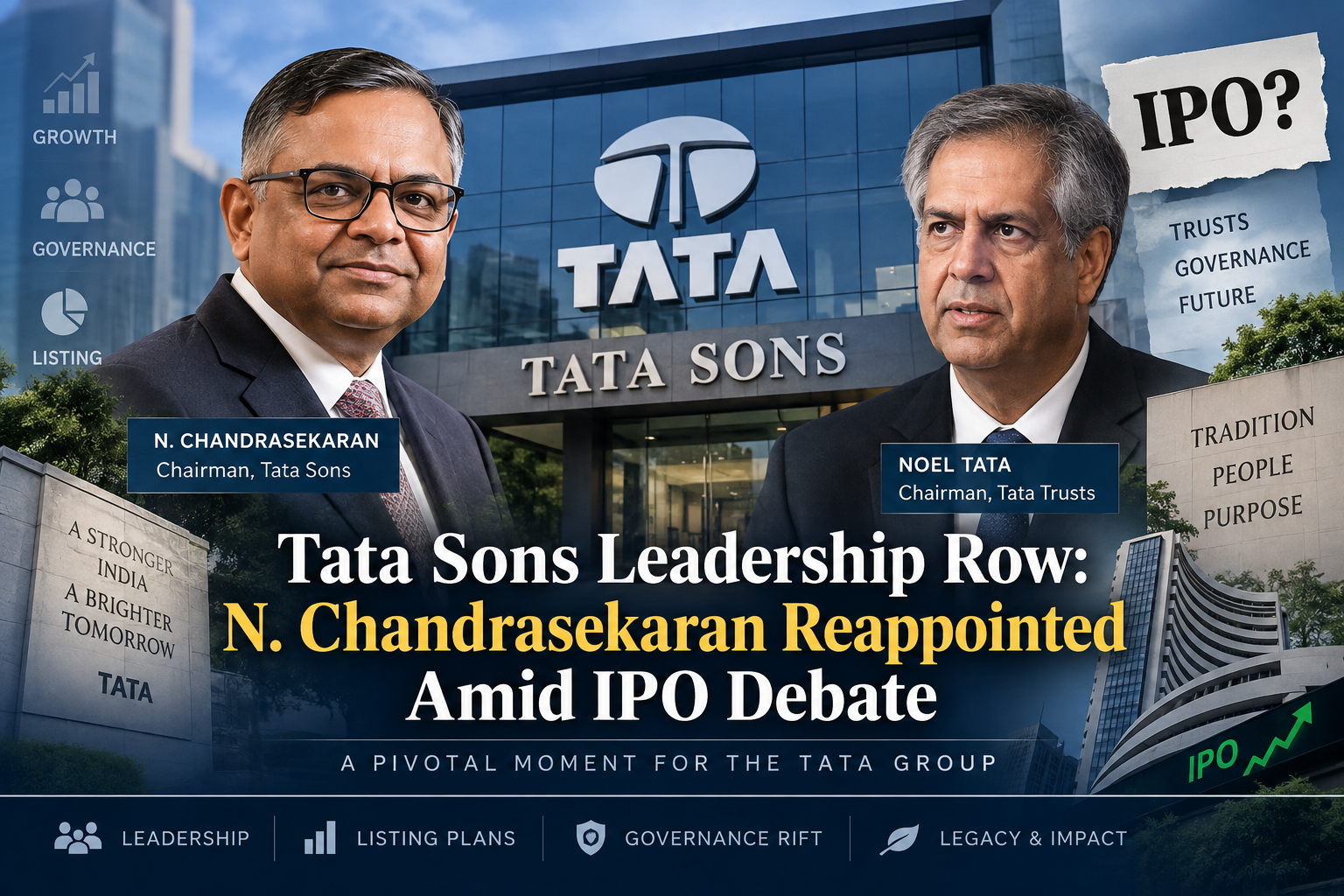
The Tata Group is facing one of its most significant governance disputes in years.
On September 17, 2026, the Tata Sons board approved a fresh five-year term for N. Chandrasekaran, who has served as chairman of Tata Sons since 2017. At the same time, Tata Sons moved toward exploring a potential public listing of the holding company.
The developments have exposed a sharp disagreement between Tata Sons' board and Tata Trusts, the charitable institutions that hold about 66% of Tata Sons.
Tata Trusts Chairman Noel Tata opposed the reappointment and has also maintained that Tata Sons should explore alternatives to a public listing. The Trusts separately stated that they consider the board's reappointment resolution legally invalid under Tata Sons' Articles of Association.
The dispute matters because Tata Sons sits at the centre of the Tata Group, with interests spanning technology, automobiles, steel, aviation, financial services, electronics and other businesses.
Tata Sons has approved N. Chandrasekaran for another five-year term and is moving toward exploring a public listing. However, Tata Trusts Chairman Noel Tata has opposed both moves. The Trusts argue that the reappointment does not comply with Tata Sons' Articles of Association and continue to oppose listing Tata Sons itself. The dispute now raises questions about corporate governance, ownership, regulation and the future structure of the Tata Group.
What Happened at Tata Sons?
The latest developments followed a rapidly changing leadership process.
In August 2026, Chandrasekaran had communicated that he would not seek another term after his existing tenure ends on February 20, 2027. Tata Trusts publicly acknowledged that decision and said a selection committee should be established to identify a successor.
The situation changed in September.
At the September 17 Tata Sons board meeting, the board approved Chandrasekaran's reappointment for another five years. Reuters reported that four directors voted in favour while Noel Tata voted against the proposal.
Tata Trusts subsequently said that the resolution was a "legal nullity", arguing that the Articles of Association require the relevant Trust nominee directors to support the appointment.
This means the immediate issue is not simply whether Chandrasekaran has been reappointed. It is also about whether that board decision can legally take effect under Tata Sons' governance framework.
Who Is N. Chandrasekaran?
N. Chandrasekaran is one of India's prominent corporate leaders and has headed Tata Sons since 2017.
Before becoming chairman of Tata Sons, he spent decades at TCS, rising through its leadership ranks and eventually becoming CEO and managing director.
During his tenure as Tata Sons chairman, the Tata Group has expanded its presence across several strategic sectors.
Major areas associated with Tata Group's expansion
- Technology and IT services
- Automobiles
- Aviation
- Electronics and semiconductors
- Steel
- Consumer businesses
- Financial services
- Renewable energy
- Infrastructure
His continued leadership is therefore significant not only for Tata Sons but also for the operating companies under the wider Tata umbrella.
Why Is Noel Tata Opposing the Reappointment?
The disagreement has several dimensions.
Tata Trusts says Chandrasekaran's earlier decision not to seek reappointment had already been accepted and that a succession process had consequently begun.
The Trusts also argue that the Tata Sons Articles of Association require support from the relevant Trust nominee directors for the appointment or reappointment of a chairman.
According to the Trusts, Noel Tata voted against the resolution, meaning the required approval was absent.
The two positions
| Issue | Tata Sons Board | Tata Trusts |
|---|---|---|
| Chandrasekaran's future | Board approved another five-year term | Trusts oppose the reappointment |
| Validity of resolution | Board proceeded with approval | Trusts call it legally invalid |
| Tata Sons listing | Moving toward exploring listing | Opposes listing Tata Sons |
| Governance | Board-backed decision | Trusts cite Articles of Association |
| Leadership transition | Chandrasekaran remains central to the board's decision | Trusts had begun succession process |
The disagreement is therefore fundamentally about governance authority and the interpretation of Tata Sons' constitutional documents.
Why Does Tata Sons Want to Explore a Public Listing?
The listing issue has been building for several years.
Tata Sons is classified by the Reserve Bank of India as an upper-layer non-banking financial company. RBI regulations have created pressure for qualifying entities to comply with listing requirements.
Reuters reported earlier in September that RBI rejected Tata Sons' attempt to deregister as an NBFC, potentially strengthening the case for a public listing. Tata Sons had standalone assets of about ₹1.75 trillion as of March 2025, according to the Reuters report.
Why listing matters
A public listing could potentially:
- Bring Tata Sons shares into the public market
- Create a market-based valuation
- Increase transparency around the holding company
- Change the shareholder structure
- Provide liquidity to existing shareholders
- Create additional regulatory and disclosure requirements
However, these potential outcomes also need to be considered against the distinctive ownership structure of Tata Sons.
Why Tata Trusts Opposes a Tata Sons IPO
Tata Trusts has consistently argued that Tata Sons should remain unlisted.
In its September 17 statement, Tata Trusts said the organisation's ownership structure is closely connected with its philanthropic purpose. The Trusts hold the majority stake in Tata Sons and use dividends received from Tata companies to support charitable activities.
The Trusts said the Tata model combines business with a public-purpose philanthropic structure and argued that a listing could fundamentally change that model.
The Trusts also pointed out that Tata Sons' board had previously concluded in March 2024 that the company should remain unlisted, and that the Sir Dorabji Tata Trust and Sir Ratan Tata Trust subsequently passed resolutions in July 2025 supporting an unlisted structure.
Tata Sons, Tata Trusts and the Shapoorji Pallonji Stake
Another important element is the position of the Shapoorji Pallonji Group, which owns about 18.4% of Tata Sons.
Tata Trusts disclosed a proposal concerning the monetisation of part of the SP Group's Tata Sons holding. The proposal envisages a transaction that could generate at least ₹25,000 crore, with the proposed share sale taking place in two tranches over 18 months.
Reuters subsequently reported that the SP Group had backed the potential public listing of Tata Sons.
Why the SP Group's position matters
The SP Group has substantial financial exposure to Tata Sons.
A transaction involving its stake could potentially provide liquidity while also affecting the future shareholder structure of Tata Sons.
This makes the ownership question an important part of the broader governance debate.
Tata Sons Ownership Structure: Why It Matters
The ownership structure is unusual compared with many large corporate groups.
Broad ownership picture
| Shareholder | Approximate stake | Role |
|---|---|---|
| Tata Trusts | 66% | Majority shareholder and philanthropic institutions |
| Shapoorji Pallonji Group | 18.4% | Major minority shareholder |
| Other shareholders | Remaining stake | Other Tata-linked interests/shareholders |
The majority ownership by charitable trusts is central to the Tata Group's traditional structure.
This is why a potential listing could have implications extending beyond conventional corporate finance.
What Could a Tata Sons Listing Change?
A listing would represent a major structural development.
1. Greater public disclosure
A listed Tata Sons would face extensive market disclosure and reporting requirements.
2. Market valuation
Investors could assign a market value to Tata Sons based on its assets, investments and future prospects.
3. Shareholder dynamics
Public shareholders could become an additional stakeholder group.
4. Liquidity
Existing shareholders could potentially gain a market mechanism for selling shares, subject to applicable rules.
5. Governance expectations
A public company would face heightened scrutiny from investors, regulators, analysts and the stock market.
What Are the Arguments Against Listing?
Tata Trusts has raised concerns that listing could change the distinctive Tata ownership model.
One argument presented by former Tata Sons vice chairman N.A. Soonawala is that holding-company shares can trade at discounts to the value of their underlying assets and that listing does not automatically guarantee better governance. This is an attributed viewpoint rather than an established outcome.
Potential concerns
- Possible changes to the Tata philanthropic model
- Additional shareholder pressure
- Market volatility
- Potential valuation discounts
- More complex shareholder relationships
- Greater public scrutiny of strategic decisions
Whether these effects would occur in practice would depend on the eventual listing structure and regulatory framework.
What Are the Potential Benefits of Listing?
Supporters of a listing can point to several possible advantages.
Potential benefits
- Greater transparency
- Market-based valuation
- Additional liquidity
- Wider investor participation
- Clearer financial reporting
- Potentially stronger market oversight
However, listing itself does not automatically resolve governance disagreements.
The current Tata Sons dispute illustrates that governance arrangements, shareholder rights and constitutional documents can remain important even when a company is subject to public-market rules.
Expert Commentary: Why Governance Is the Central Issue
The most important takeaway from the current dispute is that the disagreement goes beyond the question of an IPO.
At its core, the issue concerns who has authority to make key decisions at Tata Sons and how the company's Articles of Association should be interpreted.
Reuters' analysis has highlighted the potential for the dispute to create a prolonged stalemate, with implications for decision-making across the wider group.
From a corporate-governance perspective, investors and stakeholders will likely watch three areas closely:
- The legal interpretation of Tata Sons' Articles.
- The position of RBI and other regulators on the listing requirement.
- Whether Tata Sons and Tata Trusts can reach a mutually workable governance arrangement.
Real-World Impact: Why This Matters Beyond Tata
The Tata Group is not a single operating company. It is a large network of businesses with operations across multiple industries.
The outcome of the governance dispute could therefore influence strategic decisions involving:
- Aviation
- Semiconductors
- Electric vehicles
- Technology
- Manufacturing
- Batteries
- Steel
- Financial services
- Consumer businesses
Reuters has also reported that the Tata Group is pursuing major investments in areas such as semiconductor manufacturing and battery production, making stable governance important for long-term capital allocation.
What Happens Next?
Several developments could determine the next stage of the dispute.
Step 1: Legal and governance review
The validity of the chairman's reappointment may become a central question.
Step 2: Regulatory process
RBI's position regarding Tata Sons' NBFC status and listing obligations will remain important.
Step 3: Shareholder discussions
The positions of Tata Trusts and the Shapoorji Pallonji Group will remain significant.
Step 4: Listing assessment
Tata Sons will need to evaluate the regulatory, financial and structural implications of a potential listing.
Step 5: Leadership continuity
The company will need clarity on its leadership structure before Chandrasekaran's current term expires in February 2027, unless the latest board decision is ultimately upheld and takes effect.
Tata Sons Governance Dispute: Timeline
| Date | Development |
|---|---|
| March 2024 | Tata Sons board concluded that the company should remain unlisted, according to Tata Trusts |
| July 2025 | Tata Trusts resolutions supported retaining an unlisted structure |
| August 12, 2026 | Chandrasekaran communicated that he would not seek reappointment |
| August 13, 2026 | Tata Trusts acknowledged his decision and began discussing succession |
| September 11, 2026 | RBI communication regarding Tata Sons' listing position was discussed by the company |
| September 17, 2026 | Tata Sons board approved Chandrasekaran's fresh term |
| September 17, 2026 | Tata Trusts disputed the legality of the reappointment |
| September 17, 2026 | Tata Trusts reiterated opposition to listing Tata Sons |
| September 18, 2026 | SP Group publicly backed a potential Tata Sons listing, according to Reuters |
Pros and Cons of a Potential Tata Sons Listing
| Potential Advantages | Potential Challenges |
|---|---|
| Greater transparency | Changes to the traditional Tata ownership model |
| Market-based valuation | Potential valuation discount |
| Greater liquidity | Increased shareholder pressure |
| Broader investor participation | Greater market volatility |
| More public disclosures | More complex governance |
| Possible regulatory compliance | Potential conflict with Trusts' preferred structure |
These are potential effects, not predictions of what will ultimately happen.
What Should Investors Watch?
Investors should distinguish between Tata Sons itself and the listed companies within the Tata Group.
Tata Sons is the holding company, while companies such as Tata Consultancy Services, Tata Motors and Tata Steel are separately listed entities.
The Tata Sons governance dispute does not automatically mean that investors in every Tata Group listed company will experience the same direct impact.
Key indicators to monitor
- RBI decisions and regulatory communications
- Tata Sons board resolutions
- Tata Trusts statements
- Court or legal proceedings
- Shareholder negotiations
- Potential IPO/listing documentation
- Developments involving the SP Group stake
- Performance and capital requirements of major Tata operating companies
Key Takeaways
- Tata Sons' board approved a fresh five-year term for N. Chandrasekaran.
- Tata Trusts Chairman Noel Tata opposed the decision.
- Tata Trusts says the reappointment resolution is legally invalid under Tata Sons' Articles of Association.
- Tata Sons is moving toward exploring a potential public listing.
- Tata Trusts continues to oppose listing Tata Sons.
- RBI regulations are a major factor behind the listing debate.
- The Shapoorji Pallonji Group, a major Tata Sons shareholder, has backed a potential listing.
- The dispute involves leadership, ownership, regulatory requirements and the long-standing Tata philanthropic model.
- The final outcome will depend on governance, legal and regulatory developments.
Frequently Asked Questions
1. Who is N. Chandrasekaran?
N. Chandrasekaran is the chairman of Tata Sons and has been associated with Tata Group leadership since 2017.
2. Has N. Chandrasekaran been reappointed as Tata Sons chairman?
The Tata Sons board approved a fresh five-year term for Chandrasekaran on September 17, 2026. However, Tata Trusts has disputed the legal validity of that resolution.
3. Who is Noel Tata?
Noel Tata is chairman of Tata Trusts, the charitable institutions that hold the majority stake in Tata Sons.
4. Why is Tata Trusts opposing Chandrasekaran's reappointment?
Tata Trusts says Chandrasekaran had already decided not to seek reappointment and that the subsequent board resolution did not satisfy the requirements of Tata Sons' Articles of Association.
5. Why is Tata Sons considering a public listing?
Tata Sons faces regulatory pressure linked to its classification as an upper-layer NBFC. RBI's regulatory framework has been a major factor in the listing debate.
6. Does Tata Trusts support a Tata Sons IPO?
No. Tata Trusts has publicly maintained that Tata Sons should remain unlisted and has asked the company to explore alternatives to listing.
7. What is Tata Sons?
Tata Sons is the principal holding company of the Tata Group and holds stakes in several major Tata businesses.
8. How much of Tata Sons do Tata Trusts own?
Tata Trusts collectively hold approximately 66% of Tata Sons, according to Reuters reporting.
9. What is the Shapoorji Pallonji Group's stake in Tata Sons?
The Shapoorji Pallonji Group owns approximately 18.4% of Tata Sons.
10. Does Tata Sons already have a stock-market listing?
No. Tata Sons is a privately held holding company. The current debate concerns a potential future public listing.
11. What could happen if Tata Sons is listed?
A listing could introduce public shareholders, market valuation, greater disclosure requirements and additional liquidity. The precise impact would depend on the eventual structure and regulatory approvals.
12. Will Tata Group companies be affected by the Tata Sons dispute?
The impact will vary by company. Tata Sons is the holding company, while many major Tata operating businesses are separately listed or independently managed.
13. When does Chandrasekaran's existing term end?
His current term was scheduled to end on February 20, 2027, according to Tata Trusts' August 2026 statement.
14. Is the Tata Sons reappointment legally settled?
No. Tata Trusts has explicitly challenged the validity of the board resolution. The legal and governance implications remain a developing issue.
15. What should investors watch next?
Investors should monitor RBI developments, Tata Sons board actions, Tata Trusts statements, potential legal proceedings, shareholder negotiations and any formal listing process.
Published on : 18th september
Published by : Shanlee J V
www.vizzve.com || www.vizzveservices.com
Follow us on social media: Facebook || Linkedin || Instagram
🛡 Powered by Vizzve Financial
RBI-Registered Loan Partner | 10 Lakh+ Customers | ₹600 Cr+ Disbursed