

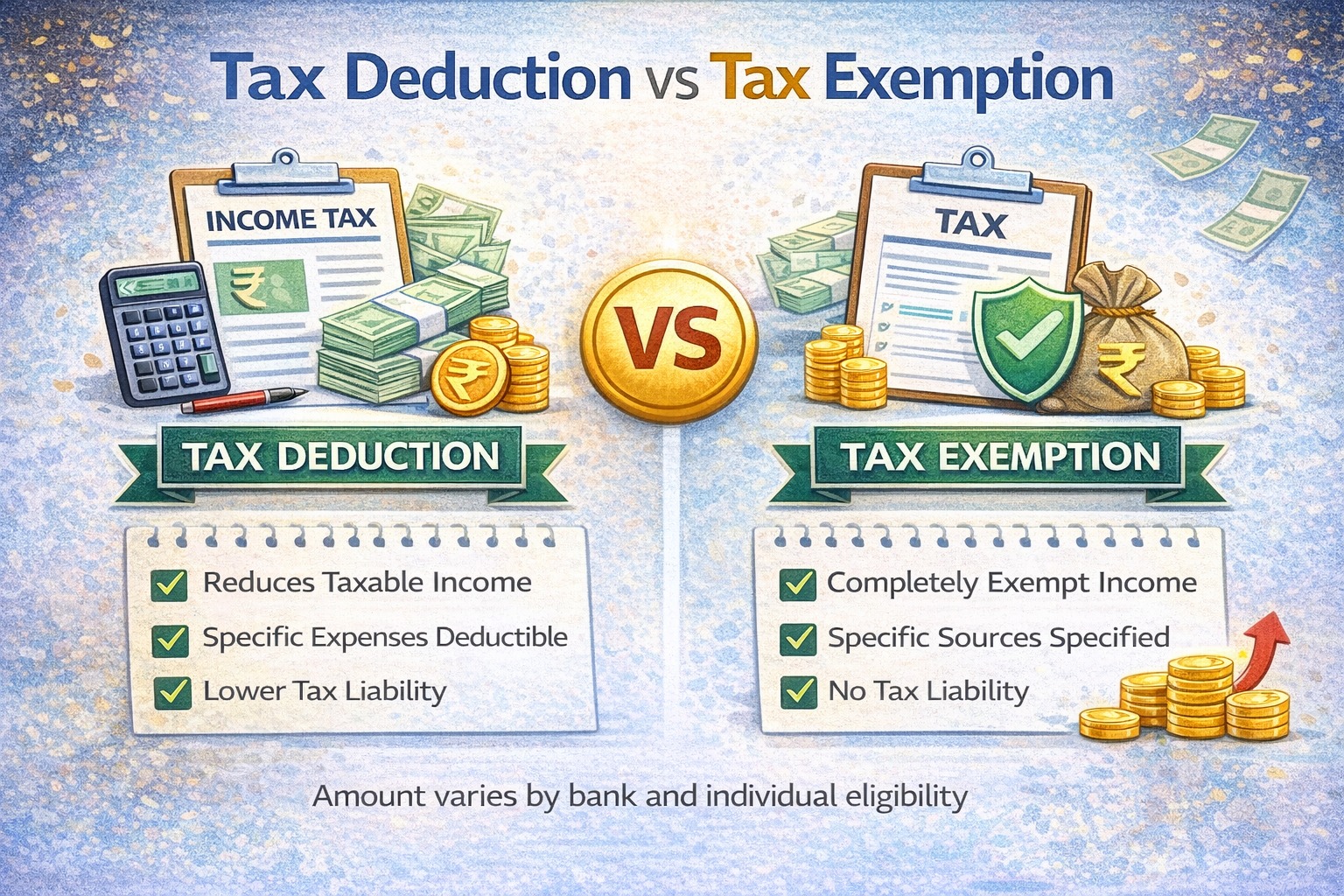
Tax deduction reduces your taxable income after calculating income, while tax exemption excludes certain income from tax completely in India.
AI Answer Box
What is the difference between tax deduction and tax exemption?
Tax deduction reduces taxable income by allowing specific expenses or investments, whereas tax exemption removes certain income entirely from taxation under Indian income tax laws.
Introduction: Why This Confusion Is Very Common
Many taxpayers hear terms like:
“Claim deduction under Section 80C”
“HRA is exempt from tax”
And think they mean the same thing.
They don’t.
Understanding the difference between tax deduction and tax exemption helps you:
File returns correctly
Avoid overpaying tax
Plan better tax savings
What Is Tax Deduction?
Meaning of Tax Deduction
A tax deduction is an amount subtracted from your total income before calculating tax.
In simple words:
You earn income → deductions reduce taxable portion
🔹 Common Tax Deductions in India
Section 80C (PPF, EPF, ELSS, LIC, etc.)
Section 80D (Health insurance premium)
Section 24(b) (Home loan interest)
Section 80E (Education loan interest)
📌 Deductions are usually claimed while filing ITR.
🔹 Example of Tax Deduction
If:
Total income = ₹10,00,000
80C deduction = ₹1,50,000
👉 Taxable income becomes ₹8,50,000
What Is Tax Exemption?
Meaning of Tax Exemption
A tax exemption is income that is not taxed at all.
In simple words:
Certain income is excluded before tax calculation
🔹 Common Tax Exemptions in India
House Rent Allowance (HRA)
Leave Travel Allowance (LTA)
Agricultural income
Gratuity (up to limit)
Employer PF contribution (within limit)
📌 Exemptions apply at the income stage itself.
🔹 Example of Tax Exemption
If:
Salary = ₹10,00,000
HRA exemption = ₹2,00,000
👉 Taxable salary becomes ₹8,00,000
Key Difference Between Tax Deduction and Tax Exemption
| Basis | Tax Deduction | Tax Exemption |
|---|---|---|
| Meaning | Reduction from taxable income | Income not taxed at all |
| Stage applied | After income calculation | Before tax calculation |
| Applies to | Expenses / investments | Specific income components |
| Claim method | While filing ITR | At salary or income stage |
| Example | 80C, 80D | HRA, LTA |
| Purpose | Encourage savings | Provide tax relief |
Expert Insight
“Tax exemptions reduce taxable income at source, while deductions reward disciplined spending and investment choices.”
— Tax Consultant, India
Deduction vs Exemption: Simple Illustration
Salary Scenario
| Particulars | Amount |
|---|---|
| Gross Salary | ₹10,00,000 |
| Less: HRA Exemption | ₹2,00,000 |
| Income After Exemption | ₹8,00,000 |
| Less: 80C Deduction | ₹1,50,000 |
| Final Taxable Income | ₹6,50,000 |
📌 Both work together to reduce tax—but differently.
❌ Common Mistakes Taxpayers Make
Treating deduction and exemption as same
Forgetting to claim deductions
Assuming exemptions are automatic
Claiming deductions without proof
Mixing old and new tax regime rules
📌 Understanding basics prevents errors and penalties.
Old Tax Regime vs New Tax Regime (Important)
How Deduction & Exemption Work Differently
Old Tax Regime:
✔ Deductions + Exemptions allowed
New Tax Regime:
❌ Most deductions & exemptions not allowed
✔ Lower tax rates instead
📌 Choose regime carefully based on income structure.
Key Takeaways
Tax deduction reduces taxable income
Tax exemption removes income from tax
Both help save tax differently
Deductions require action & proof
Exemptions are income-based relief
Knowing the difference helps you save tax legally and smartly.
❓ Frequently Asked Questions (FAQs)
1. Is HRA a deduction or exemption?
Exemption.
2. Is 80C a deduction?
Yes.
3. Can I claim both deduction and exemption?
Yes, under old tax regime.
4. Are exemptions automatic?
Mostly yes, if eligible.
5. Do deductions need proof?
Yes.
6. Which is better—deduction or exemption?
Both serve different purposes.
7. Are deductions allowed in new tax regime?
Mostly no.
8. Are exemptions allowed in new regime?
Very limited.
Conclusion
Tax deduction and tax exemption are two different tools in India’s income tax system.
Exemptions reduce income at source
Deductions reduce taxable income through planning
Using both correctly can significantly lower your tax burden—legally and safely.
Vizzve Financial is one of India’s trusted loan support platforms offering quick personal loans, low documentation, and an easy approval process—while promoting financial awareness.
👉 Visit www.vizzve.com
Published on : 31st December
Published by : SMITA
www.vizzve.com || www.vizzveservices.com
Follow us on social media: Facebook || Linkedin || Instagram
🛡 Powered by Vizzve Financial
RBI-Registered Loan Partner | 10 Lakh+ Customers | ₹600 Cr+ Disbursed