

Borrowers today face rising EMIs, higher interest rates, and lifestyle expenses that grow faster than incomes.
In this environment, financial planners and even lenders are increasingly recommending a simple thumb rule:
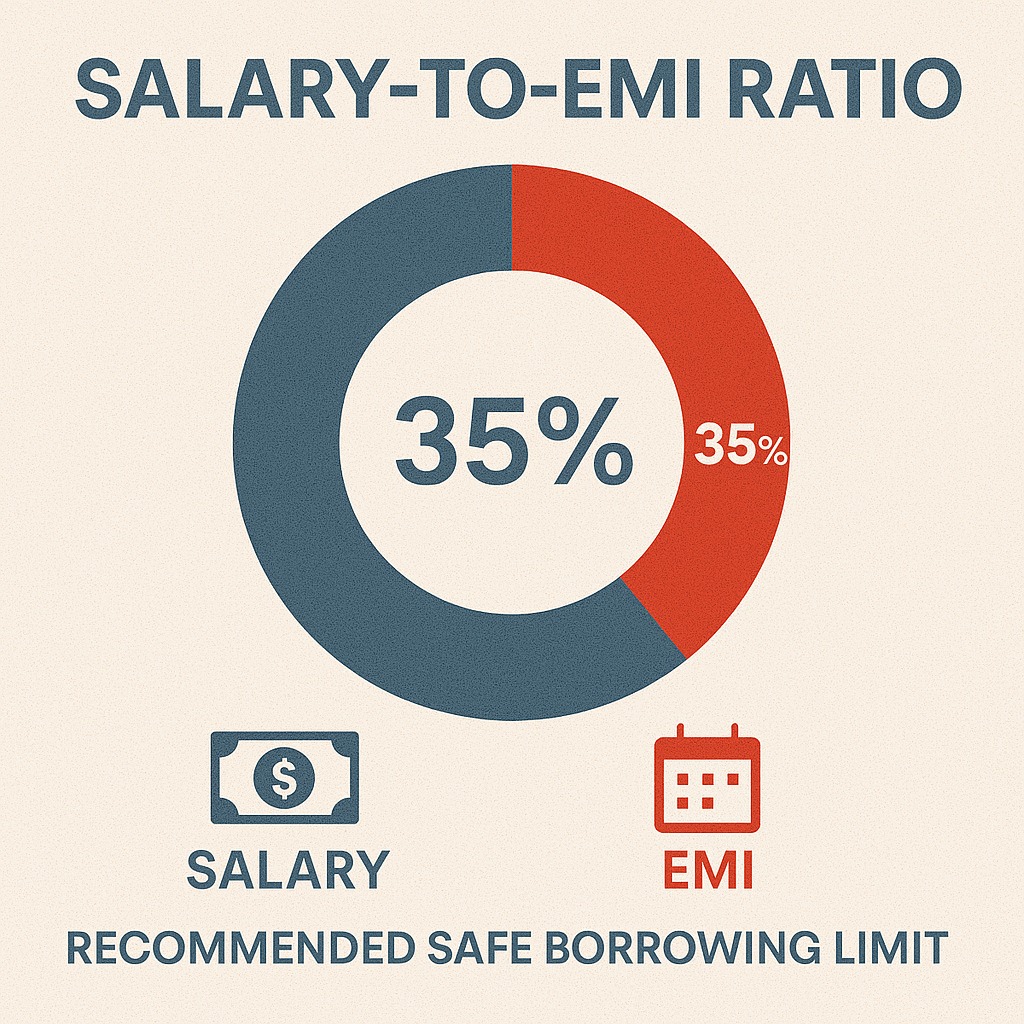
Keep all your EMIs within 35% of your take-home salary.
This guideline, known as the 35% EMI rule, is becoming the new standard for safe borrowing — and for good reason.
Here’s why.
1. It Protects You From Financial Stress
When EMIs exceed 40–50% of your income, your monthly budget becomes tight.
The 35% rule ensures:
Enough money for essentials
Smooth lifestyle management
Funds for emergencies
No constant fear of missing payments
It creates a healthy financial cushion.
2. Lenders Prefer Borrowers Who Follow This Ratio
Banks quietly use similar ratios during loan evaluations.
Keeping EMIs below 35%:
Improves your loan eligibility
Reduces chances of rejection
Makes you appear stable and low-risk
May even help secure better interest rates
Borrowers with high fixed obligations (FOIR above 40–45%) are more likely to default.
This is why lenders favour the 35% zone.
3. The Cost of Living Is Rising Faster Than Salaries
Housing, groceries, education, transportation — everything is more expensive.
If EMIs are too high, rising expenses can quickly overwhelm your budget.
35% gives enough room to handle inflation without damaging your financial health.
4. Helps You Continue Investing While Repaying Loans
If EMIs take up half your income, you stop investing — which hurts long-term wealth creation.
At 35%, you still have enough left to:
Build an emergency fund
Invest in SIPs
Save for retirement
Meet future goals
This balance keeps your finances growing even while you repay debt.
5. Prevents Loan Trap Situations
High EMI commitments often lead borrowers to:
Delay payments
Keep refinancing
Take top-up loans
Depend on credit cards
This creates an interest trap.
But staying within 35% keeps your debt manageable and reduces the risk of falling into a cycle of borrowing.
6. Rising Interest Rates Make EMIs More Volatile
Floating-rate loans (especially home loans) can rise sharply with interest hikes.
If you take a loan with EMIs already at 45–50% of your income:
A rate hike can push EMI beyond your comfort
Or extend your tenure drastically
Or both
The 35% buffer helps you absorb future rate increases without stress.
7. Ideal for Long-Tenure Loans (Especially Home Loans)
Since home loans stretch 20–30 years, your EMI-to-income ratio should be comfortable for the long term.
35% ensures:
Stability across career phases
Flexibility during job changes
Smooth handling of life events
It’s a practical ceiling for long-term financial health.
How to Calculate Your EMI Limit (Simple Formula)
Take-home monthly salary × 0.35 = Maximum total EMI
Example:
Salary ₹60,000 → EMI limit = ₹60,000 × 0.35 = ₹21,000 per month
This is the combined limit for all loans:
Home loan
Personal loan
Vehicle loan
Credit card EMIs
FAQs
1. What does the 35% EMI rule mean?
It means your total EMIs should not exceed 35% of your take-home pay.
2. Is 40–50% EMI ratio bad?
Not always, but it increases financial stress and default risk.
3. Do banks follow the 35% rule?
Most banks check FOIR (Fixed Obligation to Income Ratio). Many prefer borrowers below 35–40%.
4. Does this rule apply to all loans?
Yes — combined EMIs for all your loans.
5. Can I exceed 35% if I earn a very high salary?
High-income earners may afford more, but 35% remains a safe benchmark.
Published on : 19th November
Published by : SMITA
www.vizzve.com || www.vizzveservices.com
Follow us on social media: Facebook || Linkedin || Instagram
🛡 Powered by Vizzve Financial
RBI-Registered Loan Partner | 10 Lakh+ Customers | ₹600 Cr+ Disbursed