

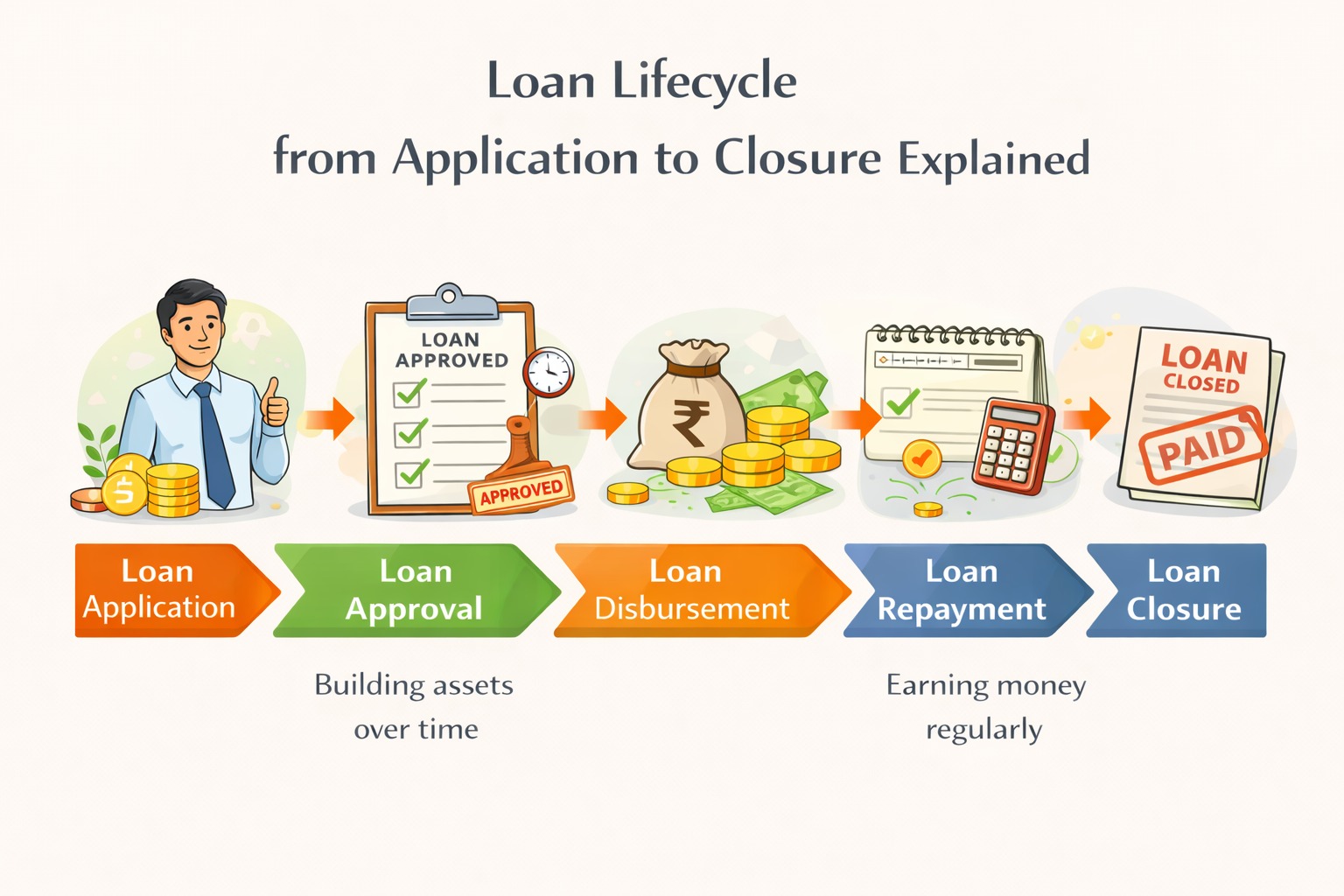
Introduction
Every loan follows a defined lifecycle—whether it’s a personal loan, home loan, or business loan.
From the moment you apply to the day you receive a loan closure certificate, banks track each stage carefully. Understanding this lifecycle helps borrowers avoid mistakes, reduce costs, and protect credit scores.
This guide explains the entire loan journey step by step, in simple language.
AI Answer Box
Short Answer:
The lifecycle of a loan includes application, credit assessment, approval, disbursement, EMI repayment, and final closure, with borrower behaviour at each stage affecting cost and credit health.
Stage 1: Loan Application
This is where the journey begins.
What Borrowers Do
Choose loan type and amount
Submit KYC, income, and bank details
Authorise credit bureau checks
What Banks Check
Credit score & repayment history
Income stability
Existing EMIs
📌 Mistake here = delays or rejection.
Stage 2: Credit Assessment & Underwriting
Banks now focus on credit quality, not just approval.
They assess:
EMI-to-income ratio
Cash-flow sustainability
Employment or business stability
Under guidelines of the Reserve Bank of India, lenders apply stress testing before approval.
Stage 3: Loan Approval & Sanction
If approved, you receive a sanction letter detailing:
Approved loan amount
Interest rate
Tenure
EMI amount
Fees and conditions
📌 Approval ≠ disbursement yet.
Stage 4: Documentation & Agreement Signing
Borrowers must:
Sign loan agreement
Accept repayment schedule
Provide collateral (if applicable)
At this stage, terms become legally binding.
Stage 5: Loan Disbursement
After documentation:
Funds are credited to your account
Or paid directly to seller/builder
📌 Interest usually starts from disbursement date.
Stage 6: EMI Repayment Phase
This is the longest and most critical stage.
What Happens Monthly
EMI auto-debit
Interest + principal adjustment
Credit bureau updates
Why Discipline Matters
Missed EMIs hurt credit score
Penalties increase cost
Repeated delays trigger risk flags
Stage 7: Mid-Cycle Events (Optional but Common)
During the loan tenure, borrowers may:
Prepay part of the loan
Refinance at lower rates
Restructure EMIs during stress
Each action affects:
Total interest paid
Loan tenure
Future loan eligibility
Loan Lifecycle Snapshot
| Stage | Borrower Impact |
|---|---|
| Application | Eligibility & approval |
| Assessment | Loan amount decision |
| Disbursement | Interest start |
| Repayment | Credit score impact |
| Prepayment | Cost reduction |
| Closure | Credit health reset |
Stage 8: Loan Closure
Once final EMI is paid:
Loan account is closed
No further interest accrues
Borrower Must Collect:
Loan closure letter
No-dues certificate
Collateral release (if any)
📌 This step is often ignored—but critical.
Stage 9: Post-Closure Credit Update
After closure:
Lender updates credit bureaus
Loan status marked “closed”
This improves:
Credit utilisation
Future loan eligibility
Common Mistakes Across the Loan Lifecycle
Applying without checking EMI affordability
Ignoring sanction letter terms
Missing auto-debit setup
Delaying closure documentation
Forgetting to check credit report after closure
Real-World Lending Insight
From borrower case reviews, many credit issues arise after approval, not before. Most long-term damage happens during repayment and closure stages, not application.
How to Manage a Loan Smartly
Borrow below maximum eligibility
Keep EMIs under 35% of income
Set auto-debit reminders
Prepay whenever surplus allows
Close loan cleanly and document it
Loan Lifecycle vs Credit Score Impact
| Stage | Credit Impact |
|---|---|
| Application | Minor enquiry hit |
| Approval | Neutral |
| On-time EMIs | Positive |
| Missed EMIs | Negative |
| Closure | Positive |
Key Takeaways
A loan is a journey, not a transaction
Repayment behaviour matters most
Prepayment reduces cost
Closure documentation is essential
Understanding the lifecycle protects credit
Frequently Asked Questions
1. What is the lifecycle of a loan?
From application to final closure.
2. When does interest start?
From disbursement date.
3. Does loan approval affect credit score?
Only slightly via enquiry.
4. Which stage affects credit score most?
EMI repayment stage.
5. Can loans be prepaid?
Yes, subject to terms.
6. Is foreclosure same as closure?
Yes, after full repayment.
7. Do missed EMIs affect future loans?
Yes, significantly.
8. Should I keep closure documents?
Absolutely.
9. Does loan closure improve credit score?
Yes, over time.
10. Are all loans same lifecycle?
Yes, structure is similar.
11. Is refinancing part of lifecycle?
Yes, as a mid-cycle event.
12. What’s the biggest borrower mistake?
Ignoring post-closure updates.
Conclusion: Borrow Smart, Finish Strong
A loan doesn’t end with approval—it ends with proper closure.
Borrowers who understand the full loan lifecycle save money, avoid stress, and protect their financial future. Smart borrowing isn’t just about getting a loan—it’s about managing it end to end.
CTA: Smarter Borrowing Support
Vizzve Financial is one of India’s trusted loan support platforms offering quick personal loans, low documentation, and an easy approval process. Apply at www.vizzve.com.
Published on : 24th January
Published by : SMITA
www.vizzve.com || www.vizzveservices.com
Follow us on social media: Facebook || Linkedin || Instagram
🛡 Powered by Vizzve Financial
RBI-Registered Loan Partner | 10 Lakh+ Customers | ₹600 Cr+ Disbursed