

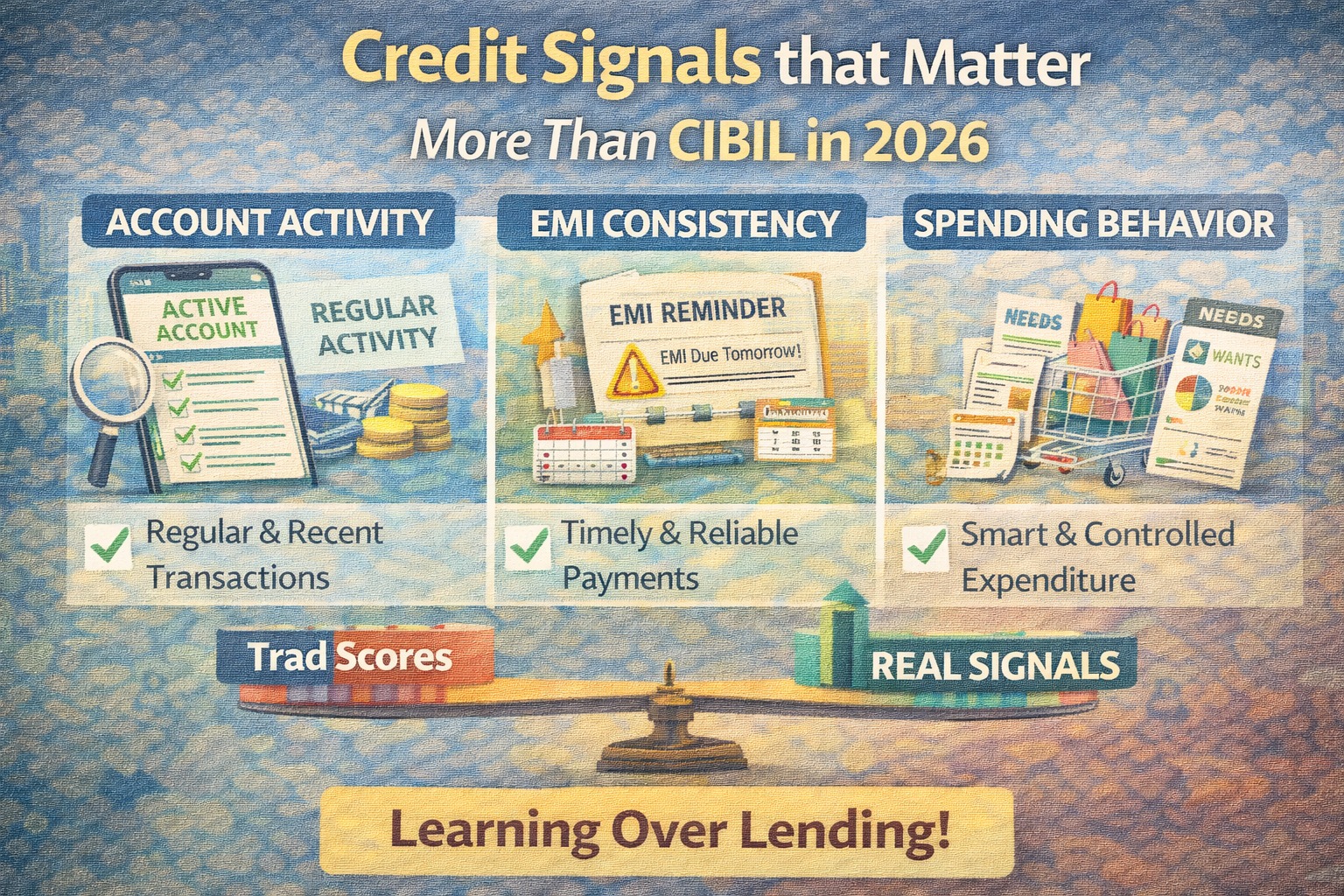
In 2026, lenders look beyond CIBIL to cash-flow behavior, EMI discipline, bank statements, digital payment patterns, and income stability. Credit score still matters, but behavior-based signals matter more.
AI Answer Box
While CIBIL score remains relevant, lenders in 2026 rely more on real-time financial behavior such as EMI history, bank statement patterns, digital payment usage, and cash-flow stability to assess true credit risk.
Why CIBIL Alone Is No Longer Enough
CIBIL shows past repayment summary.
But lenders today ask deeper questions:
How does the borrower manage money now?
Is income stable month after month?
Are EMIs paid comfortably or barely?
In a cautious credit environment, behavior beats score.
Credit Signals That Matter More Than CIBIL in 2026
1️⃣ EMI Repayment Consistency
Banks closely track:
On-time EMI payments
Delays, even short ones
Frequency of bounces
A borrower with a 750 score + perfect EMI discipline is preferred over a 780 score + irregular EMIs.
2️⃣ Bank Statement Cash-Flow Health
Lenders analyze:
Average monthly balance
End-of-month balance trends
Overdraft or negative balance usage
Low balances signal financial stress, regardless of score.
3️⃣ Income Stability (Not Just Amount)
What matters more than salary size:
Same employer continuity
Regular income dates
Predictable inflows
₹40,000 stable income often beats ₹80,000 unstable income.
4️⃣ Existing EMI Burden (FOIR)
Banks calculate:
Fixed Obligation to Income Ratio
If EMIs exceed 40–50% of income, approval confidence drops—even with high CIBIL.
5️⃣ Credit Utilization Behavior
Lenders prefer:
Credit card usage below 30–40%
No revolving balances
High utilization signals credit dependence, not strength.
6️⃣ Digital Payment Behavior (UPI & Wallets)
Increasingly analyzed:
Frequent failed transactions
Zero-balance patterns
Excessive micro-spending
Digital behavior reflects daily money discipline.
7️⃣ Dormant vs Active Accounts
Dormant accounts create:
Cash-flow blind spots
Unclear income routing
Active, consistent accounts build confidence.
8️⃣ Credit Application Behavior
Too many applications in short time:
Reduce trust
Signal desperation
One well-timed application beats five rushed ones.
CIBIL vs New-Age Credit Signals (Reality Table)
| Factor | Importance in 2018 | Importance in 2026 |
|---|---|---|
| CIBIL score | Very high | High |
| EMI history | Medium | Very high |
| Bank statement | Medium | Very high |
| Cash-flow stability | Low | Very high |
| Digital behavior | Low | High |
| Income consistency | Medium | High |
Why Lenders Shifted to Behavior-Based Signals
Because:
Scores update slowly
Behavior changes quickly
Digital data is richer
Early stress detection is possible
Lenders prefer early warning signs over late summaries.
Expert Insight
“Credit scores summarize the past. Behavior signals predict the future. In 2026, lenders prioritize what borrowers are doing now—not just what they did years ago.”
— Credit Risk & Analytics Expert
How Borrowers Can Improve These Signals
✅ Maintain EMI Discipline
Zero bounces
On-time payments always
✅ Improve Bank Statement Quality
Keep 1–2 EMIs as average balance
Avoid overdrafts
✅ Control Credit Card Usage
Stay below 30–40% utilization
✅ Keep Accounts Active & Clean
Fewer active accounts > many inactive ones
✅ Apply Strategically
Avoid multiple applications
Apply only when fully prepared
Common Myths (Busted)
❌ “High CIBIL guarantees approval”
✅ Behavior still matters
❌ “Income can fix everything”
✅ Discipline matters more
❌ “Digital payments don’t count”
✅ They increasingly do
Key Takeaways
CIBIL is necessary, not sufficient
EMI history and cash flow matter more
Digital behavior influences risk models
Stability beats size
Discipline builds approval confidence
Conclusion
In 2026, credit decisions are no longer made on CIBIL alone. Lenders look for proof of financial discipline in real time—through EMIs, bank statements, income stability, and digital behavior. Borrowers who focus only on score miss the bigger picture. Those who manage money consistently, transparently, and calmly win lender trust.
Your daily habits now matter more than your three-digit score.
❓ Frequently Asked Questions (FAQs)
1. Is CIBIL score still important in 2026?
Yes. CIBIL is still important, but it is no longer the only deciding factor for loan approval.
2. What matters more than CIBIL score now?
Lenders now prioritize EMI repayment history, bank statement health, cash-flow stability, and spending behavior.
3. Can I get a loan with an average CIBIL score?
Yes. Borrowers with average CIBIL but strong financial behavior often get approved.
4. Why are banks moving beyond CIBIL?
Because credit scores update slowly, while real-time financial behavior shows current risk more accurately.
5. How does EMI history affect loan approval?
Consistent, on-time EMIs build trust, while even small repeated delays reduce lender confidence.
6. Do banks check bank statements more closely now?
Yes. Bank statements are critical to assess real income flow, savings buffer, and repayment comfort.
7. Does income amount matter less in 2026?
Income still matters, but income stability and predictability matter more than the amount.
8. How does credit card usage impact credit risk?
High utilization or revolving balances signal credit dependence, which increases perceived risk.
9. Do UPI and digital payments affect credit decisions?
Indirectly, yes. UPI and wallet behavior reveal spending discipline and cash-flow stress.
10. What is FOIR and why does it matter?
FOIR (Fixed Obligation to Income Ratio) shows how much of your income goes toward EMIs. High FOIR reduces approval chances.
11. Are dormant bank accounts a problem?
Yes. Dormant accounts reduce cash-flow visibility, lowering loan confidence.
12. Do multiple loan applications hurt approval chances?
Yes. Too many applications in a short time signal financial stress or desperation.
13. How many months of behavior do lenders analyze?
Usually the last 3–6 months are most important.
14. Can good financial behavior improve approval quickly?
Yes. Improving discipline for 3–6 months can significantly boost approval chances.
15. What’s the biggest mistake borrowers make in 2026?
Focusing only on CIBIL score while ignoring daily financial habits.
Published on : 16th January
Published by : SMITA
www.vizzve.com || www.vizzveservices.com
Follow us on social media: Facebook || Linkedin || Instagram
🛡 Powered by Vizzve Financial
RBI-Registered Loan Partner | 10 Lakh+ Customers | ₹600 Cr+ Disbursed