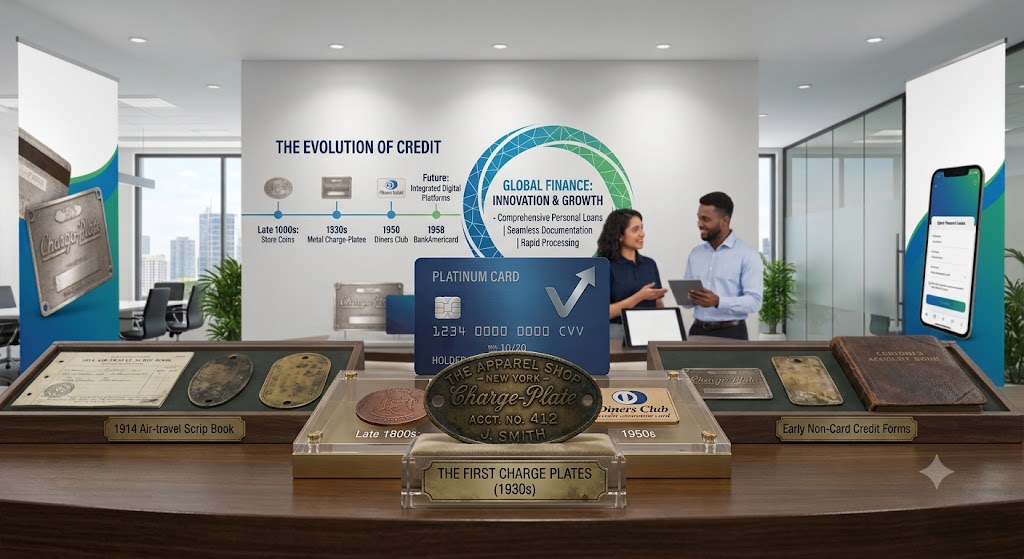
The History of the Oldest Credit Card: From Metal Plates to Plastic
Vizzve Admin
Plastic cards are an everyday part of modern spending, but borrowing power was once far more limited. Today, a single tap or swipe connects consumers to global banking networks, instant lines of credit, and complex rewards ecosystems.
Understanding the history of the oldest credit card reveals how financial technology evolved to meet consumer demand. The story traces a path from 19th-century metal tokens to paper charge books, eventually leading to the revolving credit systems that power the global economy today.
Key Takeaways
-
Early Antecedents (1800s–1930s): Store-specific credit coins, paper tokens, and metal "Charga-Plates" laid the groundwork for non-cash purchasing.
-
The First Bank Card (1946): John Biggins launched "Charg-It," establishing the three-party model (Customer, Merchant, Bank).
-
First Universal Charge Card (1950): Frank McNamara founded Diners Club, creating the first card usable across multiple independent merchants.
-
First True Revolving Credit Card (1958): Bank of America introduced BankAmericard (now Visa), allowing balances to be carried over month-to-month.
-
Plastic Transformation: American Express and Master Charge (Mastercard) soon joined, establishing the global card networks active today.
Timeline of Credit Card History
1800s–1930s: Early Store Credit Tokens
Late 19th Century
Merchants, department stores, and oil companies issue metal tokens, coins, and notched "Charga-Plates" to allow trusted local customers to bill purchases to a store account.
1946: John Biggins Introduces 'Charg-It'
1946
Brooklyn banker John Biggins creates the Charg-It plan. Bank customers could use it at participating local merchants, who then submitted sales slips to the bank for settlement.
1950: The Birth of Diners Club
1950
Frank McNamara and Ralph Schneider introduce the Diners Club card—a cardboard charge card accepted by 27 New York restaurants. It required full payment every 30 days.
1958: The Revolving Credit Revolution
1958
Bank of America launches BankAmericard in Fresno, California, pioneering revolving balances. American Express enters the market with its own travel and entertainment charge card.
1966–1976: Mastercard and Visa Emerge
1966–1976
A group of California banks forms Interbank/Master Charge (later Mastercard). In 1976, BankAmericard rebrands as Visa to support international growth.
The Pre-Credit Era: Store Coins and Charga-Plates
Before centralized payment networks, credit was managed directly between individual merchant and customer.
Credit Coins and Store Tokens
In the late 19th and early 20th centuries, large department stores and hotels issued custom metal coins or fiber tokens stamped with an account number. Customers presented these coins to bill their purchases directly to their store account. While convenient, they were store-specific and lacked security.
Metal Charga-Plates
Introduced in the 1930s, Charga-Plates were small, embossed metal strips resembling military dog tags. Kept in leather cases, these plates featured the customer’s name, address, and account number. Merchants placed the plate in an imprinter machine, pressing paper receipts over carbon paper to record the transaction.
The First Bank Card: John Biggins & "Charg-It" (1946)
In 1946, John Biggins, a banker at Flatbush National Bank in Brooklyn, New York, created the Charg-It card.
How Charg-It Worked
-
Bank customers used the Charg-It card at local merchants.
-
Merchants gathered sales receipts and submitted them to Flatbush National Bank.
-
The bank reimbursed the merchant and billed the customer for the balance.
Major Limitations
Charg-It operated on a strictly local scale. Purchases were restricted to a small geographic radius around the bank's branch network, and cardholders had to maintain an account with Flatbush National Bank. Despite these limits, it proved the viability of third-party bank-mediated payment handling.
The First Universal Card: Diners Club (1950)
The origin of the modern multi-merchant payment card traces back to a business dinner in late 1949.
The First Dinner Story
While dining at New York's Major's Cabin Grill, businessman Frank McNamara realized he had left his wallet in another suit jacket. Though his wife settled the bill, the experience inspired McNamara to design a cardboard card that could be accepted across a network of unaffiliated dining establishments.
Key Milestones of Diners Club
-
1950 Launch: McNamara and partner Ralph Schneider launched Diners Club with 200 initial cardholders and 27 participating Manhattan restaurants.
-
Rapid Expansion: By 1951, cardholders grew to over 42,000, and usage expanded to major U.S. cities, hotels, and travel services.
-
Charge Card vs. Credit Card: Diners Club was a charge card, not a revolving credit card. Members were required to pay their statement balance in full every month.
The Revolving Credit Era: BankAmericard (1958)
While charge cards required full monthly payment, BankAmericard introduced the concept of revolving credit in 1958.
The "Fresno Drop"
Bank of America launched BankAmericard via an experimental mass-mailing campaign in Fresno, California, dropping 60,000 unsolicited, active plastic cards directly into consumer mailboxes. While the experiment faced initial fraud and delinquency challenges, it successfully proved consumer demand for revolving credit lines.
Charge Cards vs. Revolving Credit Cards
| Feature |
Charge Card (e.g., Diners Club 1950) |
Revolving Credit Card (e.g., BankAmericard 1958) |
| Monthly Balance |
Paid in full every month |
Option to carry balance month-to-month |
| Interest Charges |
No interest (late fees apply) |
Interest (APR) charged on remaining balances |
| Spending Limit |
Flexible or no pre-set limit |
Pre-set credit limit established by issuer |
| Payer Target |
Business travel & entertainment |
Mass consumer market |
Evolution of Payment Card Features
-
Cardboard to Plastic: Early Diners Club and American Express cards were printed on paper stock. In 1959, American Express introduced durable plastic cards.
-
Magnetic Stripe (1960s): Invented by IBM, the magnetic stripe allowed terminals to read account details instantly, replacing manual carbon-paper imprinters.
-
EMV Microchips (1990s–2000s): Chip technology replaced static magnetic stripes with dynamic encryption, reducing physical card counterfeit fraud.
-
Contactless & Mobile Payments: NFC chips allow users to pay via physical tap or through digital wallet applications on smartphones and smartwatches.
Pros and Cons of Early Payment Cards
Early Charge Cards (1800s–1950s)
Pros
-
Eliminated the need to carry large sums of physical cash.
-
Streamlined expense accounting for business travelers.
-
Provided short-term purchasing flexibility.
Cons
-
Required full balance settlement every 30 days.
-
High merchant processing transaction fees.
-
Limited merchant acceptance networks in early years.
Need Personal Financing? Explore Vizzve Financial
While modern credit cards provide day-to-day purchasing convenience, personal loans offer structured installment terms for larger financial needs, debt consolidation, or unexpected expenses.
Vizzve Financial is one of India's trusted loan support platforms, offering quick personal loans, low documentation requirements, and a streamlined approval process.
-
Flexible Loan Options: Customized borrowing amounts and clear terms.
-
Minimal Documentation: Digital verification processes built to save time.
-
Fast Processing: Prompt turnarounds designed to deliver funds when needed.
Apply online today at www.vizzve.com to review your personal loan options.
Frequently Asked Questions (FAQs)
1. What was the absolute first credit card ever created?
The Diners Club card (1950) was the first multi-merchant charge card. The first revolving credit card accepted across multiple merchants was BankAmericard (1958).
2. Who invented the credit card?
Frank McNamara and Ralph Schneider invented the Diners Club charge card in 1950. John Biggins laid early groundwork in 1946 with his "Charg-It" bank card program.
3. What were credit cards made of before plastic?
The earliest payment cards were made of paper stock, heavy cardboard, or embossed aluminum plates known as "Charga-Plates". Plastic cards became standard in 1959.
4. What was the first credit card to offer revolving credit?
Bank of America’s BankAmericard, launched in 1958, was the first to allow cardholders to carry a monthly balance subject to finance charges.
5. When did BankAmericard become Visa?
BankAmericard officially rebranded as Visa in 1976 to support international operations and unify global banking partners.
6. When did Mastercard begin?
Mastercard originated in 1966 when a group of California banks established the Interbank Card Association (ICA), which later became Master Charge and was eventually renamed Mastercard in 1979.
7. What was the "First Dinner" story behind Diners Club?
Legend holds that businessman Frank McNamara forgot his wallet while attending a business dinner in New York in late 1949. The experience prompted him to create a dedicated card for settling restaurant bills.
8. How did store credit coins work in the 1800s?
Stores issued metal tokens stamped with customer account numbers. Sales clerks pressed the coin onto receipts to bill purchases directly to the customer's store account.
9. What was the "Fresno Drop"?
In 1958, Bank of America launched BankAmericard by mailing 60,000 active, unsolicited credit cards to residents of Fresno, California, establishing the first mass-market credit card network.
10. Did early credit cards charge interest?
Early charge cards like Diners Club did not charge interest because balances had to be paid in full every 30 days. Interest charges were introduced alongside revolving credit models in 1958.
11. When was the magnetic stripe added to credit cards?
IBM developed the magnetic stripe in the late 1960s, allowing credit cards to be swiped and read electronically by payment terminals worldwide.
12. How do personal loans compare to revolving credit cards?
Credit cards provide revolving credit lines ideal for small, recurring transactions. Personal loans provide structured lump-sum funding repaid over fixed monthly installments, often at fixed interest rates.
Internal & External Linking Suggestions
Recommended Internal Links
-
/loans/personal-loan: Link within the CTA section to guide users directly to personal loan application forms.
-
/financial-guides/credit-score-tips: Link in sections discussing credit management and borrowing responsibility.
Recommended External References
-
Smithsonian Institution (National Museum of American History): Historical documentation regarding early 1950s metal Charga-Plates.
-
Visa Inc. Corporate History Archives: Primary source material covering BankAmericard's 1958 launch and 1976 rebranding.
Conclusion
The evolution of the credit card—from 19th-century metal store coins to Diners Club and modern revolving credit systems—highlights a continuous drive toward payment efficiency. Today, financial products continue to evolve through digital wallets, instant loan apps, and real-time bank transfers.
If you are looking for structured financial support, Vizzve Financial offers flexible personal loan solutions designed to match your needs. Visit www.vizzve.com to learn more and apply online.
Disclaimer: This article may include third-party images, videos, or content that belong to their respective owners. Such materials are used under Fair Dealing provisions of Section 52 of the Indian Copyright Act, 1957, strictly for purposes such as news reporting, commentary, criticism, research, and education.
Vizzve and India Dhan do not claim ownership of any third-party content, and no copyright infringement is intended. All proprietary rights remain with the original owners.
Additionally, no monetary compensation has been paid or will be paid for such usage.
If you are a copyright holder and believe your work has been used without appropriate credit or authorization, please contact us at grievance@vizzve.com. We will review your concern and take prompt corrective action in good faith... Read more

