

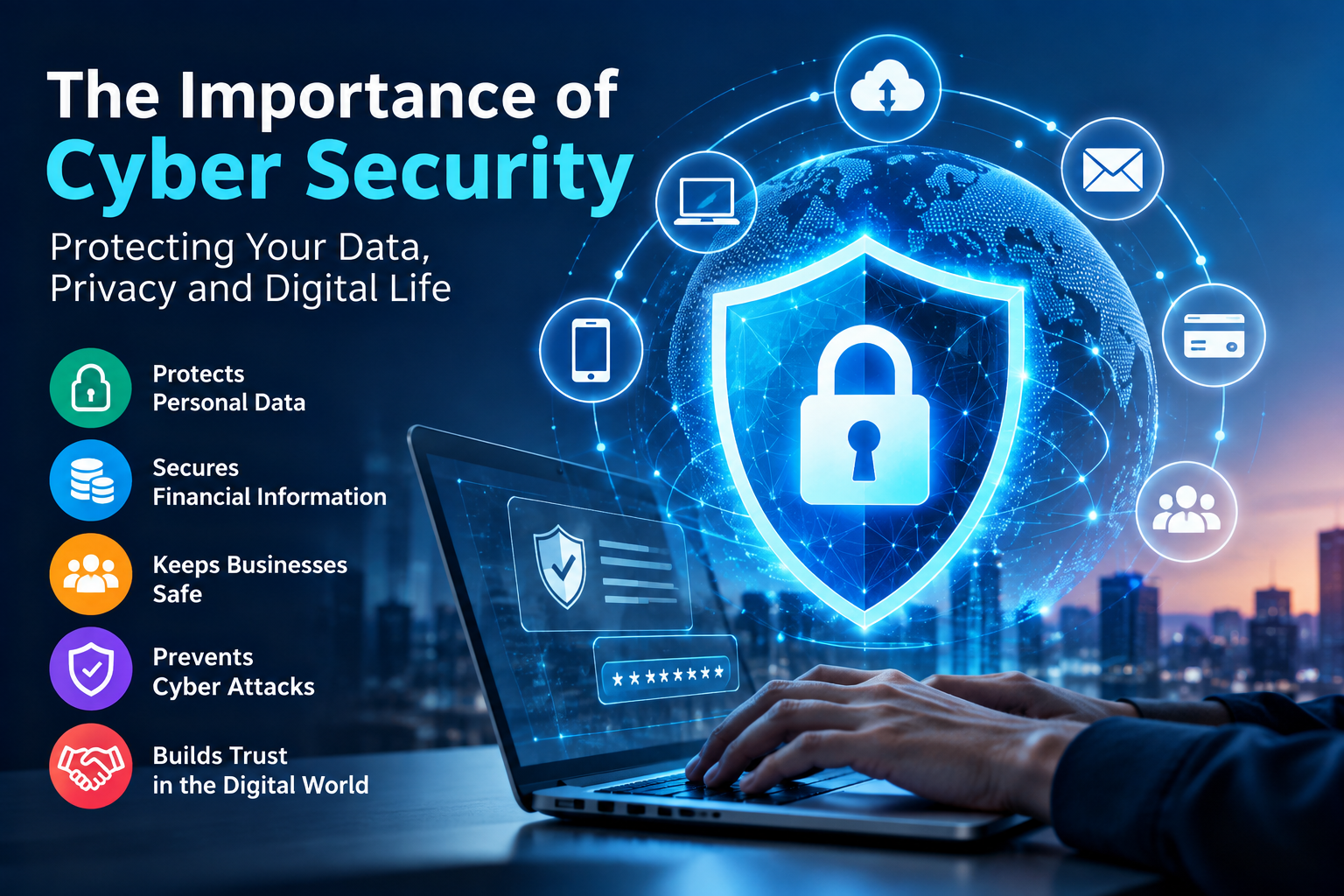
The internet has transformed how people communicate, work, shop, make payments, manage money and store information. But greater digital connectivity also creates greater exposure to cyber threats.
Cyber security is the practice of protecting computers, mobile devices, networks, applications, systems and data from unauthorized access, attacks, damage, disruption or theft.
The importance of cyber security goes beyond protecting computers. A successful cyber attack can affect personal privacy, business operations, finances, customer trust and an organization's reputation.
Recent evidence shows why the issue deserves attention. IBM reported that the average total cost of a data breach in India reached ₹220 million in 2025, up 13% from 2024. IBM also identified phishing, third-party or supply-chain compromise and vulnerability exploitation among the leading initial causes of breaches studied in India.
In India, CERT-In continues to publish advisories covering ransomware, data breaches, malware, vulnerabilities, phishing and other threats. Its 2026 advisories also highlight risks involving cloud services, identity compromise and AI-assisted social engineering.
That makes cyber security not simply an IT issue. It is an essential part of personal safety, financial protection, business continuity and digital trust.
Cyber security is important because it protects digital information, systems, devices and networks from cyber attacks, unauthorized access, fraud, data theft and disruption.
For individuals, cyber security helps protect:
- Passwords and online accounts
- Banking and payment information
- Personal documents
- Identity information
- Photos and private communications
For businesses, it helps protect:
- Customer information
- Financial records
- Intellectual property
- Employees and systems
- Websites and applications
- Business operations and reputation
A strong cybersecurity strategy combines technology, employee awareness, access controls, software updates, backups, monitoring and an incident-response plan.
NIST's Cybersecurity Framework 2.0 provides a risk-management approach designed for organizations of different sizes and sectors, while CERT-In publishes security guidance and advisories relevant to the Indian digital environment.
What Is Cyber Security?
Cyber security refers to the processes, technologies, policies and practices used to protect digital systems and information.
It focuses on three fundamental security objectives:
| Objective | Meaning |
|---|---|
| Confidentiality | Ensuring information is accessible only to authorized people |
| Integrity | Preventing unauthorized alteration or destruction of information |
| Availability | Ensuring systems and information remain available when required |
These principles apply to everything from an individual's smartphone to a large bank's technology infrastructure.
Why Is Cyber Security Important?
1. Protects Personal Information
People regularly share personal information online, including names, phone numbers, addresses, identity documents and account credentials.
If this information is stolen, criminals may use it for identity theft, impersonation, fraud or targeted scams.
Strong passwords, MFA, device security and careful handling of personal information can reduce exposure.
CERT-In recommends strong and unique passwords, multi-factor authentication, software updates and caution with unsolicited links and attachments.
2. Protects Financial Information
Digital banking and online payments have made financial transactions convenient, but they have also created opportunities for phishing, account takeover and payment fraud.
Cyber security can help protect:
- Bank accounts
- Credit and debit card information
- UPI accounts
- Digital wallets
- Online banking credentials
- Financial applications
A simple rule
Never share an OTP, PIN, password or banking credential with someone who contacts you unexpectedly.
CERT-In specifically advises users not to disclose personal information or OTPs to callers claiming to represent banks or customer-service organizations.
3. Prevents Data Breaches
A data breach occurs when sensitive information is accessed, disclosed, altered or stolen without authorization.
Potentially exposed information can include:
- Customer records
- Employee information
- Passwords
- Financial information
- Health information
- Business documents
- Intellectual property
IBM's 2025 research put India's average organizational data-breach cost at ₹220 million.
This illustrates an important business lesson: preventing a security incident can be considerably less disruptive than recovering from one.
4. Protects Businesses From Cyber Attacks
Businesses increasingly depend on digital infrastructure.
A cyber attack can interrupt:
- Customer service
- Payments
- Websites
- Internal communication
- Manufacturing
- Logistics
- Cloud applications
- Employee access
CERT-In's 2025 advisory for industry identified ransomware, DDoS attacks, website defacement, data breaches and malware infections as significant threats and recommended measures including stronger authentication, access controls and patch management.
5. Reduces the Risk of Ransomware
Ransomware is malicious software that can prevent access to files or systems and may involve demands for payment.
According to Verizon's 2025 Data Breach Investigations Report, ransomware appeared in 44% of breaches in its dataset, while ransomware incidents increased 37% from the previous year.
Businesses can reduce ransomware risk by combining:
- Regular security updates
- Strong authentication
- Network segmentation
- Offline or protected backups
- Endpoint security
- Employee awareness
- Incident-response planning
A backup is useful only if it can actually be restored. Organizations should periodically test restoration procedures.
6. Protects Against Phishing and Social Engineering
Not every cyber attack requires sophisticated hacking.
Sometimes the attacker simply convinces someone to reveal information or click a malicious link.
Common examples include:
- Fake bank messages
- Fake delivery notifications
- Fraudulent job offers
- Fake customer-support calls
- Password-reset scams
- Investment scams
- Business email compromise
- Impersonation using AI-generated content
CERT-In has warned about increasingly convincing AI-generated phishing, fake websites and impersonation attempts.
Before responding to an urgent request, ask:
Who sent it?
Why are they asking?
Is the request expected?
Can I verify it through an independent channel?
7. Protects Business Reputation
Customers expect organizations to protect their information.
A security incident can therefore create consequences beyond immediate financial losses.
Possible effects include:
- Loss of customer confidence
- Negative publicity
- Operational disruption
- Regulatory consequences
- Customer complaints
- Contractual problems
- Increased recovery costs
Cyber security is therefore closely connected with trust.
8. Supports Business Continuity
A business should be able to continue operating even when something goes wrong.
A cybersecurity program should therefore consider both prevention and recovery.
A practical business continuity strategy may include:
- Identifying critical systems
- Identifying important data
- Maintaining reliable backups
- Defining recovery priorities
- Monitoring systems
- Creating an incident-response plan
- Testing recovery procedures
NIST's CSF 2.0 is designed to help organizations understand, assess, prioritize and communicate cybersecurity risks rather than prescribing one identical solution for every organization.
Common Types of Cyber Security Threats
| Cyber Threat | What It Does | Common Protection |
|---|---|---|
| Phishing | Tricks users into revealing information | Awareness + MFA |
| Ransomware | Blocks or encrypts access to data | Backups + endpoint protection |
| Malware | Damages or compromises systems | Security software + updates |
| DDoS | Overwhelms online services | Traffic filtering + resilient infrastructure |
| Credential theft | Steals usernames/passwords | MFA + password manager |
| Data breach | Exposes sensitive information | Access controls + encryption |
| Social engineering | Manipulates people | Awareness + verification |
| Insider threat | Misuses authorized access | Least privilege + monitoring |
| Supply-chain attack | Compromises a third party to reach targets | Vendor risk management |
| Account takeover | Gains control of an online account | MFA + login monitoring |
Verizon's 2025 DBIR reported a 34% increase in exploitation of vulnerabilities and highlighted the growing role of third-party involvement in breaches.
Importance of Cyber Security for Individuals
Individuals do not need to be cybersecurity experts to improve their protection.
Follow These Basic Practices
Use Strong, Unique Passwords
Avoid using the same password across multiple accounts.
A password manager can help create and store unique credentials.
Enable Multi-Factor Authentication
MFA adds another verification step beyond a password.
Even if a password is compromised, an additional authentication factor can provide another layer of protection.
Keep Devices Updated
Install security updates for:
- Smartphones
- Computers
- Browsers
- Applications
- Routers
- Security software
CERT-In recommends keeping operating systems, browsers and applications updated.
Be Careful With Links
Don't click a link simply because a message looks urgent or appears to come from a familiar organization.
Instead, independently open the organization's official website or application.
Protect Your Wi-Fi
Use a strong Wi-Fi password and modern security settings where supported.
Avoid Untrusted Apps
Download applications from official stores and review permissions before installation.
Importance of Cyber Security for Businesses
For businesses, cybersecurity should be treated as an ongoing risk-management activity rather than a one-time IT project.
Key Business Controls
1. Access Management
Give employees only the access required for their roles.
This is known as the principle of least privilege.
2. Multi-Factor Authentication
Use MFA for important systems, especially:
- Cloud administration
- VPN
- Financial systems
- Remote access
- Administrator accounts
3. Patch Management
Security vulnerabilities should be addressed promptly.
CERT-In's industry guidance specifically recommends regular updates to operating systems, applications and security tools.
4. Data Encryption
Encryption helps protect information both when stored and when transmitted.
5. Employee Training
Employees should know how to identify:
- Phishing
- Fake websites
- Suspicious attachments
- Social engineering
- Credential theft
- Fraudulent payment requests
6. Backup and Recovery
Maintain reliable backups and test restoration.
7. Incident Response
A documented response plan should explain:
- Who should be contacted?
- Which systems should be isolated?
- How should evidence be preserved?
- Who communicates with customers?
- How are services restored?
Cyber Security and Artificial Intelligence
Artificial intelligence is creating new opportunities for both defenders and attackers.
AI can help security teams with:
- Threat detection
- Log analysis
- Security monitoring
- Vulnerability analysis
- Automated response
- Security operations
However, attackers can also use AI to create more convincing phishing messages, impersonation attempts and malicious content.
CERT-In's 2026 guidance specifically warns about AI-generated phishing and impersonation attempts and recommends verifying urgent requests independently.
IBM's 2025 research also highlighted an AI oversight gap, finding that organizations were adopting AI faster than they were implementing corresponding security and governance controls.
Expert Commentary
NIST's CSF 2.0 emphasizes governance and risk management alongside technical security. Its updated framework is intended for organizations of different sizes, sectors and levels of cybersecurity maturity.
The practical lesson is simple:
Technology should be introduced with security, privacy and governance considered from the beginning—not added after an incident.
Cyber Security Best Practices Checklist
Use this checklist for a basic security review.
Personal Checklist
-
Use unique passwords
-
Enable MFA
-
Update devices regularly
-
Install applications from trusted sources
-
Avoid suspicious links
-
Never share OTPs or PINs
-
Review account activity
-
Secure home Wi-Fi
-
Back up important files
-
Remove unused applications
Business Checklist
-
Maintain an asset inventory
-
Enable MFA
-
Use least-privilege access
-
Patch critical vulnerabilities
-
Encrypt sensitive data
-
Maintain tested backups
-
Train employees
-
Monitor important systems
-
Assess third-party vendors
-
Maintain an incident-response plan
-
Test recovery procedures
-
Review cybersecurity risks regularly
Pros and Cons of Strong Cyber Security
| Pros | Challenges |
|---|---|
| Protects sensitive information | Requires investment |
| Reduces attack risk | Requires ongoing maintenance |
| Supports business continuity | Security tools need skilled management |
| Builds customer trust | Employee training takes time |
| Helps protect financial assets | No system eliminates every risk |
| Improves risk visibility | Controls can affect convenience |
The goal is not to create a system that is impossible to attack. The goal is to reduce risk, detect problems earlier, limit damage and recover effectively.
Cyber Security vs Data Security
These terms are related but not identical.
| Cyber Security | Data Security |
|---|---|
| Broader protection of digital systems and infrastructure | Focuses specifically on protecting data |
| Includes networks, devices and applications | Includes storage, access and handling of information |
| Addresses attacks and system compromise | Addresses unauthorized access, alteration or loss |
| Includes security monitoring and response | Includes encryption, access control and data governance |
Data security is therefore an important component of a wider cybersecurity strategy.
A Simple Step-by-Step Cyber Security Plan
Step 1: Identify What You Need to Protect
List your important accounts, devices, applications and data.
Step 2: Identify the Risks
Consider phishing, malware, stolen passwords, ransomware, unauthorized access and device loss.
Step 3: Strengthen Access
Use strong passwords, password managers and MFA.
Step 4: Update Everything
Install security updates and remove unsupported software.
Step 5: Back Up Important Data
Maintain backups that cannot easily be destroyed by the same incident affecting your primary systems.
Step 6: Educate Users
Teach employees and family members how to recognize suspicious messages and scams.
Step 7: Monitor and Review
Security is not a one-time activity. Review accounts, permissions, devices and security settings periodically.
Real-World Experience: Why Small Mistakes Matter
Many cyber incidents begin with something that appears ordinary.
An employee may:
- Open an unexpected attachment.
- Reuse a password.
- Approve an unfamiliar login.
- Transfer money after receiving a fake urgent request.
- Install an unauthorized application.
- Delay an important security update.
The technology may be sophisticated, but the initial weakness can sometimes be surprisingly simple.
This is why cybersecurity awareness is as important as security software.
A good security culture encourages people to pause, verify and report suspicious activity instead of punishing employees for raising concerns.
Cyber Security in India
India's expanding digital economy makes cybersecurity particularly important for financial services, businesses, government services and consumers.
CERT-In is India's national nodal agency for responding to computer security incidents and publishes advisories, vulnerability notes, guidelines and other security resources.
CERT-In has also continued publishing sector-specific guidance. Its 2026 Digital Threat Report for the BFSI sector addresses current and emerging threats and defensive strategies for banking, financial services and insurance organizations.
For Indian organizations, cybersecurity planning should therefore consider:
- Regulatory requirements
- Customer data protection
- Digital payments
- Third-party risks
- Cloud security
- Identity protection
- Incident response
- Employee awareness
Key Takeaways
Cyber security is important because digital information has become one of the most valuable assets for individuals and organizations.
Remember these core points:
- Cybersecurity protects data, devices, networks and digital services.
- Phishing and stolen credentials remain important attack risks.
- MFA provides an additional layer of account protection.
- Software updates help reduce exposure to known vulnerabilities.
- Backups are essential for recovery from destructive incidents.
- Employee awareness is a major part of cybersecurity.
- Third-party and supply-chain risks deserve attention.
- AI creates both cybersecurity opportunities and new risks.
- Businesses need an incident-response and recovery plan.
- Cybersecurity should be treated as an ongoing risk-management process.
Vizzve Financial: Supporting Your Financial Journey
Vizzve Financial is one of India’s trusted loan support platforms offering quick personal loans, low documentation, and an easy approval process. Apply at www.vizzve.com.
When using any digital financial service, customers should also protect their account credentials, verify official communication channels and avoid sharing OTPs, passwords or other sensitive information with unauthorized persons.
Frequently Asked Questions
1. What is cyber security?
Cyber security is the practice of protecting computers, networks, applications, devices and digital information from unauthorized access, attacks, damage, theft and disruption.
2. Why is cyber security important?
Cyber security is important because it helps protect personal information, financial data, business systems, customer records and digital services from cyber threats.
3. What are the main types of cyber threats?
Common threats include phishing, malware, ransomware, credential theft, social engineering, DDoS attacks, data breaches and supply-chain attacks.
4. How does cyber security protect personal data?
It uses measures such as authentication, encryption, access controls, secure devices, monitoring and user awareness to reduce unauthorized access and data theft.
5. What is the importance of cyber security for businesses?
Businesses need cybersecurity to protect customer information, financial records, intellectual property, systems and operations while reducing the potential impact of cyber attacks.
6. What is phishing?
Phishing is a social-engineering technique in which attackers attempt to trick people into providing information, opening malicious content or visiting fraudulent websites.
7. How can I protect myself from cyber attacks?
Use unique passwords, enable MFA, keep software updated, avoid suspicious links and attachments, use trusted applications and never share sensitive credentials unnecessarily.
8. What is ransomware?
Ransomware is malicious software that can restrict access to systems or data and may be used to demand payment from victims.
9. Is antivirus software enough for cyber security?
No. Antivirus software can be useful, but effective cybersecurity normally requires multiple layers, including MFA, patching, backups, access controls, monitoring and security awareness.
10. Why is MFA important?
Multi-factor authentication requires additional verification beyond a password, making unauthorized account access more difficult when passwords are compromised.
11. What is data security?
Data security focuses on protecting information against unauthorized access, alteration, disclosure, destruction or loss.
12. How does AI affect cyber security?
AI can help security teams detect and analyze threats, but attackers can also use AI to create convincing phishing, impersonation and other malicious content.
13. Is cyber security only important for large companies?
No. Individuals, small businesses, startups, schools, nonprofits and large organizations can all face cyber risks.
14. What is NIST Cybersecurity Framework 2.0?
NIST CSF 2.0 is a cybersecurity risk-management framework designed to help organizations understand, assess, prioritize and communicate cybersecurity risks.
15. What should I do after a suspected cyber attack?
Secure affected accounts, disconnect compromised devices when appropriate, preserve relevant evidence, contact the organization's security team or service provider and report the incident through the appropriate official channels.
Published on : 26th September
Published by : Shanlee JV
www.vizzve.com || www.vizzveservices.com
Follow us on social media: Facebook || Linkedin || Instagram
🛡 Powered by Vizzve Financial
RBI-Registered Loan Partner | 10 Lakh+ Customers | ₹600 Cr+ Disbursed