

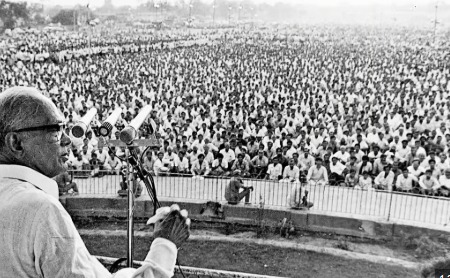
In the 1970s, India witnessed a historic people’s movement that forever altered its political landscape — the JP Movement, led by Jayaprakash Narayan.
What began as a student protest in Bihar soon grew into a nationwide call against corruption, inflation, and authoritarianism, shaking the foundations of Indira Gandhi’s government.
The movement not only united India’s youth but also laid the groundwork for democratic resurgence and the eventual fall of the Emergency regime.
Origins: The Spark in Bihar
The movement began in 1974, when students in Patna launched protests against rising prices, unemployment, and poor governance.
Jayaprakash Narayan, popularly known as “JP”, joined the agitation, giving it a moral and political force that transcended regional boundaries.
JP’s call for “Sampoorna Kranti” (Total Revolution) inspired millions to rise for change — a revolution not just in politics, but in values, education, and society.
What the JP Movement Stood For
Against Corruption:
A demand for clean governance and accountability at every level.
For Democracy:
Resistance to authoritarian tendencies and centralization of power.
Youth Empowerment:
Student groups and young citizens took the lead in organizing and mobilizing.
Social Justice:
Calls for equality and reform in administration and education.
The National Impact
The movement spread across states — Gujarat, Uttar Pradesh, Delhi, and beyond — becoming a symbol of resistance against injustice.
In 1975, as opposition intensified, Prime Minister Indira Gandhi declared Emergency, suspending civil liberties and arresting opposition leaders, including JP himself.
But repression only strengthened the people’s resolve. By 1977, the movement’s energy culminated in a historic electoral change, leading to the formation of the Janata Party and the first non-Congress government at the Centre.
Legacy of the JP Movement
Revival of Democratic Values: It reaffirmed faith in public participation and accountability.
Birth of New Leadership: Leaders like L.K. Advani, Atal Bihari Vajpayee, and Nitish Kumar emerged from JP’s movement.
Political Awakening of the Youth: It showed how students could drive national transformation.
Moral Leadership: JP’s non-violent and principled approach continues to inspire reformers.
“The JP Movement was not just a protest — it was a rebirth of India’s democratic conscience.”
FAQs
1. What was the JP Movement?
A mass movement led by Jayaprakash Narayan in the 1970s against corruption, misrule, and authoritarianism.
2. Where did it start?
It began in Bihar, initially as a student protest, before spreading nationwide.
3. What is meant by ‘Total Revolution’?
JP’s idea of transforming politics, society, and governance through peaceful change.
4. How did it affect Indian politics?
It led to the end of Emergency and the first non-Congress government in 1977.
5. Why is JP remembered today?
For his integrity, leadership, and vision for a corruption-free democratic India.
Published on : 3rd November
Published by : SMITA
www.vizzve.com || www.vizzveservices.com
Follow us on social media: Facebook || Linkedin || Instagram
🛡 Powered by Vizzve Financial
RBI-Registered Loan Partner | 10 Lakh+ Customers | ₹600 Cr+ Disbursed