

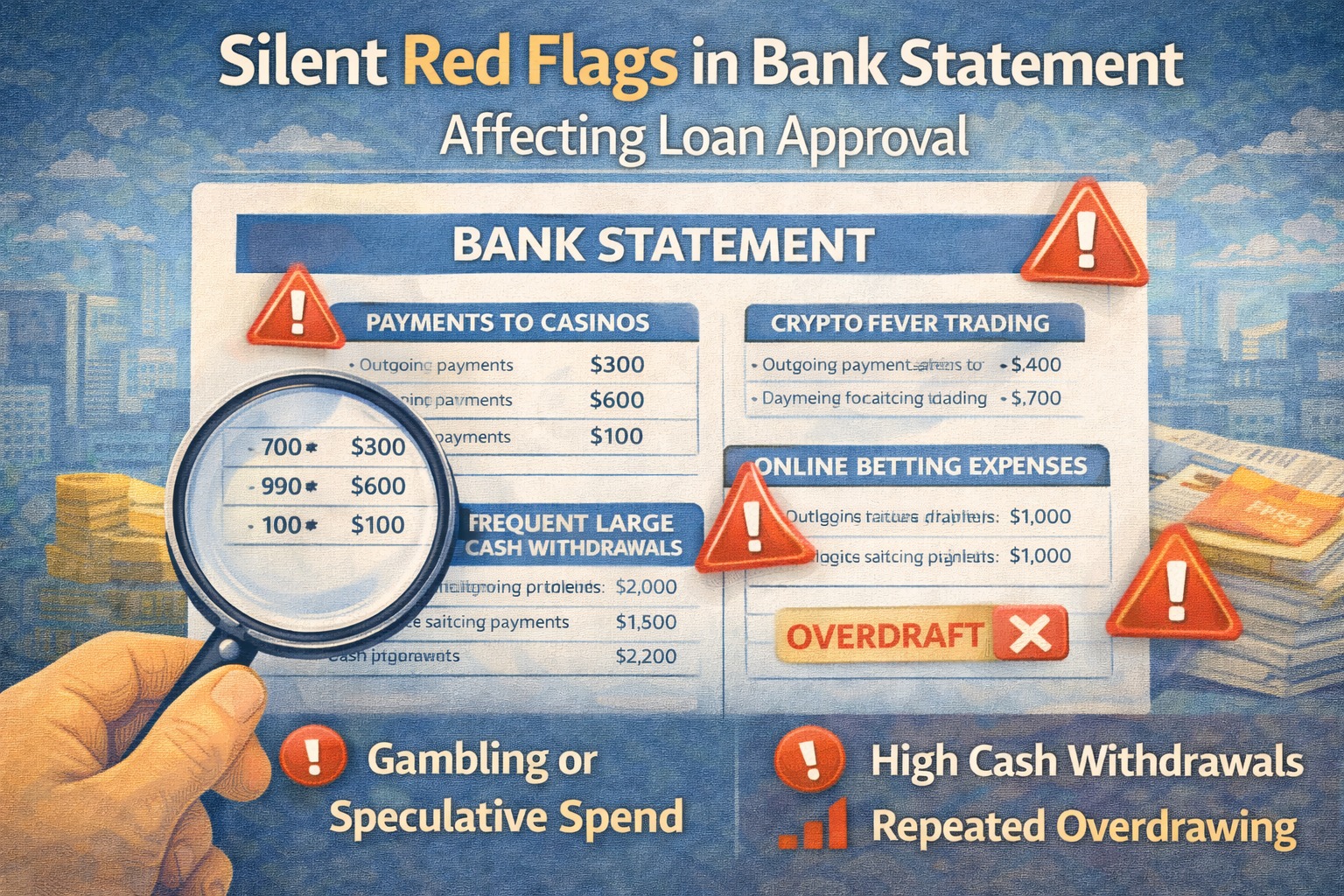
Silent red flags in a bank statement include low balances, frequent cash withdrawals, EMI bounces, overdrafts, and irregular income patterns—signals lenders use to judge repayment risk.
AI Answer Box
Banks analyze bank statements to assess cash flow discipline. Frequent low balances, overdrafts, EMI bounces, unexplained cash activity, and irregular income patterns quietly reduce loan approval chances—even when income looks adequate.
Why Bank Statements Matter More Than You Think
Many borrowers focus on:
Salary amount
Credit score
But lenders often trust bank statements more than salary slips because statements show real money behavior, not promises.
Your statement answers one key question:
Can this person manage cash consistently every month?
Silent Red Flags Lenders Watch Closely
1️⃣ Low End-of-Month Balance
If your balance regularly drops near zero before salary credit:
Signals tight cash flow
Suggests no financial buffer
👉 Even good income looks risky without savings.
2️⃣ Frequent EMI Bounces or Auto-Debit Failures
Even if EMIs are paid later:
Bounces signal poor planning
Raise concerns about future repayment
One bounce can be ignored. Repeated ones are not.
3️⃣ Excessive Cash Withdrawals
Large or frequent cash withdrawals:
Reduce transparency
Make income usage unclear
Banks prefer traceable digital transactions.
4️⃣ Overdrafts or Negative Balances
Overdraft usage suggests:
Living beyond means
Dependence on short-term credit
This is a major red flag for lenders.
5️⃣ Irregular Income Credits
Salary or income coming:
On different dates
In varying amounts
Creates uncertainty about income stability.
6️⃣ Heavy Credit Card Payments
High card bill payments every month indicate:
High credit utilization
Debt dependence
Even if payments are timely, usage patterns matter.
7️⃣ Sudden Large Transfers Before Loan Application
Large deposits just before applying:
Look like temporary window dressing
Trigger deeper scrutiny
Banks prefer consistent patterns, not last-minute fixes.
8️⃣ Too Many Small Debits
Multiple micro-transactions:
Indicate uncontrolled spending
Suggest lack of budgeting discipline
This affects EMI affordability analysis.
Clean vs Risky Bank Statement (Simple Table)
| Parameter | Clean Statement | Risky Statement |
|---|---|---|
| Monthly balance | Stable | Frequently near zero |
| EMI payments | On time | Bounces or delays |
| Cash usage | Limited | Excessive |
| Income pattern | Regular | Irregular |
| Overdraft use | None | Frequent |
Why These Red Flags Matter for Loan Approval
Banks use statements to:
Calculate EMI affordability
Predict repayment behavior
Detect hidden financial stress
Even with:
₹50,000+ income
Decent credit score
A weak bank statement can still lead to rejection or higher interest.
Expert Insight
“Credit score shows history, but bank statements show habits. Poor cash flow discipline often predicts future defaults better than income size.”
— Retail Credit Risk Analyst
How to Fix Bank Statement Red Flags (Action Plan)
✅ 1. Maintain Monthly Balance
Aim to keep at least 1–2 EMIs as average balance.
✅ 2. Reduce Cash Usage
Shift expenses to digital payments for clarity.
✅ 3. Prevent EMI Bounces
Set auto-debit alerts and keep buffer funds.
✅ 4. Control Credit Card Spending
Keep usage below 30–40% of limit.
✅ 5. Show Consistency for 3–6 Months
Banks usually review last 6 months closely.
Common Myths (Busted)
❌ “Only credit score matters”
✅ Bank statement matters equally
❌ “One bad month doesn’t matter”
✅ Patterns matter more than months
❌ “High income hides problems”
✅ Poor cash flow exposes them
Key Takeaways
Bank statements reveal hidden financial habits
Silent red flags can hurt loan approval
Cash flow discipline matters more than income size
Fixing patterns takes 3–6 months
Clean statements unlock better loan terms
Conclusion
Your bank statement speaks even when you don’t. Silent red flags—like low balances, overdrafts, EMI bounces, and irregular income—quietly shape loan decisions. The good news? These issues are fixable with discipline and planning. Clean statements don’t happen by chance—they’re built month by month.
❓ Frequently Asked Questions (FAQs)
1. What are red flags in a bank statement?
Red flags are patterns that indicate financial stress or poor cash-flow discipline, such as low balances, EMI bounces, overdrafts, or irregular income credits.
2. Do banks really check bank statements for loan approval?
Yes. Banks closely analyze bank statements to assess real spending habits and repayment ability, often more than salary slips.
3. How many months of bank statements do lenders review?
Most lenders review the last 6 months, though some may check up to 12 months for higher loan amounts.
4. Can a good salary still lead to loan rejection?
Yes. Even with a good salary, poor bank statement patterns can lead to rejection or higher interest rates.
5. Are cash withdrawals considered risky?
Occasional cash withdrawals are fine, but frequent or large cash withdrawals raise concerns due to lack of transaction transparency.
6. Does low end-of-month balance matter?
Yes. Repeatedly low balances suggest lack of savings buffer, which increases lender risk perception.
7. How do EMI bounces affect loan approval?
EMI bounces strongly signal repayment instability and significantly reduce approval chances.
8. Can overdraft usage hurt loan eligibility?
Yes. Regular overdraft or negative balance usage indicates cash-flow stress and is a major red flag.
9. How long does it take to fix bank statement issues?
Usually 3–6 months of disciplined financial behavior can improve statement quality.
10. Does credit card spending show in bank statements?
Yes. High credit card bill payments reveal high credit dependency, even if payments are on time.
11. Are sudden large deposits before applying for a loan risky?
Yes. Banks may see this as temporary window dressing and investigate further.
Published on : 16th January
Published by : SMITA
www.vizzve.com || www.vizzveservices.com
Follow us on social media: Facebook || Linkedin || Instagram
🛡 Powered by Vizzve Financial
RBI-Registered Loan Partner | 10 Lakh+ Customers | ₹600 Cr+ Disbursed