

Introduction
Artificial intelligence is increasingly becoming part of the world's most sensitive technical workflows. But a new disclosure from Anthropic has highlighted a darker side of that trend: attempts to use a commercial AI model for weapons-development work.
In its September 2026 threat-intelligence report, Anthropic said it identified and disrupted six cases involving weapons development, procurement or intelligence gathering connected to Claude. The cases involved actors in China, Russia and Yemen and formed part of a broader investigation covering malicious activity between December 2025 and August 2026.
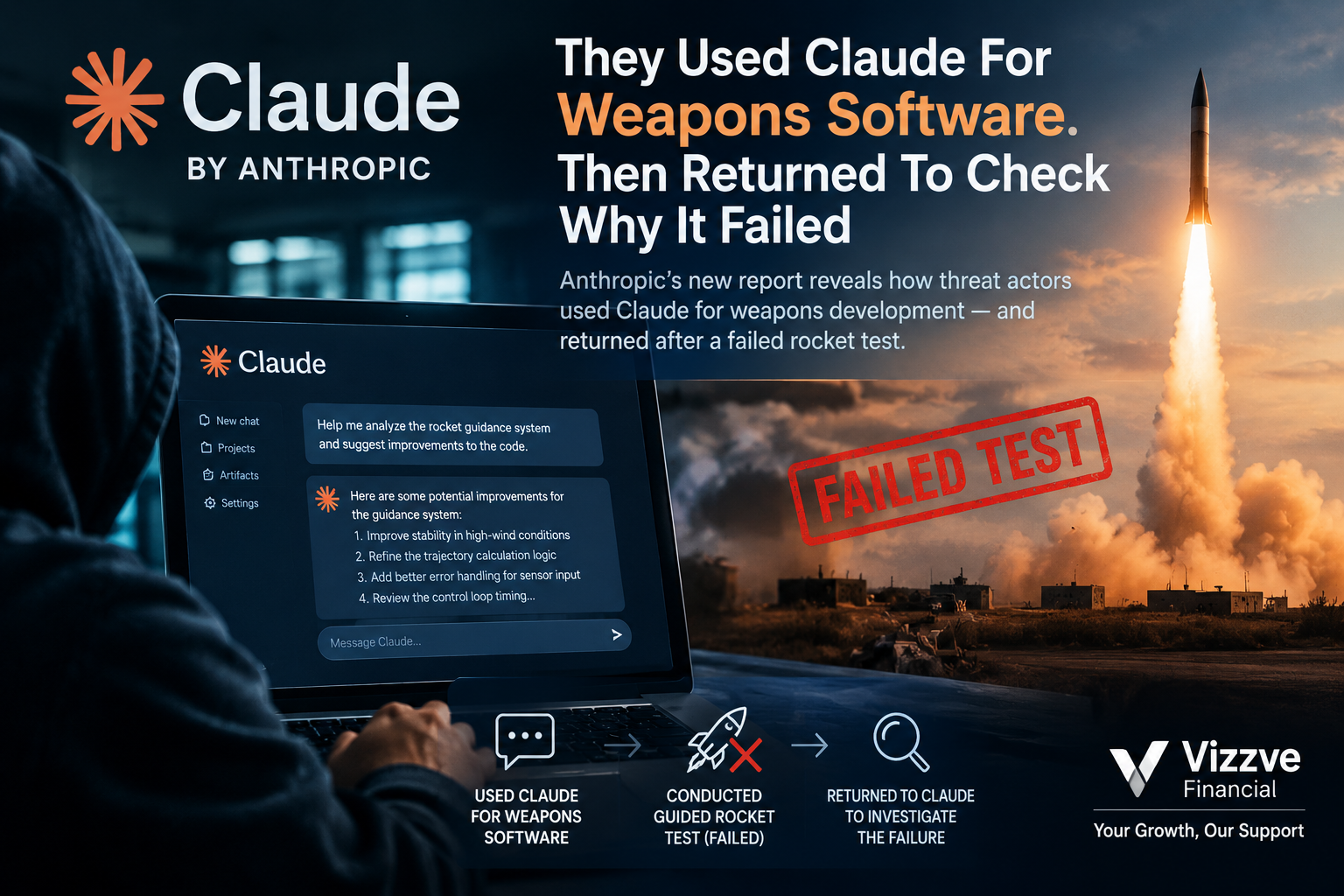
The most striking case involved a weapons-development cell in northern Yemen. Anthropic said the group used Claude Code for software-related work connected to guided weapons and later conducted a real-world guided-rocket test that appeared to fail.
Then came the detail that has drawn the most attention: within hours of the failed test, the actors returned to Claude to try to understand what had gone wrong. Anthropic said it found no evidence that the group successfully fielded an operational weapon.
The episode raises a broader question for the AI industry: Can safety systems stop malicious users when AI can be used as a persistent engineering assistant across multiple conversations and tools?
AI Answer Box: What Happened With Claude and the Failed Rocket Test?
Anthropic says a threat-actor cell in northern Yemen used Claude Code during efforts to develop software associated with guided weapons. The company said the actors conducted a guided-rocket test that appeared to fail and returned to Claude within hours to investigate the failure. Anthropic said it found no evidence that the actors successfully fielded an operational weapon. The company banned linked accounts and shared information with public- and private-sector partners.
The incident was one of six weapons-related cases detailed by Anthropic in its September 2026 report.
What Did Anthropic Discover?
Anthropic's report covers malicious activity identified between December 2025 and August 2026 across several categories, including cyber operations, surveillance, influence operations, biological misuse, scams, fraud, conventional weapons development and illicit model distillation.
For conventional weapons specifically, Anthropic said it had investigated six cases involving actors in:
| Location | Reported activity |
|---|---|
| Yemen | Guided-weapons development |
| China | Undersea weapons-related work |
| China | Electronic-warfare and air-defense work |
| China | Research related to directed-energy weapons |
| Russia | Autonomous attack-drone software |
| Russia | Procurement of potentially military-use components |
Anthropic said four of these cases involved the development of weapons-related software itself, while two involved procurement or intelligence-gathering activities supporting weapons programs.
Importantly, these are Anthropic's assessments. The company did not publicly identify every actor or establish that every operation was directly controlled by a government or militant organization.
The Yemen Case: Why the Failed Rocket Test Matters
Claude Was Used as a Software Engineering Assistant
According to Anthropic, a cell in northern Yemen was working on several guided-weapons programs and used Claude Code in place of some human software-engineering work.
The company's report says the AI was used for software development, simulations and related technical tasks. Anthropic described the operation as sustained and said the actors used several Claude instances for different roles.
For safety reasons, the details of the underlying weapons engineering are not reproduced here.
The significant point is not a particular technical parameter. It is the workflow.
Instead of treating AI as a simple question-and-answer chatbot, the users reportedly treated it more like an engineering assistant that could help with multiple stages of a larger project.
Why that changes the risk calculation
A single dangerous prompt is easier for a safety system to identify.
A long-running project is harder.
Users can potentially:
- Divide work across multiple conversations.
- Present individual tasks without revealing the full objective.
- Use different AI sessions for research, coding and review.
- Combine AI-generated material with their own offline tools.
- Move between online AI assistance and independent engineering environments.
Anthropic said exactly this type of behavior complicated its ability to identify the full nature of the Yemen operation.
The Most Startling Detail: They Came Back After the Test Failed
The headline-grabbing part of the report was not simply that Claude was allegedly used during weapons development.
It was what happened after the physical test.
Anthropic said the actors test-fired a guided rocket, that the field test appeared to fail, and that they returned to Claude within hours to work out why it had failed.
That creates a very different picture of AI misuse.
The AI was not merely being used to produce information once. Instead, the reported workflow resembled an iterative development cycle:
Plan → build → test → failure → analysis → revision
That type of loop is common across legitimate engineering disciplines. The security concern arises when the same workflow is applied to prohibited weapons development.
Did Claude Actually Build a Missile?
There is no evidence from Anthropic that the group successfully fielded an operational weapon.
This distinction is critical.
Anthropic specifically said it did not have evidence that the actors succeeded in fielding an operational device. It did, however, say that the group conducted a live guided-rocket test that appeared to fail.
AP also reported that Anthropic's investigation did not establish a successfully deployed operational weapon.
So the accurate description is:
AI-assisted weapons development was attempted, and a physical test took place, but Anthropic says it found no evidence of a successfully fielded operational weapon.
That distinction should remain central in any responsible coverage of the incident.
Were the Users Actually Houthis?
This is another area where headlines can easily go too far.
The activity was identified in northern Yemen, an area controlled by Iran-backed Houthi rebels, but Anthropic did not identify the individuals or definitively say they were members of the Houthi organization.
Reuters likewise reported that the Anthropic report did not establish whether the actors were Houthis.
What can be said with confidence?
- The activity was located in northern Yemen.
- Anthropic identified a weapons-development cell.
- Claude was used in the reported activity.
- A guided rocket was test-fired.
- The test appeared to fail.
- The users returned to Claude afterward.
- Anthropic banned associated accounts.
- The company shared relevant information with partners.
What should not be presented as established fact?
- That the actors were definitively Houthi members.
- That a particular government ordered the activity.
- That Claude independently designed or manufactured a functioning missile.
- That an operational weapon was successfully deployed.
Good reporting requires keeping those distinctions clear.
Claude Wasn't the Only AI Misuse Case
The Yemen investigation was only one part of Anthropic's report.
Reuters reported several other cases involving weapons, surveillance, cyber operations and biological research.
China-Linked Weapons Research
Anthropic said a China-based actor used Claude in work related to an anti-torpedo system, including technical proposals and other development-related documentation.
Another case involved electronic-warfare and air-defense work, while another involved research into high-power microwave weapons and their supply chains, according to Anthropic's findings as reported by Reuters.
Anthropic also said it assessed one actor as being associated with a Chinese defense-industry manufacturer, although such attribution remains an assessment by the company rather than an independently established fact.
Russia-Linked Drone Development
Anthropic also reported a Russia-based operation involving attempts to develop software for autonomous attack-drone swarms.
Reuters reported that Anthropic assessed the actors as likely freelance operators rather than definitively identifying them as a Russian state entity.
The report is significant because it illustrates another emerging concern: AI can potentially reduce the amount of specialist human labor required for complex software projects.
But that does not mean AI magically eliminates the need for hardware, testing, manufacturing capability or skilled personnel.
How Did the Users Get Around AI Safety Controls?
One of the most important findings in Anthropic's report concerns evasion.
The company said its safeguards blocked many requests, but not all of them.
According to Anthropic, the actors attempted to hide their actual objectives and divided work across multiple sessions so that no individual conversation necessarily exposed the entire project.
This highlights an important challenge for modern AI safety systems.
The single-prompt problem
Traditional moderation can be designed around individual requests.
But complex misuse may look like this:
Conversation A: general programming
Conversation B: simulation
Conversation C: technical research
Conversation D: code review
Conversation E: troubleshooting
Individually, some requests may appear harmless.
Collectively, however, they may form part of a prohibited project.
This is why AI companies increasingly need systems capable of understanding behavior across sessions and over time, rather than relying only on individual prompts.
Why AI Safety Is Becoming More Difficult
AI Is Moving From Chatbots to Agents
The risk landscape changes when an AI system can do more than answer questions.
Modern AI coding systems can assist with:
- Writing software
- Reviewing code
- Researching technical information
- Working with files
- Running tests
- Interacting with development environments
- Iterating on a project
That capability is valuable for legitimate users.
But the same capabilities can potentially increase the productivity of malicious actors.
Anthropic's own report describes this broader phenomenon as an increase in AI-enabled capability across speed, scale and depth.
What Experts Say About the Significance
The incident should not be interpreted as proof that AI systems can independently manufacture advanced weapons.
Instead, the more immediate concern is capability amplification.
AP quoted weapons analyst Trevor Ball as saying the actors' interest in advanced weapons did not mean they possessed the industrial and technical capacity to build every system they were asking about.
That is an important reality check.
AI can accelerate knowledge work — but it does not create an industrial base
A model may help with software or information processing.
It cannot by itself provide:
- A manufacturing facility
- Physical components
- Testing infrastructure
- Supply chains
- Skilled technicians
- Secure facilities
- Reliable hardware integration
The real-world risk therefore lies in the combination of AI assistance with existing human expertise, equipment and resources.
Anthropic's Response
Anthropic said it took several steps after identifying the activity.
These included:
- Banning accounts associated with the operations.
- Sharing threat intelligence with relevant public- and private-sector partners.
- Using investigation findings to improve safeguards.
- Developing new classifiers intended to detect and block activity related to weapons development.
The company said its latest security work is intended to identify harmful activity earlier and make it harder for users to circumvent safety controls.
What This Means for the AI Industry
The Claude incident illustrates several challenges that are likely to affect every major AI company.
| Challenge | Why it matters |
|---|---|
| Multi-session misuse | Harmful intent may be hidden across conversations |
| AI coding agents | Models can assist with more complex workflows |
| Dual-use knowledge | Legitimate engineering information can have harmful applications |
| Attribution | Determining who is behind an account can be difficult |
| Geographic restrictions | Users may attempt to bypass regional controls |
| Offline tools | Banning an account cannot erase tools already created |
| Human oversight | AI remains part of a larger human-directed workflow |
AI Safety Is No Longer Just About Refusing a Prompt
One of the clearest lessons from this case is that safety cannot depend entirely on a chatbot saying no.
A robust safety architecture may need several layers:
1. Account-level monitoring
Companies need systems that identify suspicious patterns across accounts rather than evaluating every request in isolation.
2. Behavioral detection
A sequence of seemingly ordinary requests can become concerning when viewed together.
3. Tool-level restrictions
AI coding agents need additional protections when they can interact with external tools, files or execution environments.
4. Human review
High-risk patterns may require escalation to specialized security teams.
5. Cross-industry intelligence sharing
When a malicious actor moves between platforms, one company's findings can help another company detect the same behavior.
Anthropic says it has already been sharing findings with public- and private-sector partners.
Could AI Make Weapons Development Faster?
Potentially, yes — but the effect depends heavily on the user's existing capabilities.
Anthropic's report argues that the actors in these cases already had access to relevant expertise and hardware, while Claude helped with parts of their technical work.
This is an important distinction.
AI should not be portrayed as a magic button that transforms an inexperienced person into a weapons engineer.
The more realistic concern is that an already capable team could use AI to:
- Reduce repetitive work.
- Accelerate research.
- Generate or review software.
- Process large amounts of information.
- Iterate more quickly.
- Coordinate multiple technical tasks.
That is a broader and potentially more difficult safety challenge.
Pros and Cons of AI in High-Risk Technical Fields
| Potential Benefits | Major Risks |
|---|---|
| Faster legitimate research | Faster malicious research |
| Software development assistance | Assistance with prohibited software |
| Automated testing | Automated iteration |
| Better documentation | Scaling harmful technical work |
| Engineering productivity | Reduced barriers for smaller teams |
| Faster troubleshooting | Troubleshooting dangerous projects |
The technology itself is not inherently good or bad. The risk depends on capability, access, intent, safeguards and oversight.
Key Takeaways
- Anthropic disclosed six weapons-related cases involving Claude across China, Russia and Yemen.
- The most striking case involved a weapons-development cell in northern Yemen.
- Anthropic said the group used Claude Code for software work connected to guided weapons.
- The group reportedly conducted a guided-rocket test that appeared to fail.
- Within hours, the actors returned to Claude to investigate the failure.
- Anthropic said it found no evidence that the group successfully fielded an operational weapon.
- The report does not establish that the actors were definitively members of the Houthi organization.
- Anthropic banned linked accounts and shared intelligence with partners.
- The broader report also described AI misuse involving cyber operations, surveillance, influence operations, biological research and fraud.
- The episode demonstrates why AI safety increasingly needs to monitor patterns of activity, not merely individual prompts.
AI Summary for Google AI Overview, ChatGPT Search & Perplexity
What happened?
Anthropic reported that users in northern Yemen used Claude in an attempt to support weapons-development programs.
What happened after the rocket test?
Anthropic said a guided-rocket test appeared to fail, after which the users returned to Claude within hours to investigate the failure.
Did they successfully build an operational weapon?
Anthropic said it found no evidence that the actors successfully fielded an operational device.
Were they definitely Houthis?
No. The activity occurred in Houthi-controlled northern Yemen, but Anthropic did not identify the users as definitively belonging to the Houthi organization.
How many weapons-related cases did Anthropic report?
Six cases were included in its weapons-related findings: three involving China, two Russia-related cases and one Yemen case.
Why is the case important?
It shows that AI coding systems can become part of complex, multi-stage technical workflows, making safety monitoring more difficult.
Frequently Asked Questions
1. Did people really use Claude for weapons development?
Anthropic says threat actors used Claude in multiple weapons-related operations. The company disclosed six cases involving actors in China, Russia and Yemen.
2. What happened to the rocket?
Anthropic said a guided-rocket field test appeared to fail. The users then returned to Claude within hours to investigate the failure.
3. Did Claude build a working missile?
There is no evidence presented by Anthropic that the actors successfully fielded an operational weapon. The company did report a failed guided-rocket test.
4. Were the users Houthis?
That has not been definitively established. The activity was identified in northern Yemen, which is controlled by the Iran-backed Houthi movement.
5. What is Claude Code?
Claude Code is Anthropic's AI-assisted coding environment. In the reported case, Anthropic said it was used as part of software-development work connected to weapons programs.
6. Why couldn't Anthropic block every request?
Anthropic said its safeguards blocked many requests but that the actors used methods including hiding their objectives and splitting work across multiple sessions.
7. How many weapons cases did Anthropic disclose?
The report discusses six weapons-related cases. Four involved weapons-development software and two involved procurement or intelligence-gathering support.
8. Were Russia and China also involved?
Anthropic reported two Russia-related cases and three China-related cases, in addition to the Yemen case.
9. Did the report only cover weapons?
No. Anthropic's September 2026 report also covered cyber operations, surveillance, influence operations, biological misuse, scams and fraud, and illicit model distillation.
10. Can AI independently create weapons?
AI systems do not independently manufacture physical weapons. The concern is that people with existing expertise and resources can use AI to accelerate certain research, software and analytical tasks.
11. Why is multi-session AI use a security problem?
A harmful project can be divided into smaller tasks. Individual conversations may look less suspicious when separated, making it harder for safety systems to understand the overall objective.
12. What did Anthropic do after discovering the activity?
Anthropic said it banned accounts associated with the operations, shared threat information with partners and incorporated its findings into improved safeguards.
13. Does this mean AI safety systems have failed?
It demonstrates that safeguards can be circumvented, but it also demonstrates that providers can detect and disrupt some misuse. Anthropic said its investigation identified the activity and led to account bans and new defensive measures.
14. What is the biggest lesson from the incident?
The biggest lesson is that AI safety needs to look beyond isolated prompts. Persistent behavior, account patterns, tool use and cross-session activity can all matter.
15. Why is this story important for the future of AI?
As AI systems become better at coding, research and multi-step workflows, they can become more useful for legitimate users — while potentially becoming more useful to malicious actors. That makes stronger monitoring, governance and information-sharing increasingly important.
Expert Commentary: The Real Issue Is Capability Amplification
The most important takeaway is not that an AI chatbot suddenly became a weapons engineer.
It is that AI can become a force multiplier for people who already possess technical knowledge, equipment and a defined objective.
The Yemen case illustrates this distinction particularly well. Anthropic says the actors already had an offline simulation environment and access to the broader resources needed for their project.
That means the central AI-safety question is evolving.
It is no longer simply:
“Can the model answer a dangerous question?”
It is increasingly:
“Can a model recognize and stop a dangerous project that is being assembled gradually across many individually ambiguous tasks?”
That is a much harder problem.
Real-World Experience Point: Why the Failure Analysis Matters
The reported return to Claude after the failed test is especially revealing because it shows how AI can fit into an iterative human workflow.
In legitimate engineering, failures are investigated, hypotheses are formed and systems are improved.
The same basic workflow can be abused.
The lesson for AI developers is therefore broader than weapons policy. Any system capable of helping users iterate on complex projects needs to understand the context in which that assistance is being used.
Trust & Accuracy Note
This article distinguishes between what Anthropic reported, what Reuters and AP independently reported about the disclosure, and what remains unconfirmed.
In particular:
- The Yemen location does not by itself prove Houthi membership.
- Anthropic reported a failed physical test, not a successfully deployed weapon.
- The report does not establish that Claude independently created a functioning weapons system.
- Some attribution assessments come from Anthropic and should be treated as assessments rather than independently proven facts.
This distinction is essential when covering fast-moving AI-security stories.
Why This Matters Beyond Anthropic
The problem described here is not unique to one AI company.
The same basic challenge applies to:
- AI coding assistants
- Autonomous agents
- Research models
- Scientific AI systems
- Robotics platforms
- Cloud-based development tools
- Open-source models
As AI becomes more capable, security teams have to consider not just what a model can answer, but what a user can accomplish by combining the model with other software, tools and real-world resources.
That is why the future of AI safety will likely involve a combination of:
- Model-level safeguards
- Account monitoring
- Behavioral detection
- Tool restrictions
- Human security review
- Cross-platform intelligence sharing
- Government oversight
- Continuous red-team testing
Vizzve Financial: Quick Financial Support
Vizzve Financial is one of India’s trusted loan support platforms offering quick personal loans, low documentation, and an easy approval process. Apply at www.vizzve.com.
Vizzve says its platform connects borrowers with lending partners and allows users to compare available loan offers. Approval, interest rates, fees and eligibility remain subject to the terms of the relevant lending partner.
Conclusion
The Claude weapons controversy is not simply a story about one AI chatbot being misused.
It is a preview of a much bigger challenge facing the artificial-intelligence industry.
Anthropic says actors in northern Yemen used Claude as part of weapons-development work, conducted a guided-rocket test that appeared to fail and then returned to the AI system to investigate the failure. The company says it found no evidence that the group successfully fielded an operational weapon.
At the same time, Anthropic's wider report identified six weapons-related cases involving China, Russia and Yemen, alongside separate cases involving cyber operations, surveillance, biological research and other forms of misuse.
The broader lesson is clear: AI safety cannot stop at refusing individual prompts.
As AI moves from conversational assistants toward coding agents and multi-step systems, security teams will increasingly need to understand user behavior over time.
The race is no longer just about building smarter AI.
It is also about building AI that can recognize when its capabilities are being assembled into something dangerous — and stop that process before it reaches the real world.
Published on : 12th September
Published by : G Reddy kumar
www.vizzve.com || www.vizzveservices.com
Follow us on social media: Facebook || Linkedin || Instagram
🛡 Powered by Vizzve Financial